



Why Comparison Turns Solitude Into Loneliness
Quick Summary
- Solitude can feel nourishing until comparison enters and turns it into a verdict about your life.
- Comparison shifts attention from direct experience to imagined rankings, which creates emotional distance.
- Loneliness often grows from “I’m behind” stories, not from being physically alone.
- Social media intensifies this by supplying endless “reference lives” to measure against.
- Noticing comparison early helps you return to what’s actually happening right now.
- Solitude becomes steadier when you relate to yourself with curiosity instead of evaluation.
- You can keep healthy standards without turning your alone time into self-judgment.
Introduction
Solitude is supposed to feel like a break, yet it can suddenly feel like proof that you’re missing out, falling behind, or somehow less than other people. That shift usually isn’t caused by being alone—it’s caused by the moment your mind starts comparing your quiet life to someone else’s louder one, and your own room turns into a courtroom. At Gassho, we write about these inner mechanics in plain language, grounded in contemplative practice and everyday psychology.
When comparison is running, even peaceful time can feel tense: you scroll, you remember, you imagine, and your body tightens as if you’re being graded. The irony is that solitude can be deeply connecting—connecting you to your senses, your values, and your actual needs—until comparison replaces contact with commentary.
A Clear Lens: How Comparison Rewrites Solitude
A helpful way to see this is to treat comparison as a filter that changes what solitude means. Solitude, by itself, is simply the condition of being with your own experience—sounds, thoughts, sensations, and the small choices you make when no one is watching. It can be restful or restless, but it’s still direct.
Comparison adds an extra layer: it turns your present moment into a measurement against an imagined standard. Instead of “This is what my evening feels like,” the mind moves to “This is what my evening says about me.” That subtle shift—from experience to evaluation—is where loneliness often begins.
Once evaluation is active, the mind tends to create a “reference group”: friends, ex-partners, coworkers, influencers, or even a younger version of you. Solitude then becomes a stage where you rehearse how you appear in that group, even though no one is actually there. The body can respond with heaviness, agitation, or a hollow feeling because you’re relating to an audience, not to your life.
This lens doesn’t ask you to stop caring about growth or relationships. It simply points out that comparison is not neutral information; it’s a mood-making process. When it dominates, it converts aloneness into a story of deficiency—and deficiency feels like disconnection.
GASSHO
Ask and learn about Buddhism in daily life.
GASSHO is a Buddhist community app where you can learn Buddhist teachings and ask questions to the head priest of Kongosanmaiin Temple on Mount Koya.
What It Feels Like When the Mind Starts Ranking
You sit down after work and notice a quiet apartment. At first it’s neutral—maybe even a relief. Then a thought appears: “Other people are out doing things.” The room hasn’t changed, but your attention has moved from what’s here to what’s elsewhere.
Next comes the mental slideshow: couples at dinner, friends laughing, someone traveling, someone succeeding. The images may be vague, but the emotional conclusion is sharp: “I’m not included.” This is comparison doing what it does—creating a hierarchy and placing you on the lower rung.
Often the body signals the shift before the mind explains it. Shoulders round, breathing gets shallow, the chest feels tight, or there’s a sinking sensation in the stomach. Solitude becomes physically uncomfortable because the nervous system reads “ranking” as “threat.”
Then the mind tries to solve the discomfort quickly. You reach for your phone, open an app, refresh, check messages, or browse. The action looks like “connection,” but the inner motive is frequently “escape from being measured.” And the more you scroll, the more material you collect for further comparison.
Sometimes comparison is quieter and more personal: “At my age I should be further along,” “I should have more friends,” “I should be happier alone.” Even the idea of being “good at solitude” can become another contest. The result is the same: your own company stops feeling like company.
In these moments, loneliness isn’t just the absence of people. It’s the presence of an inner narrator insisting that your current life is unacceptable when placed beside someone else’s highlight reel or your own idealized timeline.
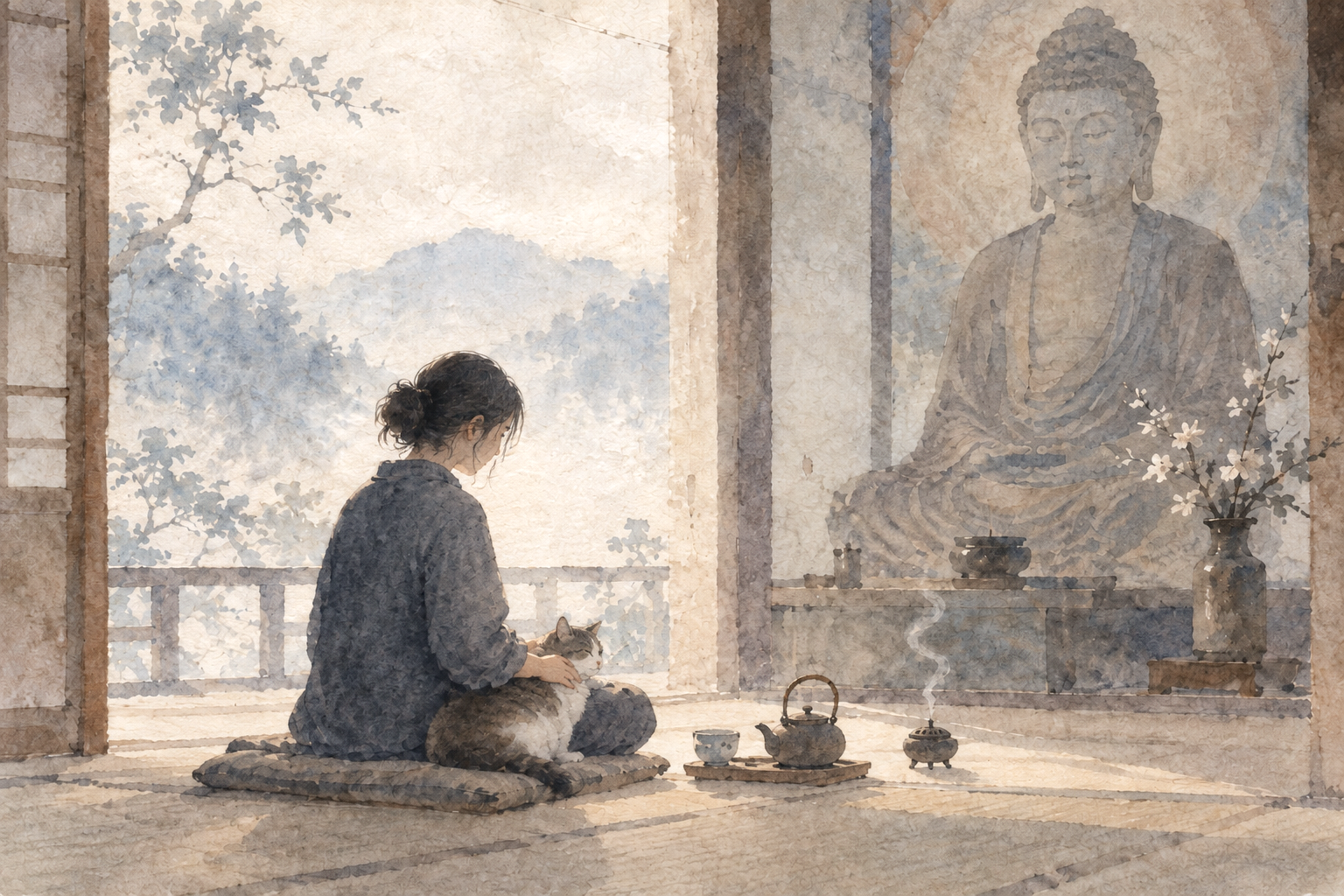
When comparison relaxes—even briefly—something else becomes available: the sound of the kettle, the texture of the air, the simple fact that you’re here. Solitude returns to being a lived moment rather than a verdict.
Common Misunderstandings That Keep Loneliness Stuck
Misunderstanding 1: “If I feel lonely alone, solitude just isn’t for me.” Many people assume loneliness proves they’re not suited to being alone. But loneliness can be a sign that comparison is active, not that solitude is inherently harmful. The skill is learning to recognize when you’ve shifted from presence into ranking.
Misunderstanding 2: “Comparison is just motivation.” Comparison can motivate in small doses, but it often sneaks in a hidden message: “You are not enough as you are.” Motivation rooted in deficiency tends to create anxiety and isolation, especially in solitude when there’s no external feedback to soften the inner critique.
Misunderstanding 3: “I should be able to think my way out of this.” When comparison triggers loneliness, it’s not only a thought problem—it’s an attention problem and a body problem. You may need to return to sensory experience, slow down, and let the nervous system settle before the mind can see clearly.
Misunderstanding 4: “If I stop comparing, I’ll lose my standards.” Dropping comparison doesn’t mean dropping discernment. You can still make plans, learn skills, and seek community. The difference is whether you relate to your life through curiosity and values, or through constant ranking and self-judgment.
Misunderstanding 5: “Everyone else is connected; I’m the exception.” Comparison tends to hide other people’s private struggles. It shows you their outcomes and your process, their best moments and your ordinary ones. That mismatch is a reliable recipe for loneliness.
Why This Matters for a Peaceful, Connected Life
When comparison turns solitude into loneliness, it doesn’t just affect your evenings—it shapes your identity. You start to believe you are “the kind of person” who is left out, behind, or unchosen. That belief then influences how you show up with others: more guarded, more performative, or more withdrawn.
Solitude is where many people digest their day, listen to their own needs, and recover from overstimulation. If comparison hijacks that time, you lose a key space for emotional regulation. The result can be a constant low-grade urgency to prove yourself, even when no one is asking.
Practically, it helps to build a small pause between “alone” and “evaluating.” When you notice the first comparative thought, you can label it gently—“ranking”—and return to something immediate: one full exhale, the feeling of your feet on the floor, the next simple task. This isn’t about forcing positivity; it’s about stepping out of the courtroom and back into the room.
Over time, solitude can become a place where you meet yourself without constantly negotiating your worth. That kind of inner companionship tends to make outer relationships healthier too—less grasping, less performative, more real.
Conclusion
Comparison turns solitude into loneliness by replacing direct experience with a ranking system. The moment your mind starts measuring your quiet life against someone else’s visible life, aloneness stops being simple and becomes loaded with meaning—usually the painful kind.
The way back is not to win the comparison game, but to notice when you’ve entered it. When you return to what’s actually here—breath, body, sound, ordinary tasks—solitude can regain its original function: a place to rest, reflect, and reconnect with what matters.
Ask a Buddhist priest
Have a question about Buddhism?
In the GASSHO app, you can ask questions about Buddhist teachings, daily concerns, and how to understand Buddhism in everyday life.
Frequently Asked Questions
- FAQ 1: Why does comparison make solitude feel lonely so quickly?
- FAQ 2: What’s the difference between solitude and loneliness in the context of comparison?
- FAQ 3: Why does social media comparison intensify loneliness during alone time?
- FAQ 4: How can I tell if I’m lonely or just comparing?
- FAQ 5: Why do I compare more when I’m alone?
- FAQ 6: Does comparison always turn solitude into loneliness?
- FAQ 7: Why does comparing my relationship status make solitude feel worse?
- FAQ 8: How does comparison create a sense of disconnection even when I have friends?
- FAQ 9: Why do I feel lonely after comparing my life timeline to others?
- FAQ 10: What’s a simple way to interrupt comparison when solitude starts feeling lonely?
- FAQ 11: Is it possible to use comparison without turning solitude into loneliness?
- FAQ 12: Why does comparison make me feel like I don’t belong anywhere?
- FAQ 13: Can comparison turn chosen solitude into loneliness even if I wanted time alone?
- FAQ 14: Why does comparison make my alone time feel unproductive or pointless?
- FAQ 15: How do I relate to myself differently so comparison doesn’t turn solitude into loneliness?
FAQ 1: Why does comparison make solitude feel lonely so quickly?
Answer: Comparison changes solitude from “being with yourself” into “judging yourself against others.” That judgment creates a sense of separation—like you’re outside a group looking in—even if you were content a moment earlier.
Takeaway: Loneliness often begins when solitude becomes a measurement.
FAQ 2: What’s the difference between solitude and loneliness in the context of comparison?
Answer: Solitude is a neutral condition of being alone; loneliness is the painful interpretation that being alone means you’re excluded, unworthy, or behind. Comparison supplies that interpretation by creating a ranking and placing you “below.”
Takeaway: Solitude is a situation; loneliness is often a story fueled by comparison.
FAQ 3: Why does social media comparison intensify loneliness during alone time?
Answer: Social media provides a constant stream of curated moments that your mind uses as a reference standard. When you’re alone, there’s less real-time connection to balance those images, so the mind can treat them as “proof” that others are living better or more connected lives.
Takeaway: Curated reference points can make ordinary solitude feel like failure.
FAQ 4: How can I tell if I’m lonely or just comparing?
Answer: Notice whether your discomfort comes with mental ranking: “They have more,” “I should be further,” “Everyone else is included.” If the pain rises with imagined scorekeeping, comparison is likely driving the loneliness.
Takeaway: Ranking thoughts are a strong clue that comparison is shaping the feeling.
FAQ 5: Why do I compare more when I’m alone?
Answer: When you’re alone, there’s more mental space and fewer immediate cues of belonging (conversation, shared tasks, eye contact). The mind may fill that space by scanning for “where you stand,” which often shows up as comparison.
Takeaway: Alone time can amplify the mind’s habit of checking status and belonging.
FAQ 6: Does comparison always turn solitude into loneliness?
Answer: Not always. Some comparisons are brief and pass without much impact. Loneliness tends to arise when comparison becomes repetitive and identity-based—when it concludes “this means something is wrong with me.”
Takeaway: It’s the sticky, self-defining comparison that most often creates loneliness.
FAQ 7: Why does comparing my relationship status make solitude feel worse?
Answer: Relationship-status comparison often carries a hidden assumption that being partnered equals being valued or safe. When solitude is measured against that assumption, being alone can be interpreted as rejection rather than simply a current life circumstance.
Takeaway: The pain often comes from the meaning assigned to being alone, not the aloneness itself.
FAQ 8: How does comparison create a sense of disconnection even when I have friends?
Answer: Comparison shifts focus from real relationships to imagined rankings within them: who is closer, who is chosen, who is invited. That mindset can make you feel separate from your friends even if the relationships are stable.
Takeaway: Comparison can manufacture distance inside otherwise supportive connections.
FAQ 9: Why do I feel lonely after comparing my life timeline to others?
Answer: Timeline comparison frames life as a schedule you’re supposed to match. When you believe you’re “late,” solitude can feel like evidence of failure rather than a normal part of a unique path.
Takeaway: Timelines turn personal life into a race, and solitude into a scoreboard.
FAQ 10: What’s a simple way to interrupt comparison when solitude starts feeling lonely?
Answer: Name the process gently (“comparing”) and return to one concrete sensation (a full exhale, feet on the floor, sounds in the room). This shifts attention from evaluation back to direct experience, which often softens loneliness.
Takeaway: Label comparison and re-anchor in the present to reduce the spiral.
FAQ 11: Is it possible to use comparison without turning solitude into loneliness?
Answer: Yes, if comparison stays informational rather than identity-based. “I’d like more community” can be useful; “I’m unlovable because I’m alone” turns solitude into loneliness. The key is whether the comparison becomes a verdict about your worth.
Takeaway: Keep comparison practical, not personal.
FAQ 12: Why does comparison make me feel like I don’t belong anywhere?
Answer: Comparison often assumes belonging must be earned by meeting certain conditions (popularity, success, attractiveness, constant activity). When you’re alone, those conditions can feel unmet, and the mind concludes “no place for me.”
Takeaway: Conditional belonging is a common byproduct of comparison.
FAQ 13: Can comparison turn chosen solitude into loneliness even if I wanted time alone?
Answer: Yes. You can choose solitude for rest or clarity, then suddenly compare your quiet choice to someone else’s social life and interpret it as “I’m missing out.” The choice remains valid; the loneliness comes from the added ranking.
Takeaway: Even healthy solitude can sour when it’s reinterpreted through comparison.
FAQ 14: Why does comparison make my alone time feel unproductive or pointless?
Answer: Comparison often values what is visible and measurable. Quiet restoration, reflection, and simple enjoyment can seem “less than” someone else’s achievements, so solitude gets labeled as wasted time, which can feel isolating and bleak.
Takeaway: Comparison can devalue the invisible benefits of solitude.
FAQ 15: How do I relate to myself differently so comparison doesn’t turn solitude into loneliness?
Answer: Practice meeting your experience with description rather than judgment: “tight chest,” “wanting contact,” “restless thoughts.” This shifts you from ranking to understanding. From there, you can choose a kind next step—rest, reach out, or do one grounded task—without using comparison as the driver.
Takeaway: Replace evaluation with gentle noticing to keep solitude from becoming loneliness.