



What Is Shojin Ryori? Japanese Buddhist Cuisine Explained
Quick Summary
- Shojin ryori is Japanese Buddhist temple cuisine built around simplicity, seasonality, and mindful restraint.
- It is plant-based, but it’s more than “Japanese vegan food”—it’s a way of cooking that reduces harm and waste.
- Meals emphasize balance through color, cooking methods, and textures rather than heavy seasoning.
- Many traditions avoid “five pungent” aromatics (like garlic and onions), though practices vary by place and purpose.
- Key ingredients include tofu, yuba, sesame, miso, soy sauce, kombu, mushrooms, and seasonal vegetables.
- The point isn’t perfection; it’s clarity—letting food be nourishing without overstimulating craving.
- You can practice the spirit of shojin ryori at home with a few simple dishes and a calmer approach to eating.
Introduction
If you’ve heard “shojin ryori” described as temple vegan food, you’re not wrong—but that label misses why it feels so different from ordinary plant-based cooking. The confusion usually comes from expecting bold flavors and big substitutions, then meeting a meal that’s quiet, deliberate, and surprisingly satisfying without trying to imitate meat or dairy. At Gassho, we focus on practical Buddhist culture and how it shows up in everyday life, including the food people actually eat.
Shojin ryori (精進料理) is often served in and around temples, but its value isn’t limited to religious settings. It’s a cuisine shaped by a particular relationship to desire, attention, and gratitude—expressed through ingredients, preparation, and the way a meal is received.
A Clear Lens for Understanding Shojin Ryori
The simplest way to understand shojin ryori is as cooking that aims to nourish without inflaming. Instead of chasing intensity—more salt, more fat, more heat—it leans toward balance and steadiness. That doesn’t mean bland food; it means flavor that supports clarity rather than hijacking attention.
This cuisine treats ingredients as complete in themselves. Rather than building a dish around what’s missing (“How do we replace meat?”), it starts with what’s present: a root vegetable’s sweetness, tofu’s clean softness, sesame’s richness, kombu’s depth. The cook’s job is to reveal those qualities with minimal force.
Shojin ryori also works as a lens on consumption. It quietly asks: what is enough? Not as a moral command, but as a practical question you can feel in the body. When meals are simpler and more seasonal, it becomes easier to notice the difference between hunger, habit, and craving.
Finally, it’s a cuisine of respect—toward the labor behind the food, the life of plants, and the time it took for everything to arrive on the plate. That respect shows up in small choices: using scraps for broth, cutting vegetables carefully, and serving portions that satisfy without pushing into excess.
GASSHO
Ask and learn about Buddhism in daily life.
GASSHO is a Buddhist community app where you can learn Buddhist teachings and ask questions to the head priest of Kongosanmaiin Temple on Mount Koya.
How Shojin Ryori Feels in Ordinary Eating
You notice it first in the pace. A shojin-style meal tends to slow you down because the flavors don’t shout. Without the usual spikes of sweetness, oil, or heavy seasoning, attention naturally returns to texture, temperature, and the simple pleasure of chewing.
You also notice how quickly the mind starts negotiating. “Could this be stronger?” “Wouldn’t garlic improve it?” “Maybe I need something crunchy.” Shojin ryori makes these impulses visible—not to suppress them, but to see them as impulses. That small gap between wanting and acting is part of the meal.
In everyday life, this can look like reaching for the soy sauce bottle, pausing, and tasting again. Or adding a squeeze of citrus instead of more salt. Or realizing that the dish is already complete, and the urge to “fix” it is just restlessness.
Because the food is often seasonal, it changes your expectations. In summer, you might crave cooling dishes—light simmered vegetables, chilled tofu, crisp pickles. In winter, you might lean into warmth—miso soup, simmered daikon, roasted kabocha. The meal becomes less about personal preference and more about meeting conditions.
There’s also a different relationship to leftovers and scraps. When you start saving kombu after making broth, or turning carrot peels into a quick kinpira-style sauté, you feel waste as something tangible—not a concept. The kitchen becomes quieter and more efficient, not because you’re trying hard, but because you’re paying attention.
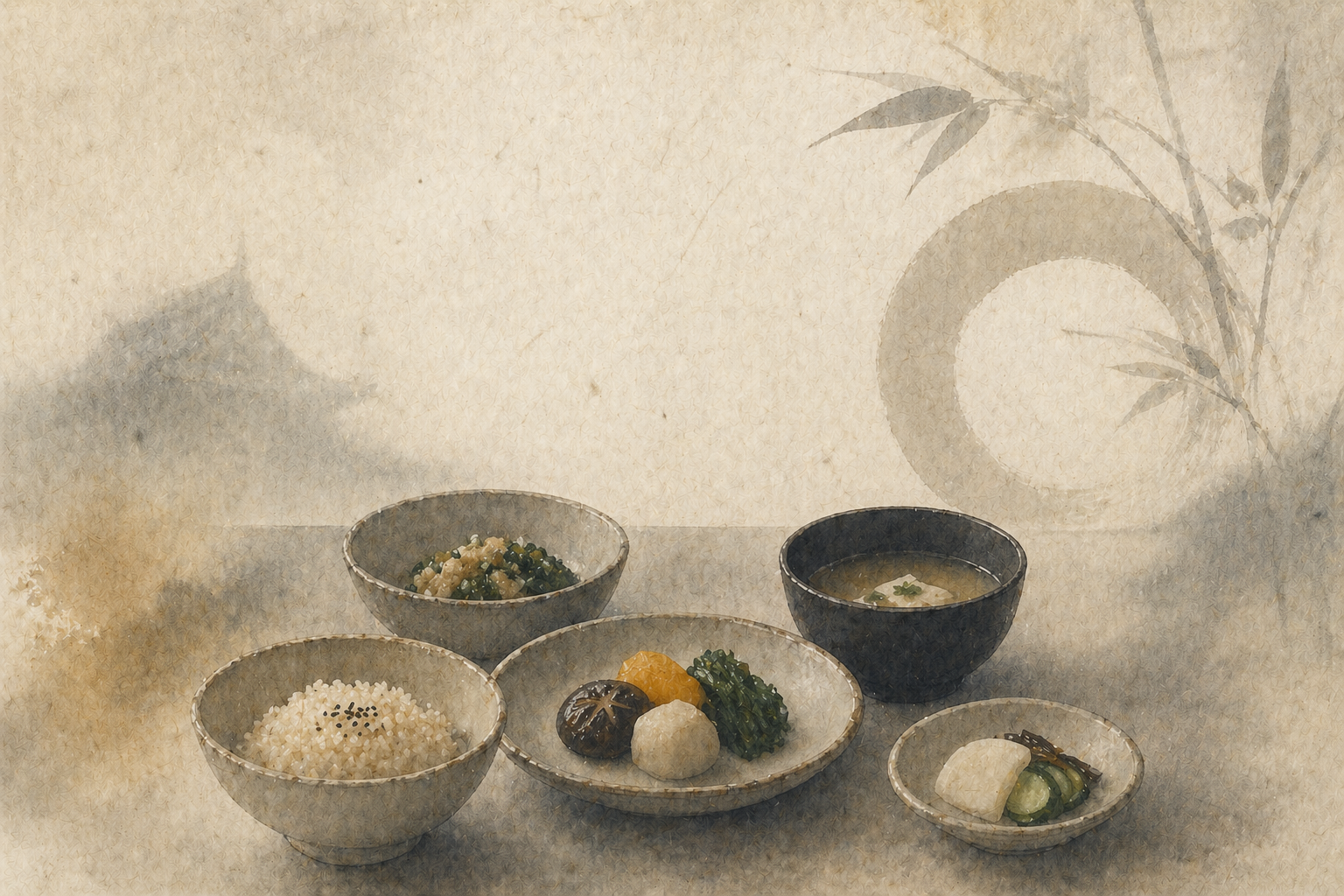
Even plating can shift your inner state. A small bowl of rice, a soup, and two or three modest sides can feel “complete” when the colors and textures are varied. The mind relaxes because it’s not searching for the missing piece.
And when you do eat something richer later, you may notice the contrast more clearly: how fast it disappears, how quickly you want more, how the body feels afterward. Shojin ryori doesn’t require you to judge that experience—only to notice it.
Common Misunderstandings About Temple Cuisine
Misunderstanding 1: “Shojin ryori is just Japanese vegan food.” It is plant-based, but the defining feature is the intention and method: simplicity, seasonality, and a careful relationship to desire. Plenty of vegan food aims for maximum stimulation; shojin ryori usually aims for steadiness.
Misunderstanding 2: “It must be bland if it avoids garlic and onions.” Many shojin kitchens avoid the “five pungent” aromatics, but flavor doesn’t disappear—it shifts. Umami from kombu and mushrooms, richness from sesame and tofu, brightness from yuzu or sansho, and depth from miso can create a full spectrum without relying on pungency.
Misunderstanding 3: “It’s too strict for normal life.” Shojin ryori is often practiced with flexibility outside temple settings. You can adopt the spirit—less waste, more seasonal cooking, simpler meals—without copying every rule. The point is to reduce harm and agitation, not to win at purity.
Misunderstanding 4: “It’s only for special occasions.” While it can be served in formal multi-dish sets, the heart of shojin ryori is everyday food: rice, soup, pickles, simmered vegetables, tofu dishes. It’s designed to be repeatable and sustainable.
Misunderstanding 5: “No animal products means not enough protein.” Traditional ingredients like tofu, yuba, natto, sesame, and beans can provide substantial protein. The bigger shift is learning to build meals around legumes and soy foods rather than treating them as side items.
Why Shojin Ryori Still Matters Today
Shojin ryori matters because it offers a workable alternative to the modern pattern of constant stimulation. Many people aren’t just overfed; they’re over-triggered—by flavors engineered to keep you reaching for more. A calmer cuisine can be a practical form of self-care that doesn’t require a new identity.
It also supports a more ethical relationship with food without turning every meal into a debate. By default, it reduces harm to animals and often lowers environmental impact. But it does this quietly, through habit and structure, not through pressure.
On a personal level, it can improve your ability to sense what you actually need. When meals are simpler, you can feel satiety sooner. When ingredients are seasonal, you’re less likely to eat on autopilot. When waste is minimized, gratitude becomes less theoretical.
And it’s accessible. You don’t need a temple kitchen. A pot of rice, a miso soup with tofu and wakame, and one vegetable side—prepared with care—already moves you toward the spirit of shojin ryori.
Conclusion
Shojin ryori is Japanese Buddhist cuisine that uses plant-based ingredients to express a calmer relationship to eating: less grasping, less waste, more seasonality, and more respect for what’s in front of you. If you approach it as a lens rather than a label, it becomes surprisingly practical—something you can taste in a single bowl of soup and carry into the next ordinary meal.
Ask a Buddhist priest
Have a question about Buddhism?
In the GASSHO app, you can ask questions about Buddhist teachings, daily concerns, and how to understand Buddhism in everyday life.
Frequently Asked Questions
- FAQ 1: What is shojin ryori in simple terms?
- FAQ 2: Is shojin ryori always vegan?
- FAQ 3: Why is shojin ryori associated with Buddhism?
- FAQ 4: What does “shojin” mean in shojin ryori?
- FAQ 5: What are the main ingredients used in shojin ryori?
- FAQ 6: Does shojin ryori avoid garlic and onions?
- FAQ 7: What is the “five pungent” rule in shojin ryori?
- FAQ 8: How is shojin ryori different from kaiseki?
- FAQ 9: What is a typical shojin ryori meal structure?
- FAQ 10: Is shojin ryori healthy?
- FAQ 11: How does shojin ryori create umami without fish-based dashi?
- FAQ 12: Can I cook shojin ryori at home without special ingredients?
- FAQ 13: What are common shojin ryori dishes?
- FAQ 14: Where can I eat authentic shojin ryori in Japan?
- FAQ 15: Is shojin ryori the same as Japanese vegetarian food?
FAQ 1: What is shojin ryori in simple terms?
Answer: Shojin ryori is traditional Japanese Buddhist temple cuisine that uses plant-based ingredients and simple techniques to create balanced meals with minimal waste and minimal stimulation.
Takeaway: Shojin ryori is plant-based Japanese cuisine shaped by simplicity, balance, and mindful restraint.
FAQ 2: Is shojin ryori always vegan?
Answer: It is generally vegan (no meat, fish, eggs, or dairy), especially in temple contexts. In practice outside temples, some restaurants may serve “shojin-style” meals that are mostly plant-based but not strictly vegan, so it’s worth confirming ingredients.
Takeaway: Traditionally vegan, but “shojin-style” can vary—ask when dining out.
FAQ 3: Why is shojin ryori associated with Buddhism?
Answer: It developed in temple settings where cooking emphasized reducing harm, avoiding excess, and supporting a steady mind. The cuisine reflects those values through ingredient choices, careful preparation, and a focus on gratitude and non-waste.
Takeaway: Shojin ryori is “Buddhist cuisine” because its cooking choices express Buddhist ethical and mindful priorities.
FAQ 4: What does “shojin” mean in shojin ryori?
Answer: “Shojin” (精進) broadly points to sincere effort and devoted practice. In food culture, it implies disciplined, careful cooking that avoids indulgence and supports clarity and balance.
Takeaway: “Shojin” signals purposeful restraint and care, not just a list of forbidden foods.
FAQ 5: What are the main ingredients used in shojin ryori?
Answer: Common ingredients include tofu, yuba (tofu skin), soybeans, sesame, miso, soy sauce, rice, seasonal vegetables, mushrooms, seaweeds, and dashi made from kombu and/or dried mushrooms rather than fish.
Takeaway: Shojin ryori builds flavor from soy foods, sesame, sea vegetables, mushrooms, and seasonal produce.
FAQ 6: Does shojin ryori avoid garlic and onions?
Answer: Many shojin traditions avoid “five pungent” aromatics (often including garlic, onions, leeks, chives, and scallions) because they’re considered overly stimulating. However, practices vary by temple, region, and restaurant.
Takeaway: Often yes, but it depends—shojin ryori is more about intention than a universal rulebook.
FAQ 7: What is the “five pungent” rule in shojin ryori?
Answer: It refers to avoiding a set of strong-smelling alliums and similar aromatics that can intensify craving or agitation. The exact list can differ, but the purpose is to keep flavors supportive and steady rather than overpowering.
Takeaway: The “five pungent” guideline aims to reduce overstimulation, not to punish enjoyment.
FAQ 8: How is shojin ryori different from kaiseki?
Answer: Kaiseki is a refined multi-course Japanese meal often paired with tea culture and can include fish and other animal products. Shojin ryori is plant-based temple cuisine; it may look similar in presentation, but its ingredient rules and intention are different.
Takeaway: Kaiseki is not necessarily vegetarian; shojin ryori is specifically plant-based and temple-rooted.
FAQ 9: What is a typical shojin ryori meal structure?
Answer: A common structure is rice, soup, and several small side dishes featuring different cooking methods (simmered, grilled, steamed, dressed, pickled). The goal is balance across flavors, colors, and textures rather than one dominant centerpiece.
Takeaway: Shojin ryori often uses a “many small dishes” approach to create balance without heaviness.
FAQ 10: Is shojin ryori healthy?
Answer: It can be, because it emphasizes vegetables, legumes, fermented foods, and moderate portions. But “healthy” depends on your needs—some dishes can be salty (miso, soy sauce) or fried (tempura-style), so balance matters.
Takeaway: Often nourishing and balanced, but health depends on overall diet and seasoning choices.
FAQ 11: How does shojin ryori create umami without fish-based dashi?
Answer: It commonly uses kombu (kelp) and dried mushrooms (like shiitake) to make a plant-based broth, plus fermented seasonings such as miso and soy sauce. Sesame and roasted ingredients can add depth and richness as well.
Takeaway: Kombu, mushrooms, and fermentation are the core umami tools in shojin ryori.
FAQ 12: Can I cook shojin ryori at home without special ingredients?
Answer: Yes. Start with rice, a simple miso soup (with tofu and wakame), and one seasonal vegetable side. If you can add kombu, sesame, and mushrooms to your pantry, you’ll be able to make many shojin-style dishes without complexity.
Takeaway: Home shojin ryori can be very simple—one soup, one side, and rice is enough.
FAQ 13: What are common shojin ryori dishes?
Answer: Frequently seen dishes include goma-ae (vegetables with sesame dressing), simmered kabocha or daikon, tofu preparations (chilled tofu, agedashi-style with plant-based broth), yuba dishes, pickles, and seasonal tempura-style vegetables in some settings.
Takeaway: Shojin ryori is built from simple vegetable, tofu, sesame, and seasonal preparations.
FAQ 14: Where can I eat authentic shojin ryori in Japan?
Answer: You can often find it at temple lodgings (shukubo), temple-run dining halls, and specialized shojin ryori restaurants, especially in areas known for temple culture. Menus may require reservations and may be seasonal or set-course.
Takeaway: Temples, shukubo stays, and dedicated restaurants are the most reliable places to find shojin ryori.
FAQ 15: Is shojin ryori the same as Japanese vegetarian food?
Answer: Not exactly. Japanese vegetarian food can include many styles and may still use fish-based dashi. Shojin ryori is a specific temple-rooted cuisine that is typically fully plant-based and guided by simplicity, seasonality, and mindful restraint.
Takeaway: Shojin ryori is a distinct Buddhist cuisine, not just any Japanese vegetarian meal.