



Why Buddhist Symbols Are Easier to Understand Through Patterns
Quick Summary
- Buddhist symbols often “click” faster when you read them as patterns (relationships) rather than as isolated pictures.
- Patterns reduce cultural guesswork by pointing to universal experiences: change, repetition, balance, and cause-and-effect.
- Many symbols are built from simple structures (circles, wheels, knots, lotuses) that the mind recognizes quickly.
- Pattern-reading shifts you from “What does this mean?” to “What does this do to attention and behavior?”
- Seeing recurring motifs across art, ritual, and daily life makes symbols feel less like code and more like guidance.
- Misreadings usually happen when we treat symbols as literal claims, decorations, or one-size-fits-all definitions.
- You can practice pattern literacy by noticing repetition, symmetry, cycles, and interdependence in ordinary moments.
Introduction
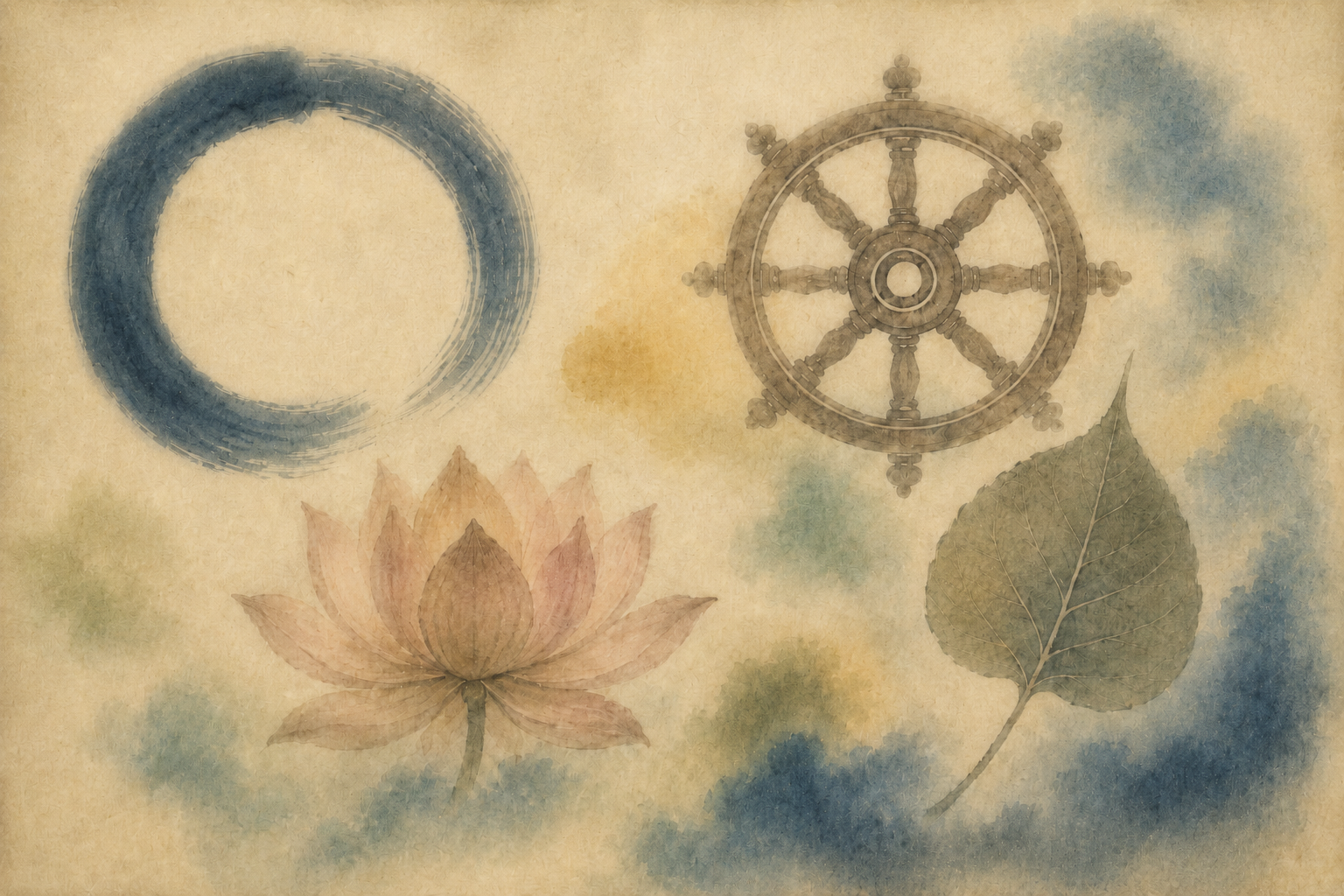
Buddhist symbols can feel oddly opaque at first: a wheel, a knot, a lotus, a circle—beautiful, but not immediately “readable” if you didn’t grow up around them. The confusion usually comes from trying to translate them like vocabulary words, when they work better like diagrams of experience—patterns you can recognize in your own attention, habits, and relationships. At Gassho, we focus on practical, experience-near ways of understanding Buddhist imagery without requiring cultural insider knowledge.
When you approach a symbol as a pattern, you stop hunting for the one correct definition and start noticing what the symbol is training you to see: cycles, causes, feedback loops, balance, and the way things co-arise. That shift matters because Buddhist symbols were often designed to be remembered, repeated, and contemplated—less like labels and more like compact maps.
Patterns also travel well. A person in any culture understands a circle as continuity, a wheel as motion and direction, a knot as entanglement, and a lotus as growth through conditions. You don’t need to force a perfect translation; you need a way to relate the form to lived experience.
A Pattern Lens for Reading Buddhist Symbols
Reading Buddhist symbols through patterns means treating them as structured reminders of how experience works. A pattern is not a belief; it’s a repeatable relationship you can observe: when this happens, that tends to follow; when you pull here, something shifts there. Symbols become easier when you ask, “What relationship is being shown?” rather than “What object is being depicted?”
This lens is grounded in how the mind naturally learns. We recognize shapes and relationships faster than we parse explanations. A wheel suggests a center and a rim, movement and direction, stability and change. A circle suggests wholeness and continuity. A knot suggests interweaving and difficulty in separating strands. These are not exotic ideas; they’re pattern-recognition at work.
Patterns also protect you from over-literal readings. A symbol doesn’t need to be a factual claim about the universe to be useful. It can be a prompt that organizes attention: notice what repeats, notice what’s connected, notice what you’re clinging to, notice what can be released. In that sense, the “meaning” is partly what the symbol helps you notice in real time.
Finally, patterns make symbols portable across contexts. Even if you don’t know the historical origin of a motif, you can still work with its structure: symmetry can point to balance, a spiral can point to unfolding, a mandala-like layout can point to ordered complexity. The symbol becomes a tool for seeing, not a test of background knowledge.
GASSHO
Ask and learn about Buddhism in daily life.
GASSHO is a Buddhist community app where you can learn Buddhist teachings and ask questions to the head priest of Kongosanmaiin Temple on Mount Koya.
How Pattern-Reading Shows Up in Ordinary Moments
Imagine you see a Buddhist wheel and your mind immediately wants a definition. Pattern-reading starts one step earlier: you notice the center, the spokes, the rim. Your attention naturally organizes around “what holds” (center), “what connects” (spokes), and “what moves” (rim). Even before you know any traditional explanation, you’re already relating the image to stability, connection, and motion.
In daily life, you can feel the same structure when you’re pulled in many directions. There’s the “rim” of activity—messages, tasks, opinions—spinning quickly. There’s also the possibility of a “center”—a steadier reference point like breath, posture, or a simple intention. The symbol becomes easier because it matches something you can notice: the difference between being carried by the rim and remembering the center.
Or take the endless knot. If you treat it as a picture to decode, you may get stuck. If you treat it as a pattern, you notice interweaving: one strand crosses another, and the whole shape depends on mutual support. That can mirror how a small irritation becomes a larger mood because it links with fatigue, memory, and expectation—an entanglement pattern rather than a single cause.
The lotus becomes clearer in the same way. You don’t need to romanticize it. You simply notice a pattern: growth depends on conditions, and beauty can arise from messy inputs. In ordinary terms, a difficult conversation can become the condition for clarity; a mistake can become the condition for learning. The symbol is easier because it points to conditionality, not perfection.
Mandala-like designs can also be read as patterns of attention. When you look at a structured, symmetrical image, the mind tends to settle and organize. You notice edges and center, repetition and variation. That experience—attention becoming more coherent—is part of why patterns help: they don’t only “mean” something; they also do something to the way you perceive.
Even the simplest circle (often seen in Buddhist art and calligraphy) can be approached as a pattern of completeness and openness. In a tense moment, the mind narrows; it selects a threat and excludes everything else. A circle gently suggests widening—letting the moment be whole enough to include breath, sound, body, and context, not just the problem.
Over time, you may notice that the same few patterns repeat across many symbols: cycles, interdependence, balance, and the possibility of re-centering. That repetition is not redundancy; it’s reinforcement. The symbols become easier because they’re not separate puzzles—they’re different angles on the same human tendencies.
Where People Commonly Get Stuck
One common misunderstanding is assuming every symbol has a single fixed definition, like a dictionary entry. In practice, symbols often carry a range of meanings that depend on context—where it appears, what it’s paired with, and what aspect of experience it’s highlighting. Pattern-reading helps because it allows “family resemblance” without forcing one rigid translation.
Another sticking point is treating symbols as purely cultural decoration. Yes, they are cultural artifacts, but they’re also functional designs meant to train perception and memory. When you look for the pattern—center/rim, interweaving, unfolding, symmetry—you recover the functional side without needing to become an art historian.
A third misunderstanding is taking symbols too literally, as if they are making scientific claims. Many symbols are better understood as experiential prompts: “Notice how things change,” “Notice how causes link,” “Notice how grasping tightens.” If you demand literalism, you miss the practical invitation.
Finally, people sometimes over-intellectualize and skip the felt sense. Patterns are not only concepts; they are perceptual. If a symbol is meant to evoke balance, you can check whether your attention feels balanced when you contemplate it. If it’s meant to evoke interdependence, you can check whether you start noticing connections you previously ignored.
Why This Way of Understanding Helps in Real Life
Patterns make Buddhist symbols easier to understand because they match how stress and clarity actually work: through repetition, triggers, feedback loops, and shifting attention. When you can recognize a pattern, you can respond earlier—before a reaction becomes a spiral.
This approach also reduces the pressure to “get it right.” Instead of worrying whether you know the official meaning, you ask whether the symbol helps you see something true in your own experience. That makes the symbol usable, not just interesting.
Pattern literacy supports compassion, too. When you see suffering as patterned—conditions leading to reactions—you’re less likely to reduce yourself or others to a fixed identity. You can notice, “This is what happens when fatigue meets fear,” rather than, “This is who I am” or “This is who they are.”
And it makes practice more integrated. Symbols stop being “religious objects over there” and become reminders embedded in ordinary life: re-center, widen the view, notice interdependence, soften the knot of grasping. The point isn’t to collect meanings; it’s to become more fluent in seeing patterns as they arise.
Conclusion
Buddhist symbols become easier when you treat them as patterns that organize attention rather than as secret codes that require the right translation. Circles, wheels, knots, lotuses, and symmetrical designs are memorable because they mirror repeatable features of lived experience: cycles, centers, connections, and conditions.
If you want a simple next step, pick one symbol you often see and ask three pattern questions: What repeats? What relates to what? Where is the center? You may find the symbol starts to feel less like an artifact to interpret and more like a quiet instruction for how to look.
Ask a Buddhist priest
Have a question about Buddhism?
In the GASSHO app, you can ask questions about Buddhist teachings, daily concerns, and how to understand Buddhism in everyday life.
Frequently Asked Questions
- FAQ 1: What does it mean to understand Buddhist symbols “through patterns”?
- FAQ 2: Why are patterns easier for the mind than explanations when reading Buddhist symbols?
- FAQ 3: How does a pattern-based approach reduce cultural confusion around Buddhist symbols?
- FAQ 4: Are Buddhist symbols meant to have one correct meaning, or multiple pattern-level meanings?
- FAQ 5: How can I use patterns to understand the Dharma wheel more easily?
- FAQ 6: Why does the endless knot make more sense when seen as a pattern?
- FAQ 7: How do patterns help explain why the lotus is such a common Buddhist symbol?
- FAQ 8: Why do mandala-like designs feel “intuitive” even if I don’t know their background?
- FAQ 9: Is understanding Buddhist symbols through patterns the same as “over-analyzing” them?
- FAQ 10: What’s a simple method to interpret any Buddhist symbol using patterns?
- FAQ 11: Why do circles and circular motifs show up so often in Buddhist symbolism?
- FAQ 12: How does pattern-based understanding help prevent literal misunderstandings of Buddhist symbols?
- FAQ 13: Can patterns explain why the same Buddhist symbol appears in different styles across countries?
- FAQ 14: How do I know if I’m reading a Buddhist symbol’s pattern well?
- FAQ 15: Why are Buddhist symbols easier to remember when understood as patterns?
FAQ 1: What does it mean to understand Buddhist symbols “through patterns”?
Answer: It means focusing on the relationships a symbol shows—cycles, centers, symmetry, interweaving, cause-and-effect—rather than trying to translate it into a single sentence definition. You treat the image like a diagram of experience that you can recognize in daily life.
Takeaway: Patterns turn symbols into practical maps instead of vocabulary tests.
FAQ 2: Why are patterns easier for the mind than explanations when reading Buddhist symbols?
Answer: The brain is built to recognize shape, repetition, and structure quickly. A circle, a wheel, or a knot communicates organization at a glance, while verbal explanations require more cultural and conceptual background to interpret accurately.
Takeaway: Pattern recognition is fast, universal, and low-effort.
FAQ 3: How does a pattern-based approach reduce cultural confusion around Buddhist symbols?
Answer: It shifts the focus from “What does this mean in that culture?” to “What relationship is being shown that I can observe?” Cycles, balance, and interdependence are human experiences, so the symbol becomes readable even without insider knowledge.
Takeaway: Patterns help you connect directly to experience, not just history.
FAQ 4: Are Buddhist symbols meant to have one correct meaning, or multiple pattern-level meanings?
Answer: Often multiple. A single symbol can point to different aspects of experience depending on context, and pattern-reading supports that flexibility by emphasizing structure (like center/rim or interweaving) rather than a single rigid definition.
Takeaway: Symbols can be stable in form while flexible in application.
FAQ 5: How can I use patterns to understand the Dharma wheel more easily?
Answer: Start with the pattern: a center (stability), spokes (connection and direction), and a rim (movement and continuity). Then notice where that pattern appears in your life—being pulled by activity at the “rim” versus remembering a steadier “center.”
Takeaway: Read the wheel as a relationship between stability, connection, and motion.
FAQ 6: Why does the endless knot make more sense when seen as a pattern?
Answer: Because it visually demonstrates interdependence and entanglement: strands cross and rely on each other, and you can’t isolate one part without affecting the whole. That mirrors how emotions and reactions often arise from linked conditions, not a single cause.
Takeaway: The knot is easier when you see “interweaving,” not a hidden code.
FAQ 7: How do patterns help explain why the lotus is such a common Buddhist symbol?
Answer: The lotus expresses a conditional pattern: growth depends on conditions, and what’s beautiful can arise from messy inputs. Read as a pattern, it points to how change and development happen through causes rather than through purity or perfection.
Takeaway: The lotus is a pattern of conditional growth, not just a pretty flower.
FAQ 8: Why do mandala-like designs feel “intuitive” even if I don’t know their background?
Answer: Many mandala forms use symmetry, repetition, and a clear center, which naturally organizes attention. The pattern itself can create a sense of coherence, making the symbol feel understandable through direct perception rather than explanation.
Takeaway: Structured patterns can communicate through how they shape attention.
FAQ 9: Is understanding Buddhist symbols through patterns the same as “over-analyzing” them?
Answer: No. Over-analysis piles on concepts; pattern-reading simplifies. It asks you to notice basic structures (repetition, balance, cycles, interdependence) and relate them to experience, without forcing complicated interpretations.
Takeaway: Pattern-reading is usually a move toward simplicity, not complexity.
FAQ 10: What’s a simple method to interpret any Buddhist symbol using patterns?
Answer: Use three questions: (1) What repeats or mirrors? (2) What connects to what? (3) Where is the center or organizing principle? Then test it in daily life by noticing where that same pattern appears in your reactions and choices.
Takeaway: Repetition, relationship, and center are reliable pattern clues.
FAQ 11: Why do circles and circular motifs show up so often in Buddhist symbolism?
Answer: Circles are a strong pattern for continuity, wholeness, and cycles—things people can recognize immediately. They can also function as attention cues, encouraging a wider, more inclusive view rather than a narrow fixation.
Takeaway: The circle is a universal pattern that points to cycles and completeness.
FAQ 12: How does pattern-based understanding help prevent literal misunderstandings of Buddhist symbols?
Answer: It frames symbols as experiential prompts rather than factual claims. When you look for the relationship being illustrated—like cause-and-effect or interdependence—you’re less likely to treat the image as a literal statement that must be defended or disproved.
Takeaway: Patterns keep symbols practical and experience-centered.
FAQ 13: Can patterns explain why the same Buddhist symbol appears in different styles across countries?
Answer: Yes. The surface style can change while the underlying pattern stays recognizable—like a wheel structure or an interwoven knot. That stable pattern is what carries the symbol’s “readability” across languages and artistic traditions.
Takeaway: Styles vary, but patterns travel.
FAQ 14: How do I know if I’m reading a Buddhist symbol’s pattern well?
Answer: A good pattern-reading makes the symbol simpler, more memorable, and more applicable to ordinary experience. If your interpretation requires lots of special pleading, or doesn’t connect to anything you can observe, it may be drifting away from the symbol’s functional role.
Takeaway: A useful pattern-reading clarifies and connects to lived experience.
FAQ 15: Why are Buddhist symbols easier to remember when understood as patterns?
Answer: Patterns compress information. A single image can hold a whole set of relationships—center and rim, interweaving strands, unfolding petals, repeated symmetry—so memory hooks onto structure instead of trying to store a long explanation.
Takeaway: Pattern structure makes symbolic meaning compact and memorable.