



What Are the Three Realms in Buddhism? Desire, Form, and Formlessness Explained
Quick Summary
- In three realms Buddhism, “realm” is a way to map how craving, perception, and identity shape experience.
- The Desire Realm is life driven by wanting, aversion, and sensory pull.
- The Form Realm is a quieter, more refined mode where attention stabilizes and gross craving softens.
- The Formless Realm points to extremely subtle states where “objects” feel thin or absent, yet clinging can still remain.
- The three realms aren’t just “places”; they can describe moment-to-moment mind-states in ordinary life.
- The point isn’t to rank experiences, but to notice what keeps stress repeating: grasping, resistance, and confusion.
- Understanding the three realms helps you spot attachment even in calm, spiritual, or “high” states.
Introduction
If “three realms Buddhism” sounds like a cosmic map you’re supposed to believe in, you’re not alone—and that assumption usually makes the whole idea feel distant, mystical, or irrelevant to real life. A more useful approach is to treat the three realms as a practical way of describing how the mind organizes experience around desire, refined stability, and subtle formlessness, and how suffering can persist in all three. At Gassho, we focus on clear, lived explanations of Buddhist ideas without requiring metaphysical buy-in.
The traditional names are the Desire Realm (often linked with strong sensory pull), the Form Realm (linked with refined, steady attention), and the Formless Realm (linked with extremely subtle experiences where “things” feel less defined). You can read them as cosmology, psychology, or both—but either way, the value is in what they reveal about clinging.
When people get confused, it’s usually because they think the three realms are only about where beings are “reborn,” or they assume the higher realms mean “better” in a simple moral sense. The more grounded reading is: each realm highlights a different style of attachment, and each style has its own blind spots.
A Practical Lens for the Three Realms
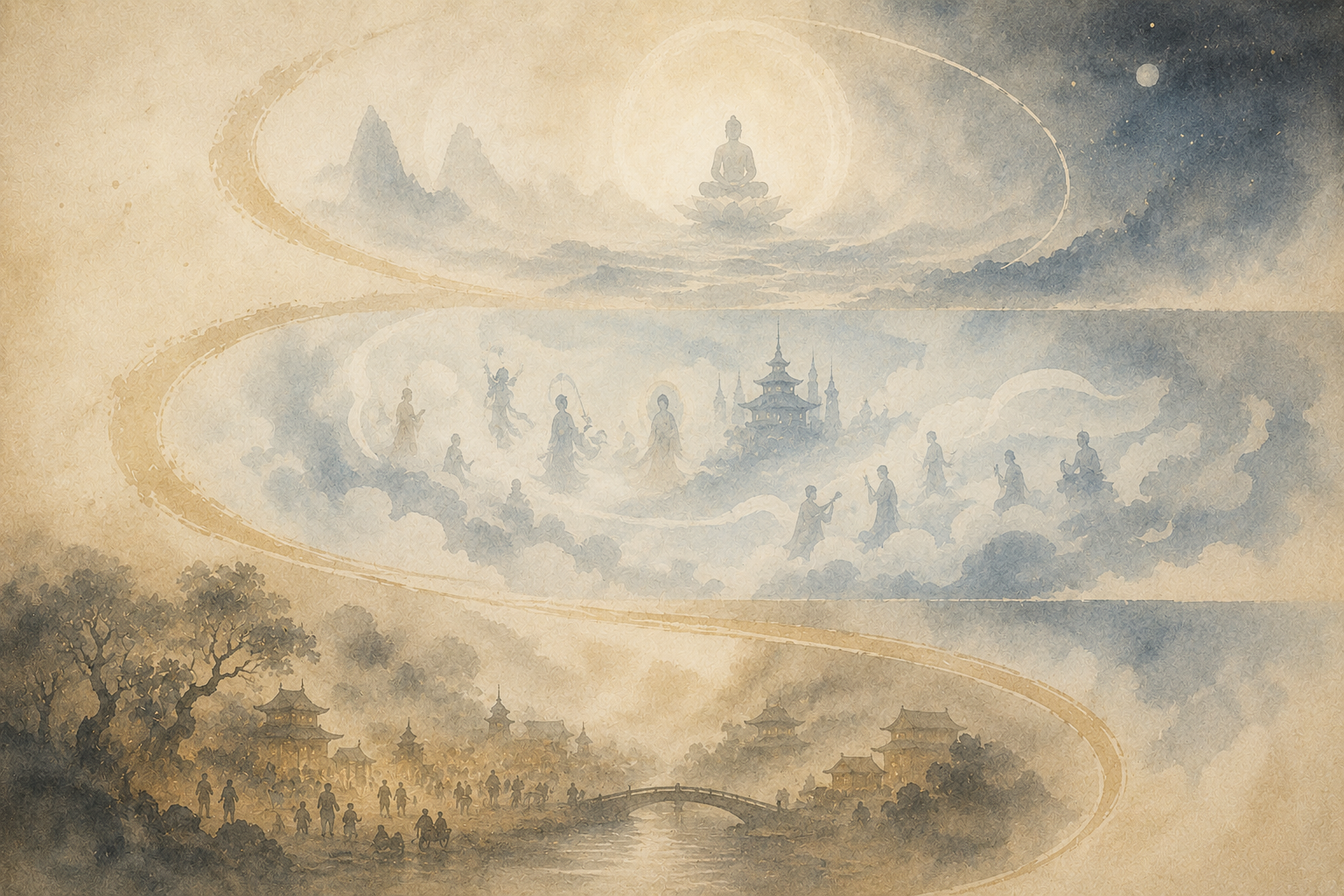
The three realms in Buddhism can be understood as three broad patterns of experience shaped by what the mind takes as satisfying, stable, or “me.” They describe how consciousness tends to build a world: first around obvious sense pleasures and dislikes, then around refined states of calm and clarity, and finally around very subtle experiences where even “form” seems to drop away.
The Desire Realm is the most familiar because it matches everyday life: sights, sounds, tastes, comfort, status, romance, irritation, boredom, and the constant push-pull of “I want” and “I don’t want.” In this realm, the mind easily believes that the next purchase, message, compliment, snack, or win will finally settle things. The lens here is simple: notice how quickly wanting turns into tension.
The Form Realm points to experience that is less driven by raw sensory hunger and more shaped by steadiness, composure, and refined pleasure. It’s not “no body” or “no world”; it’s more like the mind can stay with an object (breath, lightness, quiet, clarity) without immediately chasing stimulation. The lens here is: even calm can become something we grasp, protect, or use to define ourselves.
The Formless Realm describes experience where the usual sense of “thing-ness” becomes extremely subtle—space-like, boundless, or hard to pin down. Read practically, it highlights a key point: even when experience feels vast or empty of objects, the habit of identification can remain (“this is my special state,” “I’ve escaped ordinary life,” “nothing can touch me”). The lens here is: attachment can survive even when the content of experience becomes very thin.
GASSHO
Ask and learn about Buddhism in daily life.
GASSHO is a Buddhist community app where you can learn Buddhist teachings and ask questions to the head priest of Kongosanmaiin Temple on Mount Koya.
How the Three Realms Show Up in Ordinary Moments
In the Desire Realm mode, attention is frequently yanked around by preference. You notice a pleasant sensation and lean in; you notice an unpleasant one and brace or push away. Even neutral moments can feel intolerable, so the mind reaches for something—scrolling, snacking, planning, replaying conversations—anything to avoid the plainness of “just this.”
This doesn’t require dramatic cravings. It can be as small as checking your phone again because silence feels slightly itchy, or tightening your jaw because someone’s tone sounded dismissive. The “realm” is the pattern: experience is filtered through wanting and resisting, and the body often shows it first.
In a Form Realm mode, the mind can feel more collected. You might be focused on a task, absorbed in music, or simply sitting quietly with less internal commentary. There’s still experience—sounds, sensations, thoughts—but the urge to meddle with everything is reduced. It can feel clean, orderly, even safe.
But watch closely: the moment calm appears, a subtle management impulse can follow. “Don’t lose this.” “Stay here.” “If I can keep this feeling, I’ll be okay.” The mind may start policing experience, rejecting anything that threatens the pleasant stability. That policing is a refined form of clinging.
In a Formless Realm mode, the mind may relate to experience as open, spacious, or less centered on objects. Sometimes it shows up as a sense of vastness while walking outside, or a quiet, boundary-light feeling when you stop narrating your life for a moment. The content can feel minimal, but the relationship to it still matters.
A common tell here is subtle superiority or escape: “I’m above petty concerns,” or “Nothing matters, so I don’t have to feel this.” That isn’t freedom; it’s often a more abstract way of avoiding discomfort. The realm lens helps you notice that avoidance can wear spiritual clothing.
Across all three, the key observation is not “Which realm am I in?” but “What am I doing with experience right now?” Are you grasping, resisting, spacing out, or quietly knowing? The three realms become a mirror for the mind’s habits, not a scoreboard.
Common Mix-Ups About Desire, Form, and Formlessness
Misunderstanding 1: The three realms are only literal locations. In traditional Buddhist contexts, the realms can be discussed cosmologically. But even if you set cosmology aside, the framework still works as a description of how the mind constructs a world around certain kinds of satisfaction and identity.
Misunderstanding 2: Higher realms mean you’re “better.” The Form and Formless realms can sound superior because they’re less coarse. But the point isn’t prestige; it’s diagnosis. A refined state can still contain clinging, and clinging is what keeps dissatisfaction repeating.
Misunderstanding 3: Desire Realm means “bad,” so desire must be crushed. The Desire Realm is not a moral label; it’s a description of how experience feels when it’s organized around wanting and aversion. The practical move is to see desire clearly—how it arises, what it promises, what it costs—rather than to wage war on being human.
Misunderstanding 4: Formless means numb, blank, or dissociated. Formlessness is often misunderstood as shutting down. In practice, spacing out and being open are different. The three realms lens is useful precisely because it encourages honesty about whether “nothingness” is clarity or avoidance.
Misunderstanding 5: The realms are stages you climb in a straight line. In lived experience, these modes can alternate quickly. You can be calm (Form) and then get hooked by a notification (Desire). You can feel spacious (Formless) and then cling to that spaciousness. The framework is cyclical and diagnostic, not a ladder.
Why This Teaching Helps in Daily Life
The three realms matter because they broaden your definition of attachment. Most people can see obvious craving—food, praise, comfort, entertainment. Fewer people notice the subtler versions: craving for calm, craving for purity, craving for being “the kind of person who doesn’t get bothered.” The three realms in Buddhism name those subtleties without shaming them.
This lens also reduces self-blame. When you see that the mind naturally cycles through these patterns, you can stop treating every spike of desire or irritation as a personal failure. It becomes something observable: conditions arise, the mind reacts, tension appears, and you can learn to relate differently.
It’s especially helpful for people who value spirituality or self-improvement. The Form and Formless realms show how “good” experiences can still be used to build an identity. If you’ve ever thought, “I need to get back to that peaceful version of me,” you’ve already met the problem this teaching points to.
On a practical level, you can use the realms as a quick check-in: Is this moment being driven by sensory pull (Desire), by the wish to maintain a refined state (Form), or by the wish to disappear into vagueness (Formless)? The answer doesn’t need to be dramatic. It just helps you see what kind of grasping is most active right now.
And when you see the grasping clearly, even briefly, there’s often a small release: shoulders soften, the breath drops, the story loses some urgency. That release is not a special realm—it’s a more honest relationship with whatever realm-like pattern is present.
Conclusion
Three realms Buddhism isn’t only about an ancient map of the universe; it’s a map of how the mind makes a universe out of experience. The Desire Realm highlights the push-pull of wanting and resisting. The Form Realm highlights attachment to refinement and stability. The Formless Realm highlights attachment to subtlety, vastness, or disappearance.
Used well, the teaching doesn’t ask you to chase a higher realm. It asks you to notice what you’re clinging to—especially when clinging looks sophisticated—and to relate to experience with a little more clarity and a little less compulsion.
Ask a Buddhist priest
Have a question about Buddhism?
In the GASSHO app, you can ask questions about Buddhist teachings, daily concerns, and how to understand Buddhism in everyday life.
Frequently Asked Questions
- FAQ 1: What are the three realms in Buddhism?
- FAQ 2: Why are they called the Desire, Form, and Formless realms?
- FAQ 3: Are the three realms literal places or states of mind?
- FAQ 4: What is the Desire Realm in three realms Buddhism?
- FAQ 5: What is the Form Realm in Buddhism?
- FAQ 6: What is the Formless Realm in Buddhism?
- FAQ 7: How do the three realms relate to suffering (dukkha)?
- FAQ 8: Are the Form and Formless realms considered “higher” than the Desire Realm?
- FAQ 9: How do the three realms connect to rebirth in Buddhism?
- FAQ 10: Is the human world part of the Desire Realm?
- FAQ 11: How do the three realms relate to the six realms?
- FAQ 12: Can you move between the three realms in daily life?
- FAQ 13: Does “Formless” mean nothing exists?
- FAQ 14: What is the main point of studying the three realms in Buddhism?
- FAQ 15: How can I apply three realms Buddhism without getting lost in metaphysics?
FAQ 1: What are the three realms in Buddhism?
Answer: The three realms in Buddhism are the Desire Realm, the Form Realm, and the Formless Realm—three broad categories used to describe modes of existence and experience shaped by different kinds of attachment and perception.
Takeaway: The “three realms” are a framework for understanding how experience is organized around craving and identification.
FAQ 2: Why are they called the Desire, Form, and Formless realms?
Answer: They’re named for what dominates experience in each: sensory desire and aversion in the Desire Realm, refined “form-based” experience in the Form Realm, and extremely subtle experience where “form” is minimal or absent in the Formless Realm.
Takeaway: The names point to what the mind is relating to and clinging to.
FAQ 3: Are the three realms literal places or states of mind?
Answer: They can be discussed as cosmological realms in traditional contexts, but they also work as a practical description of mind-states—how attention, craving, and identity operate moment to moment.
Takeaway: Even without taking them as “places,” the three realms remain useful as a psychological map.
FAQ 4: What is the Desire Realm in three realms Buddhism?
Answer: The Desire Realm is experience dominated by sensory pull and push—wanting pleasant sights, sounds, tastes, comfort, and status, and resisting discomfort, boredom, and frustration.
Takeaway: The Desire Realm highlights the everyday mechanics of craving and aversion.
FAQ 5: What is the Form Realm in Buddhism?
Answer: The Form Realm refers to more refined experience where attention is steadier and less driven by coarse sensory craving, yet experience still has “form” (objects of awareness) and can still be a basis for attachment.
Takeaway: Calm and clarity can be real—and still become something we cling to.
FAQ 6: What is the Formless Realm in Buddhism?
Answer: The Formless Realm points to extremely subtle modes of experience where the sense of defined objects is very thin, such as space-like or boundless-feeling awareness, while the tendency to identify or grasp can still persist.
Takeaway: “Subtle” doesn’t automatically mean “free from attachment.”
FAQ 7: How do the three realms relate to suffering (dukkha)?
Answer: In three realms Buddhism, suffering persists whenever there is clinging—whether to pleasure (Desire), to refined stability (Form), or to subtle openness (Formless). The realms show different styles of clinging, not different amounts of “worth.”
Takeaway: The problem isn’t the realm; it’s attachment within the realm.
FAQ 8: Are the Form and Formless realms considered “higher” than the Desire Realm?
Answer: They’re often described as more refined and less coarse, but “higher” can be misleading if it implies spiritual superiority. From a practical angle, they simply involve subtler attachments and subtler blind spots.
Takeaway: Refinement is not the same thing as liberation.
FAQ 9: How do the three realms connect to rebirth in Buddhism?
Answer: Traditionally, the three realms are used to categorize possible rebirth destinations based on karma and mental tendencies. Even then, the teaching emphasizes that any realm remains conditioned and impermanent.
Takeaway: In traditional readings, the realms frame rebirth—but none are presented as final security.
FAQ 10: Is the human world part of the Desire Realm?
Answer: Yes, humans are typically placed within the Desire Realm in traditional three realms Buddhism, because human experience is strongly shaped by sensory desire and aversion, even though humans can also cultivate refined states of mind.
Takeaway: “Desire Realm” doesn’t mean constant chaos; it means desire is a major organizing force.
FAQ 11: How do the three realms relate to the six realms?
Answer: The six realms (often listed as gods, demi-gods, humans, animals, hungry ghosts, hell beings) are typically understood as subdivisions within the Desire Realm, while the Form and Formless realms are additional categories beyond those six.
Takeaway: The three realms are a broader container; the six realms usually sit inside the Desire Realm.
FAQ 12: Can you move between the three realms in daily life?
Answer: As mind-states, yes: you can shift from desire-driven reactivity to steadier, more refined attention, and sometimes into very spacious, subtle experience—then back again—depending on conditions and habits.
Takeaway: The realms can describe changing patterns of experience, not just distant cosmology.
FAQ 13: Does “Formless” mean nothing exists?
Answer: In three realms Buddhism, “Formless” doesn’t have to mean a philosophical claim that nothing exists; it refers to experience where form (defined objects) is not prominent, while subtle perception and identification can still occur.
Takeaway: “Formless” is about the texture of experience, not necessarily a doctrine of nihilism.
FAQ 14: What is the main point of studying the three realms in Buddhism?
Answer: The main point is discernment: seeing how attachment operates at different levels of experience—obvious craving, refined calm, and subtle spaciousness—so you can recognize clinging even when it looks “peaceful” or “spiritual.”
Takeaway: The three realms help you spot the many disguises of clinging.
FAQ 15: How can I apply three realms Buddhism without getting lost in metaphysics?
Answer: Treat the realms as a simple check: (1) Is this moment organized around wanting/resisting (Desire)? (2) Around maintaining refined stability (Form)? (3) Around disappearing into subtle openness (Formless)? Then notice what grasping feels like in the body and mind, and soften it where you can.
Takeaway: Use the three realms as a mirror for your relationship to experience, not as a belief test.