



Are Buddhist Realms Literal or Symbolic? A Beginner-Friendly Answer
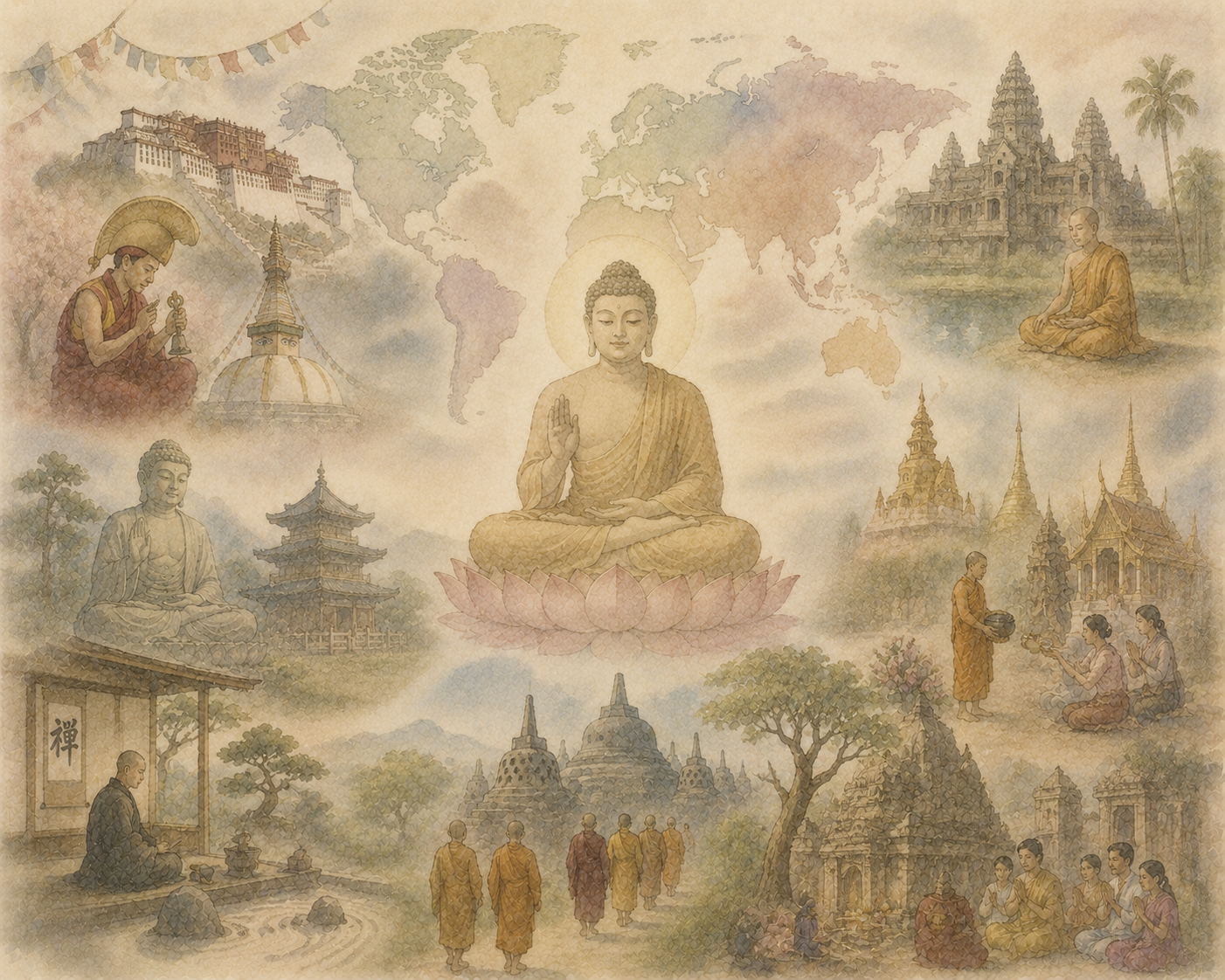
Are Buddhist Realms Literal or Symbolic? A Beginner-Friendly Answer
Quick Summary
- “Buddhist realms” can be understood in more than one way: as descriptions of rebirth cosmology and as symbols for states of mind.
- A beginner-friendly approach is to treat realms as a practical lens for noticing how suffering is built moment by moment.
- Literal vs. symbolic is often a false either/or; many teachings work on multiple levels at once.
- Even if you read realms symbolically, the ethical message stays the same: actions shape experience.
- “Hell realm” can point to rage and panic; “hungry ghost” to craving; “animal” to numb habit; “god” to complacent pleasure.
- The most useful question is not “Which is correct?” but “What does this reveal about my reactions right now?”
- You don’t need to settle metaphysics to benefit; you can test the teachings in daily life.
Introduction
You’re trying to figure out whether Buddhist realms are meant as actual places you go after death or as symbolic maps of the mind—and the mixed answers can make Buddhism feel either too supernatural or too “just psychology.” The cleanest way through the confusion is to treat “realms” as a teaching tool that can operate on more than one level without forcing you into a single belief upfront. At Gassho, we focus on beginner-friendly, practice-oriented explanations grounded in everyday experience.
When people ask “are Buddhist realms literal or symbolic,” they’re often really asking two different questions: “What did traditional texts intend?” and “What am I supposed to do with this in my life?” Those questions don’t always have the same answer, and that’s okay.
So instead of treating realms as a loyalty test—believe or don’t—this article treats them as a lens: a way of noticing how certain mental patterns create certain worlds, right here, right now.
GASSHO
Ask and learn about Buddhism in daily life.
GASSHO is a Buddhist community app where you can learn Buddhist teachings and ask questions to the head priest of Kongosanmaiin Temple on Mount Koya.
A Practical Lens: What “Realms” Are Pointing To
In Buddhist language, “realms” are ways of describing different modes of experience shaped by causes and conditions. That can include a traditional cosmological reading (realms as literal destinations in a cycle of rebirth), and it can also include a psychological reading (realms as recurring mind-states that feel like entire worlds).
For beginners, the most workable starting point is this: a “realm” is what life feels like when a particular pattern takes over. When anger dominates, the world narrows, everything looks like a threat, and even neutral events get interpreted as attacks. When craving dominates, nothing is enough, and the mind keeps reaching. When dullness dominates, you drift, postpone, and live on autopilot. Each pattern constructs a world with its own logic.
This is why “literal or symbolic” can be a misleading fork in the road. A symbol, in this context, isn’t “fake.” It’s a compressed way of describing something real in experience. And a literal reading, even if you don’t personally adopt it, is still trying to communicate something practical: actions have consequences, and the mind you cultivate matters.
Seen this way, realms are less about winning an argument about metaphysics and more about learning to recognize: “What realm am I building right now through my reactions, habits, and choices?”
How Realms Show Up in Ordinary Moments
Start with a simple observation: your “world” changes with your mood, even when the room stays the same. A single message can feel like warmth or rejection depending on what the mind is already doing. That shift is a small, everyday example of how a realm forms.
Consider irritation in traffic. The body tightens, attention locks onto obstacles, and the mind produces a storyline: “Everyone is in my way.” In that moment, the environment becomes hostile. You don’t need a dramatic event for this; the realm is built out of interpretation, tension, and repetition.
Now consider craving. You open your phone for one thing, then keep scrolling. The mind keeps leaning forward: “Maybe the next thing will satisfy me.” Even if you get what you want—praise, a purchase, a snack—the satisfaction fades quickly, and the reaching returns. That’s a realm too: a world organized around lack.
Then there’s numbness or inertia. You know what would help—sleep, a walk, an honest conversation—but you can’t quite move. The mind chooses the easiest loop. Time passes, and life feels muted. This isn’t “badness” as a moral label; it’s simply a recognizable mode of experience with predictable results.
On the brighter side, notice how generosity changes the atmosphere. When you help someone without keeping score, the mind feels more spacious. The same day, the same tasks, but a different inner climate. The “realm” here isn’t a fantasy; it’s the felt sense of living with less contraction.
Even pleasant states can become their own trap. When things are going well, the mind may cling to comfort and avoid anything that threatens it. You might ignore a needed apology, postpone a hard decision, or tune out someone else’s pain because it disturbs your calm. That’s a subtle realm: not obviously painful, but still shaped by attachment.
Reading realms this way encourages a gentle kind of honesty. Instead of asking, “Which realm is objectively out there?” you can ask, “What am I feeding right now—anger, craving, numbness, kindness, clarity?” The teaching becomes a mirror, not a verdict.
Misunderstandings That Make the Topic Harder Than It Needs to Be
Misunderstanding 1: “Symbolic means it’s not real.” Symbolic language can describe real patterns with precision. Saying “I’m in hell today” is not a geology claim; it’s a report about lived experience. Buddhist realm imagery often works like that: it names the texture of suffering and the habits that sustain it.
Misunderstanding 2: “Literal means you must accept every detail.” Many people assume that if realms are literal, you must hold a rigid, all-or-nothing belief. In practice, beginners can acknowledge that traditions contain cosmological teachings while still focusing on what is verifiable: how actions, intentions, and attention shape experience.
Misunderstanding 3: “The realms are only about punishment and reward.” Realms are better understood as cause-and-effect descriptions than as moral sentencing. When the mind is dominated by hatred, it burns; when dominated by greed, it starves; when dominated by confusion, it stumbles. The emphasis is on what certain habits feel like and where they lead.
Misunderstanding 4: “If it’s psychological, ethics don’t matter.” A symbolic reading can actually make ethics more immediate. If harmful speech creates a “hell realm” in relationships right now, then restraint and kindness aren’t abstract virtues—they’re practical ways to stop manufacturing misery.
Misunderstanding 5: “You have to pick a side to practice.” You can practice with an open question. Many people hold a “both/and” posture: realms can be meaningful as inner states, and they may also refer to a broader cosmology. Practice doesn’t require you to force certainty where you don’t have it.
Why This Question Matters in Daily Life
How you interpret Buddhist realms changes what you pay attention to. If you treat realms as distant places only, you might miss how quickly you create a “world” through resentment, comparison, or grasping. If you treat realms only as metaphors, you might miss how seriously Buddhism takes cause and effect across time. Either way, the practical point remains: what you cultivate becomes your environment.
Seeing realms as mind-made worlds can reduce shame. Instead of “I’m a bad person for feeling this,” the frame becomes “This is a painful realm arising; what conditions are feeding it?” That shift supports responsibility without self-hatred.
It also improves relationships. When you recognize “I’m in a hungry-ghost mode right now” (restless, never satisfied), you’re less likely to demand that another person fix the feeling. When you recognize “I’m in a hell mode” (heated, reactive), you can pause before sending the message that escalates everything.
Finally, it makes practice concrete. The goal isn’t to collect correct opinions about the universe; it’s to suffer less and cause less suffering. Realms language gives you a vivid vocabulary for noticing what’s happening and choosing a different response.
Conclusion
So, are Buddhist realms literal or symbolic? A beginner-friendly answer is: they can be read as both, and you don’t have to settle the metaphysics to use the teaching well. Treat realms as a map of how certain mental patterns create certain lived worlds, then test it in ordinary moments—irritation, craving, numbness, generosity, and ease.
If the realms feel too mythical, read them as a mirror of experience. If they feel too psychological, remember the deeper point about cause and effect: what you repeatedly do, think, and intend shapes the kind of life you inhabit.
Ask a Buddhist priest
Have a question about Buddhism?
In the GASSHO app, you can ask questions about Buddhist teachings, daily concerns, and how to understand Buddhism in everyday life.
Frequently Asked Questions
- FAQ 1: Are Buddhist realms literal or symbolic?
- FAQ 2: If Buddhist realms are symbolic, does that mean they’re “not real”?
- FAQ 3: If Buddhist realms are literal, do I have to believe in them to practice?
- FAQ 4: What does “hell realm” mean in a symbolic reading?
- FAQ 5: What does “hungry ghost realm” mean if it’s symbolic?
- FAQ 6: Are the six realms meant as psychology or as places of rebirth?
- FAQ 7: Why do Buddhist texts describe realms so vividly if they’re symbolic?
- FAQ 8: Can Buddhist realms be both literal and symbolic at the same time?
- FAQ 9: If realms are symbolic, what is the “human realm” supposed to represent?
- FAQ 10: What does the “god realm” mean in a symbolic interpretation?
- FAQ 11: Do I have to decide whether Buddhist realms are literal or symbolic to understand karma?
- FAQ 12: Is it disrespectful to treat Buddhist realms as symbolic?
- FAQ 13: How can I work with the realms if I’m agnostic about rebirth?
- FAQ 14: Are Buddhist realms meant to be taken as moral judgment?
- FAQ 15: What’s the simplest way to answer “are Buddhist realms literal or symbolic” as a beginner?
FAQ 1: Are Buddhist realms literal or symbolic?
Answer: Many Buddhists understand realms on more than one level: as traditional descriptions of rebirth cosmology and as symbolic descriptions of recurring states of mind. A practical beginner approach is to treat them as a lens for noticing how certain habits (anger, craving, numbness, generosity) create distinct “worlds” of experience.
Takeaway: You don’t have to force an either/or; realms can function as both cosmology and lived-experience map.
FAQ 2: If Buddhist realms are symbolic, does that mean they’re “not real”?
Answer: Not necessarily. Symbolic teachings can describe real patterns in the mind and in behavior. For example, “hell realm” can symbolize the very real experience of being consumed by rage, fear, or shame, where the world feels hostile and tight.
Takeaway: “Symbolic” can mean “experientially real,” not “made up.”
FAQ 3: If Buddhist realms are literal, do I have to believe in them to practice?
Answer: You can practice without settling that belief. Many people focus on what is immediately testable: how intentions and actions shape suffering and ease. The realm framework still helps as a way to recognize patterns and choose wiser responses.
Takeaway: Practice can be effective even while you keep the literal question open.
FAQ 4: What does “hell realm” mean in a symbolic reading?
Answer: Symbolically, “hell realm” often points to states dominated by intense aversion—rage, panic, hatred, or relentless self-attack—where experience feels burning, urgent, and inescapable. It describes the texture of suffering when the mind is trapped in fight-or-flight and hostile interpretation.
Takeaway: Hell realm can describe a mind-state that turns life into an inner emergency.
FAQ 5: What does “hungry ghost realm” mean if it’s symbolic?
Answer: Symbolically, the hungry ghost realm points to compulsive craving and chronic dissatisfaction: wanting, getting, and still feeling empty. It can show up as doomscrolling, overeating, shopping for a mood fix, or needing constant reassurance.
Takeaway: Hungry ghost realm is a vivid image for the “never enough” loop.
FAQ 6: Are the six realms meant as psychology or as places of rebirth?
Answer: They’re often presented as both: a traditional map of rebirth and a practical map of mind. Even when read as rebirth realms, the teaching emphasizes causes and conditions—how patterns of intention and action shape the kind of experience that follows.
Takeaway: The six realms can be read as “where you go” and “what you become,” depending on context.
FAQ 7: Why do Buddhist texts describe realms so vividly if they’re symbolic?
Answer: Vivid imagery makes patterns easier to recognize and harder to rationalize away. A graphic description of torment or hunger can function like a warning sign: “This is what this habit feels like when it takes over.” The point is often moral and practical—showing consequences—rather than providing a travel brochure of the afterlife.
Takeaway: Strong images can be teaching tools that help you notice cause-and-effect in your own mind.
FAQ 8: Can Buddhist realms be both literal and symbolic at the same time?
Answer: Yes. A teaching can function on multiple levels: it can describe a cosmology for those who hold it, and it can also describe immediate mind-states that anyone can observe. The “both/and” approach is common in religious language, where symbols carry practical meaning regardless of metaphysical commitment.
Takeaway: You can use the realm teachings as a mirror now, even if you’re unsure about their literal status.
FAQ 9: If realms are symbolic, what is the “human realm” supposed to represent?
Answer: Symbolically, the human realm can represent a balanced mix of pleasure and pain—enough discomfort to motivate change, and enough clarity to reflect and choose. It points to the everyday condition where you can notice patterns, learn, and respond rather than simply react.
Takeaway: Human realm can mean the workable middle ground where awareness and choice are possible.
FAQ 10: What does the “god realm” mean in a symbolic interpretation?
Answer: Symbolically, the god realm can point to comfort, success, or pleasure that becomes complacency—where things feel so good that you avoid looking at impermanence, ignore others’ pain, or cling to status. It’s not “bad,” but it can be blinding when it turns into attachment to ease.
Takeaway: God realm can describe the subtle trap of comfort when it leads to avoidance and clinging.
FAQ 11: Do I have to decide whether Buddhist realms are literal or symbolic to understand karma?
Answer: No. You can understand karma at a practical level as cause and effect in intention, speech, and action—how habits condition perception, relationships, and future choices. That works whether you interpret realms as literal rebirth destinations or as symbolic mind-worlds.
Takeaway: Karma remains meaningful and usable without a final verdict on literal vs. symbolic realms.
FAQ 12: Is it disrespectful to treat Buddhist realms as symbolic?
Answer: It depends on your attitude. If “symbolic” is used to dismiss the tradition as childish, that’s disrespectful. If it’s used as a sincere way to engage the teachings and reduce suffering—while acknowledging that others may hold a literal view—then it can be a respectful, honest approach for beginners.
Takeaway: Respect is shown by sincerity and care, not by forcing yourself into beliefs you don’t hold.
FAQ 13: How can I work with the realms if I’m agnostic about rebirth?
Answer: Use the realms as a daily diagnostic: notice which “realm” is being constructed by your current mental state, then adjust the conditions. For example, when anger is high, prioritize pausing and softening the body; when craving is high, practice not feeding the next impulse; when numbness is high, bring gentle structure and attention to one small task.
Takeaway: You can apply the realm framework as a practical tool without taking a stance on rebirth.
FAQ 14: Are Buddhist realms meant to be taken as moral judgment?
Answer: They’re better understood as descriptions of consequences than as labels of worth. A “lower realm” can describe what experience is like when the mind is dominated by certain patterns (hatred, greed, confusion). The emphasis is on changing causes and conditions, not condemning a person.
Takeaway: Realms point to cause-and-effect in suffering, not a permanent verdict on who you are.
FAQ 15: What’s the simplest way to answer “are Buddhist realms literal or symbolic” as a beginner?
Answer: Say: “They can be read as both, and I’m using them as a practical map of experience.” Then focus on what you can observe: how anger, craving, and confusion create painful worlds, and how kindness, clarity, and restraint create more workable ones.
Takeaway: A beginner-friendly answer is to keep the question open while using the teaching to reduce suffering now.