



What Is Mount Sumeru? Buddhist Cosmology and Sacred Mountain Explained
Quick Summary
- Mount Sumeru in Buddhism is a symbolic “world-mountain” used to map experience, values, and perspective—not a peak you can book a hike to.
- It sits at the center of a traditional Buddhist cosmology, surrounded by oceans and continents, with different realms arranged in relation to it.
- Many teachings use Sumeru as a practical image for how a “center” forms in the mind: what we treat as most important shapes everything else.
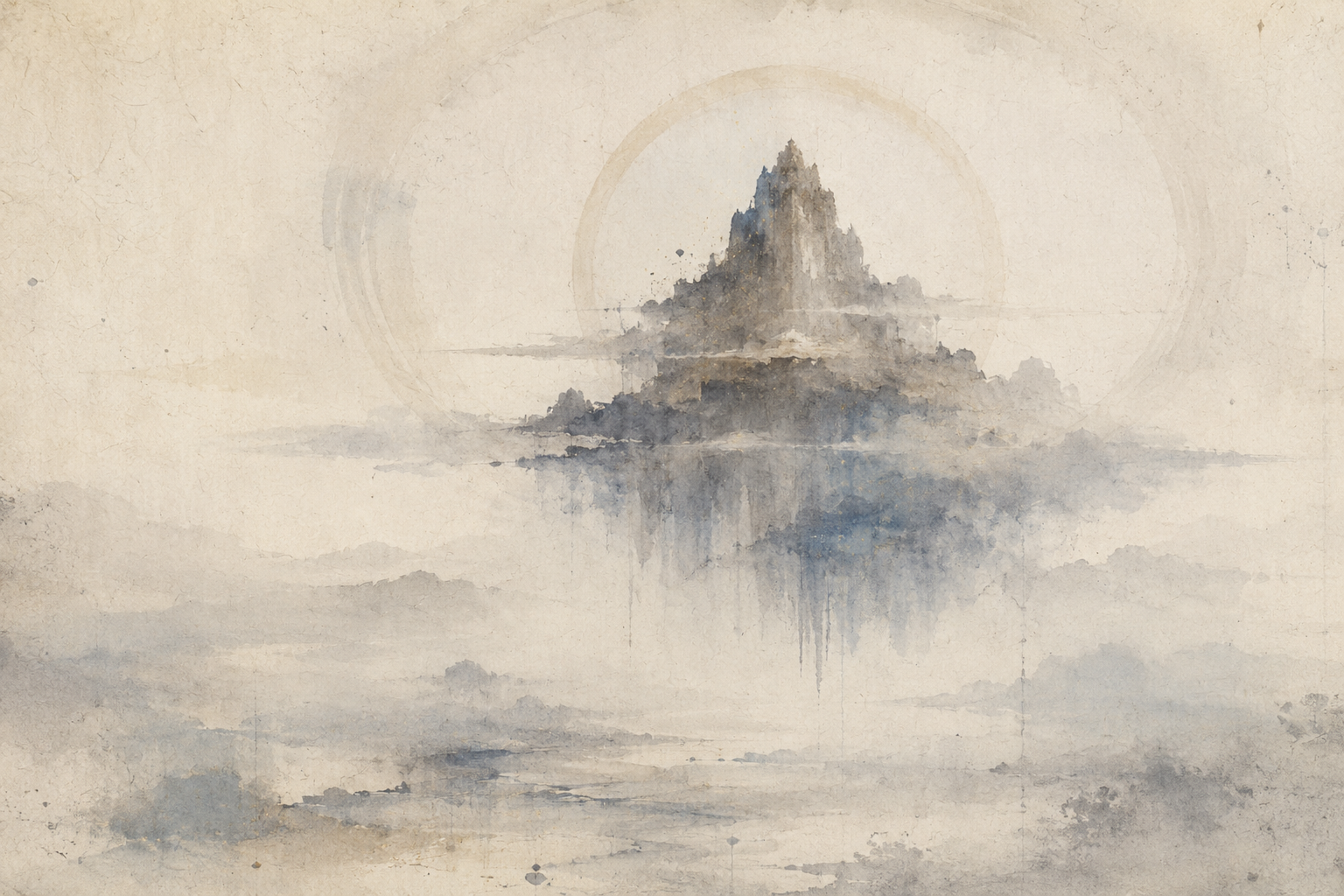
- Temple art and mandalas often echo Sumeru’s structure to show order, orientation, and the possibility of clarity amid complexity.
- Taking Sumeru literally can miss the point; taking it only as “myth” can also miss how skillfully it points to lived perception.
- In daily life, “Sumeru practice” can mean noticing what you place at the center—status, fear, comfort, kindness—and how that reorganizes your world.
- The most useful question isn’t “Where is Mount Sumeru?” but “What is my mind centering right now?”
Introduction
If you’ve heard “Mount Sumeru” described as the center of the universe in Buddhism, it can sound either embarrassingly unscientific or frustratingly vague—especially if you’re trying to understand what Buddhists actually mean by it. The cleanest way to approach Mount Sumeru Buddhism is to treat Sumeru as a working map of how a world is organized around a center, and then notice how often your own mind does the same thing. At Gassho, we focus on Buddhist ideas as tools for clear seeing rather than as arguments you’re required to accept.
In classical Buddhist cosmology, Mount Sumeru (often called Meru) is portrayed as a vast central mountain around which oceans, continents, and realms are arranged. This picture shows up in stories, commentaries, and visual culture, and it can be presented with striking detail—enough detail that modern readers sometimes assume it’s meant as a literal geography lesson.
But “cosmology” here isn’t only about outer space. It’s also a way of describing orientation: what counts as “up” and “down,” what is “central” and “peripheral,” what is “higher” and “lower,” and how beings get pulled by desire, fear, pride, and confusion. Mount Sumeru becomes a vivid image for how a whole world can be built around what we take to be most real.
So when you read about Sumeru, you can hold two truths at once: it’s a traditional model of the universe, and it’s also a psychological mirror. The second is where the concept becomes immediately useful, even if you never settle the first.
A Clear Lens on Mount Sumeru
Mount Sumeru Buddhism can be understood as a lens for seeing how “center” and “edge” are created. In the cosmological picture, Sumeru is the axis that everything else relates to. In lived experience, your attention does something similar: it selects a center—an idea, a worry, a role, a craving—and then arranges the day around it.
Seen this way, Sumeru isn’t asking you to believe in a mountain hidden somewhere beyond modern maps. It’s pointing to a pattern: when the mind builds a world, it builds it around what it clings to. The “mountain” is the sense of solidity we give to that center. The “continents” are the stories and plans that spread outward from it.
This is why Sumeru imagery often feels orderly. It suggests that experience has structure, even when it feels chaotic. The structure isn’t imposed by a judge; it emerges from causes and conditions—habits, perceptions, and repeated reactions. If you change what you place at the center, the whole map changes.
As a practical lens, Mount Sumeru invites a gentle question: “What is my inner world orbiting right now?” Not as self-criticism, but as orientation. When you can see the center clearly, you’re less compelled by it.
GASSHO
Ask and learn about Buddhism in daily life.
GASSHO is a Buddhist community app where you can learn Buddhist teachings and ask questions to the head priest of Kongosanmaiin Temple on Mount Koya.
How the “World-Mountain” Shows Up in Ordinary Life
Think about how quickly a single concern can become the center of everything. You wake up and remember an email you sent, and suddenly the whole morning is arranged around that one thread: checking for replies, rehearsing explanations, scanning for signs of approval or rejection. The “world” narrows, and the center hardens.
Or consider how status becomes a private Mount Sumeru. You walk into a room and immediately compare: who seems confident, who seems important, where you rank, what you need to prove. Nothing external has to be said. The mind builds a map with “me” at the center and everyone else placed on invisible slopes.
Sometimes the center is comfort. You plan the day around avoiding inconvenience, avoiding awkwardness, avoiding effort. Then even small disruptions feel like threats, because they shake the mountain you’ve been relying on. The reaction isn’t “wrong”—it’s simply revealing what has been made central.
Sometimes the center is fear. A headline, a diagnosis, a financial worry, a relationship uncertainty—then the mind starts arranging everything around worst-case scenarios. Attention becomes sticky. You may notice how the body participates: tightness in the chest, shallow breathing, a restless scanning for danger.
Mount Sumeru as a lived metaphor becomes helpful right at the moment you notice this centering process. Noticing doesn’t require you to replace the center with a “better” one immediately. It simply interrupts the trance that the current center is the whole universe.
From there, small shifts become possible: widening attention, naming the reaction, letting the body soften, returning to what is actually in front of you. The “map” doesn’t disappear, but it becomes less tyrannical. You can hold the concern without letting it become the axis of everything.
And occasionally, you may notice a different kind of center appear—something quieter, like basic decency, patience, or a wish not to add harm. When that becomes central, the same day can feel surprisingly different. The outer circumstances may not change much, but the inner geography does.
Common Misunderstandings About Mount Sumeru
One common misunderstanding is that Mount Sumeru is “just an ancient mistake about astronomy,” and therefore irrelevant. Even if you read it that way historically, the image still functions as a precise teaching tool: it describes how a world is organized around a center, and that is a daily, observable process.
Another misunderstanding is the opposite: insisting that you must accept every cosmological detail literally to take Buddhism seriously. That approach can turn a useful map into a loyalty test. For many practitioners and readers, the value of Sumeru is how it clarifies orientation, not how it competes with modern cosmology.
A third misunderstanding is to treat Sumeru as purely “mystical” and therefore beyond questioning. But the Sumeru image is actually quite practical: it invites investigation. What is central in your mind? What happens when that center is threatened? What happens when it relaxes?
Finally, people sometimes assume Mount Sumeru is meant to describe a personal “spiritual hierarchy” where some people are inherently higher or lower. Used carelessly, any vertical image can be turned into pride or shame. Used skillfully, the image points to how grasping creates elevation and humiliation inside the mind—and how both are unstable.
Why This Symbol Still Matters Today
Mount Sumeru matters because modern life constantly competes to become your center. Notifications, outrage cycles, productivity pressure, identity performance—each one offers to be the axis around which your attention spins. The Sumeru image helps you see that “my whole world” is often just “my current center.”
It also matters because it reframes control. Many people try to fix life by rearranging the outer continents—changing jobs, changing relationships, changing routines—without noticing the inner mountain that keeps recreating the same world. When the center is unexamined, the map repeats.
In relationships, the Sumeru lens can soften conflict. When you notice that your partner’s words have become the center of your universe for the last ten minutes, you can step back and see the larger field: tone, intention, your own sensitivity, the day’s stress, the shared goal of being understood. The “world” becomes wider than the trigger.
In ethical life, Sumeru is a quiet prompt: what do you want to place at the center on purpose? If the center is “winning,” the world becomes combative. If the center is “not adding harm,” the world becomes more workable. This isn’t moral perfectionism; it’s noticing how a chosen center shapes perception and action.
And in moments of overwhelm, the image is grounding. Overwhelm often feels like “everything is happening.” But usually it’s “everything is being pulled into one center.” Seeing that can restore proportion. You don’t have to deny the problem; you just don’t have to let it become the entire cosmos.
Conclusion
Mount Sumeru in Buddhism is best approached as a meaningful map: a way to picture how worlds are organized around a center, and how that centering happens in the mind moment by moment. Whether you treat the cosmology as literal, symbolic, or both, the practical invitation is the same—notice what you’re orbiting, and notice how that orbit shapes your experience.
If you keep Mount Sumeru as a gentle question rather than a debate topic, it becomes surprisingly modern: “What is my center right now, and is it helping?” That single shift—from being inside the map to seeing the map—can change the feel of an ordinary day.
Ask a Buddhist priest
Have a question about Buddhism?
In the GASSHO app, you can ask questions about Buddhist teachings, daily concerns, and how to understand Buddhism in everyday life.
Frequently Asked Questions
- FAQ 1: What is Mount Sumeru in Buddhism?
- FAQ 2: Is Mount Sumeru meant to be a real physical mountain?
- FAQ 3: Why is Mount Sumeru called the center of the world in Buddhist cosmology?
- FAQ 4: What is the relationship between Mount Sumeru and the Buddhist realms?
- FAQ 5: Is Mount Sumeru the same as Mount Meru?
- FAQ 6: How does Mount Sumeru appear in Buddhist art and temple design?
- FAQ 7: What does Mount Sumeru symbolize in Buddhist practice?
- FAQ 8: Does Mount Sumeru Buddhism conflict with modern science?
- FAQ 9: Where is Mount Sumeru located according to Buddhist cosmology?
- FAQ 10: What is the practical takeaway of Mount Sumeru Buddhism for everyday life?
- FAQ 11: Is Mount Sumeru mentioned in Buddhist scriptures?
- FAQ 12: How should beginners interpret Mount Sumeru without getting stuck on literalism?
- FAQ 13: What is the connection between Mount Sumeru and mandalas?
- FAQ 14: Does Mount Sumeru Buddhism teach a hierarchy of beings?
- FAQ 15: What is one simple reflection inspired by Mount Sumeru Buddhism?
FAQ 1: What is Mount Sumeru in Buddhism?
Answer: In Mount Sumeru Buddhism, Mount Sumeru (also called Meru) is the central “world-mountain” in traditional Buddhist cosmology, used to describe an ordered universe with realms and continents arranged around a center. Many readers also use it as a symbolic map for how experience organizes itself around what the mind treats as central.
Takeaway: Mount Sumeru is a cosmological center that can also be read as a practical image of mental centering.
FAQ 2: Is Mount Sumeru meant to be a real physical mountain?
Answer: Traditional texts present Mount Sumeru as a real feature within a cosmological model, but many modern Buddhists and scholars treat it as symbolic or pedagogical—an image that communicates orientation, hierarchy, and causality rather than a claim you must verify with geography.
Takeaway: It can be read literally within tradition, but it’s often most useful as a teaching image.
FAQ 3: Why is Mount Sumeru called the center of the world in Buddhist cosmology?
Answer: Mount Sumeru functions as an axis: the model places oceans, continents, and various realms in relation to it, creating a coherent “map” of the world. The “center” language also highlights a theme Buddhism returns to often—how what is central determines how everything else is interpreted.
Takeaway: “Center” is both a cosmological location and a way of describing how meaning is organized.
FAQ 4: What is the relationship between Mount Sumeru and the Buddhist realms?
Answer: In Mount Sumeru Buddhism, realms of existence are often described as arranged in a structured cosmos with Mount Sumeru as the central reference point. This arrangement helps depict different modes of experience—ranging from refined to painful—as part of an ordered system shaped by causes and conditions.
Takeaway: Sumeru provides the “layout” that situates realms within a single cosmological picture.
FAQ 5: Is Mount Sumeru the same as Mount Meru?
Answer: Yes. “Sumeru” and “Meru” are commonly used to refer to the same central mountain in Buddhist cosmology, with the naming varying by language and translation conventions.
Takeaway: Mount Sumeru and Mount Meru usually refer to the same cosmological mountain.
FAQ 6: How does Mount Sumeru appear in Buddhist art and temple design?
Answer: Mount Sumeru often appears indirectly through symmetrical layouts, tiered structures, and mandala-like compositions that suggest a centered universe with ordered layers. The goal is typically orientation—helping the viewer sense a coherent “world-map” that points toward clarity and balance.
Takeaway: Sumeru imagery frequently shows up as centered, layered visual order rather than a literal mountain portrait.
FAQ 7: What does Mount Sumeru symbolize in Buddhist practice?
Answer: As a symbol, Mount Sumeru can represent the way the mind builds a “world” around a chosen center—such as fear, desire, pride, or care. Using the symbol skillfully means noticing what has become central and how that centrality shapes perception and reaction.
Takeaway: Symbolically, Sumeru points to the mind’s habit of organizing life around a center.
FAQ 8: Does Mount Sumeru Buddhism conflict with modern science?
Answer: It can conflict if it’s treated strictly as a physical description of the universe in the modern scientific sense. But many people approach Mount Sumeru as a traditional cosmological model and a symbolic teaching device, which shifts the question from “Is it astronomically accurate?” to “What does this model help us notice about experience?”
Takeaway: The tension depends on whether you read Sumeru as literal astronomy or as a teaching map.
FAQ 9: Where is Mount Sumeru located according to Buddhist cosmology?
Answer: In traditional Buddhist cosmology, Mount Sumeru is located at the center of the world-system, with surrounding oceans and continents arranged around it. This “location” is within the cosmological framework itself rather than a coordinate on a modern map.
Takeaway: Sumeru’s location is central within a traditional world-model, not a modern geographic claim.
FAQ 10: What is the practical takeaway of Mount Sumeru Buddhism for everyday life?
Answer: The practical takeaway is to notice what your attention is orbiting—what you’ve made central—and how that “center” reorganizes your emotions, body, and choices. When you see the centering process, you gain room to respond rather than automatically revolve around the same fixation.
Takeaway: Use Sumeru as a prompt to identify and soften the mental “center” driving your day.
FAQ 11: Is Mount Sumeru mentioned in Buddhist scriptures?
Answer: Yes. Mount Sumeru appears across a range of Buddhist literature that discusses cosmology and the structure of world-systems. References vary by text and translation, but the mountain is a recurring element in traditional descriptions of the universe.
Takeaway: Sumeru is a well-established cosmological motif in Buddhist textual traditions.
FAQ 12: How should beginners interpret Mount Sumeru without getting stuck on literalism?
Answer: A helpful approach is “both/and”: respect that Mount Sumeru belongs to a traditional cosmology while also asking what the image reveals about how you construct a world around a center. If the symbol increases clarity and reduces reactivity, you’re using it in the spirit of a practical teaching tool.
Takeaway: Hold Sumeru as a meaningful map and test its usefulness in your own experience.
FAQ 13: What is the connection between Mount Sumeru and mandalas?
Answer: Many mandalas present a centered, ordered world with layers and directions, which echoes the organizing role Mount Sumeru plays in Buddhist cosmology. Even when Sumeru isn’t depicted explicitly, the “center-and-surrounding” structure often reflects the same idea of orientation around a central axis.
Takeaway: Mandalas often mirror Sumeru’s centered cosmological logic in visual form.
FAQ 14: Does Mount Sumeru Buddhism teach a hierarchy of beings?
Answer: Cosmological descriptions can look hierarchical because they depict different realms and conditions of existence. Interpreted skillfully, the emphasis is less “who is better” and more “how different mental and ethical causes shape different lived worlds,” which can be observed as shifting states of mind even within one human life.
Takeaway: The “hierarchy” is best read as a map of conditions and causes, not a ranking of personal worth.
FAQ 15: What is one simple reflection inspired by Mount Sumeru Buddhism?
Answer: Ask: “What am I making the center of my universe right now?” Then notice the immediate effects—tightening, urgency, comparison, defensiveness, or openness. This reflection doesn’t require adopting a cosmology; it uses Mount Sumeru as a mirror for how attention builds a world.
Takeaway: A single question about your current “center” can reveal the whole map your mind is living in.