



What Is the Animal Realm in Buddhism? Instinct, Fear, and Awareness Explained
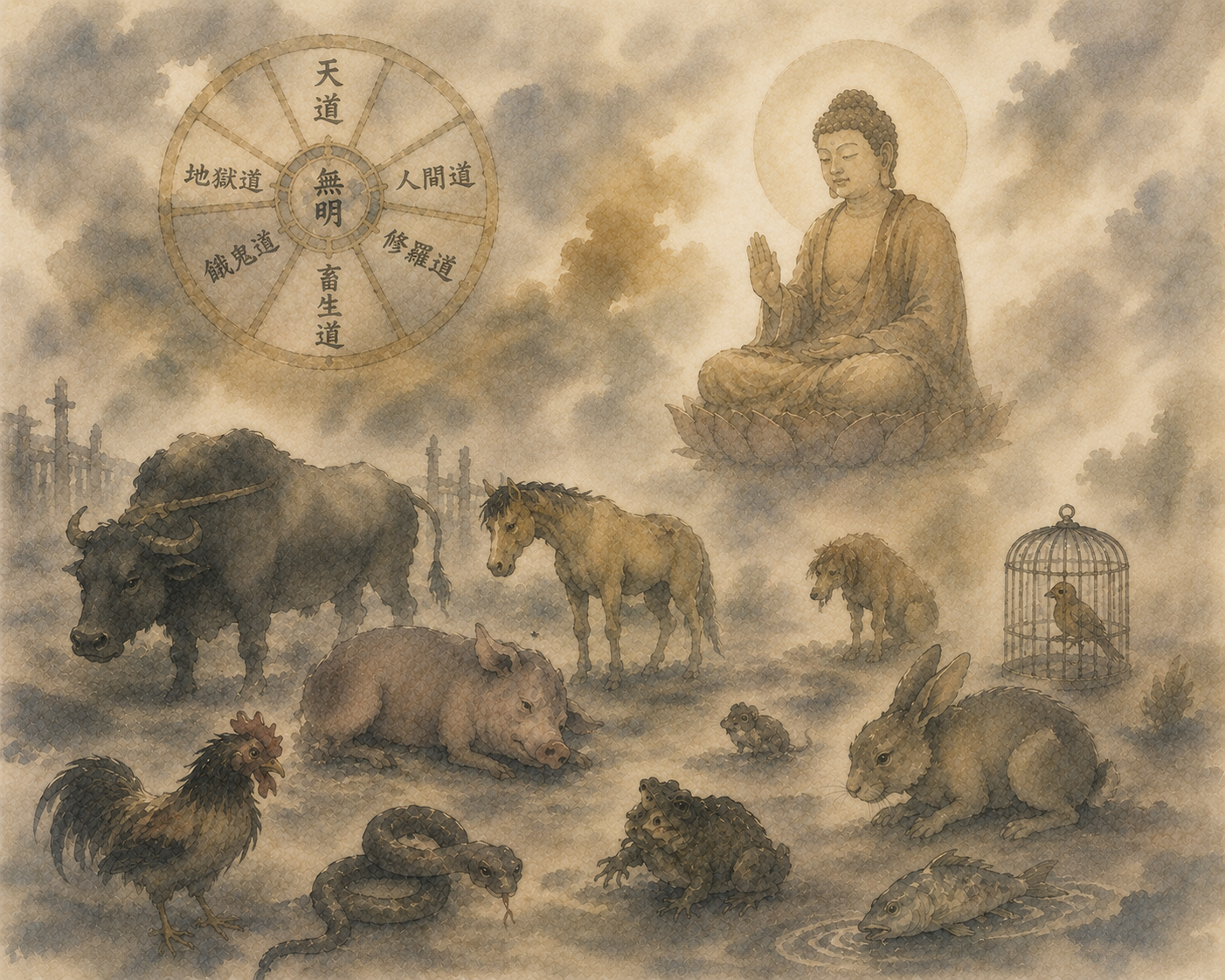
Quick Summary
- In animal realm Buddhism, the “animal realm” points to a mind dominated by instinct, fear, and habit.
- It’s less about judging animals and more about recognizing a contracted, survival-first way of experiencing life.
- Common signs include tunnel vision, defensiveness, numbness, and “just get through it” thinking.
- The shift begins by noticing the body’s alarm signals and widening attention beyond the immediate threat.
- Awareness doesn’t erase instinct; it adds choice, patience, and a fuller view of consequences.
- Compassion matters here: shame tends to deepen the animal-realm loop, while kindness loosens it.
- Daily life practice looks like pausing, naming the impulse, and choosing one small non-reactive action.
Introduction
If “animal realm Buddhism” sounds like it’s calling you primitive or saying animals are lesser, the concept will feel either insulting or irrelevant—and that reaction is understandable. The animal realm is mainly a mirror for a certain kind of human experience: when fear, appetite, and habit take the steering wheel and awareness shrinks to whatever feels safest right now. At Gassho, we focus on practical, experience-based Buddhist language that helps you recognize patterns without turning them into shame.
The point isn’t to label yourself as “in a realm” like a permanent identity. It’s to notice a temporary mode of mind: reactive, cautious, and often exhausted. When you can see that mode clearly, you can relate to it with steadiness—and sometimes step out of it.
A Clear Lens on the Animal Realm
In animal realm Buddhism, the “animal realm” is a lens for understanding what happens when the mind prioritizes survival over understanding. Instinct isn’t treated as bad; it’s treated as limited. It narrows the field of attention to immediate threats and immediate rewards, and it tends to repeat what worked before—even if it no longer fits the situation.
Fear is central here, but not only the obvious kind. It can show up as low-grade vigilance, suspicion, or a constant readiness to defend your position. When fear is running the system, curiosity drops, nuance disappears, and other people become either obstacles or resources.
Habit is the other major ingredient. The animal realm points to a life run on grooves: eat, scroll, distract, lash out, shut down, repeat. The mind may not feel dramatic—it may feel dull. That dullness is part of the pattern: a kind of protective fog that keeps you from feeling too much, thinking too far ahead, or questioning the routine.
Awareness, in this context, doesn’t mean becoming “above” instinct. It means adding a wider view: sensing the body, noticing the urge, recognizing the story forming around it, and remembering that you have options. The animal realm is what it feels like when those options are temporarily forgotten.
GASSHO
Ask and learn about Buddhism in daily life.
GASSHO is a Buddhist community app where you can learn Buddhist teachings and ask questions to the head priest of Kongosanmaiin Temple on Mount Koya.
How the Animal Realm Shows Up in Everyday Life
You might notice it first in the body. The shoulders rise, the jaw tightens, the breath gets shallow, and the mind starts scanning for what could go wrong. Nothing “spiritual” is happening in that moment; it’s a nervous system doing its job. The animal realm lens simply helps you name the experience without getting lost inside it.
Then attention narrows. You stop hearing the full sentence and only catch the part that sounds like criticism. You read a message and assume the worst. You focus on one detail that confirms your worry and ignore the rest. This is animal-realm attention: selective, protective, and fast.
Next comes the impulse to secure safety quickly. That can look like snapping back, people-pleasing, withdrawing, overeating, overworking, or numbing out. The specific behavior varies, but the inner logic is similar: “Reduce discomfort now.” The future becomes less real than the immediate pressure.
In this mode, thinking often becomes blunt. The mind prefers simple categories: friend/enemy, safe/unsafe, win/lose, mine/theirs. Subtlety feels like a luxury. Even when you’re not outwardly aggressive, there can be an inner bracing—an assumption that you must protect yourself because nobody else will.
Another common sign is a drop in learning. You repeat the same argument, the same coping strategy, the same avoidance pattern, even after it has clearly failed. It’s not because you’re incapable; it’s because the mind is prioritizing short-term relief over long-term clarity.
Awareness enters as something very small and very ordinary: a half-second pause. You notice “fear is here” or “I’m bracing.” You feel the feet on the floor. You let the breath lengthen slightly. That doesn’t magically fix the situation, but it widens the space enough to choose a response that isn’t purely reflex.
Over time, you may recognize that the animal realm isn’t only triggered by danger. It can also be triggered by craving: the restless push for more stimulation, more certainty, more validation. The mind becomes hungry and impatient, and awareness gets used as a tool to get what it wants rather than to understand what’s happening.
Common Misunderstandings That Create Confusion
Misunderstanding 1: “This teaching is anti-animal.” The animal realm is not a moral ranking of species. It’s a description of a constrained mode of mind. Many animals show tenderness, cooperation, and attunement; the “animal realm” label is about instinct-dominance and limited reflection, not about worth.
Misunderstanding 2: “If I feel fear, I’m failing.” Fear is a natural signal. The animal realm lens becomes useful when fear takes over the whole field and dictates behavior automatically. The practice is not to eliminate fear but to relate to it with more room and less compulsion.
Misunderstanding 3: “The animal realm is only about anger or aggression.” It can look like aggression, but it can also look like freezing, hiding, appeasing, or going numb. Sometimes it’s quiet: you stop asking questions, stop imagining alternatives, and just endure.
Misunderstanding 4: “This is a literal place I’m doomed to.” People interpret “realms” in different ways, but you don’t need metaphysical certainty to use the teaching. As a practical lens, it describes a repeatable human experience: contraction, habit, and survival-first thinking.
Misunderstanding 5: “The solution is to suppress instinct.” Suppression often backfires and can intensify reactivity. A more workable approach is to include instinct in awareness: feel it, name it, and let it inform you without letting it rule you.
Why This Perspective Matters in Real Life
The animal realm lens is useful because it reduces self-deception. When you can admit “I’m in a survival mode right now,” you stop building elaborate justifications for behavior that is basically fear-driven. That honesty is not harsh; it’s clarifying.
It also improves relationships. Animal-realm reactions tend to treat people as threats or tools, even subtly. When awareness widens, you can hear more, assume less, and respond with fewer automatic defenses. That alone can change the tone of a conversation.
In work and decision-making, this perspective helps you spot tunnel vision. Under pressure, it’s easy to chase quick relief—send the sharp email, make the rushed purchase, accept the bad compromise—because your system wants the discomfort to end. Recognizing the animal realm can be the difference between “react now” and “respond after one breath.”
Most importantly, it supports compassion without excuses. You can acknowledge the animal-realm impulse—protect, grab, hide—while still choosing a small action that reduces harm. The goal isn’t perfection; it’s a slightly wider awareness that makes kinder choices more available.
Conclusion
The animal realm in Buddhism is a practical name for a familiar human state: instinct-led, fear-shaped, and habit-driven. When you recognize it as a mode rather than an identity, you can meet it with steadiness instead of shame. The work is simple and ongoing—notice contraction, feel the impulse, widen attention, and choose one response that isn’t purely reflex.
Ask a Buddhist priest
Have a question about Buddhism?
In the GASSHO app, you can ask questions about Buddhist teachings, daily concerns, and how to understand Buddhism in everyday life.
Frequently Asked Questions
- FAQ 1: What does “animal realm” mean in animal realm Buddhism?
- FAQ 2: Is the animal realm in Buddhism meant to insult animals?
- FAQ 3: What emotions are most associated with the animal realm in Buddhism?
- FAQ 4: How can I tell if I’m in an animal-realm mindset?
- FAQ 5: Is the animal realm in Buddhism the same as being “unmindful”?
- FAQ 6: Does animal realm Buddhism say we should get rid of instinct?
- FAQ 7: How does the animal realm relate to the six realms in Buddhism?
- FAQ 8: Can the animal realm in Buddhism show up as procrastination or avoidance?
- FAQ 9: What is the role of “ignorance” in animal realm Buddhism?
- FAQ 10: How do I work with an animal-realm reaction in the moment?
- FAQ 11: Is the animal realm in Buddhism always linked to trauma or anxiety?
- FAQ 12: Does animal realm Buddhism imply people are “less evolved” when they react?
- FAQ 13: How is the animal realm different from the hungry ghost realm in Buddhism?
- FAQ 14: Can compassion help with the animal realm in Buddhism, or is it only about mindfulness?
- FAQ 15: What is a simple daily practice to reduce animal-realm patterns in Buddhism?
FAQ 1: What does “animal realm” mean in animal realm Buddhism?
Answer: It refers to a mind-state dominated by survival instincts—seeking safety, avoiding threat, and repeating habits—where awareness and reflection feel limited or unavailable.
Takeaway: The animal realm is a lens for a contracted, instinct-led mode of mind.
FAQ 2: Is the animal realm in Buddhism meant to insult animals?
Answer: No. In animal realm Buddhism, the term is used to describe a pattern of experience—fear, habit, and limited perspective—not to claim animals are inferior or unworthy of respect.
Takeaway: It’s about human reactivity, not a judgment of animals.
FAQ 3: What emotions are most associated with the animal realm in Buddhism?
Answer: Fear and anxiety are common, along with suspicion, dullness, and craving for comfort. The emotional tone is often “protect myself” or “get relief now.”
Takeaway: Fear and habit-driven craving are key animal-realm signals.
FAQ 4: How can I tell if I’m in an animal-realm mindset?
Answer: Look for narrowed attention, quick defensiveness, black-and-white thinking, and repetitive coping (numbing, avoiding, snapping, clinging). The body often feels tense, braced, or restless.
Takeaway: Animal realm shows up as contraction, tunnel vision, and reflexive coping.
FAQ 5: Is the animal realm in Buddhism the same as being “unmindful”?
Answer: It overlaps, but “animal realm” is more specific: it highlights survival-first functioning where instinct and habit override reflection. You can be generally distracted without the strong fear-and-safety flavor of the animal realm.
Takeaway: Animal realm is a particular kind of unawareness shaped by survival mode.
FAQ 6: Does animal realm Buddhism say we should get rid of instinct?
Answer: No. Instinct is natural and often protective. The issue is when instinct becomes the only guide and awareness can’t widen to include context, consequences, and choice.
Takeaway: The aim is balance—instinct informed by awareness.
FAQ 7: How does the animal realm relate to the six realms in Buddhism?
Answer: The animal realm is one of the six realms used as a map of recurring mind-states. In this map, the animal realm emphasizes fear, habit, and limited perspective compared with more open, reflective states.
Takeaway: It’s one part of a broader framework for understanding patterns of mind.
FAQ 8: Can the animal realm in Buddhism show up as procrastination or avoidance?
Answer: Yes. Avoidance can be a safety strategy: if a task feels threatening (failure, judgment, overwhelm), the mind may default to hiding, numbing, or delaying to reduce discomfort quickly.
Takeaway: Animal realm isn’t only aggression; it can be withdrawal and delay.
FAQ 9: What is the role of “ignorance” in animal realm Buddhism?
Answer: “Ignorance” here can be understood as not seeing clearly—especially not seeing options, causes, and consequences—because fear and habit narrow attention. It’s less about being unintelligent and more about being constricted.
Takeaway: Ignorance in the animal realm is a narrowing of clarity, not a lack of IQ.
FAQ 10: How do I work with an animal-realm reaction in the moment?
Answer: Start small: feel the body (feet, hands, breath), name what’s present (“fear,” “bracing,” “urge to defend”), and delay action by one breath. Then choose one response that reduces harm, even slightly.
Takeaway: Widen attention first; choose action second.
FAQ 11: Is the animal realm in Buddhism always linked to trauma or anxiety?
Answer: Not always. Trauma and anxiety can make survival-mode more frequent, but anyone can enter an animal-realm mindset under stress, scarcity, conflict, or strong craving.
Takeaway: Animal realm is a universal stress pattern, though it may be intensified by anxiety.
FAQ 12: Does animal realm Buddhism imply people are “less evolved” when they react?
Answer: No. The teaching is descriptive, not a hierarchy of human worth. Reactivity is a normal human capacity; the practice is learning to recognize it and respond with more awareness when possible.
Takeaway: It’s not about superiority; it’s about recognizing a common mode of mind.
FAQ 13: How is the animal realm different from the hungry ghost realm in Buddhism?
Answer: In animal realm Buddhism, the emphasis is on fear, safety, and habit. The hungry ghost realm emphasizes insatiable craving and chronic dissatisfaction. In real life, they can overlap, but the “flavor” differs: protection versus endless wanting.
Takeaway: Animal realm is survival-first; hungry ghost is craving-first.
FAQ 14: Can compassion help with the animal realm in Buddhism, or is it only about mindfulness?
Answer: Compassion helps directly. Shame and self-attack often intensify survival mode, while kindness steadies the nervous system and makes it easier to pause, reflect, and choose a less reactive response.
Takeaway: Compassion is not extra—it’s a practical antidote to animal-realm contraction.
FAQ 15: What is a simple daily practice to reduce animal-realm patterns in Buddhism?
Answer: Use a brief “widening” check-in a few times a day: relax the jaw, feel the breath for three cycles, and ask, “What am I protecting right now?” Then do one small action that reflects your wider values, not just immediate comfort.
Takeaway: A short pause plus one value-based action weakens animal-realm autopilot.