



Banyan Deer Jataka Explained: Mercy, Protection, and Buddhist Leadership
Quick Summary
- The Banyan Deer Jataka tells of a deer-king who offers himself to save another, changing a human ruler’s heart.
- Its central lesson is mercy that protects the vulnerable without turning into weakness or passivity.
- The story highlights leadership as responsibility: the strong use power to reduce fear, not increase it.
- It also shows how compassion can be practical—negotiating, setting terms, and creating safety.
- Reading it as a “lens” helps you notice where you trade kindness for control in daily life.
- Common misreads include treating it as anti-hunting propaganda or as a demand for self-sacrifice at any cost.
- A modern takeaway: protect what’s fragile (in yourself and others) while staying clear, firm, and humane.
Introduction: Why This Old Deer Story Still Feels Uncomfortably Relevant
You can read the Banyan Deer Jataka and still feel stuck on the same question: is mercy just a nice emotion, or is it a real form of protection that changes outcomes? The story doesn’t let you hide behind vague “be kind” advice—it forces a sharper look at how fear spreads when power is careless, and how safety grows when someone chooses restraint at the exact moment they could dominate. This is the kind of Buddhist storytelling Gassho specializes in: practical ethics told through memorable, human-scale scenes.
The title points to two themes that belong together: mercy (a softening of harm) and protection (a commitment to reduce danger), and the Jataka ties them into one decision that ripples outward.
A Clear Lens for Reading the Banyan Deer Jataka
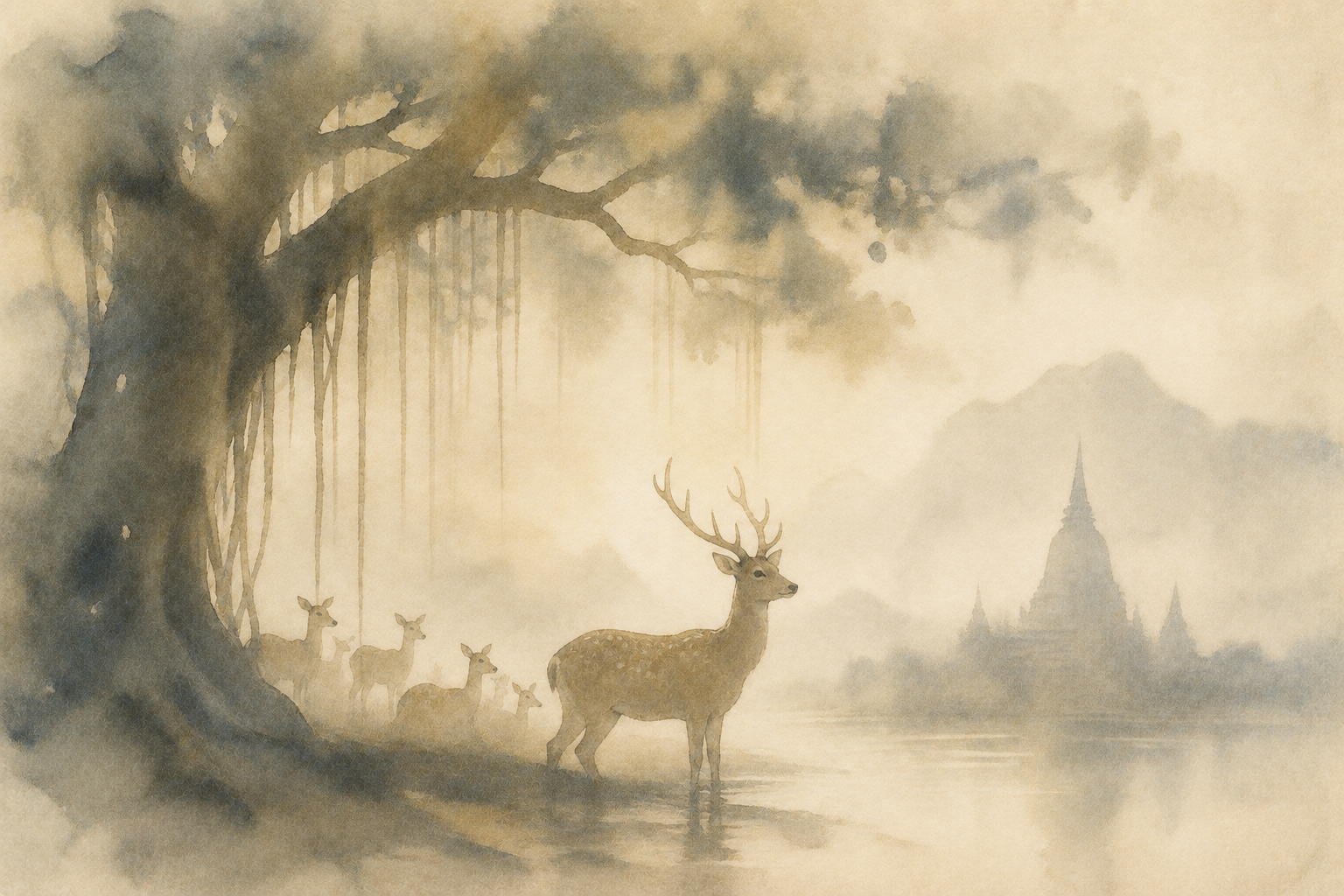
One useful way to approach the Banyan Deer Jataka is to treat it as a lens on how suffering is produced—and how it can be interrupted—when one side holds more power than the other. In the story, the deer live under threat from a king’s hunting. That imbalance creates a constant background of fear, and fear makes every choice narrower: hide, run, sacrifice someone else, or accept loss as “normal.”
The Banyan Deer (the deer-king) responds in a way that’s surprisingly concrete. Rather than relying on moral outrage, he works with the reality of the situation and tries to reduce harm. He negotiates, he takes responsibility for his herd, and when a particular deer is selected to die, he steps forward to protect her. Mercy here isn’t sentimental; it’s a deliberate interruption of the usual pattern.
Another part of the lens is how the story treats leadership. The deer-king leads by absorbing risk, not by outsourcing it. The human king, meanwhile, is shown as capable of change when he actually sees the cost of his actions. The Jataka doesn’t claim people are permanently cruel or permanently good; it suggests that perception matters, and that compassion can be contagious when it’s embodied rather than preached.
Read this way, the Banyan Deer Jataka becomes less about deer and more about the moment you realize: “My choices are making someone else unsafe.” The story points to a practical question: what would it look like to use your leverage—social, emotional, institutional—to protect rather than pressure?
GASSHO
Ask and learn about Buddhism in daily life.
GASSHO is a Buddhist community app where you can learn Buddhist teachings and ask questions to the head priest of Kongosanmaiin Temple on Mount Koya.
How Mercy and Protection Show Up in Ordinary Moments
Most of us don’t face life-or-death scenes, but we do face smaller versions of the same dynamic: someone has more power, someone has less, and fear quietly shapes the room. You can feel it in a meeting where one person’s tone decides whether others speak. You can feel it in a family pattern where one person’s anger sets the rules. You can feel it in yourself when you realize you’re about to “win” an argument by humiliating someone.
The Banyan Deer Jataka helps you notice the instant before you act—the half-second where you can either intensify fear or reduce it. Internally, that moment often feels like heat in the chest, a tightening in the jaw, a rush to be right. The story’s mercy is not a vague kindness; it’s the choice to pause and not add extra harm.
Protection, in daily life, often looks like creating conditions where others can breathe. That might mean clarifying expectations instead of letting anxiety do the managing. It might mean refusing to use sarcasm as a weapon. It might mean stepping in when someone is being singled out—not dramatically, but simply by changing the social weather: asking a fair question, naming what’s happening, or redirecting attention.
There’s also a quieter internal version: protecting the vulnerable parts of your own mind. When you’re ashamed, you may hunt yourself with harsh commentary. When you’re stressed, you may “sacrifice” sleep, food, or gentleness to keep producing. The Jataka’s deer-king can be read as the part of you that refuses to let the most frightened part be thrown away for convenience.
Another ordinary place this shows up is in negotiation. The deer-king doesn’t merely plead; he engages the king and appeals to something human in him. In your life, that can look like stating a boundary without contempt, or asking for a change without turning the other person into a villain. Mercy can include firmness: “I won’t participate in this,” or “We can do this, but not that.”
And sometimes the most relevant detail is the simplest: the story suggests that seeing clearly changes behavior. When you actually register the impact of your choices—on a coworker’s nervous system, on a child’s sense of safety, on your own capacity to rest—compassion stops being an ideal and becomes a practical adjustment.
Common Misreadings That Flatten the Story
One misunderstanding is to reduce the Banyan Deer Jataka to a single political message, as if it’s only “about hunting.” The hunting is the setting, but the deeper focus is the relationship between power and vulnerability, and the possibility of restraint. If you only read it as a debate topic, you miss the psychological realism: fear narrows choices, and mercy widens them.
Another misread is to treat the deer-king’s action as a command to self-sacrifice in every situation. The story praises a specific kind of courage: stepping forward to protect another when you can do so without hatred. That is not the same as enabling harm, staying in abuse, or erasing your own needs. Protection includes discernment; it’s not a blank check.
A third misunderstanding is to assume the human king changes because he is shamed into it. The emotional pivot is subtler: he is confronted with a form of nobility he didn’t expect from those he treated as lesser. The story’s transformation is less “you’re bad” and more “look at what you’re doing—and look at what you could be instead.”
Finally, some readers treat the Jataka as unrealistic because it ends with a ruler choosing mercy. But the point isn’t that every powerful person will soften; it’s that your actions still matter even when outcomes aren’t guaranteed. Mercy is presented as a cause you can embody, not a result you can control.
Why the Banyan Deer Jataka Matters in Modern Life
The Banyan Deer Jataka matters because it gives a workable definition of compassion: compassion is what reduces fear and prevents unnecessary harm. That’s measurable in daily life. You can often tell within minutes whether a conversation became safer or more threatening, whether a workplace became more humane or more coercive, whether your inner voice became more supportive or more predatory.
It also offers a grounded model of protection that doesn’t rely on domination. The deer-king doesn’t “win” by crushing the king; he wins by changing the conditions under which harm is considered normal. In modern terms, that’s the difference between seeking revenge and seeking safety. One repeats the cycle; the other interrupts it.
For anyone in a leadership role—parent, manager, teacher, older sibling—the story is a quiet challenge: your power is always teaching people what to expect from the world. If your power creates fear, people become smaller. If your power creates safety, people become more honest, more creative, and less defensive.
And for anyone who feels powerless, the Jataka offers a different kind of agency: you may not control the whole system, but you can still choose the next action that reduces harm. Sometimes that’s speaking up. Sometimes it’s refusing to participate. Sometimes it’s protecting the one who is about to be “selected” as the scapegoat.
Conclusion: Mercy as a Form of Strength
The Banyan Deer Jataka doesn’t romanticize kindness; it shows mercy as a disciplined choice made under pressure. The deer-king protects another life not by pretending danger isn’t real, but by meeting danger with clarity and restraint. The human king’s change, in turn, suggests that cruelty often depends on distance—and that compassion becomes possible when the cost of harm is finally seen.
If you carry one lesson forward, let it be this: protection isn’t only what you do with force. Protection is also what you do with attention—what you refuse to normalize, what you refuse to sacrifice, and what you choose to spare.
Ask a Buddhist priest
Have a question about Buddhism?
In the GASSHO app, you can ask questions about Buddhist teachings, daily concerns, and how to understand Buddhism in everyday life.
Frequently Asked Questions
- FAQ 1: What is the Banyan Deer Jataka about?
- FAQ 2: Who is the Banyan Deer in the Banyan Deer Jataka?
- FAQ 3: What lesson does the Banyan Deer Jataka teach about mercy?
- FAQ 4: How does the Banyan Deer Jataka portray protection?
- FAQ 5: Why does the human king change in the Banyan Deer Jataka?
- FAQ 6: Is the Banyan Deer Jataka mainly about nonviolence?
- FAQ 7: What does the Banyan Deer Jataka suggest about leadership?
- FAQ 8: Does the Banyan Deer Jataka encourage self-sacrifice in all situations?
- FAQ 9: What is the role of fear in the Banyan Deer Jataka?
- FAQ 10: How can I apply the Banyan Deer Jataka to everyday conflicts?
- FAQ 11: What makes the Banyan Deer Jataka a Buddhist story specifically?
- FAQ 12: Is the Banyan Deer Jataka historically factual or symbolic?
- FAQ 13: What does the “Banyan” in Banyan Deer Jataka refer to?
- FAQ 14: What is the main moral of the Banyan Deer Jataka?
- FAQ 15: Why is the Banyan Deer Jataka still read today?
FAQ 1: What is the Banyan Deer Jataka about?
Answer: The Banyan Deer Jataka is a Buddhist Jataka tale in which a deer-king (the Banyan Deer) leads his herd under a human king’s hunting threat and ultimately offers himself to save another deer, prompting the king to adopt mercy and protection toward the deer.
Takeaway: It’s a story about interrupting harm through courageous compassion.
FAQ 2: Who is the Banyan Deer in the Banyan Deer Jataka?
Answer: The Banyan Deer is the deer-king and central figure of the story, portrayed as a leader who takes responsibility for others’ safety and acts with restraint and compassion even when facing danger.
Takeaway: The Banyan Deer represents protective leadership rather than dominance.
FAQ 3: What lesson does the Banyan Deer Jataka teach about mercy?
Answer: It presents mercy as an active choice that reduces suffering—especially when you have leverage—rather than a passive feeling or a vague ideal.
Takeaway: Mercy is something you do, not just something you admire.
FAQ 4: How does the Banyan Deer Jataka portray protection?
Answer: Protection appears as taking responsibility for the vulnerable, negotiating to reduce harm, and stepping forward to prevent an unjust sacrifice—without relying on hatred or revenge.
Takeaway: Protection can be firm and compassionate at the same time.
FAQ 5: Why does the human king change in the Banyan Deer Jataka?
Answer: The king changes after witnessing unexpected nobility and selfless concern from the Banyan Deer, which makes the cost of his actions undeniable and opens the possibility of restraint.
Takeaway: Seeing the impact of harm clearly can shift a heart faster than argument.
FAQ 6: Is the Banyan Deer Jataka mainly about nonviolence?
Answer: Non-harm is a major theme, but the story is also about power, fear, and ethical responsibility—how those with power can choose restraint and create safety for those without it.
Takeaway: It’s as much about ethics and power as it is about nonviolence.
FAQ 7: What does the Banyan Deer Jataka suggest about leadership?
Answer: It suggests leadership is proven by willingness to protect others and absorb risk, not by the ability to intimidate or take what you want.
Takeaway: Real leadership reduces fear in the group.
FAQ 8: Does the Banyan Deer Jataka encourage self-sacrifice in all situations?
Answer: No. The story highlights a specific act of courageous protection; it doesn’t imply you must accept harm, erase your needs, or stay in dangerous situations to be “compassionate.”
Takeaway: Compassion isn’t the same as self-erasure.
FAQ 9: What is the role of fear in the Banyan Deer Jataka?
Answer: Fear is the background condition created by hunting and power imbalance; the Banyan Deer’s actions aim to reduce that fear by changing what is treated as normal and acceptable.
Takeaway: Reducing fear is a practical measure of compassion.
FAQ 10: How can I apply the Banyan Deer Jataka to everyday conflicts?
Answer: Use it as a prompt to notice when you’re about to “win” by increasing someone’s fear, and experiment with responses that protect dignity—pausing, clarifying, setting a boundary, or refusing to scapegoat someone.
Takeaway: Choose the next action that reduces harm, not the one that proves a point.
FAQ 11: What makes the Banyan Deer Jataka a Buddhist story specifically?
Answer: It frames ethical action as the reduction of suffering through compassion and restraint, showing how a single merciful choice can transform relationships and social norms.
Takeaway: The “Buddhist” element is the emphasis on ending harm at its source.
FAQ 12: Is the Banyan Deer Jataka historically factual or symbolic?
Answer: Jataka tales are traditionally moral narratives; whether read as literal history or symbolic teaching, the value lies in the ethical insight and the behavioral mirror it provides.
Takeaway: Treat it as a practical teaching story, not a courtroom record.
FAQ 13: What does the “Banyan” in Banyan Deer Jataka refer to?
Answer: “Banyan” functions as an identifying name for the deer-king in the tale; it distinguishes him and often evokes steadiness and shelter, fitting the story’s theme of protection.
Takeaway: The name points toward the deer-king’s role as a refuge for others.
FAQ 14: What is the main moral of the Banyan Deer Jataka?
Answer: The main moral is that mercy is a strength that can interrupt cycles of harm, and that true protection means using power to safeguard the vulnerable rather than exploit them.
Takeaway: Strength is measured by what you choose not to harm.
FAQ 15: Why is the Banyan Deer Jataka still read today?
Answer: It remains relevant because it addresses timeless dynamics—power, fear, responsibility, and the possibility of change—through a simple story that’s easy to remember and hard to dismiss.
Takeaway: The tale endures because it maps directly onto everyday ethical choices.