



The Monkey King Jataka: A Buddhist Story About Sacrifice and Leadership
Quick Summary
- The Monkey King Jataka is a Buddhist birth story where a monkey king risks himself to save his troop.
- Its core theme is leadership as responsibility, not status or control.
- The story highlights sacrifice without glorifying self-destruction.
- It offers a practical lens for everyday decisions: protect the vulnerable, reduce harm, act early.
- The human king’s response matters: power can learn humility and restraint.
- Read it as a training in attention and motive: “Who benefits from my choice?”
- Best takeaway: real authority shows up as care under pressure.
Introduction
If the Monkey King Jataka feels like a simple animal fable, you’re probably missing why it still lands so hard: it’s not “be nice,” it’s a blunt picture of what leadership costs when the stakes are real and time is short. I write for Gassho, a Zen/Buddhism site focused on making classic stories usable in ordinary life.
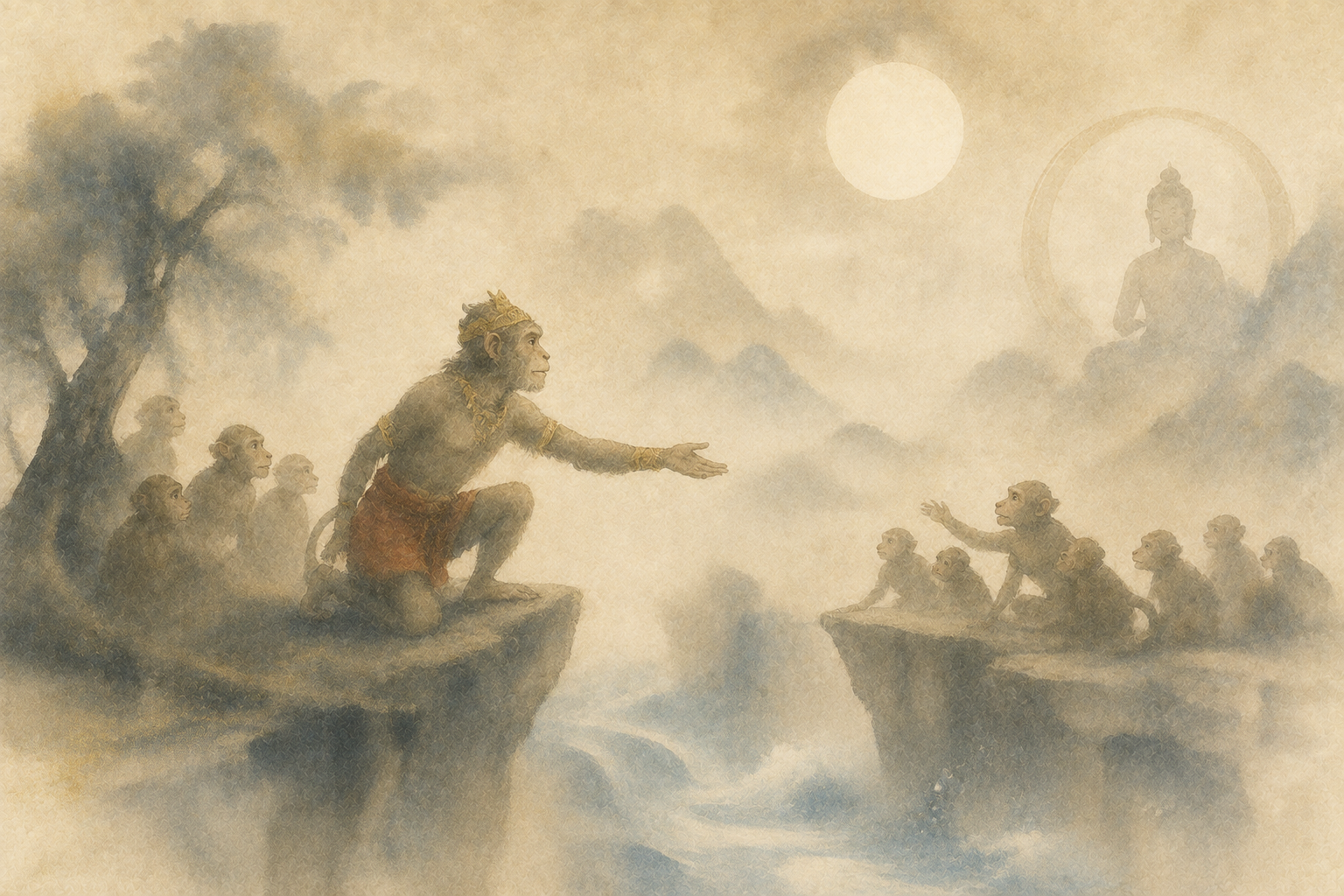
In the story, a troop of monkeys lives by a river where a fruit tree leans over the water. The fruit is abundant, and the troop thrives—until a human king discovers the tree and decides to claim it. The monkeys are suddenly trapped between hunger, fear, and an armed force that can wipe them out. Their leader, the monkey king, doesn’t negotiate from comfort; he acts from responsibility.
What makes the Monkey King Jataka memorable is the clarity of its moral geometry. Someone with power wants something. A community without power is in the way. A leader has to choose between saving himself and saving others. And then, crucially, the powerful person has to decide what kind of person he will be after witnessing that choice.
A Lens for Reading the Monkey King Jataka
A helpful way to understand the Monkey King Jataka is to treat it as a lens on cause-and-effect in human behavior: when fear rises, we narrow; when responsibility rises, we widen. The monkey king widens. He sees not only his own survival, but the whole field—his troop, the river, the tree, the humans, the likely outcomes, and the time available.
Leadership here isn’t charisma or dominance. It’s the willingness to carry the consequences that others can’t carry. The monkey king doesn’t ask the troop to “be brave.” He doesn’t demand sacrifice from the weakest. He uses his own body and ingenuity to create a bridge—often told as him forming a living bridge between the tree and safety—so others can cross first.
Read this less as a belief about saints and more as a practical question: when pressure hits, do you default to self-protection, or do you keep enough awareness to protect what depends on you? The story points to a kind of steadiness that isn’t cold. It’s warm, but it’s also strategic—compassion that can count.
Another key angle is the human king’s role. The Jataka doesn’t only praise the monkey king; it also tests the human response to virtue. Power can double down (“I can take what I want”), or it can be educated by what it sees. The story suggests that witnessing sacrifice can interrupt cruelty—if the witness is willing to be changed.
GASSHO
Ask and learn about Buddhism in daily life.
GASSHO is a Buddhist community app where you can learn Buddhist teachings and ask questions to the head priest of Kongosanmaiin Temple on Mount Koya.
How the Story Shows Up in Everyday Moments
You see the Monkey King Jataka in small, unglamorous situations: a team deadline, a family conflict, a friend in crisis, a workplace decision that quietly harms someone. The “river” is the constraint you can’t wish away. The “archers” are the pressures that make people panic—money, reputation, time, fear of blame.
In the moment, the mind often does one of two things. It either fixates (“How do I get out of this?”) or it opens (“What’s the least harmful path through?”). The monkey king’s move is an opening move. It’s not passive acceptance; it’s a shift from self-centered calculation to whole-situation awareness.
That shift can be felt internally as a change in attention. First there’s the spike—tight chest, fast thoughts, the urge to defend. Then, if you pause even briefly, you can notice what you’re about to do: speak sharply, hide information, let someone else take the hit, or pretend you didn’t see the problem. The story invites a different pause: “Who is exposed here, and what do I actually have the capacity to do?”
Sometimes “building the bridge” looks like taking responsibility for a mistake before it spreads. Sometimes it’s setting a boundary early so others aren’t forced into chaos later. Sometimes it’s doing the hard conversation yourself instead of sending a vulnerable person to do it. The monkey king doesn’t outsource the risk; he places himself where the risk is most concentrated.
There’s also a quieter layer: the temptation to be seen as the hero. In ordinary life, sacrifice can become a performance—overwork, martyrdom, resentment. The Monkey King Jataka is cleaner than that. The monkey king acts because the troop needs a path, not because he needs applause. If you watch your own motives closely, you can feel the difference between “I have to prove I’m good” and “This is simply what reduces harm.”
And then there’s the human king inside each of us: the part that has power over others in small ways—tone of voice, authority at work, control over resources, social influence. The story asks what happens when you witness someone else’s integrity. Do you soften? Do you become more careful? Or do you treat it as weakness you can exploit?
Even if you’re not “the leader,” you still meet the story whenever you choose whether to protect the vulnerable in a room. That might mean speaking up when someone is mocked, sharing credit, refusing to pile on, or noticing who is being quietly cornered. The Jataka’s leadership is not a title; it’s a function that appears when someone decides to carry what’s heavy.
Common Misreadings of the Monkey King Jataka
One misunderstanding is that the Monkey King Jataka teaches that “good people should suffer.” That’s not the point. The story highlights a specific kind of responsibility: when others will be harmed unless someone acts, the leader chooses to absorb risk. It’s about reducing harm, not romanticizing pain.
Another misreading is to treat the monkey king as a superhuman ideal and everyone else as morally inferior. The story is more useful when it becomes diagnostic: it shows what fear does, what power does, and what care does. You don’t have to become a legend; you can notice where you tighten, where you avoid, and where you can widen your response by one degree.
Some readers also miss the human king’s transformation. If the story only praised the monkey king, it would be a one-note morality tale. Instead, it suggests that power can be educated by contact with courage and compassion. The human king’s choice—whether to continue violence or to stop—matters as much as the monkey king’s sacrifice.
Finally, it’s easy to confuse sacrifice with poor boundaries. The monkey king’s action is targeted and time-bound: it creates a crossing. In real life, “sacrifice” that never ends often turns into burnout and resentment. The Jataka points toward effective care, not endless self-erasure.
Why This Jataka Still Matters for Leadership
The Monkey King Jataka matters because it defines leadership in a way that cuts through modern noise. Leadership isn’t primarily about being followed; it’s about being accountable for the impact you create. When the troop is threatened, the monkey king doesn’t ask, “How do I keep my position?” He asks, “How do they get across?”
It also offers a practical ethic for people with power. The human king’s hunting party represents the everyday ways institutions can harm: policies that ignore the vulnerable, decisions made from distance, “it’s just business” logic. The story suggests that the most important moment for a powerful person is the moment they realize they could harm—and choose not to.
On a personal level, the Jataka is a training in motive. Before speaking, deciding, or acting, you can ask: “Is this about protecting my image, or protecting what’s actually at risk?” That question doesn’t require perfection. It requires honesty.
And it gives a grounded picture of compassion: not sentiment, but structure. Compassion becomes a bridge—something that changes the outcome. When care becomes practical, it stops being vague and starts being reliable.
Conclusion
The Monkey King Jataka endures because it’s simple without being simplistic. A leader sees danger coming, acts decisively, and takes the risk so others can live. A person with power witnesses that act and is forced to confront his own choices. Between them, the story sketches a moral world where strength is measured by restraint, and leadership is measured by what it protects.
If you keep one thread from the Monkey King Jataka, let it be this: when pressure narrows the mind, widen the view. Look for the bridge you can build—one that reduces harm, protects the vulnerable, and doesn’t require anyone else to be sacrificed in your place.
Ask a Buddhist priest
Have a question about Buddhism?
In the GASSHO app, you can ask questions about Buddhist teachings, daily concerns, and how to understand Buddhism in everyday life.
Frequently Asked Questions
- FAQ 1: What is the Monkey King Jataka?
- FAQ 2: What happens in the Monkey King Jataka story?
- FAQ 3: What is the main moral of the Monkey King Jataka?
- FAQ 4: Why is the Monkey King considered a model leader in the Monkey King Jataka?
- FAQ 5: Is the Monkey King Jataka specifically about sacrifice?
- FAQ 6: Who is the human king in the Monkey King Jataka, and why does he matter?
- FAQ 7: How does the Monkey King Jataka relate to Buddhist ethics?
- FAQ 8: What makes the Monkey King Jataka different from other Jataka tales?
- FAQ 9: Is the Monkey King Jataka the same as the Chinese “Monkey King” (Sun Wukong)?
- FAQ 10: Where can I find the Monkey King Jataka in Buddhist texts?
- FAQ 11: What does the “bridge” symbolize in the Monkey King Jataka?
- FAQ 12: Does the Monkey King Jataka teach that leaders should always put themselves last?
- FAQ 13: What are common interpretations of the Monkey King Jataka?
- FAQ 14: How can I apply the Monkey King Jataka to modern leadership?
- FAQ 15: What is the simplest takeaway from the Monkey King Jataka?
FAQ 1: What is the Monkey King Jataka?
Answer: The Monkey King Jataka is a Buddhist birth story (Jataka tale) in which the Buddha is said to have been born as a monkey king who protects his troop by risking his own life to help them escape danger.
Takeaway: It’s a classic Jataka about protective leadership under pressure.
FAQ 2: What happens in the Monkey King Jataka story?
Answer: In most tellings, a troop of monkeys lives near a fruit tree by a river. A human king discovers the fruit and threatens the monkeys. The monkey king creates a way for the troop to cross to safety, taking the greatest risk himself, and is often injured in the process.
Takeaway: The plot centers on a leader creating a safe passage for others first.
FAQ 3: What is the main moral of the Monkey King Jataka?
Answer: The main moral is that true leadership prioritizes the welfare of others, especially the vulnerable, and that compassion becomes real when it changes outcomes rather than staying as a feeling.
Takeaway: Leadership is measured by what it protects.
FAQ 4: Why is the Monkey King considered a model leader in the Monkey King Jataka?
Answer: He is portrayed as a model leader because he anticipates danger, acts decisively, and accepts personal risk so the troop can survive—without demanding sacrifice from those with less power.
Takeaway: He leads by responsibility, not by privilege.
FAQ 5: Is the Monkey King Jataka specifically about sacrifice?
Answer: Yes, but in a focused way: the monkey king’s sacrifice is purposeful and protective, aimed at preventing harm to many rather than proving virtue or seeking recognition.
Takeaway: The story frames sacrifice as harm-reduction, not martyrdom.
FAQ 6: Who is the human king in the Monkey King Jataka, and why does he matter?
Answer: The human king is the figure with worldly power who threatens the monkeys. He matters because the story also examines how power responds when confronted with courage and compassion—whether it continues violence or chooses restraint.
Takeaway: The Jataka critiques power and highlights the possibility of moral change.
FAQ 7: How does the Monkey King Jataka relate to Buddhist ethics?
Answer: The story illustrates ethical themes like non-harming, responsibility, and compassionate action. Rather than debating rules, it shows ethics as a lived response to danger, fear, and unequal power.
Takeaway: It teaches ethics through a concrete situation, not abstract theory.
FAQ 8: What makes the Monkey King Jataka different from other Jataka tales?
Answer: While many Jatakas teach generosity or patience, the Monkey King Jataka strongly emphasizes leadership logistics: seeing the whole situation, acting quickly, and placing oneself where the risk is highest to protect the group.
Takeaway: It’s especially focused on leadership under threat.
FAQ 9: Is the Monkey King Jataka the same as the Chinese “Monkey King” (Sun Wukong)?
Answer: No. The Monkey King Jataka is a Buddhist birth story about a self-sacrificing monkey leader, while Sun Wukong is a different character from the Chinese novel “Journey to the West.” They share a title-like phrase but come from different traditions and narratives.
Takeaway: Similar wording, different stories and meanings.
FAQ 10: Where can I find the Monkey King Jataka in Buddhist texts?
Answer: The Monkey King Jataka appears in collections of Jataka tales (stories of the Buddha’s previous lives). Exact numbering and wording can vary by translation and collection, so searching within a Jataka anthology for “Monkey King” is often the easiest approach.
Takeaway: Look for it in Jataka collections; versions differ across translations.
FAQ 11: What does the “bridge” symbolize in the Monkey King Jataka?
Answer: The bridge (or crossing) symbolizes practical compassion: a real method that allows others to move from danger to safety. It can also symbolize the leader’s willingness to become the support others rely on in a crisis.
Takeaway: Compassion is shown as something that functions, not just something felt.
FAQ 12: Does the Monkey King Jataka teach that leaders should always put themselves last?
Answer: Not necessarily. The story highlights a moment where taking the greatest risk is the most protective choice. It doesn’t imply endless self-neglect; it points to situational responsibility and minimizing harm when others depend on you.
Takeaway: It’s about appropriate responsibility, not permanent self-erasure.
FAQ 13: What are common interpretations of the Monkey King Jataka?
Answer: Common interpretations include: leadership as protection, compassion as decisive action, the moral education of power, and the idea that courage can interrupt violence when it is witnessed clearly.
Takeaway: The story is often read as both a leadership lesson and a critique of cruelty.
FAQ 14: How can I apply the Monkey King Jataka to modern leadership?
Answer: You can apply it by taking responsibility early, refusing to shift risk onto weaker people, designing “bridges” (processes, protections, clear communication) that help others succeed, and using power with restraint when you could easily cause harm.
Takeaway: Build structures that protect people, especially under pressure.
FAQ 15: What is the simplest takeaway from the Monkey King Jataka?
Answer: When a group is threatened, the best leader looks for the least harmful path and takes on the hardest part of the risk so others can get to safety.
Takeaway: Real leadership is protective, practical, and willing to carry weight.