



The Story of Prince Vessantara: Generosity in Buddhist Teaching Explained
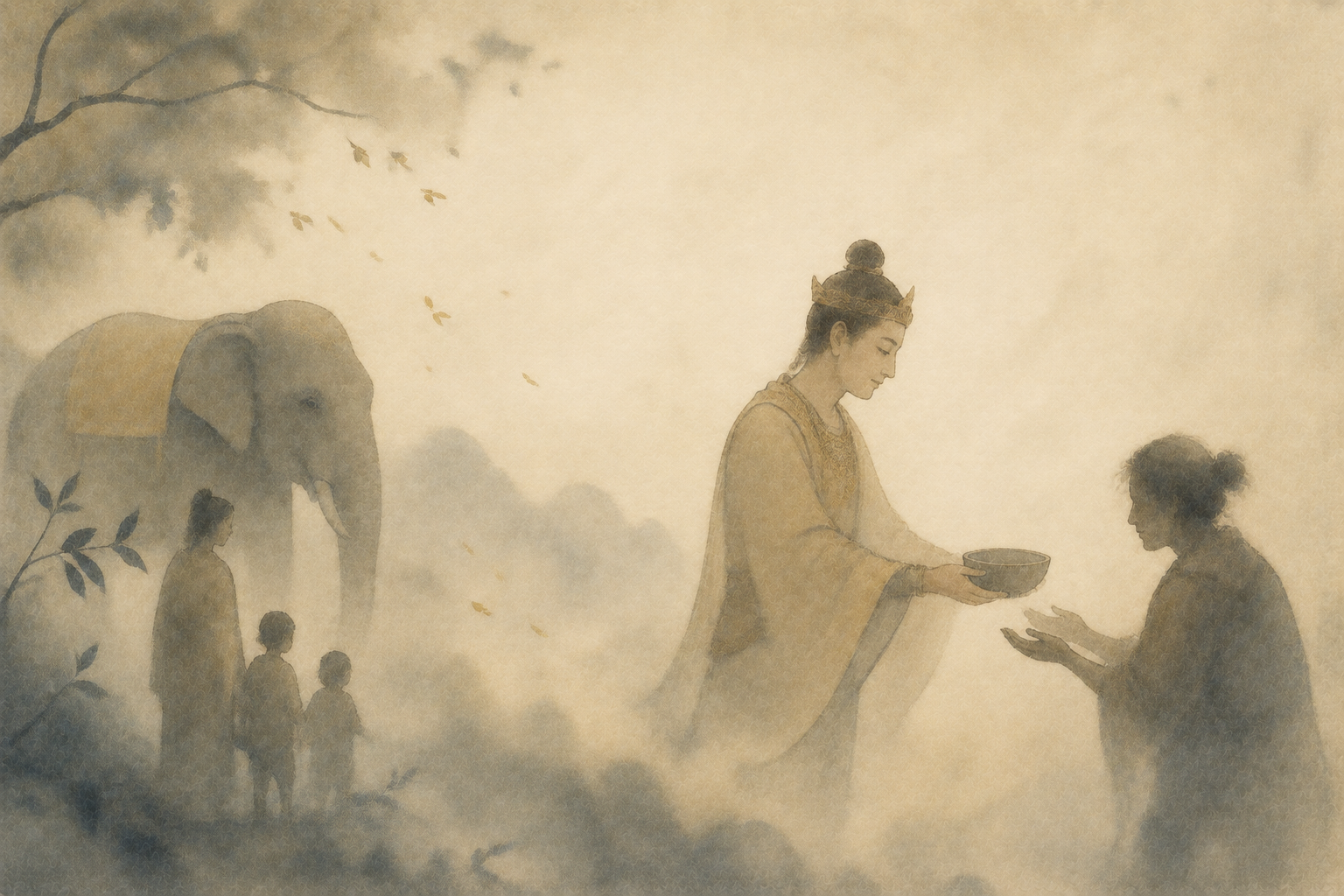
The Story of Prince Vessantara: Generosity in Buddhist Teaching Explained
Quick Summary
- The Prince Vessantara story is a Buddhist tale that tests generosity to an extreme, so it can feel inspiring and troubling at the same time.
- Its main theme is giving (dāna) as a training of the heart, not a command to abandon common sense or responsibilities.
- Key episodes include giving away a prized white elephant, exile to the forest, and the controversial giving of his children and wife.
- Read it as a “lens” on attachment, identity, and fear—what we cling to, and why.
- The story raises ethical questions on purpose; discomfort can be part of the teaching rather than a failure to understand.
- In daily life, the lesson often looks like smaller, wiser generosity: time, attention, forgiveness, and fair sharing.
- A balanced takeaway: generosity is powerful when paired with discernment, consent, and care for those affected.
Introduction
If the Prince Vessantara story confuses you, it’s probably because it seems to praise generosity while also showing choices that look irresponsible or even harmful—especially when family is involved. That tension is real, and it’s exactly why the story keeps getting retold: it forces you to look closely at what “giving” means when pride, fear, reputation, and attachment are in the room. I write for Gassho, where we focus on practical Buddhist themes and careful reading rather than blind agreement.
In traditional tellings, Prince Vessantara is portrayed as someone with an almost unstoppable impulse to give. When he gives away a treasured white elephant—an emblem of prosperity and protection—his people react with anger and fear, and he is sent into exile. Later, in the forest, requests come that push the idea of generosity to its breaking point, including the request for his children and then his wife.
Many readers try to “solve” the story quickly: either by defending every action as holy, or rejecting the whole tale as immoral. A more useful approach is to treat it like a mirror held up to the mind: what do you feel when something precious is asked of you, and what stories do you tell yourself to justify holding on—or letting go?
GASSHO
Ask and learn about Buddhism in daily life.
GASSHO is a Buddhist community app where you can learn Buddhist teachings and ask questions to the head priest of Kongosanmaiin Temple on Mount Koya.
A Clear Lens for Reading the Prince Vessantara Story
The Prince Vessantara story can be read as a lens on attachment: not just attachment to possessions, but attachment to control, to being seen as “good,” to being safe, and to having life go the way you planned. Generosity, in this lens, is less about the object given and more about what loosens inside when you stop gripping.
That doesn’t mean the story is asking you to copy the prince’s actions literally. It’s closer to a stress test: if giving is a virtue, what happens when giving collides with fear, social pressure, and responsibility? The narrative exaggerates the stakes so the inner mechanics become visible—how quickly the mind reaches for excuses, how it bargains, how it hardens, how it performs.
Another helpful lens is intention and consequence held together. The story highlights intention—Vessantara’s willingness to give without resentment—but it also refuses to hide consequences: public outrage, exile, grief, and moral discomfort. Reading it well means not picking one side (intention only, or consequence only), but noticing how both matter when generosity becomes complicated.
Finally, the tale points to a subtle question: is generosity still generosity when it is tangled with identity? If “I am a generous person” becomes the thing you protect, giving can turn into a performance, or even a compulsion. The story invites you to watch for that edge in yourself—where virtue becomes self-image.
How the Teaching Shows Up in Ordinary Life
You may not be asked for a white elephant, but you will be asked for things that feel like “status” or “security”: credit for work, the last word in an argument, the comfort of being right. The Prince Vessantara story becomes practical when you notice how the body tightens around these invisible possessions.
In a simple moment—someone interrupts you, a coworker takes your idea, a family member needs more than you expected—you can watch the first reaction. Often it’s not generosity or stinginess yet; it’s a flash of threat. The mind quickly calculates: “If I give, what will I lose?”
Then comes the second layer: the story you tell yourself. You might call withholding “boundaries,” or call over-giving “kindness,” without checking what’s actually driving it. The Vessantara lens asks for a quieter honesty: is this giving coming from care, fear, guilt, or the need to be admired?
Another everyday place this shows up is time. Time is often harder to give than money because it exposes what you value. When you offer attention—listening without multitasking, staying present without fixing—you can feel the same inner resistance the story dramatizes: the urge to protect “my time” as if it were a fortress.
The story also highlights how giving affects others, which is where real life gets ethically textured. If you say yes to every request, the cost may be paid by your partner, your children, your team, or your future self. Noticing that ripple effect is part of maturing generosity: you start to see that “my gift” is rarely only mine to give.
There’s also the experience of regret. Sometimes you give and later feel used, or you give and feel proud, or you don’t give and feel relieved but slightly closed. The point isn’t to judge the feeling; it’s to learn from it. The Prince Vessantara story keeps returning to this territory: what does the heart do after the moment of giving?
Over time, many people discover a quieter form of generosity that doesn’t need drama: giving what is appropriate, at the right time, without self-congratulation, and without resentment. That kind of giving can feel less heroic than the story, but more stable—and more humane.
Common Misreadings That Make the Story Harder Than It Needs to Be
One common misunderstanding is treating the Prince Vessantara story as a literal rule: “A good person must give anything to anyone who asks.” Read that way, the tale becomes a recipe for burnout and harm. A more workable reading is that the story is exploring the inner clinging that makes giving difficult, not issuing a blanket command to comply with every request.
Another misreading is assuming the story praises suffering for its own sake. The narrative includes pain and loss, but the teaching value is not “pain is good.” It’s that the mind’s relationship to possession, identity, and control can be examined under pressure—and that examination can reveal where compassion is real and where it is performative.
A third misunderstanding is flattening the ethical tension by saying, “It’s just a myth, so it doesn’t matter.” Myths matter because they shape instincts. If a story normalizes reckless giving, it can be misused; if it only provokes outrage, it can be dismissed without learning anything. The middle approach is to let the discomfort sharpen discernment: what kind of generosity actually reduces harm?
Finally, some readers assume the only options are admiration or condemnation. But the story can be held as a question rather than an answer. You can respect the emphasis on generosity while still refusing to romanticize choices that ignore consent, responsibility, or the wellbeing of dependents.
Why the Prince Vessantara Story Still Matters Today
Modern life constantly trains subtle forms of grasping: hoarding attention, curating image, protecting comfort, and treating relationships as transactions. The Prince Vessantara story matters because it challenges the reflex to ask, “What do I get?” before asking, “What is needed?”
It also matters because it forces a conversation about wise generosity. Many people are either over-givers (driven by guilt or approval-seeking) or under-givers (driven by fear or scarcity). The story’s extremes can help you locate your own imbalance without pretending that balance is easy.
In families and workplaces, generosity often looks like fairness and reliability rather than grand sacrifice. Paying attention, sharing credit, telling the truth kindly, and not making promises you can’t keep are all forms of giving. The story can be a reminder that generosity is not only about objects—it’s about how you relate to people when something is at stake.
Finally, the tale invites a mature question: “Can I give without making myself the center of the story?” When giving becomes less about “me being good” and more about reducing suffering in a concrete situation, it tends to become simpler, quieter, and more sustainable.
Conclusion
The Prince Vessantara story is not comfortable, and it’s not meant to be. It uses extreme generosity to expose the mind’s attachments and the social consequences of giving, so you can examine what you cling to and why. If you read it as a lens rather than a literal blueprint, the story becomes less about copying a prince and more about understanding your own motives—then practicing generosity that is both open-hearted and responsible.
Ask a Buddhist priest
Have a question about Buddhism?
In the GASSHO app, you can ask questions about Buddhist teachings, daily concerns, and how to understand Buddhism in everyday life.
Frequently Asked Questions
- FAQ 1: What is the Prince Vessantara story about?
- FAQ 2: Why does Prince Vessantara give away the white elephant?
- FAQ 3: Why is Prince Vessantara exiled in the story?
- FAQ 4: What is the main lesson of the Prince Vessantara story in Buddhist teaching?
- FAQ 5: Why does the Prince Vessantara story include giving away his children?
- FAQ 6: Does the Prince Vessantara story teach that you should give away your family if asked?
- FAQ 7: Who asks for the children in the Prince Vessantara story?
- FAQ 8: What happens to Vessantara’s wife in the Prince Vessantara story?
- FAQ 9: Is the Prince Vessantara story considered a Jātaka tale?
- FAQ 10: What does “generosity” mean in the Prince Vessantara story beyond giving objects?
- FAQ 11: Why do some people criticize the Prince Vessantara story?
- FAQ 12: How can you read the Prince Vessantara story without taking it literally?
- FAQ 13: What role does exile to the forest play in the Prince Vessantara story?
- FAQ 14: What is a balanced modern takeaway from the Prince Vessantara story?
- FAQ 15: Why is the Prince Vessantara story still told and performed in many places?
FAQ 1: What is the Prince Vessantara story about?
Answer: The Prince Vessantara story is a Buddhist tale centered on extreme generosity, where the prince gives away prized possessions and faces exile and difficult requests that test the meaning of giving.
Takeaway: It’s a story designed to examine generosity under pressure, not a simple moral slogan.
FAQ 2: Why does Prince Vessantara give away the white elephant?
Answer: In the Prince Vessantara story, the white elephant symbolizes prosperity and protection; giving it away shows the prince’s commitment to generosity even when the gift has major public consequences.
Takeaway: The elephant episode sets up the central tension between personal virtue and communal impact.
FAQ 3: Why is Prince Vessantara exiled in the story?
Answer: Prince Vessantara is exiled because the people and leaders fear that his giving—especially the white elephant—endangers the kingdom’s welfare, so they remove him to protect stability.
Takeaway: The story openly shows that generosity can trigger social backlash and fear.
FAQ 4: What is the main lesson of the Prince Vessantara story in Buddhist teaching?
Answer: The main lesson is the cultivation of generosity (dāna) as a way to loosen attachment and self-centeredness, while inviting reflection on intention, responsibility, and consequences.
Takeaway: Read it as training the heart, not as a command to give recklessly.
FAQ 5: Why does the Prince Vessantara story include giving away his children?
Answer: The story includes this extreme episode to push the theme of non-clinging to a shocking limit, forcing listeners to confront what they consider “mine” and where ethical discomfort arises.
Takeaway: The discomfort is part of the story’s function—it provokes careful discernment.
FAQ 6: Does the Prince Vessantara story teach that you should give away your family if asked?
Answer: No. A practical reading treats the Prince Vessantara story as a dramatic teaching narrative about attachment and generosity, not a literal instruction for real-life decisions involving consent and duty of care.
Takeaway: The story is a mirror for motives, not a template for harmful actions.
FAQ 7: Who asks for the children in the Prince Vessantara story?
Answer: In traditional tellings of the Prince Vessantara story, a brahmin named Jūjaka requests the children, and the request becomes the central test of the prince’s commitment to giving.
Takeaway: Knowing the requester helps readers see how the story frames “tests” of generosity.
FAQ 8: What happens to Vessantara’s wife in the Prince Vessantara story?
Answer: In the story, Vessantara’s wife (often named Maddī) is also requested and given; later, events resolve with reunification in many versions, but the episode remains ethically challenging for modern readers.
Takeaway: The wife episode intensifies the story’s focus on attachment, agency, and consequence.
FAQ 9: Is the Prince Vessantara story considered a Jātaka tale?
Answer: Yes. The Prince Vessantara story is widely known as the Vessantara Jātaka, a narrative about a previous life of the Buddha that highlights the perfection of generosity.
Takeaway: It’s traditionally framed as a teaching story about cultivating a virtue over time.
FAQ 10: What does “generosity” mean in the Prince Vessantara story beyond giving objects?
Answer: In the Prince Vessantara story, generosity points to an inner willingness to release grasping—status, security, and self-image—not only material possessions.
Takeaway: The deepest “gift” in the story is the loosening of clinging.
FAQ 11: Why do some people criticize the Prince Vessantara story?
Answer: People criticize the Prince Vessantara story because certain episodes—especially giving away children and wife—can appear to ignore consent and responsibility, raising serious ethical concerns.
Takeaway: Criticism often signals the need to read the story with discernment, not denial.
FAQ 12: How can you read the Prince Vessantara story without taking it literally?
Answer: You can read the Prince Vessantara story as a symbolic stress test of attachment: notice your reactions, question your assumptions about “mine,” and reflect on how generosity and harm can become entangled.
Takeaway: Use the story to investigate the mind, not to justify extreme behavior.
FAQ 13: What role does exile to the forest play in the Prince Vessantara story?
Answer: Exile removes social comfort and status, placing Vessantara in a simpler setting where requests for help and giving become more direct, exposing motives and attachments more clearly.
Takeaway: The forest setting functions like a pressure chamber for the theme of generosity.
FAQ 14: What is a balanced modern takeaway from the Prince Vessantara story?
Answer: A balanced takeaway is to practice generosity that is sincere and non-grasping while also being responsible—considering consent, dependents, and real-world consequences rather than chasing an image of holiness.
Takeaway: Generosity becomes wiser when compassion and discernment work together.
FAQ 15: Why is the Prince Vessantara story still told and performed in many places?
Answer: The Prince Vessantara story endures because it dramatizes generosity in a memorable way, invites communal reflection on values, and keeps the question of attachment versus care emotionally alive across generations.
Takeaway: The story persists because it provokes reflection, not because it offers easy answers.