



Kisa Gotami Story Explained: Grief, Mustard Seeds, and Impermanence
Quick Summary
- The Kisa Gotami story centers on a mother’s grief and a simple request: mustard seeds from a house untouched by death.
- Its lesson isn’t “don’t feel”—it’s “don’t isolate,” because loss is shared by every household.
- The story uses a practical task to shift the mind from panic and denial toward clear seeing.
- It points to impermanence as a lived fact, not a theory or a slogan.
- Grief softens when it’s allowed to be real, named, and held with compassion.
- The “mustard seed” moment is about community, perspective, and returning to the present.
- You can apply the story through small daily practices: asking for help, telling the truth, and letting feelings move.
Introduction
If you’re reading about the Kisa Gotami story, you’re probably trying to make sense of a line that can sound harsh at first: a grieving mother is sent away to find mustard seeds, as if her pain could be “fixed” by an errand. The point is subtler—and more compassionate—than many retellings make it seem, because the story is really about how grief narrows the mind and how contact with shared human loss can widen it again. At Gassho, we focus on Buddhist stories as practical mirrors for ordinary life, not as distant legends.
The story endures because it describes something painfully familiar: when loss hits, the heart wants an exception, a loophole, a way for this one death not to be true. Kisa Gotami’s search doesn’t erase love or sadness; it changes the shape of her suffering by reconnecting her to reality and to other people.
The Heart of the Kisa Gotami Story
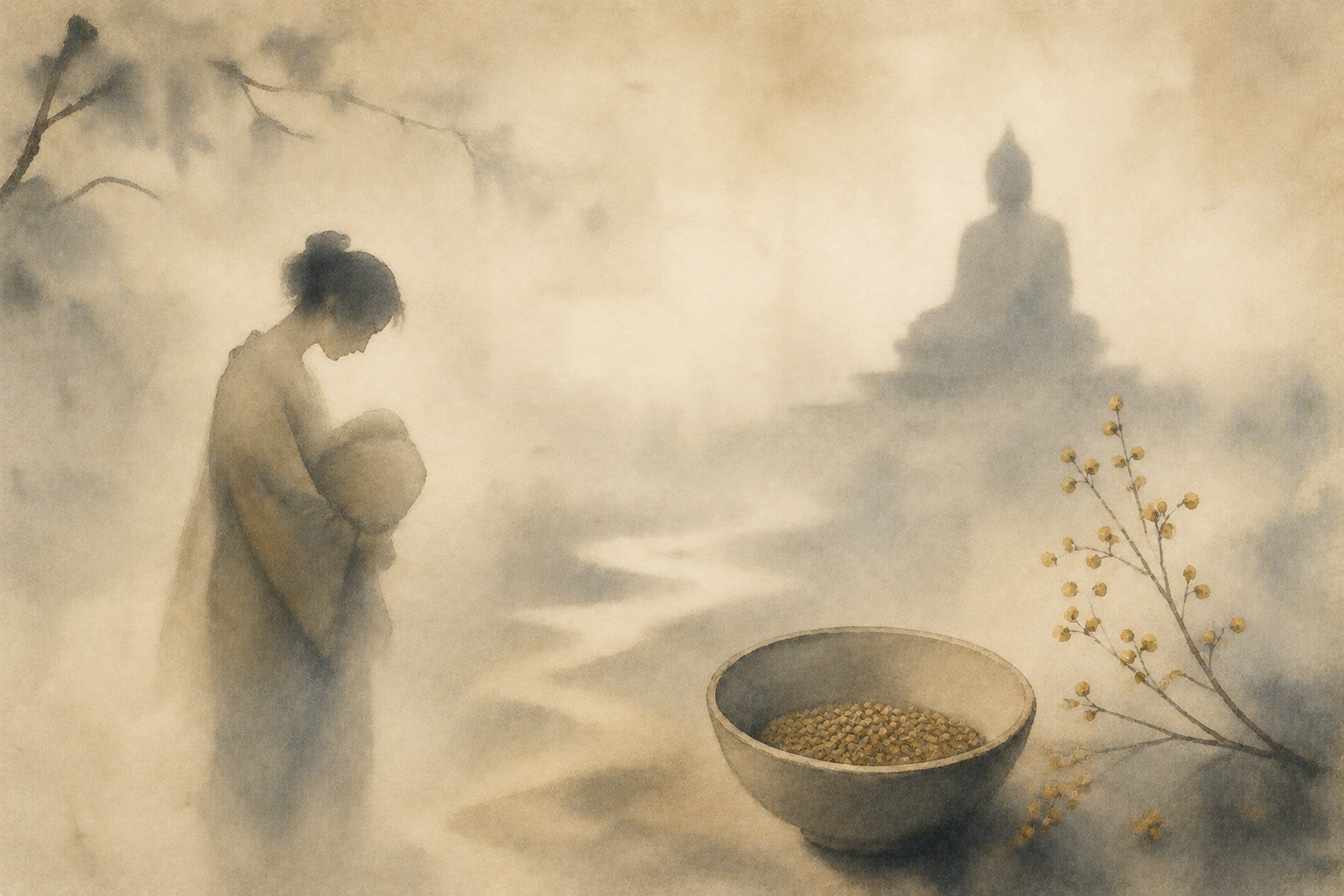
In the traditional telling, Kisa Gotami loses her young child and is overwhelmed by shock. She carries the child’s body from place to place, asking for medicine—still moving as if the right person, the right remedy, or the right words could reverse what has happened.
She is eventually directed to the Buddha, who listens and then gives her a task: bring mustard seeds from a household where no one has died. It sounds simple. Mustard seeds are common. The condition is the real instruction.
Kisa Gotami goes door to door. Each home can offer mustard seeds, but each home also carries its own story of death: a parent, a child, a spouse, a sibling. The search fails in its literal goal, yet succeeds in its deeper purpose—her grief is no longer sealed inside a private nightmare. She meets the truth that death is not a personal punishment or a rare accident; it is woven into every family.
In many versions, she returns with empty hands but a changed mind. The story closes not with a “solution,” but with a shift: from frantic resistance to a clearer, more grounded sorrow—one that can be carried without being consumed.
GASSHO
Ask and learn about Buddhism in daily life.
GASSHO is a Buddhist community app where you can learn Buddhist teachings and ask questions to the head priest of Kongosanmaiin Temple on Mount Koya.
A Lens for Understanding Grief Without Denial
The Kisa Gotami story offers a lens: suffering intensifies when the mind insists that reality must be different. Grief is already hard; what makes it feel unbearable is the added layer of refusal—“this can’t be true,” “this shouldn’t be happening,” “this must be fixable if I try harder.” The story doesn’t condemn that reaction; it simply shows where it leads.
The mustard seed request is a compassionate way to meet denial without arguing with it. Instead of telling Kisa Gotami to “accept impermanence,” the story gives her an experience that teaches it. She learns through contact: every door she knocks on reveals the same human pattern—love, attachment, loss.
Seen this way, impermanence isn’t a belief you adopt; it’s a fact you gradually stop fighting. The story points to a shift from “Why is this happening to me?” to “This is part of being human.” That shift doesn’t remove pain, but it often removes the sense of isolation and injustice that makes pain feel endless.
Most importantly, the story frames wisdom as something that can hold tenderness. Kisa Gotami’s love for her child is not treated as a mistake. What changes is the demand that love must guarantee permanence.
How the Mustard Seed Search Shows Up in Everyday Life
In ordinary life, grief often begins as a narrowing of attention. The mind loops on one image, one conversation, one “if only.” Even when you’re functioning—working, cooking, answering messages—part of you is still bargaining with the past.
The Kisa Gotami story describes a different movement: not forcing yourself to “move on,” but gently widening the frame. When you speak with someone who has also lost a parent, a partner, a friend, something shifts. Your pain doesn’t become smaller; it becomes less lonely.
There’s also a subtle lesson about tasks. In grief, the mind wants a dramatic cure, but what helps is often simple structure: make a call, take a walk, eat something, ask a neighbor for help, show up to a support group. These aren’t magical fixes. They are ways of re-entering the human world.
Notice how the story uses conversation at each door. Kisa Gotami isn’t told to sit alone and think about death. She learns by listening to real people. In lived experience, this can look like letting others tell their stories without comparing, without ranking losses, without trying to be “strong.” Just listening and being listened to.
Another everyday parallel is the moment you realize you’ve been searching for the “one household” where tragedy never happens: the family that stays intact, the body that never breaks down, the relationship that never changes. The story invites a sober recognition: that household doesn’t exist. Seeing that can be sad—and strangely relieving—because it ends the exhausting hunt for an exception.
Grief also comes in waves. Some days you feel steady; other days a smell, a song, or a quiet evening brings everything back. The story doesn’t promise a straight line. It suggests a different skill: when the wave rises, you don’t have to add a second wave of self-judgment (“I should be over this”). You can let the feeling be present and still remain connected to life.
Finally, the mustard seed search points to a compassionate realism: you can love deeply and still face what cannot be controlled. In practice, this might mean allowing tears, saying the person’s name, keeping a small ritual of remembrance, and also taking the next doable step in front of you.
Common Misreadings of the Kisa Gotami Story
One misunderstanding is that the story is telling you to “get over it.” It isn’t. Kisa Gotami’s grief is honored as real; what changes is her relationship to it. The story critiques denial and isolation, not love or mourning.
Another misreading is that the Buddha is being cold or testing her. In the story’s logic, the task is a skillful way to meet her where she is. When someone is in shock, abstract advice rarely lands. A concrete search—paired with human contact—can reach the heart more effectively than a lecture.
Some retellings reduce the message to a slogan: “Everyone dies.” That’s true, but incomplete. The deeper point is communal: every household carries loss, so you don’t have to carry yours alone. The story is as much about compassion and connection as it is about impermanence.
Finally, people sometimes use the story to minimize someone else’s pain: “Remember Kisa Gotami—others have it worse.” That is the opposite of the lesson. The story doesn’t compare grief; it normalizes it, making room for tenderness rather than shame.
Why This Story Still Helps When You’re Hurting
The Kisa Gotami story matters because it describes a turning point many people need: moving from private anguish to shared humanity. When grief is locked inside the mind, it can feel like a personal catastrophe that no one else could understand. When grief is spoken and witnessed, it becomes part of a larger human pattern—still painful, but less alien.
It also offers a gentle correction to the modern pressure to “perform” grief correctly. Some people cry openly; others go quiet. Some feel numb for months; others feel everything at once. The story doesn’t prescribe a timeline. It points to one practical direction: stop searching for an impossible exception, and start letting reality be real.
In daily life, that can look like small acts of honesty: telling a friend you’re not okay, asking for company, letting yourself rest, or seeking professional support when you need it. The story’s wisdom is not a replacement for care; it’s a reminder that care works best when it’s grounded in truth.
And if you’re supporting someone else, the story offers guidance too: don’t rush to fix. Create conditions for connection. Help them knock on a few doors—real doors, metaphorical doors—until they remember they’re still part of the living world.
Conclusion
The story of Kisa Gotami is a Buddhist lesson about grief that refuses both extremes: it doesn’t romanticize suffering, and it doesn’t demand emotional shutdown. It shows a mind in shock, a compassionate intervention, and a return to reality through human contact.
If the story lands painfully, that may be because it touches the place in us that still wants a loophole. The mustard seed search is not a punishment; it’s a path back to shared life. Grief remains, but it becomes something you can carry with honesty, support, and a little more space around the pain.
Ask a Buddhist priest
Have a question about Buddhism?
In the GASSHO app, you can ask questions about Buddhist teachings, daily concerns, and how to understand Buddhism in everyday life.
Frequently Asked Questions
- FAQ 1: What is the Kisa Gotami story in Buddhism?
- FAQ 2: Why does the Buddha ask Kisa Gotami to find mustard seeds?
- FAQ 3: What is the main lesson of the Kisa Gotami story?
- FAQ 4: Is the Kisa Gotami story meant to say “everyone dies, so stop grieving”?
- FAQ 5: What does the mustard seed symbolize in the Kisa Gotami story?
- FAQ 6: Did Kisa Gotami actually bring her child back to life in the story?
- FAQ 7: What does the Kisa Gotami story teach about impermanence?
- FAQ 8: Why is the Kisa Gotami story often used in teachings about grief?
- FAQ 9: Is the Buddha being cruel to Kisa Gotami by sending her away?
- FAQ 10: What happens when Kisa Gotami goes from house to house?
- FAQ 11: What is the “mustard seed from a house with no death” line really pointing to?
- FAQ 12: How can I apply the Kisa Gotami story to my own grief?
- FAQ 13: What should I avoid saying when referencing the Kisa Gotami story to someone grieving?
- FAQ 14: Are there different versions of the Kisa Gotami story?
- FAQ 15: What is the simplest one-sentence meaning of the Kisa Gotami story?
FAQ 1: What is the Kisa Gotami story in Buddhism?
Answer: The Kisa Gotami story tells of a mother who loses her child and seeks a way to bring the child back. She is asked to collect mustard seeds from a household untouched by death, and through going door to door she realizes that every family has experienced loss.
Takeaway: The story uses a simple search to reveal that grief is universal, not isolating.
FAQ 2: Why does the Buddha ask Kisa Gotami to find mustard seeds?
Answer: Mustard seeds are common, so the request seems doable, but the condition—finding a home where no one has died—guides her into direct contact with the universality of death. It’s a practical way to shift her from denial toward clear seeing without arguing with her grief.
Takeaway: The mustard seeds are a teaching device, not a cure.
FAQ 3: What is the main lesson of the Kisa Gotami story?
Answer: The main lesson is that loss is part of every human life, and suffering grows when we demand an exception for ourselves. The story points toward accepting reality while keeping compassion for the pain of love and attachment.
Takeaway: Acceptance here means facing what’s true, not suppressing emotion.
FAQ 4: Is the Kisa Gotami story meant to say “everyone dies, so stop grieving”?
Answer: No. The story doesn’t dismiss grief; it shows how grief changes when it’s no longer trapped in isolation and denial. Recognizing universality can soften the added suffering of “this shouldn’t be happening.”
Takeaway: The story validates grief while loosening the grip of resistance.
FAQ 5: What does the mustard seed symbolize in the Kisa Gotami story?
Answer: The mustard seed often symbolizes how something ordinary can carry extraordinary insight. It represents a simple, everyday entry point into a difficult truth: no household is free from death and loss.
Takeaway: The symbol is “commonness”—truth found in ordinary life.
FAQ 6: Did Kisa Gotami actually bring her child back to life in the story?
Answer: In the traditional story, she does not bring the child back. The transformation is internal: she moves from frantic searching for reversal to a clearer, more grounded relationship with grief and impermanence.
Takeaway: The “resolution” is wisdom and compassion, not reversal of death.
FAQ 7: What does the Kisa Gotami story teach about impermanence?
Answer: It teaches impermanence as a lived fact rather than an idea to agree with. Kisa Gotami learns through experience—meeting many families touched by death—that change and loss are woven into life.
Takeaway: Impermanence becomes real when you see it reflected everywhere.
FAQ 8: Why is the Kisa Gotami story often used in teachings about grief?
Answer: Because it captures common grief reactions—shock, bargaining, searching for a fix—and then shows a compassionate way those reactions can soften. It also highlights the healing power of shared humanity and community.
Takeaway: The story maps grief realistically without shaming it.
FAQ 9: Is the Buddha being cruel to Kisa Gotami by sending her away?
Answer: The story frames the request as skillful compassion: a concrete task that meets her mind in crisis and leads her to discover the truth herself. It avoids abstract preaching and instead creates conditions for insight through contact with others.
Takeaway: The “errand” is a gentle intervention, not a punishment.
FAQ 10: What happens when Kisa Gotami goes from house to house?
Answer: She finds that people can offer mustard seeds, but no one can offer a home untouched by death. Each household shares its own story of loss, and this repeated encounter shifts her perspective from private despair to shared human reality.
Takeaway: The doors she knocks on become mirrors of universal experience.
FAQ 11: What is the “mustard seed from a house with no death” line really pointing to?
Answer: It points to the impossibility of finding a life free from loss. The line is designed to reveal that the mind’s demand for an exception is understandable but unworkable, and that relief begins when we stop chasing that exception.
Takeaway: The condition exposes denial gently, without argument.
FAQ 12: How can I apply the Kisa Gotami story to my own grief?
Answer: You can apply it by letting grief be shared rather than hidden: talk with trusted people, listen to others’ experiences, and allow the truth of loss without forcing yourself to “be fine.” The story suggests widening the frame, not rushing the feelings.
Takeaway: Connection and honesty often reduce the loneliness that intensifies grief.
FAQ 13: What should I avoid saying when referencing the Kisa Gotami story to someone grieving?
Answer: Avoid using it to minimize their pain (for example, “others have it too” or “you should accept it”). If you share the story at all, emphasize compassion and shared humanity, and prioritize listening over teaching.
Takeaway: The story is meant to open the heart, not shut someone down.
FAQ 14: Are there different versions of the Kisa Gotami story?
Answer: Yes, retellings vary in details and emphasis, but the core elements are consistent: a mother’s grief, the mustard seed request with the “no death” condition, and the realization that loss touches every household.
Takeaway: Focus on the story’s function—shifting perspective—more than minor variations.
FAQ 15: What is the simplest one-sentence meaning of the Kisa Gotami story?
Answer: The Kisa Gotami story means that grief becomes more bearable when we stop searching for an impossible exception to loss and instead meet reality with compassion and shared human connection.
Takeaway: It’s a lesson in facing loss without isolation.