



The Four Encounters of the Buddha: The Story That Changed His Life
The Four Encounters of the Buddha: The Story That Changed His Life
Quick Summary
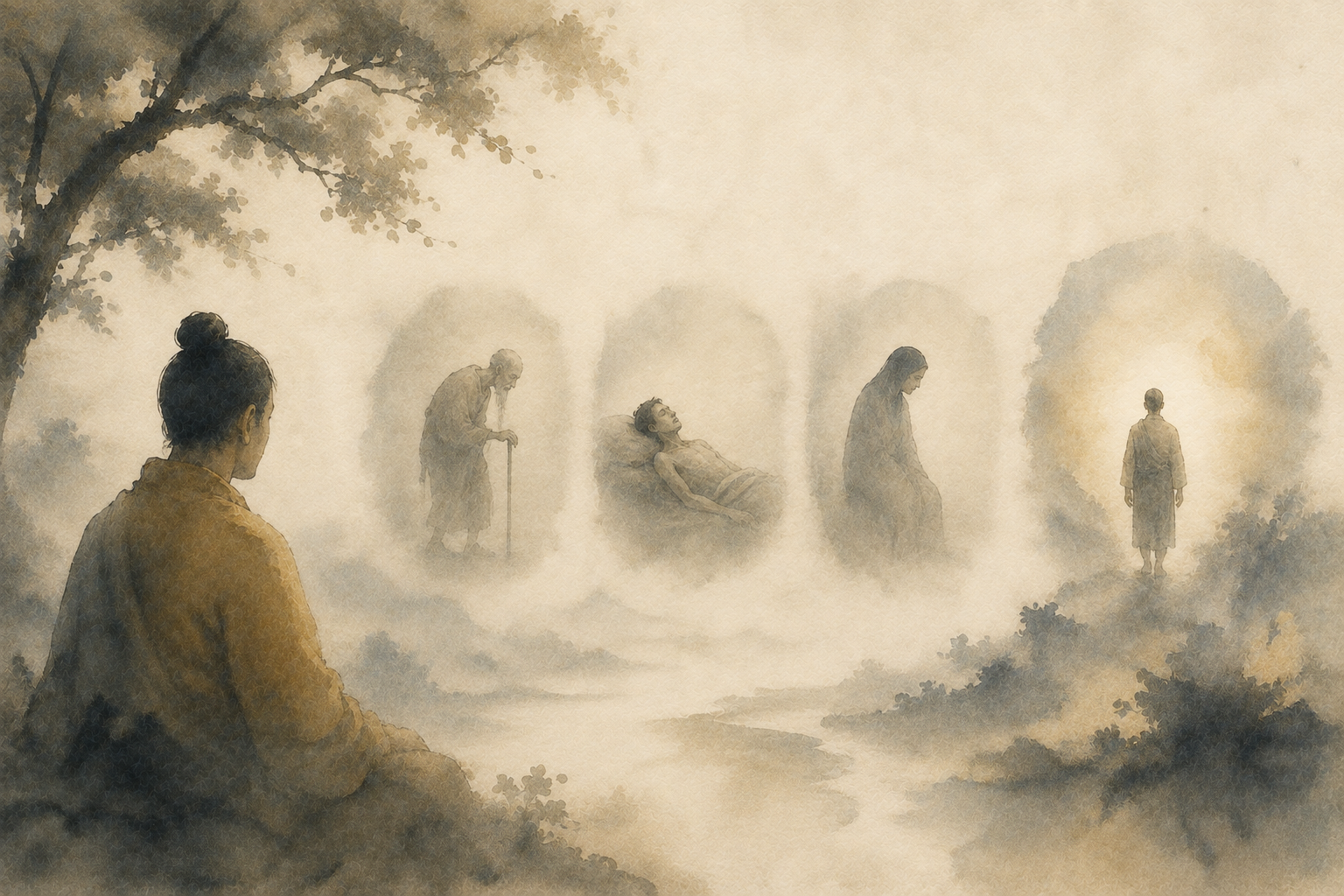
- The “four encounters of Buddha” describe four sights that disrupted Prince Siddhartha’s sheltered life: old age, sickness, death, and a renunciant.
- They aren’t meant as miracles; they function like a clear-eyed look at what life already contains.
- The first three encounters expose vulnerability; the fourth introduces the possibility of a different response.
- The story points less to “pessimism” and more to honesty about change, loss, and uncertainty.
- Read as a lens, the encounters highlight how avoidance shapes our choices and how attention can reshape them.
- In daily life, the “encounters” show up as moments when we can’t unsee reality—and we mature because of it.
- The lasting question is practical: when you meet aging, illness, and death, what kind of life do you want to live?
Introduction: Why This Story Still Lands So Hard
You’ve probably heard a simplified version of the four encounters of Buddha and wondered what you’re supposed to do with it: is it just an ancient legend, a gloomy message, or a moral about “leaving everything behind”? The story is sharper than that—it names the exact moments when comfort stops working as a strategy and reality becomes impossible to outsource. I’m writing this for Gassho with a focus on clear, practice-adjacent reading rather than religious salesmanship.
In the traditional narrative, Prince Siddhartha is raised in a protected environment designed to keep him from seeing anything disturbing. When he finally goes out beyond the palace walls, he meets four sights that change his direction: an old person, a sick person, a dead person, and a wandering renunciant (often described as a holy person or ascetic). These are the “four encounters,” sometimes also called the “four sights.”
What makes the story endure is that it doesn’t rely on exotic ideas. It relies on recognition. Most of us have our own “palace walls”—carefully curated routines, distractions, and assumptions that keep the uncomfortable parts of life at a distance until they don’t.
GASSHO
Ask and learn about Buddhism in daily life.
GASSHO is a Buddhist community app where you can learn Buddhist teachings and ask questions to the head priest of Kongosanmaiin Temple on Mount Koya.
A Clear Lens: What the Four Encounters Point To
The four encounters of Buddha can be read as a lens for understanding experience: we live as if life will stay manageable, then we meet evidence that it won’t. The first three sights—aging, illness, and death—aren’t “bad omens.” They are ordinary facts that become shocking mainly when we’ve been insulated from them.
Seen this way, the story isn’t asking you to adopt a belief. It’s highlighting a pattern of attention: what we allow ourselves to notice, what we refuse to notice, and how that refusal quietly shapes our priorities. When the mind is committed to comfort and control, it tends to treat vulnerability as an exception. The encounters remove that exception.
The fourth encounter—the renunciant—matters because it introduces a different possibility: not denial, not panic, not cynicism, but a life oriented around understanding. The renunciant represents the idea that you can respond to life’s instability with investigation, discipline, and compassion rather than constant avoidance.
Put simply: the first three encounters show what cannot be negotiated away; the fourth suggests that your relationship to those facts can change. That shift—from managing appearances to meeting reality—is the pivot the story is trying to make visible.
How the Four Encounters Show Up in Everyday Life
You don’t need palace walls to live a sheltered life. It can look like staying busy enough that you never sit still long enough to feel what you’re actually afraid of. It can look like treating health as a permanent baseline rather than a temporary condition. It can look like assuming time is abundant until a calendar, a diagnosis, or a goodbye proves otherwise.
An “old age” encounter can be as simple as noticing your parents’ hands change, or realizing your own body doesn’t recover the way it used to. The mind often reacts by bargaining: new routines, new products, new plans—anything to restore the previous sense of control. The encounter is the moment you see that change is not a personal failure; it’s the nature of things.
A “sickness” encounter often arrives as inconvenience first: fatigue that lingers, a friend who cancels because they can’t get out of bed, a medical appointment that suddenly feels serious. Internally, it can trigger a tight, scanning attention—looking for threats, looking for guarantees. The story invites a different kind of attention: steady, honest, and less addicted to certainty.
A “death” encounter doesn’t always mean a funeral. Sometimes it’s the end of a relationship, the closing of a chapter, the loss of a role you built your identity around. The mind’s reflex is often to harden—either into numbness or into frantic replacement. The encounter is the moment you recognize that loss is not an interruption to life; it is part of life.
Then there’s the “renunciant” encounter, which in modern terms can look like meeting someone who isn’t performing the usual chase: not chasing status, not chasing constant entertainment, not chasing the next identity upgrade. It can also look like discovering a quiet practice—journaling, ethical reflection, time in silence, service—that doesn’t erase difficulty but changes how you carry it.
What’s most practical here is the internal sequence. First comes contact: you see something real. Then comes reaction: fear, sadness, defensiveness, urgency. Then comes a choice point: do you turn away into distraction, or do you stay close enough to learn? The “four encounters of Buddha” are a story-form way of naming that choice point.
In that sense, the encounters aren’t about becoming someone else. They’re about becoming less avoidant. And that shift—small, repeated, ordinary—changes how you speak, how you plan, how you love, and how you grieve.
Common Misreadings That Flatten the Story
One common misunderstanding is that the four encounters of Buddha are “anti-life,” as if the message is that everything is bleak. But the story doesn’t say life is worthless; it says life is unstable. There’s a difference. Seeing instability clearly can make you more careful with what you value, not less.
Another misreading is to treat the story as a command to abandon your responsibilities. The renunciant encounter is often interpreted as “leave your family and job.” A more grounded reading is that it introduces the possibility of a different orientation—less driven by denial and more driven by understanding—whether or not your outer life changes dramatically.
People also sometimes argue about whether the encounters “really happened” exactly as described. Historically, the narrative has been told in different versions, and details vary. But the psychological truth of the story doesn’t depend on perfect biography. The point is the pattern: sheltered certainty meets undeniable reality, and a new question appears.
Finally, the four encounters can be misunderstood as four separate “lessons” you master one by one. In lived experience, they overlap. Aging includes sickness; sickness raises the question of death; death reshapes how you view aging. The story is less like a checklist and more like a single wake-up call told in four images.
Why the Four Encounters Matter for How You Live Today
The four encounters of Buddha matter because they challenge a default lifestyle built on postponement: “I’ll be present later,” “I’ll care later,” “I’ll face that later.” Aging, illness, and death don’t cooperate with later. They make the present unavoidable.
When you take the encounters seriously, priorities get simpler. You may notice how much energy goes into maintaining an image of invulnerability—always fine, always productive, always in control. The story suggests that a more realistic self-image is not defeat; it’s relief. You can stop spending so much effort pretending.
The renunciant encounter adds an ethical dimension: if life is fragile, how do you want to treat people while you’re here? Not as a grand vow, but in small choices—how you speak when you’re stressed, how you show up when someone is unwell, how you handle endings without making them uglier than they need to be.
Most importantly, the story offers a workable alternative to despair: you can meet reality directly and still live with steadiness. The encounters don’t remove pain; they reduce the extra suffering created by denial, avoidance, and constant bargaining with what cannot be bargained away.
Conclusion: The Turning Point Hidden in Plain Sight
The four encounters of Buddha endure because they describe a turning point that keeps happening in human lives. We meet aging, sickness, and death—not as ideas, but as facts that touch our bodies and our relationships. Then we meet the possibility of a different response: a life shaped by attention, honesty, and care.
If you take one thing from the story, let it be this: the encounters are not meant to make you gloomy; they’re meant to make you awake. And waking up, in this context, looks like living in a way that doesn’t require denial to feel okay.
Ask a Buddhist priest
Have a question about Buddhism?
In the GASSHO app, you can ask questions about Buddhist teachings, daily concerns, and how to understand Buddhism in everyday life.
Frequently Asked Questions
- FAQ 1: What are the four encounters of Buddha?
- FAQ 2: Why are they called the “four encounters” or “four sights”?
- FAQ 3: What is the order of the four encounters of Buddha?
- FAQ 4: Who did Siddhartha meet in the fourth encounter?
- FAQ 5: What did the first three encounters (old age, sickness, death) represent?
- FAQ 6: Did the four encounters of Buddha actually happen historically?
- FAQ 7: Why didn’t Siddhartha already know about aging, illness, and death?
- FAQ 8: What is the main lesson of the four encounters of Buddha?
- FAQ 9: Are the four encounters of Buddha meant to be depressing?
- FAQ 10: How did the four encounters lead Siddhartha toward renunciation?
- FAQ 11: What does the renunciant symbolize in the four encounters of Buddha?
- FAQ 12: Are the four encounters of Buddha the same as the Four Noble Truths?
- FAQ 13: Do different Buddhist texts describe the four encounters of Buddha differently?
- FAQ 14: What is a practical way to reflect on the four encounters of Buddha today?
- FAQ 15: Why are the four encounters of Buddha considered a turning point in his life story?
FAQ 1: What are the four encounters of Buddha?
Answer: The four encounters of Buddha (also called the four sights) are the traditional story of Prince Siddhartha seeing an old person, a sick person, a dead person, and a renunciant (a wandering seeker). These sights are said to have prompted his deep questioning about life and suffering.
Takeaway: The four encounters are four images that shift Siddhartha from sheltered comfort to honest inquiry.
FAQ 2: Why are they called the “four encounters” or “four sights”?
Answer: They’re called “encounters” because the story emphasizes direct contact—seeing something face-to-face rather than hearing about it. They’re called “sights” because the narrative frames them as things Siddhartha observed on trips outside the palace.
Takeaway: The language highlights firsthand recognition, not abstract theory.
FAQ 3: What is the order of the four encounters of Buddha?
Answer: The most common order is: old age, sickness, death, and then the renunciant. Some retellings vary in details, but the basic sequence moves from vulnerability (the first three) to an alternative response (the fourth).
Takeaway: The story builds from “life is fragile” to “there may be a wiser way to live.”
FAQ 4: Who did Siddhartha meet in the fourth encounter?
Answer: In the fourth encounter, Siddhartha meets a renunciant—often described as a wandering ascetic, mendicant, or holy person—someone who has stepped away from ordinary social striving to seek understanding and freedom from suffering.
Takeaway: The fourth encounter introduces the possibility of a different orientation toward life.
FAQ 5: What did the first three encounters (old age, sickness, death) represent?
Answer: They represent unavoidable aspects of human life that challenge the assumption of lasting youth, health, and control. In the story, Siddhartha realizes these conditions are not rare exceptions but universal realities.
Takeaway: The first three encounters are a confrontation with vulnerability.
FAQ 6: Did the four encounters of Buddha actually happen historically?
Answer: The four encounters are part of traditional biographies and are told in multiple versions. Historians can’t verify the events as literal reportage, but the story has been preserved because it expresses a psychologically realistic turning point: sheltered certainty meeting undeniable facts.
Takeaway: Whether literal or symbolic, the encounters communicate a recognizable human shift.
FAQ 7: Why didn’t Siddhartha already know about aging, illness, and death?
Answer: The story portrays Siddhartha as raised in luxury and intentionally shielded from distressing realities. The point is less about ignorance as stupidity and more about insulation—how privilege, comfort, or careful management can keep harsh truths out of view until direct contact breaks the illusion.
Takeaway: The “palace” symbolizes the ways we avoid seeing what we don’t want to face.
FAQ 8: What is the main lesson of the four encounters of Buddha?
Answer: The main lesson is that life includes aging, illness, and death, and that avoiding these truths doesn’t prevent them—it only narrows how we live. The fourth encounter suggests there is value in seeking a wiser relationship to these realities rather than living in denial.
Takeaway: The story points from avoidance toward honest engagement and inquiry.
FAQ 9: Are the four encounters of Buddha meant to be depressing?
Answer: They can feel heavy because they name what many people prefer not to think about. But the story’s function is clarifying, not nihilistic: it strips away false security so that compassion, urgency, and meaning can be grounded in reality.
Takeaway: The encounters aim for honesty, not gloom.
FAQ 10: How did the four encounters lead Siddhartha toward renunciation?
Answer: The first three encounters destabilized the promise that comfort could protect him from life’s fundamentals. The fourth encounter showed a person responding to those fundamentals by seeking understanding rather than distraction. Together, they reframed what a “successful” life might mean.
Takeaway: Renunciation arises as a response to reality, not a rejection of life for its own sake.
FAQ 11: What does the renunciant symbolize in the four encounters of Buddha?
Answer: The renunciant symbolizes the possibility of stepping out of automatic craving and fear-driven living. In the story, this figure represents discipline, simplicity, and a search for insight—an alternative to trying to secure permanent comfort in an impermanent world.
Takeaway: The fourth encounter is the “there is another way” moment.
FAQ 12: Are the four encounters of Buddha the same as the Four Noble Truths?
Answer: No. The four encounters are a biographical story about what Siddhartha saw; the Four Noble Truths are a later teaching framework about suffering, its causes, its cessation, and a path. The encounters are often presented as part of what motivated his search that eventually led to his teachings.
Takeaway: The encounters are narrative; the Four Noble Truths are a teaching structure.
FAQ 13: Do different Buddhist texts describe the four encounters of Buddha differently?
Answer: Yes. Retellings vary in details—who accompanies Siddhartha, how the sights appear, and how the conversations unfold. The consistent core is the same four themes: aging, illness, death, and the renunciant as an alternative response.
Takeaway: Variations exist, but the fourfold structure stays recognizable.
FAQ 14: What is a practical way to reflect on the four encounters of Buddha today?
Answer: A practical reflection is to notice where you rely on avoidance: how you relate to aging in yourself or others, how you respond to illness (yours or someone else’s), and how you handle endings. Then ask what the “fourth encounter” would look like for you—what steadier, more honest response is available right now.
Takeaway: Use the four encounters as prompts for attention and values, not as distant mythology.
FAQ 15: Why are the four encounters of Buddha considered a turning point in his life story?
Answer: They mark the moment when Siddhartha’s protected worldview breaks open. Instead of treating discomfort as an anomaly to be managed away, he recognizes it as woven into human life—and he becomes oriented toward finding a response that meets that reality directly.
Takeaway: The turning point is not the sights themselves, but the shift in how he understands life.