



The Finger Pointing at the Moon: A Buddhist Lesson About Truth and Words
Quick Summary
- “Finger pointing at the moon” warns against confusing words, concepts, and teachings with direct reality.
- The “moon” is what’s actually happening; the “finger” is any explanation, label, or method that helps you notice it.
- Clinging to the finger shows up as arguing definitions, collecting quotes, or chasing the “right” view while missing lived experience.
- The lesson isn’t anti-language; it’s about using language as a tool, then letting it go when it’s no longer useful.
- You can practice this by returning to immediate sensations, simple facts, and what you can verify right now.
- Misunderstandings include rejecting all teachings, idolizing “wordlessness,” or using the metaphor to dismiss others.
- In daily life, it improves listening, reduces needless conflict, and makes spiritual talk more honest and grounded.
Introduction
You’ve probably heard “the finger pointing at the moon” and felt both impressed and irritated: it sounds profound, but it can also feel like a conversation-stopper—especially when you’re sincerely trying to understand what Buddhism is actually saying. The confusion usually comes from treating the phrase as a mystical slogan instead of a practical warning about how quickly the mind mistakes descriptions for reality. At Gassho, we focus on translating Buddhist metaphors into clear, usable guidance for ordinary life.
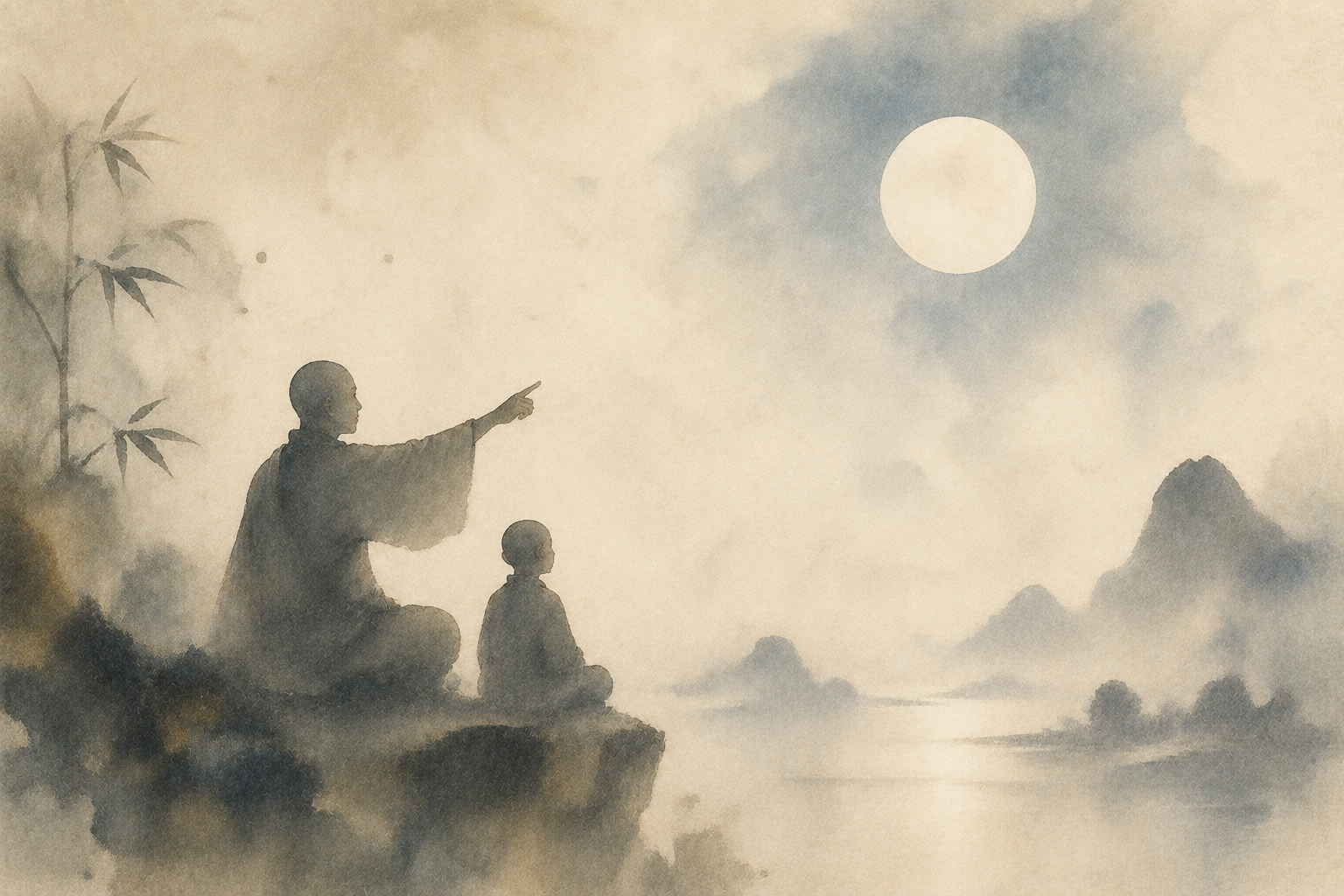
The image is simple: someone points at the moon so you can look up and see it. If you stare at the finger, debate the finger, or measure the finger, you miss the moon entirely. In Buddhist language, the “finger” can be a teaching, a practice instruction, a doctrine, a story, a ritual, a teacher’s words, or even your own internal commentary about what’s happening. The “moon” is what those things are trying to reveal: direct experience, as it is, before you wrap it in conclusions.
This matters because most of our suffering is amplified by the mind’s habit of substituting concepts for contact. We don’t just feel sadness; we narrate it. We don’t just experience uncertainty; we build a courtroom around it. We don’t just notice a moment of peace; we immediately try to own it, repeat it, and explain it. The metaphor points to a different move: use words to orient yourself, then look where they indicate.
A Clear Way to Understand the Metaphor
The core view behind “finger pointing at the moon” is not a belief you’re asked to adopt; it’s a lens for checking what you’re actually relating to in any moment. Are you relating to the living situation itself, or to your idea of it? Are you responding to what someone said, or to the story you built about what they meant? The metaphor invites a gentle audit of attention: where is your mind looking right now?
Words and teachings are treated as skillful tools—useful because they can direct attention. A good instruction can help you notice something you were overlooking: tension in the jaw, the way craving feels in the body, the speed of judgment, the quiet relief of exhaling. But the instruction is not the thing itself. The map is not the territory; the label is not the labeled; the explanation is not the explained.
In practice, this lens reduces overinvestment in “correct” phrasing. It doesn’t say truth is unreachable or that language is worthless. It says language has a job: to point. When it has done that job, clinging to it becomes a subtle form of distraction. The mind can hide inside commentary—collecting interpretations, polishing identity, and avoiding the raw simplicity of what’s present.
So the lesson is surprisingly down-to-earth: let teachings do their work, then verify in your own experience. If a phrase helps you see more clearly, it’s functioning as a finger. If a phrase becomes something you defend, perform, or use to feel superior, you’ve likely started treating the finger as the moon.
GASSHO
Ask and learn about Buddhism in daily life.
GASSHO is a Buddhist community app where you can learn Buddhist teachings and ask questions to the head priest of Kongosanmaiin Temple on Mount Koya.
How It Shows Up in Ordinary Moments
Imagine you’re stressed and you tell yourself, “I should be calm.” That sentence sounds like guidance, but it often becomes a new layer of pressure. The “finger” is the concept of calm; the “moon” is the actual texture of stress right now—tightness in the chest, shallow breathing, a restless urge to fix things. When you look at the moon, you stop arguing with the moment and start noticing it.
Or consider a disagreement. Someone says something sharp, and your mind instantly produces a story: “They don’t respect me.” That story might be true, partly true, or not true at all—but it’s still a finger. The moon is what you can directly observe: the words that were spoken, the tone, your body’s reaction, the heat in the face, the impulse to retaliate, the narrowing of attention. Seeing that clearly gives you options you don’t have when you’re trapped inside the story.
This also appears in spiritual conversations. People trade quotes, definitions, and “takes,” and the room fills with fingers. None of that is automatically wrong; it can be helpful orientation. The problem is the subtle replacement: you leave feeling like you “got it” because you can repeat the phrasing, even though your relationship to anger, craving, or fear hasn’t shifted by a millimeter. The metaphor asks for a more honest measure: did you look up?
In meditation or quiet reflection, the same pattern happens internally. A thought arises: “This is going well” or “This is pointless.” Those judgments are fingers. If you follow them, you’re no longer with breath, sound, sensation, or the simple fact of awareness. If you recognize them as pointers—mental events that can be noticed—you return to the moon: the immediate field of experience.
Even positive ideas can become sticky. You might have a meaningful insight and then spend days trying to recreate it. The memory becomes the finger; the moon is the present moment, which never repeats itself in the same way. When you stop chasing the remembered “moon,” you can meet what’s here without comparing it to what was.
There’s also a quieter version: overthinking your own identity. “I’m the kind of person who…” is often a finger that points away from what you’re actually feeling and doing. The moon is simpler: right now, there is kindness or irritation; right now, there is avoidance or honesty; right now, there is openness or contraction. Noticing that doesn’t require a grand self-definition.
In all these cases, the shift is small but real: from commentary to contact. You don’t need to destroy language. You just learn to recognize when language has become a substitute for seeing.
Where People Get Stuck With “Finger” and “Moon”
A common misunderstanding is thinking the metaphor means “words are bad.” That can lead to a performative anti-intellectualism where people refuse clarity, refuse questions, or treat confusion as spiritual depth. But the metaphor itself uses words and images—because words can help. The point is not to abandon language; it’s to stop worshiping it.
Another trap is using “finger pointing at the moon” as a way to dismiss others: “You’re stuck in concepts.” Sometimes that’s true, but it’s also an easy way to avoid explaining yourself or listening carefully. Ironically, “I’m beyond concepts” can become one of the stickiest concepts of all—an identity built from supposed wordlessness.
People also confuse the metaphor with the idea that truth is purely private and cannot be communicated. Yet communication works all the time: you can point to a location, teach a skill, describe a feeling, and help someone see what they hadn’t noticed. Teachings can be accurate pointers. The caution is about confusing the pointer with the pointed-to, not about denying the possibility of pointing.
Finally, some take the metaphor as permission to ignore ethical or practical guidance: “Rules are just fingers.” But guidance can be a finger that points to consequences you might otherwise overlook. If a teaching helps reduce harm and confusion, it’s doing its job. The question is whether you use it to see more clearly—or cling to it to feel right.
Why This Lesson Changes Daily Life
When you stop confusing the finger for the moon, conversations get simpler. You listen for what someone is trying to indicate rather than pouncing on their wording. You ask, “What do you mean in experience?” instead of “Is your phrasing correct?” That shift alone reduces a lot of needless conflict.
It also makes your inner life less crowded. Many mental loops are just fingers arguing with other fingers: one thought insists, another resists, a third judges the whole process. Returning to the moon means returning to what’s verifiable: sensations, emotions, impulses, and the immediate facts of the situation. From there, action tends to be more proportionate.
This lesson supports humility without self-erasure. If your views are pointers rather than possessions, you can hold them lightly. You can revise them when new information appears. You can admit, “I don’t know,” without collapsing. The moon doesn’t require you to win an argument; it requires you to look.
It also protects you from spiritual consumerism—the habit of collecting teachings like trophies. A teaching is valuable when it changes how you meet your life: how you speak, how you pause, how you repair, how you notice. If it stays at the level of impressive language, it’s probably still a finger you’re staring at.
Most importantly, “finger pointing at the moon” brings you back to intimacy with reality. Not dramatic intimacy—just the plain closeness of being here: hearing sound, feeling breath, noticing tension soften, recognizing a reactive impulse before it becomes a mess. The moon is always available, and it doesn’t demand perfect concepts.
Conclusion
“The finger pointing at the moon” is a reminder to use teachings the way they’re meant to be used: as directions, not destinations. Words can guide you toward what’s real, but they can’t replace the act of seeing. When you notice yourself clinging to explanations—your own or someone else’s—try the simplest experiment: look up. Return to what’s happening in the body, in the mind, and in the situation before the commentary hardens into certainty.
If you keep the metaphor practical, it becomes less of a mystical slogan and more of a daily skill: letting language point, then meeting life directly. The moon doesn’t need defending. It needs attention.
Ask a Buddhist priest
Have a question about Buddhism?
In the GASSHO app, you can ask questions about Buddhist teachings, daily concerns, and how to understand Buddhism in everyday life.
Frequently Asked Questions
- FAQ 1: What does “finger pointing at the moon” mean in Buddhism?
- FAQ 2: What is the “finger” in the finger pointing at the moon metaphor?
- FAQ 3: What is the “moon” in the finger pointing at the moon metaphor?
- FAQ 4: Is “finger pointing at the moon” saying that words are useless?
- FAQ 5: How do I know when I’m “staring at the finger” instead of seeing the moon?
- FAQ 6: Can the finger pointing at the moon apply to meditation instructions?
- FAQ 7: Does the finger pointing at the moon metaphor mean truth can’t be taught?
- FAQ 8: Why is the finger pointing at the moon metaphor so common in Buddhist discussions?
- FAQ 9: How can I “look at the moon” in a practical way?
- FAQ 10: Can “finger pointing at the moon” be used to dismiss questions or debate?
- FAQ 11: Is the “moon” in finger pointing at the moon a mystical experience?
- FAQ 12: How does finger pointing at the moon relate to suffering?
- FAQ 13: Can the finger pointing at the moon metaphor apply to spiritual books and quotes?
- FAQ 14: What’s a healthy way to use the “finger” without clinging to it?
- FAQ 15: What is the main lesson of the finger pointing at the moon in one sentence?
FAQ 1: What does “finger pointing at the moon” mean in Buddhism?
Answer: It means teachings, words, and concepts are pointers to direct reality, not reality itself. The “finger” is the explanation; the “moon” is what you can actually experience when you look for yourself.
Takeaway: Use teachings to orient attention, then verify in experience.
FAQ 2: What is the “finger” in the finger pointing at the moon metaphor?
Answer: The “finger” is anything that indicates: a phrase, doctrine, instruction, story, or even your own mental label. It’s helpful as a guide, but it isn’t the thing being indicated.
Takeaway: A pointer is useful, but it’s not the destination.
FAQ 3: What is the “moon” in the finger pointing at the moon metaphor?
Answer: The “moon” is direct seeing—what’s actually happening in lived experience before you turn it into a story. It can mean reality as-it-is, not as you describe it.
Takeaway: Look for what’s present, not just what’s explainable.
FAQ 4: Is “finger pointing at the moon” saying that words are useless?
Answer: No. It says words are limited and should be used as tools. They can guide attention effectively, but clinging to them can block direct understanding.
Takeaway: Language can help—just don’t confuse it with what it points to.
FAQ 5: How do I know when I’m “staring at the finger” instead of seeing the moon?
Answer: You’re likely staring at the finger when you’re fixated on definitions, winning arguments, collecting quotes, or repeating “correct” phrasing while ignoring what you can observe right now in your mind and body.
Takeaway: If it’s all commentary and no contact, you’ve probably missed the moon.
FAQ 6: Can the finger pointing at the moon apply to meditation instructions?
Answer: Yes. Instructions are pointers meant to help you notice experience (breath, sensation, thought). If you cling to the instruction as a performance or a rule, you may miss what it was meant to reveal.
Takeaway: Let instructions guide attention, then return to immediate experience.
FAQ 7: Does the finger pointing at the moon metaphor mean truth can’t be taught?
Answer: It suggests truth can be indicated but not fully contained in words. Teaching can point effectively, but the learner still has to look and confirm through experience.
Takeaway: Teachings can point; seeing is still your job.
FAQ 8: Why is the finger pointing at the moon metaphor so common in Buddhist discussions?
Answer: Because it addresses a universal problem: mistaking concepts for reality. It’s a compact reminder to keep practice grounded in what’s directly knowable rather than purely theoretical.
Takeaway: It’s popular because it corrects a common mental habit.
FAQ 9: How can I “look at the moon” in a practical way?
Answer: Pause and check what’s immediate: bodily sensations, emotional tone, the actual words spoken, the impulse arising, the breath moving. Treat your interpretations as hypotheses, not facts.
Takeaway: Return from interpretation to observation.
FAQ 10: Can “finger pointing at the moon” be used to dismiss questions or debate?
Answer: It can be misused that way. The metaphor isn’t a license to shut down inquiry; it’s a reminder to keep inquiry connected to experience rather than trapped in word-games.
Takeaway: Don’t use the metaphor as a conversation-stopper—use it as a reality-check.
FAQ 11: Is the “moon” in finger pointing at the moon a mystical experience?
Answer: Not necessarily. The “moon” can be very ordinary: the felt sense of anger, the simplicity of breathing, the immediacy of hearing, the moment you notice grasping and release it.
Takeaway: The moon can be plain, present experience—not something exotic.
FAQ 12: How does finger pointing at the moon relate to suffering?
Answer: Suffering often intensifies when we cling to stories, labels, and rigid views (the finger) instead of meeting what’s happening directly (the moon). Direct contact can reduce extra mental struggle.
Takeaway: Less clinging to concepts often means less added pain.
FAQ 13: Can the finger pointing at the moon metaphor apply to spiritual books and quotes?
Answer: Yes. Books and quotes can orient you, but they’re still pointers. If reading replaces practice—meaning you collect ideas without looking into your own experience—you’re holding the finger tightly.
Takeaway: Read to be guided, not to substitute for seeing.
FAQ 14: What’s a healthy way to use the “finger” without clinging to it?
Answer: Treat teachings as provisional: apply them, observe results, and adjust. When a pointer helps you see clearly, appreciate it—then let it fade into the background as you stay with what’s real.
Takeaway: Use pointers pragmatically, then release them.
FAQ 15: What is the main lesson of the finger pointing at the moon in one sentence?
Answer: Don’t confuse explanations for reality—let words point you toward direct experience, then look for yourself.
Takeaway: Let the finger point; keep your eyes on the moon.