



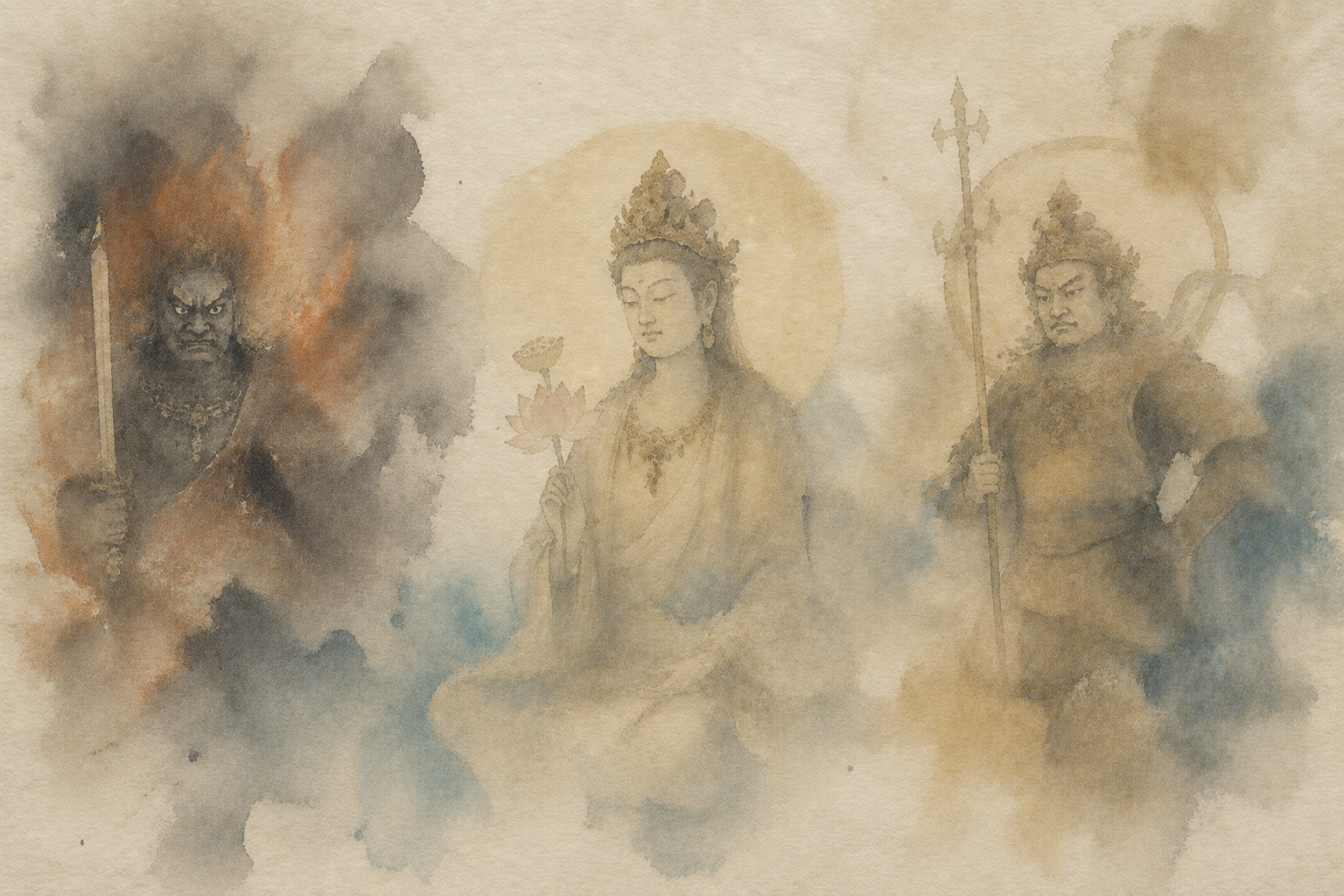
Why Do Buddhist Deities Look So Different? Peaceful, Fierce, and Protective Forms
Quick Summary
- Buddhist deities look different because their forms are visual “languages” for different human needs: calm, courage, boundaries, clarity, and care.
- Peaceful and fierce images aren’t “good vs. bad”; they’re different ways compassion appears when meeting different kinds of suffering.
- Many arms, eyes, and symbolic tools are not literal anatomy—they’re shorthand for abilities like attention, protection, and skillful action.
- Local cultures shaped clothing, faces, colors, and artistic styles, so the “same” deity can look very different across regions.
- Protective forms often look intense because they represent cutting through fear, confusion, and harmful habits—not harming people.
- What matters most is what the image trains in you: steadiness, kindness, honesty, and wise restraint.
- If a depiction unsettles you, treat that reaction as information—then choose a form that supports clarity rather than forcing yourself.
Introduction
You see one Buddhist deity that looks serene and almost human, then another with fangs, flames, and a glare that feels like a warning—and it’s hard not to wonder if you’re looking at completely different religions. The confusion is understandable, but the mismatch is the point: Buddhist imagery is designed to meet different inner states, not to present one “correct” face of holiness. At Gassho, we focus on practical, experience-based ways to understand Buddhist symbols without requiring you to adopt anyone’s metaphysics.
When people say “Buddhist deities look different,” they’re usually noticing three things at once: the emotional tone (peaceful vs. fierce), the symbolic anatomy (many arms/eyes/heads), and the cultural styling (Indian, Himalayan, Chinese, Japanese, Southeast Asian aesthetics). Each layer has its own logic, and once you see that logic, the variety stops feeling random.
A Practical Lens for Understanding Different Deity Forms
A helpful way to read Buddhist deity images is to treat them as mirrors for the mind rather than portraits of supernatural individuals. The form is a teaching device: it communicates qualities—like calm, protection, discernment, or courage—in a way that bypasses long explanations and lands directly in the nervous system.
Peaceful forms emphasize ease, openness, and steadiness. They often communicate, “Nothing needs to be forced right now.” Fierce forms emphasize urgency, boundaries, and the willingness to cut through confusion. They communicate, “Stop negotiating with what harms you.” Both can point to compassion; they simply express compassion with different “faces,” because suffering shows up in different ways.
Symbolic features—multiple arms, eyes, weapons, flames, skulls, animal mounts—are best read as visual verbs. Arms suggest capacity to act; eyes suggest awareness; a rope or lasso suggests gathering scattered attention; a sword suggests discernment; fire suggests transformation. The image is less about what a deity “is” and more about what a quality “does.”
Finally, Buddhist art is also human art. Communities used familiar aesthetics to make teachings feel close: local clothing, jewelry, facial features, and artistic conventions. So the same compassionate principle can be dressed in different cultural clothing without changing its function.
GASSHO
Ask and learn about Buddhism in daily life.
GASSHO is a Buddhist community app where you can learn Buddhist teachings and ask questions to the head priest of Kongosanmaiin Temple on Mount Koya.
How These Images Show Up in Ordinary Inner Life
On a calm day, a peaceful deity makes immediate sense. Your body already knows what “settled” feels like, so the image reads as reassurance: soften the jaw, unclench the hands, let the breath be natural. The deity’s stillness becomes a cue for your own.
On a stressful day, that same peaceful image can feel distant—almost naive. When you’re flooded with irritation or fear, “just relax” can sound like bad advice. This is where fierce and protective forms start to feel psychologically accurate: they match the intensity of what you’re experiencing, without pretending it isn’t intense.
Notice what happens when you look at a wrathful face: your attention sharpens. You may feel a reflexive recoil, then a second reaction—curiosity, respect, or even relief. That sequence matters. The image is doing something: it’s interrupting autopilot and making your mind more alert.
Protective imagery also speaks to boundaries. Many people struggle not because they lack kindness, but because they lack a clean “no.” A guardian figure holding a weapon can function as a reminder that compassion includes refusal: refusal to indulge harmful habits, refusal to enable cruelty, refusal to abandon your own integrity.
Multiple arms and eyes can reflect what it feels like to be pulled in many directions—work, family, messages, worries—while still needing to respond wisely. The image can normalize complexity: you don’t need one perfect move; you need flexible, responsive attention.
Even the parts that seem “dark” can map to ordinary experience. Skulls, cemeteries, and flames can point to impermanence and the heat of change. They can also bring honesty: life includes loss, aging, and endings, and a mature compassion doesn’t look away.
If a depiction triggers discomfort, you don’t have to override that. You can simply note: “This is what my mind does around intensity.” Then choose an image that supports steadiness today. The point isn’t to prove bravery; it’s to cultivate clarity.
Common Misreadings That Make the Variety Seem Contradictory
One common misunderstanding is assuming fierce forms represent anger in the ordinary sense. In everyday life, anger often narrows perception and seeks a target. In Buddhist iconography, wrathful energy is frequently depicted as precise and protective—more like a surgeon’s decisiveness than a tantrum. The face is intense because the job is to confront what we avoid.
Another misreading is taking symbols literally. Many arms can look “monstrous” if you expect realism, but the intent is communication, not anatomy. The image is closer to a diagram than a photograph: it compresses meaning into a single glance.
People also assume different appearances mean different “rankings” of truth, as if one region got it right and another got it wrong. Often, the differences are artistic and cultural adaptations—ways of translating the same values into a local visual vocabulary. Variation can be a sign of living tradition rather than disagreement.
Finally, it’s easy to project a Western “one God, one face” expectation onto Buddhist imagery. But these forms are frequently understood as skillful representations of qualities and functions. When you shift from “Who is this?” to “What does this train in me?” the diversity becomes coherent.
Why the Differences Matter for Practice and Daily Choices
The way Buddhist deities look different matters because images shape attention. A peaceful form can train softness and patience; a protective form can train courage and boundaries. In daily life, you need both: warmth without collapse, strength without cruelty.
These depictions also offer a nonverbal way to work with emotion. When you’re anxious, you might borrow steadiness from a calm image. When you’re stuck in self-doubt, you might borrow decisiveness from a fierce protector. It’s not about worshiping a mood; it’s about remembering capacities you already have.
They can also reduce shame. If compassion can look gentle or fierce, then your own care for others can take different shapes too: listening quietly, telling the truth, setting limits, or stepping in to prevent harm. The images validate that “kind” is not always “nice.”
Most importantly, the variety invites discernment. Instead of asking which image is “right,” you can ask which quality is needed now—and whether your current reaction is avoidance, attraction, or clear seeing. That question is immediately practical.
Conclusion
Buddhist deities look different because they’re meant to communicate different functions: soothing, awakening, protecting, clarifying, and strengthening. Peaceful forms speak to the mind that needs rest; fierce forms speak to the mind that needs honesty and backbone; protective forms speak to the mind that needs safe boundaries. When you read the imagery as symbolic language shaped by culture and psychology, the diversity stops being confusing and starts being useful.
If you’re unsure where to begin, start with your own response. Which image helps you become a little more steady, a little more kind, and a little more clear today? That’s the form doing its job.
Ask a Buddhist priest
Have a question about Buddhism?
In the GASSHO app, you can ask questions about Buddhist teachings, daily concerns, and how to understand Buddhism in everyday life.
Frequently Asked Questions
- FAQ 1: Why do Buddhist deities look different from each other?
- FAQ 2: Why do some Buddhist deities look peaceful while others look fierce?
- FAQ 3: Does a wrathful-looking Buddhist deity represent evil or violence?
- FAQ 4: Why do Buddhist deities sometimes have many arms or many heads?
- FAQ 5: Why do Buddhist deities look different in India, Tibet, China, Japan, and Southeast Asia?
- FAQ 6: Why do Buddhist deities hold weapons if Buddhism teaches non-harming?
- FAQ 7: Why do some Buddhist deities look scary with fangs, bulging eyes, or flames?
- FAQ 8: Why do Buddhist deities look different even when they have the same name?
- FAQ 9: Why do Buddhist deities look male in some images and female in others?
- FAQ 10: Why do Buddhist deities look different in color, like white, green, red, or blue?
- FAQ 11: Why do Buddhist deities look different with different hand gestures?
- FAQ 12: Why do Buddhist deities look different with animal mounts, halos, or elaborate crowns?
- FAQ 13: Why do Buddhist deities look different from Buddhas and bodhisattvas in statues and paintings?
- FAQ 14: Why do Buddhist deities look different across temples, even in the same country?
- FAQ 15: If Buddhist deities look different, how can I tell who I’m looking at?
FAQ 1: Why do Buddhist deities look different from each other?
Answer: They look different because the images are designed to express different qualities and functions—calm reassurance, protective strength, sharp discernment, or compassionate activity—using visual symbols. Cultural art styles also shape how the same figure is depicted across regions and time periods.
Takeaway: Different looks usually signal different symbolic “jobs,” not different religions.
FAQ 2: Why do some Buddhist deities look peaceful while others look fierce?
Answer: Peaceful forms emphasize ease, openness, and stability; fierce forms emphasize protection, urgency, and cutting through confusion. Both can represent compassion—one soothes, the other confronts what causes harm.
Takeaway: Peaceful and fierce are two expressions of care responding to different needs.
FAQ 3: Does a wrathful-looking Buddhist deity represent evil or violence?
Answer: In Buddhist iconography, wrathful appearance typically symbolizes strong protective energy and uncompromising clarity, not evil. The “threat” is aimed at ignorance, fear, and harmful patterns rather than at ordinary people.
Takeaway: Fierce imagery is usually about protection and transformation, not cruelty.
FAQ 4: Why do Buddhist deities sometimes have many arms or many heads?
Answer: Multiple arms and heads are symbolic shorthand for expanded capacity—many ways of helping, many perspectives, and responsive action. It’s a visual way to show “able to meet many situations,” not a literal body description.
Takeaway: Extra limbs and heads are symbols of capability and awareness.
FAQ 5: Why do Buddhist deities look different in India, Tibet, China, Japan, and Southeast Asia?
Answer: As Buddhism moved through cultures, artists used local aesthetics—facial features, clothing, color palettes, and design conventions—so the teachings felt familiar and communicative. The core symbolism can remain while the style changes.
Takeaway: Regional differences often reflect artistic translation, not contradiction.
FAQ 6: Why do Buddhist deities hold weapons if Buddhism teaches non-harming?
Answer: Weapons in Buddhist art are usually symbolic tools: a sword can represent discernment that cuts confusion; a vajra-like implement can represent indestructible clarity; a bow or spear can represent focused intention. The message is inner protection and wise action, not aggression.
Takeaway: “Weapons” often symbolize cutting through delusion, not hurting others.
FAQ 7: Why do some Buddhist deities look scary with fangs, bulging eyes, or flames?
Answer: Those features communicate intensity and immediacy: fangs and wide eyes can symbolize fearless confrontation with confusion, and flames often symbolize transformation—burning up what obscures clarity. The “scary” look is a deliberate visual shock that wakes attention up.
Takeaway: Scary elements are often wake-up symbols, not threats.
FAQ 8: Why do Buddhist deities look different even when they have the same name?
Answer: The same named figure can be depicted with different iconographic details depending on region, era, and artistic tradition, and sometimes different aspects are emphasized (mercy, protection, wisdom, or activity). Small changes can highlight a different teaching focus.
Takeaway: One name can carry multiple visual “profiles” that stress different qualities.
FAQ 9: Why do Buddhist deities look male in some images and female in others?
Answer: Gender presentation in Buddhist art can be symbolic, cultural, or tied to which qualities are being emphasized (nurturing, protection, wisdom, or strength). In many contexts, the form is a teaching symbol rather than a claim about a fixed biological identity.
Takeaway: Gendered appearance often communicates qualities and cultural style more than literal identity.
FAQ 10: Why do Buddhist deities look different in color, like white, green, red, or blue?
Answer: Colors are symbolic cues that point to different qualities—such as calm clarity, active compassion, transformative energy, or protective strength—depending on the specific iconography. Color helps the viewer “read” the function of the form quickly.
Takeaway: Color is part of the symbolic language that explains what the form represents.
FAQ 11: Why do Buddhist deities look different with different hand gestures?
Answer: Hand gestures (mudras) are visual signals for actions and intentions—reassurance, generosity, teaching, protection, or meditation. Changing the gesture changes the “message” of the image even if the figure is otherwise similar.
Takeaway: Gestures are like captions: they tell you what quality is being expressed.
FAQ 12: Why do Buddhist deities look different with animal mounts, halos, or elaborate crowns?
Answer: These elements are symbolic attributes: an animal mount can represent a mastered energy or instinct; halos can represent awakened clarity; crowns and ornaments can represent noble qualities or perfected virtues. They’re not decoration only—they’re meaning.
Takeaway: “Accessories” in deity art usually function as symbols, not fashion.
FAQ 13: Why do Buddhist deities look different from Buddhas and bodhisattvas in statues and paintings?
Answer: Different categories of figures are often depicted with different visual conventions to communicate their role: a Buddha image may emphasize simplicity and stillness, while other figures may emphasize compassionate activity or protection through more complex symbolism.
Takeaway: Visual differences often reflect different roles and teaching functions.
FAQ 14: Why do Buddhist deities look different across temples, even in the same country?
Answer: Temples may follow different artistic workshops, historical periods, local patronage, and iconographic preferences. Materials (wood, bronze, stone), restoration choices, and regional aesthetics can all change how a deity appears while keeping key identifying symbols.
Takeaway: Local history and artistry strongly influence how a deity is portrayed.
FAQ 15: If Buddhist deities look different, how can I tell who I’m looking at?
Answer: Look for identifying markers: hand gestures, objects held, number of arms/heads, posture, associated animals, and consistent symbolic items (like a lotus, wheel, sword, or specific color). Museum labels and temple guides often list these attributes because they function like a visual ID system.
Takeaway: Identity is usually in the symbols and attributes, not just the face.