



Who Is Hotei? The Laughing Figure of Happiness in Japanese Buddhism
Quick Summary
- Hotei is the smiling, big-bellied monk figure often linked with good fortune, generosity, and ease.
- In Hotei Buddhism, the point isn’t “worshiping happiness,” but using Hotei as a lens for loosening tightness and self-importance.
- Hotei is commonly associated with the Seven Lucky Gods in Japan and is sometimes (loosely) connected with Maitreya in popular culture.
- His cloth bag symbolizes practical kindness: carrying what people need, not what boosts your image.
- The laughter matters because it interrupts fear-based thinking and invites a wider view.
- Misunderstandings are common: Hotei is not simply “the Japanese Buddha of wealth,” and not a shortcut to prosperity.
- A useful approach is to treat Hotei as a reminder to soften, share, and return to what’s simple.
Introduction: Why Hotei Confuses People (and Why That’s Useful)
If you’ve seen Hotei—round belly, wide grin, sack over his shoulder—you may be unsure whether you’re looking at a Buddha, a folk god, a lucky charm, or just a cheerful statue for restaurants. That confusion is understandable, and it’s also the doorway: Hotei Buddhism is less about pinning down a label and more about noticing what happens in you when you meet a figure who refuses to look “serious” while still pointing to something deeply human. Gassho is a Zen/Buddhism site focused on clear, grounded explanations without hype.
Who Hotei Is: A Laughing Monk, Not a Mood
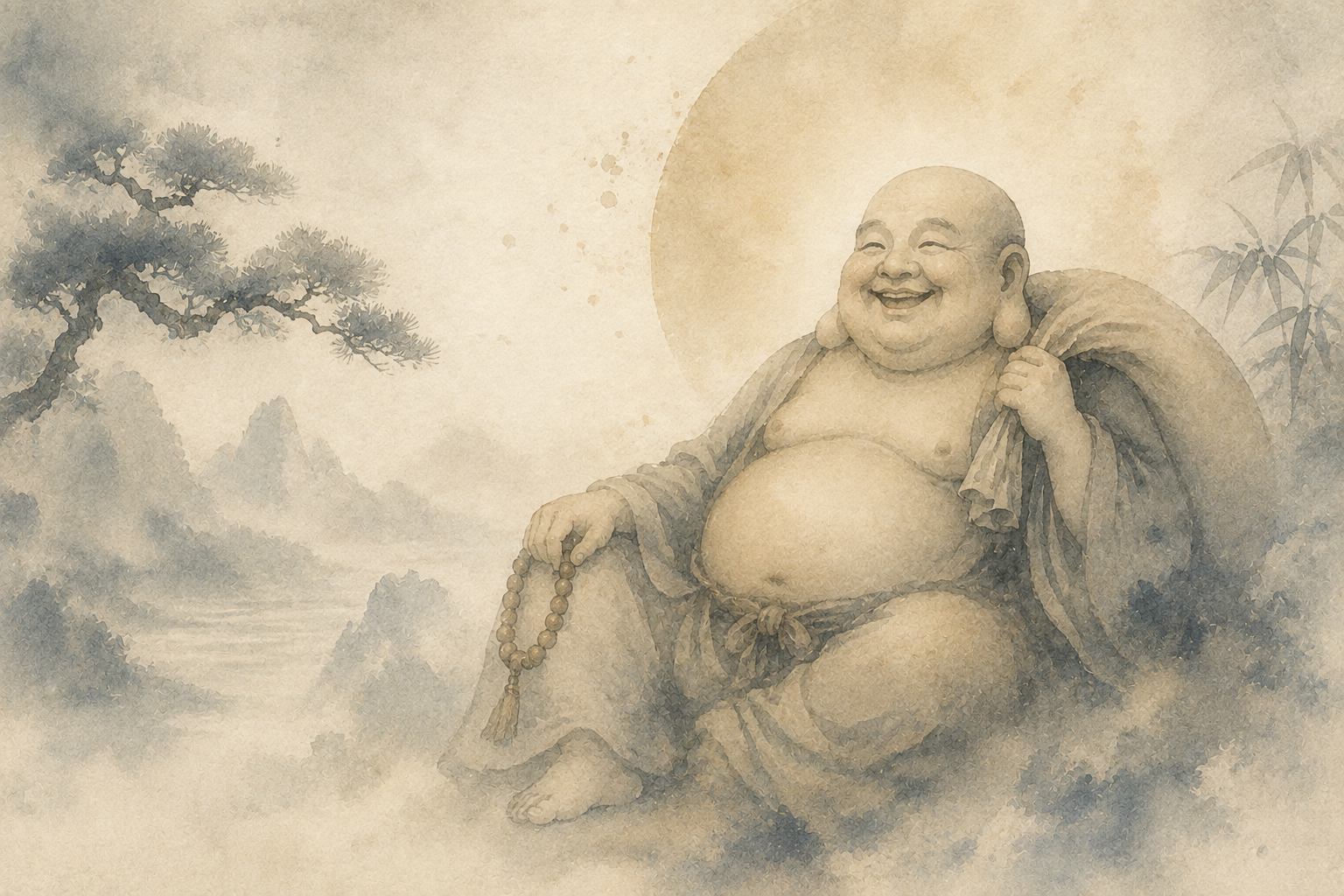
Hotei is typically depicted as a wandering monk with a big belly, a bright smile, and a cloth bag. In Japanese culture he’s widely recognized as a symbol of good fortune, contentment, and generous spirit. In Buddhist-adjacent contexts, he often functions as a reminder that warmth and simplicity can be part of spiritual life rather than a distraction from it.
Historically, Hotei is associated with Budai (often spelled Pu-tai), a Chinese monk from around the late Tang to Five Dynasties period who became a beloved folk figure. Over time, stories and images of Budai traveled and transformed, and in Japan the figure became known as Hotei. The details vary by region and tradition, which is one reason people encounter mixed explanations.
In popular understanding, Hotei is sometimes linked with Maitreya (the future Buddha). You’ll see this stated strongly in some places and more cautiously in others. For most everyday encounters with Hotei Buddhism, the practical point is not to win a historical argument, but to recognize what the image is doing: it offers a counterweight to grim striving and performative holiness.
Hotei is also one of Japan’s Seven Lucky Gods (Shichifukujin) in many modern presentations. That placement can make him feel “non-Buddhist,” yet the boundary between Buddhist imagery and folk practice has long been porous in lived Japanese religion. Hotei often sits right in that overlap—accessible, friendly, and easy to misunderstand if you demand a single category.
GASSHO
Ask and learn about Buddhism in daily life.
GASSHO is a Buddhist community app where you can learn Buddhist teachings and ask questions to the head priest of Kongosanmaiin Temple on Mount Koya.
The Core Lens of Hotei Buddhism: Softening the Grip
Hotei Buddhism can be approached as a lens: what changes when you stop treating life as a problem you must clench your way through? The laughing figure doesn’t argue with you; he simply presents an alternative posture toward experience—open hands instead of fists, a relaxed belly instead of a braced chest.
Seen this way, Hotei is not a doctrine about “being happy all the time.” He points to the difference between forced positivity and genuine ease. Forced positivity tries to replace uncomfortable feelings with a smile; genuine ease makes room for discomfort without building an identity around it.
The bag Hotei carries is a useful symbol in this lens. It suggests a life oriented toward what’s needed in the moment—food, small gifts, practical help, humor—rather than what proves your worth. In other words, the “spiritual” move is not to float above ordinary life, but to meet it with less self-centered tension.
Hotei’s laughter can also be read as a gentle disruption. When the mind is locked into worry, comparison, or control, laughter breaks the spell for a second. That second matters. It’s a small opening where you can see that your current story is not the whole world.
How Hotei Shows Up in Ordinary Experience
You’re rushing, already late, and your mind is narrating a familiar script: “This always happens. I can’t handle my life.” In that moment, Hotei functions like a mental image that loosens the script. Not by denying the rush, but by interrupting the extra layer of self-blame that turns a schedule problem into an identity problem.
Or you’re in a conversation and you feel the urge to look smart, correct someone, or win. The Hotei lens notices the tightening: shoulders lift, jaw sets, attention narrows. The question becomes simple: can you relax the need to be “right” by even 5%? That small release often changes the whole tone of the exchange.
Sometimes it’s about money or security. You might notice how quickly the mind converts “I want stability” into “I must hoard, I must fear, I must never be caught unprepared.” Hotei’s big bag and easy smile can be read as a reminder that preparedness and panic are not the same thing. You can plan without worshiping anxiety.
In daily irritations—slow lines, noisy neighbors, a messy kitchen—Hotei points to the difference between responding and rehearsing. Responding is direct: clean, ask, adjust, leave. Rehearsing is the endless inner monologue about how things “should” be and what it “means” about you. The laughter is a cue to drop the rehearsal and return to the next doable action.
There’s also the experience of being seen. Many people carry a private sense of not being acceptable unless they’re productive, composed, and impressive. Hotei’s body—unhidden belly, unguarded smile—quietly challenges that. The image suggests that dignity doesn’t require constant self-editing.
When you feel emotionally heavy, Hotei doesn’t demand that you become light. Instead, he models a kind of friendliness toward the human condition. The internal move is subtle: you notice the heaviness, you stop adding shame to it, and you allow a little space around it.
And when things are genuinely good—good food, a shared joke, a safe evening—Hotei is a reminder to actually receive it. Many minds can’t rest even in comfort; they immediately scan for what’s next. The Hotei lens says: let the good be good, without turning it into a possession.
Common Misunderstandings About Hotei
Misunderstanding 1: “Hotei is just the Buddha of wealth.” Hotei is often placed in prosperity contexts, but reducing him to a money symbol flattens the image. The deeper theme is generosity and ease—how you relate to having, lacking, sharing, and fearing.
Misunderstanding 2: “Hotei Buddhism is about being cheerful no matter what.” Hotei’s smile is not a command to suppress sadness or anger. It’s more like a reminder that your emotions don’t have to become a rigid identity, and that humor can coexist with seriousness.
Misunderstanding 3: “If I rub Hotei’s belly, my luck will change.” Some folk practices involve touching statues for luck, and there’s nothing inherently wrong with a harmless custom. But if you treat Hotei as a vending machine for outcomes, you miss the practical invitation: loosen grasping, practice generosity, and notice the mind’s compulsions.
Misunderstanding 4: “Hotei is either fully Buddhist or not Buddhist at all.” In Japan, religious life has often blended Buddhist, local, and folk elements. Hotei sits in that blended space. For many people, the value is experiential: what the symbol evokes and how it shapes conduct.
Misunderstanding 5: “The belly means indulgence.” The big belly is frequently read as abundance and openness, not necessarily excess. It can symbolize a life that isn’t constantly defended—less guarded, less brittle, less obsessed with appearing perfect.
Why Hotei Still Matters in Daily Life
Modern life trains the nervous system to stay slightly clenched: optimize, compare, perform, worry. Hotei Buddhism matters because it offers a counter-image that is easy to remember. You don’t need special vocabulary to understand a laughing monk with an open posture.
Hotei also reframes happiness as something sturdier than “getting what you want.” His presence suggests that contentment can come from reduced friction with reality: fewer battles you don’t need to fight, fewer stories you don’t need to believe, more willingness to share what you can.
Practically, the Hotei lens supports three everyday shifts: (1) notice where you’re gripping, (2) soften without collapsing, and (3) turn outward through small acts of generosity. These are not grand spiritual achievements; they’re ordinary human skills that make relationships and inner life less harsh.
Finally, Hotei’s humor is a kind of medicine for self-importance. Not humiliation—just perspective. When you can laugh gently at your own tight patterns, you’re less trapped by them. That’s a quiet freedom that doesn’t depend on perfect circumstances.
Conclusion: Meeting Hotei as a Reminder, Not a Requirement
Hotei Buddhism doesn’t ask you to adopt a new personality or chase a permanent smile. It invites you to recognize the moment you start hardening—around status, control, fear, or scarcity—and to experiment with softening instead. If Hotei’s grin feels almost too simple, that may be the point: the most helpful reminders are the ones you can actually carry into a stressful Tuesday afternoon.
Ask a Buddhist priest
Have a question about Buddhism?
In the GASSHO app, you can ask questions about Buddhist teachings, daily concerns, and how to understand Buddhism in everyday life.
Frequently Asked Questions
- FAQ 1: Who is Hotei in Buddhism?
- FAQ 2: Is Hotei the same as the Buddha?
- FAQ 3: Why is Hotei called the Laughing Buddha?
- FAQ 4: What does Hotei’s bag represent in Hotei Buddhism?
- FAQ 5: Is Hotei one of the Seven Lucky Gods, and does that relate to Hotei Buddhism?
- FAQ 6: Is Hotei connected to Maitreya in Hotei Buddhism?
- FAQ 7: What does Hotei’s big belly mean in Hotei Buddhism?
- FAQ 8: Is Hotei Buddhism about happiness and good luck?
- FAQ 9: Do people pray to Hotei in Hotei Buddhism?
- FAQ 10: Where is Hotei commonly found in Japan?
- FAQ 11: Is rubbing Hotei’s belly part of Hotei Buddhism?
- FAQ 12: How is Hotei different from other Buddhist figures in Japan?
- FAQ 13: What is the main teaching people take from Hotei Buddhism?
- FAQ 14: Can Hotei Buddhism be practiced without rituals?
- FAQ 15: Is Hotei Buddhism a separate Buddhist tradition?
FAQ 1: Who is Hotei in Buddhism?
Answer: In Hotei Buddhism, Hotei is commonly understood as the Japanese form of the laughing monk Budai, a folk-Buddhist figure associated with generosity, contentment, and an unguarded, friendly presence. He’s often treated more as a living symbol than a strict doctrinal figure.
Takeaway: Hotei is best approached as a reminder of ease and generosity, not just a label to classify.
FAQ 2: Is Hotei the same as the Buddha?
Answer: Not exactly. In Hotei Buddhism, Hotei is widely depicted like a monk and sometimes called “Laughing Buddha” in popular culture, but he is not the historical Buddha (Shakyamuni). The nickname reflects his imagery and the feelings he evokes rather than a precise identity claim.
Takeaway: “Laughing Buddha” is a popular term; it doesn’t mean Hotei equals the historical Buddha.
FAQ 3: Why is Hotei called the Laughing Buddha?
Answer: Hotei is called the Laughing Buddha because he is almost always shown smiling or laughing, with a relaxed posture and a big belly—an image that contrasts with stern or austere religious stereotypes. In Hotei Buddhism, the laughter points to loosened grasping and a more spacious mind.
Takeaway: The laughter symbolizes release and openness, not forced positivity.
FAQ 4: What does Hotei’s bag represent in Hotei Buddhism?
Answer: Hotei’s cloth bag is often interpreted as carrying gifts, necessities, or whatever helps beings in ordinary life. In Hotei Buddhism, it can symbolize practical compassion—responding to needs without making it about status or spiritual image.
Takeaway: The bag points to down-to-earth generosity rather than abstract ideals.
FAQ 5: Is Hotei one of the Seven Lucky Gods, and does that relate to Hotei Buddhism?
Answer: Yes, Hotei is commonly included among Japan’s Seven Lucky Gods in many modern presentations. In Hotei Buddhism, this reflects how Buddhist imagery and folk practices can overlap in Japan, with Hotei functioning as a bridge between temple culture and everyday hopes for well-being.
Takeaway: Hotei’s popularity comes partly from his place in both Buddhist-adjacent and folk contexts.
FAQ 6: Is Hotei connected to Maitreya in Hotei Buddhism?
Answer: Hotei is sometimes associated with Maitreya (the future Buddha), especially through stories that identify Budai as an embodiment or manifestation of Maitreya. In Hotei Buddhism as practiced culturally, this connection may be emphasized or treated more loosely depending on context.
Takeaway: The Maitreya link exists in tradition, but everyday meaning often centers on Hotei’s symbolic qualities.
FAQ 7: What does Hotei’s big belly mean in Hotei Buddhism?
Answer: Hotei’s belly is commonly read as a symbol of abundance, openness, and a lack of defensiveness. In Hotei Buddhism, it can also suggest a mind that isn’t constantly bracing—less shame, less self-protection, and more capacity to receive and share.
Takeaway: The belly often symbolizes openness and ease, not mere indulgence.
FAQ 8: Is Hotei Buddhism about happiness and good luck?
Answer: It’s related, but not in a simplistic way. Hotei Buddhism uses Hotei as a symbol of contentment and good fortune, while also pointing to the inner causes of ease—like reduced grasping, generosity, and a lighter relationship to self-image.
Takeaway: Hotei points to the conditions of happiness, not a guarantee of constant good luck.
FAQ 9: Do people pray to Hotei in Hotei Buddhism?
Answer: Some people do, especially in popular or folk settings where Hotei is approached as a beneficent figure for well-being. Others relate to Hotei more as an inspirational image. Hotei Buddhism in everyday life can include both devotional and symbolic approaches.
Takeaway: Hotei can be approached through prayer or as a reminder; both are common depending on culture and intent.
FAQ 10: Where is Hotei commonly found in Japan?
Answer: Hotei appears in temples, shops, restaurants, homes, and on pilgrimage routes connected with the Seven Lucky Gods. In Hotei Buddhism, this wide presence reflects his role as an approachable figure tied to everyday life rather than only formal religious settings.
Takeaway: Hotei is widely visible because his symbolism is meant to be lived, not kept distant.
FAQ 11: Is rubbing Hotei’s belly part of Hotei Buddhism?
Answer: Belly-rubbing is a folk custom sometimes associated with Hotei statues and good luck. While it can appear alongside Hotei Buddhism in popular practice, it’s better understood as a cultural gesture rather than a core Buddhist requirement. The deeper “practice” is the shift toward generosity and ease.
Takeaway: The custom exists, but Hotei’s main message is about loosening grasping and living kindly.
FAQ 12: How is Hotei different from other Buddhist figures in Japan?
Answer: Hotei is distinctive for his humor, informality, and strong association with everyday good fortune. In Hotei Buddhism, he often functions less like a distant ideal and more like a friendly mirror—showing how softness, generosity, and perspective can be embodied in ordinary life.
Takeaway: Hotei stands out as an accessible symbol of ease rather than a strictly formal icon.
FAQ 13: What is the main teaching people take from Hotei Buddhism?
Answer: A common takeaway is to relax the tight grip of fear and self-importance and to practice generosity in practical ways. Hotei Buddhism emphasizes a lived shift in posture—open, warm, and less defended—rather than a complex set of beliefs.
Takeaway: Hotei’s “teaching” is a change in how you hold life: softer, simpler, more giving.
FAQ 14: Can Hotei Buddhism be practiced without rituals?
Answer: Yes. Many people relate to Hotei through simple reflection: noticing where they’re clenched, easing the body and mind, and choosing small acts of generosity. In Hotei Buddhism, the symbol works even without formal ritual because it points to everyday behavior and attitude.
Takeaway: You can engage Hotei’s meaning through daily choices, not only ceremonies.
FAQ 15: Is Hotei Buddhism a separate Buddhist tradition?
Answer: Usually, “Hotei Buddhism” is not a separate, organized tradition with its own exclusive institutions. It’s more a way people refer to Hotei’s place within Japanese Buddhist culture and folk-religious life—how his image is used to express generosity, contentment, and good fortune.
Takeaway: Think of Hotei Buddhism as a cultural-spiritual lens centered on Hotei, not a standalone sect.