



Who Is Daikokuten? The Buddhist Guardian of Fortune and Abundance
Quick Summary
- Daikokuten is a widely loved Buddhist guardian figure associated with fortune, abundance, and protection of the household.
- In Japan, Daikokuten blends Buddhist and local religious imagery, becoming a practical symbol of “enough” rather than a promise of instant riches.
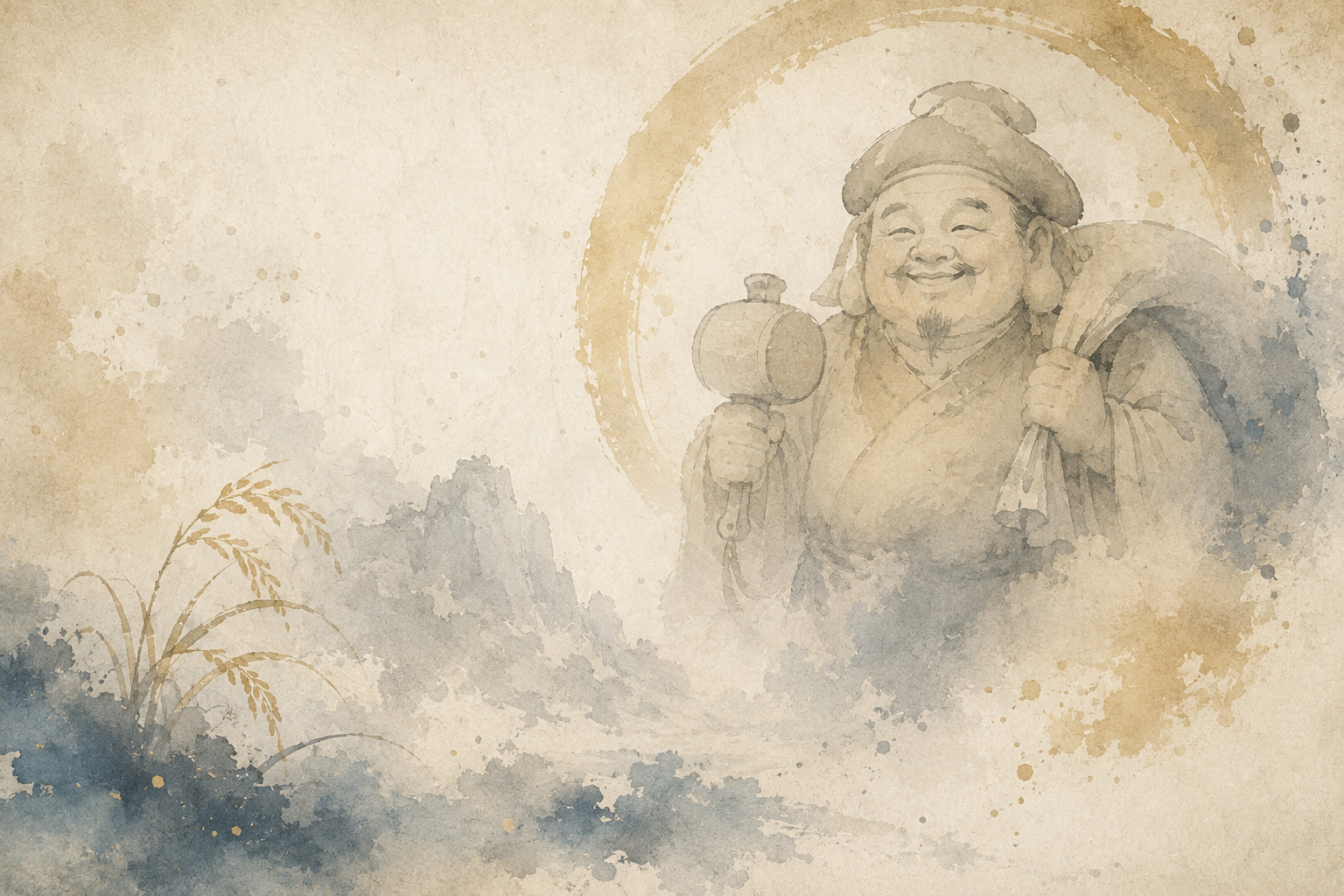
- Common iconography includes a smiling face, a mallet, rice bales, and a large sack—each pointing to nourishment, timing, and wise use of resources.
- Daikokuten can be understood as a lens: how we relate to security, work, generosity, and fear of scarcity.
- Devotion is often simple—gratitude, ethical livelihood, and steady care for what supports life.
- Misunderstandings usually come from treating Daikokuten as a “money vending machine” rather than a guardian of conditions for well-being.
- Daily practice can be as ordinary as budgeting honestly, sharing food, and noticing grasping when it tightens the mind.
Introduction: The Confusion Around “Fortune” in Buddhism
If you’ve heard that Daikokuten is a “god of wealth,” it’s easy to feel torn between curiosity and skepticism: Buddhism isn’t supposed to be about chasing money, so why is a fortune-bringing guardian sitting in temples and homes? The honest answer is that Daikokuten isn’t mainly about getting more—he’s about relating differently to what supports life, so abundance becomes steadiness instead of anxiety. At Gassho, we focus on practical Buddhist culture and lived meaning rather than superstition or salesy promises.
Daikokuten (often written 大黒天) is one of the most familiar protective figures in Japanese Buddhist life, frequently associated with household well-being, food security, business stability, and the kind of luck that comes from good conditions meeting good choices.
People meet Daikokuten in many places: a small statue near a shop entrance, an image at a temple, or as part of the Seven Lucky Gods (Shichifukujin). The details vary, but the emotional tone is consistent—warmth, reassurance, and a sense that life can be supported.
Seeing Daikokuten as a Guardian of Conditions
A helpful way to understand Daikokuten is to treat him as a lens for noticing “conditions”: the ordinary supports that make a stable life possible—food, shelter, community, honest work, and the inner capacity to use resources without being used by them. In that sense, “fortune” is not a magical payout; it’s the felt experience of life being workable.
Daikokuten’s imagery points to this. The rice bales suggest nourishment and the basics of survival. The large sack can be read as stored provisions—preparedness rather than panic. The mallet (uchide no kozuchi) is often taken as wish-fulfilling, but it can also be seen as timing and skill: knowing when to act, when to wait, and how to turn effort into results.
From a Buddhist angle, the deeper question isn’t “How do I get more?” but “What happens in my mind when I feel I don’t have enough?” Daikokuten becomes a mirror for scarcity thinking—tightness in the chest, compulsive comparing, the urge to hoard, the fear that generosity will leave you unsafe.
So Daikokuten can be approached without forcing belief. You can relate to him as a cultural symbol of protection and sufficiency, and use that symbol to reflect on your habits: how you earn, how you spend, how you share, and how you respond when life feels uncertain.
GASSHO
Ask and learn about Buddhism in daily life.
GASSHO is a Buddhist community app where you can learn Buddhist teachings and ask questions to the head priest of Kongosanmaiin Temple on Mount Koya.
How Daikokuten Shows Up in Everyday Experience
You notice Daikokuten most clearly when money or security becomes emotionally charged. A bill arrives, a job feels shaky, prices rise, or a family member needs help. The mind often narrows right there—attention collapses onto threat, and everything else becomes background noise.
In that narrowing, “abundance” can start to mean control. You may catch yourself refreshing bank apps, replaying worst-case scenarios, or mentally bargaining: if only this one thing works out, then I’ll finally relax. The body tells the truth—jaw tight, shoulders up, breath shallow.
Daikokuten’s presence—whether as a statue you pass, a small image at home, or simply the idea—can function like a cue to widen attention. Not to deny the problem, but to include more of reality: what resources you do have, who you can talk to, what can be simplified, what is actually urgent today.
Sometimes the shift is subtle: you pause before an impulsive purchase, not from deprivation, but from clarity. You feel the difference between “I want this” and “I’m trying to soothe anxiety.” That moment of seeing is already a kind of protection.
At other times it shows up as gratitude without sentimentality. You cook rice, you lock the door, you pay a bill, you put a little aside. These actions can feel like care rather than burden—like you’re maintaining the conditions that let life continue.
It can also show up in generosity that doesn’t perform. You tip fairly, you share food, you donate quietly, you help a friend find work. Not because you’re trying to “buy luck,” but because you recognize that abundance is relational: what supports you is tied to what supports others.
And when luck does arrive—an opportunity, a helpful person, a good month—you may notice a different reflex: instead of clinging, you use it well. You repair what’s been neglected, you reduce harmful stress, you make choices that keep the good conditions going.
Common Misreadings of Daikokuten
One common misunderstanding is treating Daikokuten as a guarantee of wealth. When people approach him like a cosmic transaction—pray, receive money—they often end up disappointed or superstitious. Daikokuten is better understood as a guardian of supportive conditions, not a bypass around reality.
Another misreading is assuming that “fortune” means greed is endorsed. In practice, Daikokuten imagery often sits alongside values like diligence, gratitude, and sharing. The point isn’t to inflate desire; it’s to stabilize life so the mind can be less dominated by fear.
Some people also get stuck on labels: “Is Daikokuten a god, a Buddha, or something else?” In lived culture, the categories can blur. What matters for most practitioners is function—protection, nourishment, and the reminder to handle resources with care and integrity.
Finally, there’s the mistake of thinking devotion must be elaborate. For many households, the “practice” is simple: keeping a clean space, offering thanks, and living in a way that doesn’t poison one’s livelihood with deception or harm.
Why Daikokuten Still Matters for Modern Life
Modern life makes scarcity feel constant: endless comparison, unstable work, and the pressure to optimize everything. Daikokuten matters because he points to a calmer question—what is enough, and what supports enough?
He also offers a grounded alternative to both cynicism and magical thinking. You can respect the reality of finances while refusing to let money become the only measure of safety, worth, or success.
As a guardian figure, Daikokuten can reframe “abundance” as stewardship: caring for food, time, tools, relationships, and the mind that uses them. That kind of abundance is quieter than winning the lottery, but it’s far more reliable.
And in a culture of constant wanting, Daikokuten’s smile can be read as permission to relax the grip—enjoy what’s here, share what you can, and keep building conditions that reduce suffering for yourself and others.
Conclusion: Fortune as Steady Support
Daikokuten is best met as a guardian of the everyday: food on the table, honest work, protection from needless fear, and the ability to use resources without being trapped by them. If you approach him as a symbol of conditions—rather than a promise of instant wealth—his meaning becomes surprisingly practical.
When you notice scarcity tightening the mind, Daikokuten points back to steadiness: widen attention, care for what supports life, and let generosity be part of what “abundance” means.
Ask a Buddhist priest
Have a question about Buddhism?
In the GASSHO app, you can ask questions about Buddhist teachings, daily concerns, and how to understand Buddhism in everyday life.
Frequently Asked Questions
- FAQ 1: Who is Daikokuten in Buddhism?
- FAQ 2: What does the name “Daikokuten” mean?
- FAQ 3: Is Daikokuten a Buddha, a god, or something else?
- FAQ 4: What is Daikokuten the god of?
- FAQ 5: Why is Daikokuten often shown with rice bales?
- FAQ 6: What is the mallet Daikokuten holds?
- FAQ 7: What does Daikokuten’s sack represent?
- FAQ 8: Is Daikokuten one of the Seven Lucky Gods?
- FAQ 9: How is Daikokuten related to Mahākāla?
- FAQ 10: Where are Daikokuten statues commonly found?
- FAQ 11: How do people traditionally honor Daikokuten?
- FAQ 12: Can you pray to Daikokuten for money?
- FAQ 13: What offerings are appropriate for Daikokuten?
- FAQ 14: What day is associated with Daikokuten?
- FAQ 15: What is the main spiritual lesson of Daikokuten?
FAQ 1: Who is Daikokuten in Buddhism?
Answer: Daikokuten is a protective figure honored in Japanese Buddhist culture and beyond, widely associated with good fortune, abundance, and safeguarding the household. He is often approached as a guardian of supportive conditions—food, stability, and well-being—rather than as a guarantee of sudden wealth.
Takeaway: Daikokuten is best understood as protection and steadiness, not a “get rich” promise.
FAQ 2: What does the name “Daikokuten” mean?
Answer: “Daikokuten” (大黒天) is commonly translated as “Great Black Deva/Heavenly Being.” In Japan, the name also resonates with the character for “great” (大) and “black” (黒), and it became closely linked with images of prosperity and protection in everyday life.
Takeaway: The name points to a powerful protective figure whose meaning expanded in Japanese culture.
FAQ 3: Is Daikokuten a Buddha, a god, or something else?
Answer: Daikokuten is typically treated as a guardian deity figure in Buddhist contexts. In lived practice, people don’t always separate categories strictly; what matters is the role Daikokuten plays—protecting, supporting, and symbolizing abundance and security.
Takeaway: Think “guardian figure” first; strict labels are less important than function.
FAQ 4: What is Daikokuten the god of?
Answer: Daikokuten is commonly associated with fortune, wealth, food, and household prosperity. Many people also connect him with business success and protection from misfortune, especially in settings where stability and livelihood are central concerns.
Takeaway: Daikokuten is linked to prosperity, but especially to the basics that keep life supported.
FAQ 5: Why is Daikokuten often shown with rice bales?
Answer: Rice bales symbolize nourishment, sustenance, and the foundation of prosperity. In traditional Japan, rice was both food and a measure of wealth, so the imagery emphasizes stable provision rather than flashy luxury.
Takeaway: The rice bales highlight “enough to live well” as the heart of abundance.
FAQ 6: What is the mallet Daikokuten holds?
Answer: Daikokuten is often depicted with the uchide no kozuchi, a “wish-granting” mallet in Japanese folklore. In practice, it can be read symbolically as timely action and the ability to bring forth beneficial results when conditions are right.
Takeaway: The mallet can represent skillful timing and supportive outcomes, not instant magic.
FAQ 7: What does Daikokuten’s sack represent?
Answer: The large sack commonly represents stored goods, provisions, or treasures—resources that support life. Symbolically, it can point to preparedness, gratitude for what is already present, and the responsibility to use resources wisely.
Takeaway: The sack suggests stewardship and security, not hoarding.
FAQ 8: Is Daikokuten one of the Seven Lucky Gods?
Answer: Yes, Daikokuten is commonly included among the Seven Lucky Gods (Shichifukujin) in Japan. In that grouping, he is especially associated with prosperity, food, and good fortune in the home and in work.
Takeaway: Daikokuten is a central prosperity figure within the Shichifukujin tradition.
FAQ 9: How is Daikokuten related to Mahākāla?
Answer: Daikokuten is historically connected to Mahākāla, a powerful protector figure in broader Buddhist traditions. Over time in Japan, the imagery and popular associations shifted toward a more household-friendly guardian of fortune and abundance, while retaining the sense of protective strength.
Takeaway: Daikokuten has roots in Mahākāla, but developed a distinct, prosperity-focused role in Japan.
FAQ 10: Where are Daikokuten statues commonly found?
Answer: Daikokuten statues and images can be found in temples, at small neighborhood shrines, in shops, and in some homes. Placement often reflects a wish for protection, steady livelihood, and a well-supported household.
Takeaway: You’ll see Daikokuten in both religious and everyday spaces tied to livelihood and home life.
FAQ 11: How do people traditionally honor Daikokuten?
Answer: Practices vary, but they often include simple gestures: keeping the space clean, offering incense or food, and expressing gratitude. Many people pair devotion with practical ethics—honest work, fair dealing, and generosity—so “fortune” is supported by conduct.
Takeaway: Honoring Daikokuten is often simple, respectful, and tied to everyday integrity.
FAQ 12: Can you pray to Daikokuten for money?
Answer: People do ask Daikokuten for financial help, especially for business stability or relief from hardship. A balanced approach is to treat prayer as clarifying intention and strengthening resolve—then follow with practical steps like budgeting, seeking advice, and acting ethically.
Takeaway: It’s common to ask for support, but pair it with realistic action and values.
FAQ 13: What offerings are appropriate for Daikokuten?
Answer: Offerings depend on local custom, but common ones include incense, candles, water or tea, and simple foods (often reflecting gratitude for nourishment). The most important “offering” is sincerity—avoiding a transactional mindset and focusing on respect and care.
Takeaway: Keep offerings simple and sincere; gratitude matters more than extravagance.
FAQ 14: What day is associated with Daikokuten?
Answer: In some Japanese traditions, certain “lucky days” or temple festival days are associated with Daikokuten, but they vary by region and temple. If you’re visiting, the most reliable method is to check the specific temple’s calendar for Daikokuten-related observances.
Takeaway: Daikokuten observance dates are local—confirm with the temple or community you’re visiting.
FAQ 15: What is the main spiritual lesson of Daikokuten?
Answer: Daikokuten’s central lesson is that “abundance” is not only about accumulation—it’s about supportive conditions and a mind that can use resources without fear, greed, or panic. In daily life, that often looks like gratitude, ethical livelihood, preparedness, and generosity.
Takeaway: Daikokuten points to steadiness and wise stewardship as the heart of fortune.