



How Jizo Became a Protector of Travelers and the Vulnerable in Japan
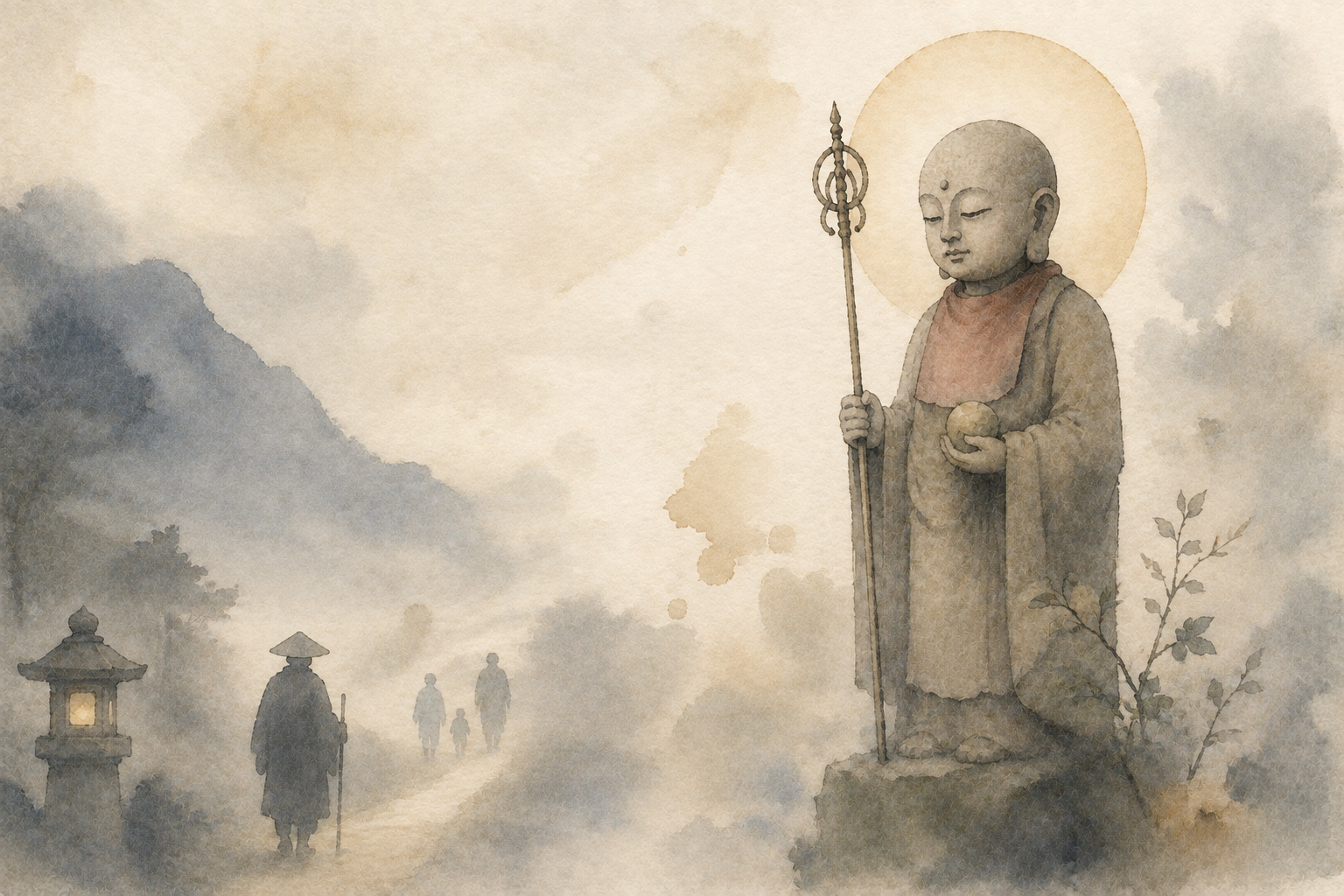
How Jizo Became a Protector of Travelers and the Vulnerable in Japan
Quick Summary
- Jizo is widely approached in Japan as a compassionate protector at boundaries: roads, bridges, passes, and village edges.
- The idea of “Jizo protector travelers” grew from everyday needs: safe passage, guidance, and reassurance when you’re exposed and far from home.
- Jizo’s role expanded to include people seen as especially vulnerable—children, the sick, the grieving, and those without social protection.
- Roadside Jizo statues functioned like spiritual waypoints: places to pause, orient yourself, and renew intention.
- Small offerings (water, flowers, bibs, stones) are less “payment” and more a practice of care and remembrance.
- Jizo devotion is practical and local: it’s about the next step, the next crossing, the next safe arrival.
- Even today, Jizo remains a quiet symbol for safe travel, protection on commutes, and solidarity with those at risk.
Introduction
You’ve probably seen a small stone figure in a red bib by a roadside in Japan and wondered why that particular statue is treated like a guardian of the journey—especially when it isn’t a grand shrine or a dramatic “protector deity” image. The clue is that travel used to mean exposure: to weather, injury, bandits, illness, wrong turns, and the simple fact of being away from the safety of your community. I write for Gassho, where we focus on how Buddhist symbols work in lived life rather than as distant theory.
Jizo (often called Jizo Bosatsu) became a protector not because people needed a perfect explanation, but because they needed a reliable presence at the exact places where life feels most uncertain: crossings, thresholds, and moments when you’re carrying someone—or something—fragile.
GASSHO
Ask and learn about Buddhism in daily life.
GASSHO is a Buddhist community app where you can learn Buddhist teachings and ask questions to the head priest of Kongosanmaiin Temple on Mount Koya.
A grounded way to understand Jizo’s protection
A helpful lens for understanding “Jizo protector travelers” is to see protection as a relationship, not a guarantee. Jizo represents a steady kind of care that meets people where they are—on the road, at the edge of town, at a bridge, at a mountain pass—when the next step is unknown. In that sense, Jizo is less about controlling outcomes and more about supporting the human capacity to continue with clarity and restraint.
Travel is a classic situation where the mind runs ahead: imagining accidents, delays, getting lost, or arriving too late. Jizo’s presence at roadsides and boundaries can be read as a cultural reminder to return to what’s workable: check your footing, watch the weather, ask for directions, pace yourself, and keep your attention close to the body. “Protection” becomes the calming of panic into practical care.
This same logic extends naturally to people considered vulnerable. If travel is exposure, vulnerability is exposure too—children, the sick, those in grief, those without family support, those on the margins. Jizo’s compassion is often pictured as patient and non-judging, which makes the figure approachable when someone feels they have no “right” to ask for help.
So the core view is simple: Jizo marks the places where we admit uncertainty and choose care anyway. That’s why the figure fits both the traveler’s road and the vulnerable person’s threshold—different situations, same human need for steadiness.
What this looks like in ordinary moments
Imagine you’re walking in an unfamiliar neighborhood and you notice a small Jizo statue near a corner. You slow down without thinking much about it. The body pauses first; the mind follows. That pause is already a kind of protection because it interrupts rushing.
Then comes the quick scan: “Where am I? Which way is the station? Is this the right street?” The statue doesn’t answer, but it changes the quality of the question. Instead of spiraling into embarrassment or irritation, you’re more likely to re-check your map, look for a landmark, or ask someone politely.
If you’re traveling with a child, an elderly parent, or heavy luggage, you become more aware of edges—curbs, stairs, narrow paths, traffic. Jizo’s roadside placement mirrors that attention to edges. It’s like the environment is teaching you: “This is where you take care.”
In grief, the mind often searches for something to do with love that has nowhere to go. People tie a bib, place flowers, pour water, or stack small stones. The action is modest and repetitive, which can be stabilizing. It gives the hands a task that matches the heart: care, again and again, without demanding closure.
On a commute, you might not “believe” anything in particular, but you still feel the difference between distracted travel and attentive travel. A brief bow or moment of quiet can shift you from agitation to composure. That shift affects decisions: crossing on a signal, not jaywalking; taking a break when tired; not pushing through bad weather just to stay on schedule.
Even when nothing dramatic happens, the practice is in the noticing: anxiety arises, the body tightens, the mind predicts trouble, and then you return to the next step. Jizo’s role as protector of travelers can be understood as supporting that return—back to the road, back to care, back to what you can actually do.
How Jizo became linked with roads, crossings, and safety
Historically, roads in Japan were not just transportation routes; they were social and psychological borders. Leaving your village meant leaving a web of recognition and help. Waypoints mattered: bridges, riverbanks, mountain passes, and junctions where a wrong turn could cost hours—or worse. Placing Jizo at these points made sense because the statue became a visible sign of care where care was most needed.
Jizo statues also served as communal markers. A community could maintain a roadside Jizo as a shared act: keeping the area clean, replacing flowers, repairing damage. That maintenance is part of how “protection” becomes real—less as supernatural intervention and more as a culture of attention around dangerous or uncertain places.
Over time, the association strengthened: travelers stopped, offered a brief prayer, and continued. The repetition created a pattern that outlasted any single person’s story. When enough people treat a figure as a guardian of safe passage, the figure becomes a guardian in the most practical sense: it shapes behavior, encourages pauses, and reminds people they are not traveling alone in spirit or in community.
This is also why Jizo appears in clusters along routes and near cemeteries or temple grounds. The road and the vulnerable life situation are not separate worlds; they overlap. People travel for work, for family, for illness, for funerals, for childbirth, for survival. Jizo stands quietly at the intersection of movement and fragility.
Why Jizo is also approached for children and those at risk
The phrase “the vulnerable” can sound broad, but in everyday devotion it often becomes very specific: a child who is sick, a parent who is aging, a family member who is missing, a person who feels unprotected by society. Jizo’s image is gentle and approachable, which matters when someone is already overwhelmed and doesn’t want a demanding or fear-based form of religion.
Jizo is frequently depicted as a humble monk-like figure, not armored or triumphant. That humility communicates something important: protection can be quiet. It can look like patience, accompaniment, and the willingness to stay close to suffering without turning away.
In Japan, you’ll often see Jizo dressed with a red bib or knit cap. These are not decorations for show; they echo the way you would dress a child to keep them warm and safe. The gesture turns devotion into caregiving. It’s a way of saying, “Someone is being looked after,” even when the person cannot be protected in ordinary ways.
That same caregiving logic is why travelers connect with Jizo. On the road, you are temporarily vulnerable. You are, in a sense, “like a child” in unfamiliar territory—needing guidance, needing safe passage, needing a calm mind.
Common misunderstandings that flatten the meaning
One common misunderstanding is treating “Jizo protector travelers” as a promise that nothing bad will happen. In real life, people sought Jizo because bad things do happen on roads and in vulnerable situations. The point is not denial; it’s support—emotional, communal, and practical—when outcomes can’t be controlled.
Another misunderstanding is assuming roadside Jizo is “just folklore” and therefore not serious. But seriousness isn’t measured by complexity. A small statue at a crossing can shape behavior more effectively than a long explanation: it invites a pause, a check-in, a moment of humility before moving on.
Some visitors also mistake offerings as transactional—like paying for protection. In many cases, the offering is better understood as training the heart: gratitude for safe arrival, remembrance for those who didn’t arrive, and a commitment to travel with care.
Finally, it’s easy to reduce Jizo to a “cute” figure because of the bibs and small size. But the tenderness is the point. The protection Jizo symbolizes is not domination; it’s closeness to what is fragile.
Why this still matters for modern travel and daily life
Modern travel is safer in many ways, yet the mind’s vulnerability hasn’t changed. Airports, trains, highways, and unfamiliar cities still trigger the same patterns: rushing, distraction, irritation, and the sense that you must control everything. Jizo’s role as protector of travelers points to a different approach—one that values steadiness over speed.
Practically, Jizo devotion can function like a micro-ritual for attention. A brief pause before a long drive, a quiet moment before boarding, or a small act of gratitude after arriving can reduce impulsive decisions. The “protection” shows up as fewer avoidable mistakes: not pushing when exhausted, not ignoring weather warnings, not letting frustration dictate choices.
For people caring for someone vulnerable, Jizo also offers a language of companionship. You may not be able to fix the situation, but you can keep showing up with care. That’s a form of protection that doesn’t depend on perfect outcomes.
And socially, roadside Jizo reminds us that safety is shared. Someone placed that statue, someone cleans around it, someone leaves water or flowers. It’s a quiet record of community responsibility—especially for those who pass through and those who are easily overlooked.
Conclusion
Jizo became a protector of travelers in Japan because the road concentrates what humans struggle with most: uncertainty, exposure, and the need to keep going without hardening the heart. Placed at crossings and edges, Jizo offers a steady cue to slow down, pay attention, and act with care.
That same cue naturally extends to the vulnerable—those whose lives are shaped by risk, dependence, or grief. Whether you approach Jizo as religious devotion, cultural heritage, or a simple practice of pausing, the message is consistent: protection begins where attention and compassion become concrete.
Ask a Buddhist priest
Have a question about Buddhism?
In the GASSHO app, you can ask questions about Buddhist teachings, daily concerns, and how to understand Buddhism in everyday life.
Frequently Asked Questions
- FAQ 1: What does “Jizo protector travelers” mean in Japan?
- FAQ 2: Why are Jizo statues often placed near roads and intersections for travelers?
- FAQ 3: Is Jizo specifically a protector of travelers or also of other vulnerable people?
- FAQ 4: What do travelers typically do when they stop at a Jizo statue?
- FAQ 5: Does praying to Jizo guarantee safety for travelers?
- FAQ 6: Why do some Jizo statues wear red bibs or hats, and how does that relate to travelers?
- FAQ 7: Are roadside Jizo statues meant for long-distance travelers only?
- FAQ 8: What kinds of dangers were travelers historically asking Jizo to protect them from?
- FAQ 9: How is Jizo different from other Japanese figures associated with travel safety?
- FAQ 10: Is it respectful for non-Japanese travelers to pray to Jizo in Japan?
- FAQ 11: What offerings are appropriate when asking Jizo to protect travelers?
- FAQ 12: Why do some travelers stack stones near Jizo statues?
- FAQ 13: Can Jizo be a protector for travelers outside Japan, or is it only a Japanese tradition?
- FAQ 14: What is a simple prayer or phrase travelers use with Jizo for protection?
- FAQ 15: How can I relate to Jizo as a protector of travelers without treating it as superstition?
FAQ 1: What does “Jizo protector travelers” mean in Japan?
Answer: It refers to the widespread Japanese custom of viewing Jizo as a compassionate guardian for safe passage—especially at roadsides, crossroads, bridges, and mountain paths where travelers feel exposed or uncertain.
Takeaway: Jizo’s “protection” is closely tied to the realities of travel and the need for steadiness on the road.
FAQ 2: Why are Jizo statues often placed near roads and intersections for travelers?
Answer: Intersections and crossings are natural points of risk and decision—wrong turns, traffic, weather changes, and fatigue. A roadside Jizo marks these thresholds and invites a pause for attention, prayer, or careful checking before continuing.
Takeaway: Jizo’s placement matches the places where travelers most need to slow down and re-orient.
FAQ 3: Is Jizo specifically a protector of travelers or also of other vulnerable people?
Answer: In Japanese practice, Jizo is strongly associated with travelers, but the same protective compassion is also directed toward those seen as vulnerable—especially children, the sick, and people in grief—because they share a similar sense of exposure and need for care.
Takeaway: The traveler and the vulnerable person are linked by the theme of being “unprotected” in ordinary ways.
FAQ 4: What do travelers typically do when they stop at a Jizo statue?
Answer: Many people simply pause, bow, put their hands together briefly, or offer a short request for safe travel. Others leave small offerings like flowers or water, especially if the statue is maintained by the local community.
Takeaway: A small pause at Jizo is often the main practice—simple, respectful, and practical.
FAQ 5: Does praying to Jizo guarantee safety for travelers?
Answer: In lived Japanese devotion, Jizo is not usually treated as a “guarantee” against harm. The prayer is more like asking for guidance, calm attention, and supportive conditions—especially when outcomes can’t be controlled.
Takeaway: Jizo protection is commonly understood as support, not a contract.
FAQ 6: Why do some Jizo statues wear red bibs or hats, and how does that relate to travelers?
Answer: Red bibs and hats echo caregiving—like dressing a child warmly. For travelers, it reinforces the idea that Jizo’s protection is nurturing and close-to-home, offering comfort and steadiness during uncertain journeys.
Takeaway: The clothing symbolizes care, which is the emotional core of Jizo’s protection for travelers.
FAQ 7: Are roadside Jizo statues meant for long-distance travelers only?
Answer: No. Jizo as a protector of travelers can apply to any journey—pilgrimage routes, business trips, daily commutes, school routes, and neighborhood walks—because the underlying concern is safe passage through shared spaces.
Takeaway: “Traveler” can mean anyone moving through risk, even in ordinary daily life.
FAQ 8: What kinds of dangers were travelers historically asking Jizo to protect them from?
Answer: Historically, travel could involve injury, illness, harsh weather, getting lost, unsafe river crossings, and crime. Jizo’s roadside presence addressed these real anxieties by offering a place to pray, pause, and gather resolve.
Takeaway: Jizo’s travel protection grew from practical risks, not abstract ideas.
FAQ 9: How is Jizo different from other Japanese figures associated with travel safety?
Answer: Jizo is often experienced as especially approachable and compassionate, emphasizing accompaniment and care. While other figures may be linked to specific shrines or functions, roadside Jizo commonly feels local and intimate—like a guardian at the neighborhood level.
Takeaway: Jizo’s distinct “travel protection” tone is gentle, close, and community-rooted.
FAQ 10: Is it respectful for non-Japanese travelers to pray to Jizo in Japan?
Answer: Yes, if done simply and respectfully: pause quietly, avoid climbing on statues, don’t disturb offerings, and follow local signage. A brief bow or moment of gratitude aligns well with how many locals relate to Jizo as a protector of travelers.
Takeaway: Respectful simplicity is usually the best approach when visiting Jizo as a traveler.
FAQ 11: What offerings are appropriate when asking Jizo to protect travelers?
Answer: Common, appropriate offerings include flowers, clean water, or a small coin if there is an offering box. The key is modesty and cleanliness—offerings are gestures of care and gratitude rather than “payment” for protection.
Takeaway: Keep offerings simple, sincere, and aligned with local custom.
FAQ 12: Why do some travelers stack stones near Jizo statues?
Answer: Stone stacking can be a quiet act of prayer and remembrance, sometimes connected to caring intentions for those who are vulnerable. For travelers, it can also function as a mindful pause—doing something small and steady before continuing the journey.
Takeaway: Stacking stones is often about attention and care, not spectacle.
FAQ 13: Can Jizo be a protector for travelers outside Japan, or is it only a Japanese tradition?
Answer: The strongest cultural context is Japan, but the underlying practice—pausing, asking for safe passage, and committing to careful travel—can be carried anywhere. Many people keep Jizo in mind as a symbol of compassionate protection while traveling abroad.
Takeaway: The “Jizo protector travelers” meaning can travel with you as a practice of mindful care.
FAQ 14: What is a simple prayer or phrase travelers use with Jizo for protection?
Answer: Many people keep it very plain, such as “Please let me travel safely” or “Please help me arrive safely.” In Japanese, a common, simple request is “Anzen ni ikemasu you ni” (May I travel safely).
Takeaway: A short, sincere request fits the everyday spirit of Jizo as a protector of travelers.
FAQ 15: How can I relate to Jizo as a protector of travelers without treating it as superstition?
Answer: Treat Jizo as a cue for attention and compassion: pause, breathe, check your route, travel at a safe pace, and hold care for yourself and others on the road. The “protection” can be understood as the practical effects of steadiness rather than a demand for certainty.
Takeaway: You can honor Jizo’s travel protection as a grounded practice of careful presence.