



Who Is Acala? Fudo Myoo’s Sanskrit Origin and Immovable Wisdom
Quick Summary
- Acala Buddhism centers on Acala (Sanskrit: Acalanātha), known in Japan as Fudō Myōō, a fierce-looking protector figure.
- “Acala” means “immovable,” pointing to steadiness of mind rather than physical rigidity or stubbornness.
- Fudō Myōō’s intense imagery (flames, sword, rope) is symbolic: cutting confusion, binding harmful impulses, and burning away delusion.
- Acala is not “a wrathful god of anger”; the wrath is a visual language for uncompromising clarity and protection.
- The Sanskrit origin helps explain why the same figure appears across cultures with different names and artistic styles.
- Practically, Acala Buddhism can be read as training in staying present under pressure and choosing the next clean action.
Introduction: Why Acala Looks So Fierce (and What That’s Really Saying)
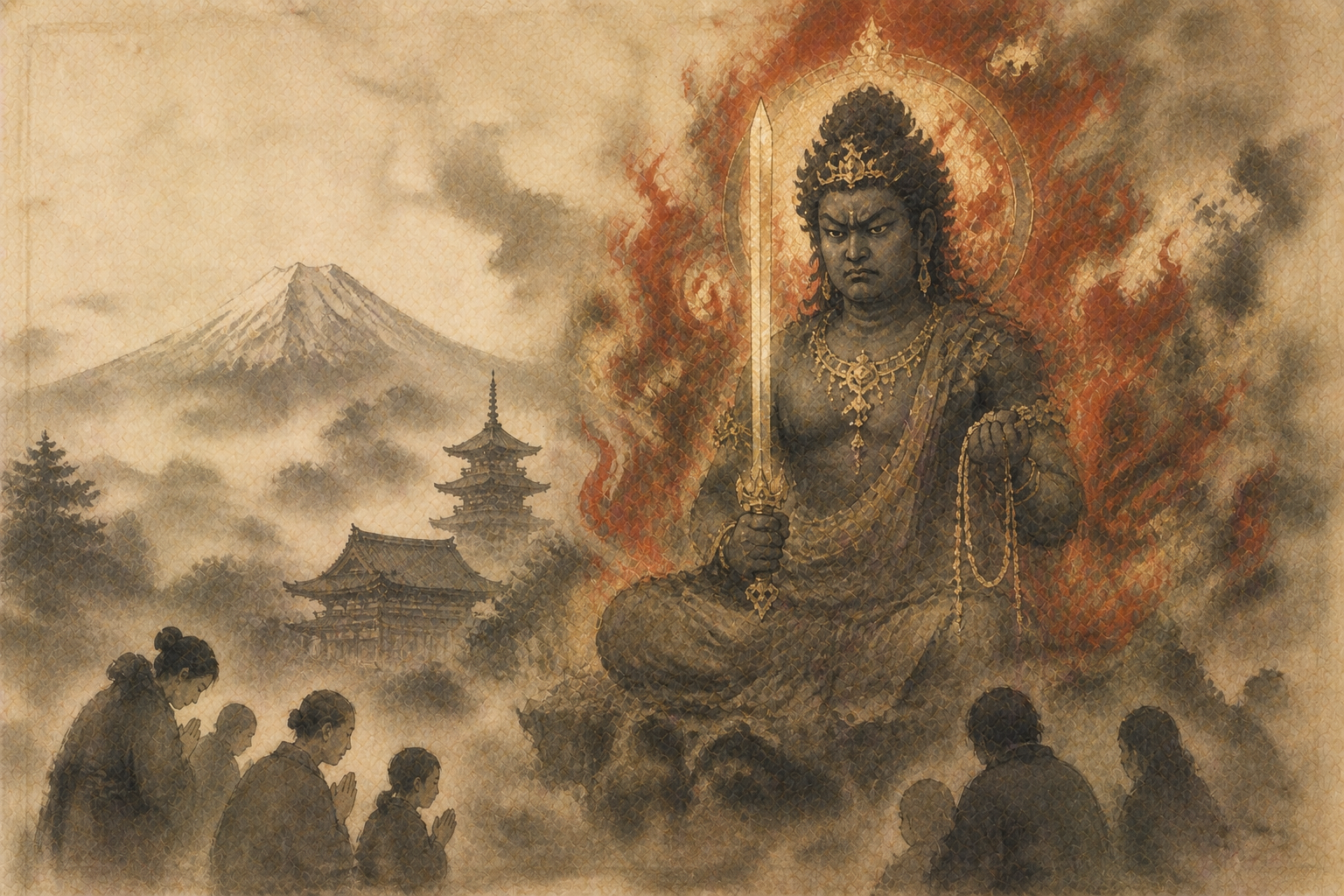
You see Fudō Myōō—glare, fangs, flames, sword—and it’s easy to assume Buddhism suddenly turned violent or “angry,” or that Acala Buddhism is about worshiping a wrathful deity. That reaction is understandable, but it misses the point: the fierceness is a teaching device for what it feels like to stop negotiating with your own confusion and actually hold steady. At Gassho, we focus on clear, grounded explanations of Buddhist symbols without requiring you to already know the jargon.
Acala is the Sanskrit name behind the figure many people meet first through Japanese art as Fudō Myōō, and the name itself is the simplest clue to the whole message: immovable, unshaken, not pushed around by fear, craving, or social pressure.
The Core Lens: “Immovable” as a Way of Seeing Your Mind
Acala Buddhism can be approached as a lens for understanding what steadiness looks like in real time. “Immovable” doesn’t mean you never change your mind; it means you’re not yanked around by every impulse, mood, or threat. The image of Acala points to a mind that can feel heat—anger, anxiety, temptation—without instantly becoming it.
This is why the Sanskrit origin matters. “Acala” (often understood as “immovable” or “unmoving”) frames the figure as a quality of stability. When you read the iconography through that word, the symbolism becomes less supernatural and more psychological: the point is not to admire a scary statue, but to recognize the possibility of being steady inside your own storm.
Fudō Myōō’s tools are basically a visual vocabulary for inner work. A sword can be read as discernment that cuts through muddled thinking. A rope can be read as restraint—gathering scattered attention, binding harmful habits before they run the show. Flames can be read as intensity and purification: the heat of awareness that burns away excuses and self-deception.
Seen this way, Acala Buddhism isn’t asking you to adopt a new belief about the universe. It’s pointing at a practical question: when life presses hard, what in you stays clear, and what in you collapses into reaction?
GASSHO
Ask and learn about Buddhism in daily life.
GASSHO is a Buddhist community app where you can learn Buddhist teachings and ask questions to the head priest of Kongosanmaiin Temple on Mount Koya.
How Acala Shows Up in Ordinary Moments
Think about the moment you receive a message that feels disrespectful. Before you even decide what to do, there’s a surge: the body tightens, the mind drafts a reply, the story of “how they always are” appears. The Acala lens notices that surge without immediately obeying it.
In that pause, you can feel how quickly the mind tries to move—toward defending, attacking, proving, escaping. “Immovable” here doesn’t mean frozen; it means you don’t have to be dragged by the first wave. You can let the wave rise and fall while staying present enough to choose.
Or take procrastination. The task is simple, but the mind manufactures fog: “Later,” “Not now,” “I need the perfect plan.” Acala’s sword, in everyday terms, is the clean cut through that fog: naming what’s happening and returning to the next small action.
Another common scene is social pressure. You sense the room wants a certain version of you—more agreeable, more impressive, less honest. The “rope” symbolism can be felt as gentle restraint: holding your attention close, not letting it scatter into performance, not letting your values slip just to be liked.
Even anxiety can be read through Acala. Anxiety often feels like the mind running ahead, rehearsing disasters, trying to control uncertainty by thinking harder. The immovable quality is the willingness to stay with what is actually here—breath, sensations, the real problem in front of you—without feeding the spiral.
And sometimes the most honest “Acala moment” is when you catch yourself mid-justification. You’re about to say something sharp, or make a choice you know you’ll regret, and you feel the internal momentum. The fierce face in the iconography can be understood as that uncompromising inner clarity that says, “No—stop. Not this.”
None of this requires dramatic experiences. It’s about the small, repeated points where attention either gets kidnapped by reaction or returns to steadiness.
Common Misreadings of Acala Buddhism
One misunderstanding is taking the wrathful appearance literally, as if Acala represents rage as a virtue. The imagery is intense because the inner forces it addresses can be intense: compulsion, self-deception, panic, cruelty. The “wrath” is better understood as a refusal to cooperate with what harms.
Another confusion is assuming “immovable” means emotionally numb. In practice, steadiness includes feeling what you feel—sometimes strongly—without letting it dictate your behavior. The point is responsiveness rather than reactivity.
People also sometimes treat Acala as a lucky charm: a figure you keep around so nothing bad happens. But the symbolism points inward. Protection, in this frame, is largely protection from your own unexamined impulses—what you say when you’re cornered, what you do when you’re tempted, what you become when you’re afraid.
Finally, the Sanskrit-to-Japanese shift can create the impression that these are different beings: “Acala” over here, “Fudō Myōō” over there. It’s more accurate to see them as different names and cultural expressions orbiting the same core idea: unwavering clarity in the middle of pressure.
Why Acala Still Matters When Life Gets Messy
Modern life rewards speed: quick takes, quick replies, quick outrage, quick consumption. Acala Buddhism, read simply, is a counterweight. It values the ability to stay put long enough to see what’s actually happening before you add fuel.
That matters in relationships. A steady mind can hear criticism without instantly counterattacking. It can apologize without collapsing into shame. It can set boundaries without needing to punish.
It matters at work, too. When pressure rises, people often narrow into panic or control. The “immovable” quality is the capacity to keep priorities clear, do the next right step, and not spread stress through the room.
And it matters privately, when nobody is watching. The fiercest battles are often quiet: the urge to lie to yourself, the urge to numb out, the urge to delay what you know you need to face. Acala’s symbolism is a reminder that compassion can be firm, and clarity can be kind.
Conclusion: Acala as “Immovable Clarity,” Not a Threat
Acala Buddhism becomes much less mysterious when you start with the word “Acala”: immovable. Fudō Myōō’s fierce form is a visual shorthand for a mind that doesn’t bargain with confusion—steady, protective, and direct. If the imagery feels intense, that may be because it mirrors how intense our inner reactions can be, and how much relief there is in not being ruled by them.
Ask a Buddhist priest
Have a question about Buddhism?
In the GASSHO app, you can ask questions about Buddhist teachings, daily concerns, and how to understand Buddhism in everyday life.
Frequently Asked Questions
- FAQ 1: What does “Acala” mean in Acala Buddhism?
- FAQ 2: Who is Acala in Buddhism, in simple terms?
- FAQ 3: Is Acala the same as Fudō Myōō?
- FAQ 4: Why does Acala look angry if Buddhism teaches compassion?
- FAQ 5: What is the Sanskrit origin behind Fudō Myōō’s name?
- FAQ 6: What does Acala’s sword mean in Acala Buddhism?
- FAQ 7: What does the rope (lasso) represent for Acala?
- FAQ 8: Why is Acala surrounded by flames?
- FAQ 9: Is Acala Buddhism about worshiping a wrathful deity?
- FAQ 10: What does “immovable” mean in daily practice related to Acala Buddhism?
- FAQ 11: Is Acala considered a Buddha, a bodhisattva, or something else?
- FAQ 12: Why is Acala sometimes shown with fangs or a fierce expression?
- FAQ 13: How is Acala Buddhism connected to the name “Fudō Myōō” in Japan?
- FAQ 14: Does Acala Buddhism teach that anger is useful?
- FAQ 15: What is the simplest way to understand Acala Buddhism without getting lost in terminology?
FAQ 1: What does “Acala” mean in Acala Buddhism?
Answer: “Acala” is a Sanskrit term commonly understood to mean “immovable” or “unshakable.” In Acala Buddhism, that meaning is the key theme: steadiness of awareness under pressure, rather than being pushed around by fear, craving, or anger.
Takeaway: “Acala” points to inner stability, not intimidation.
FAQ 2: Who is Acala in Buddhism, in simple terms?
Answer: Acala is a protective, fierce-looking Buddhist figure whose imagery represents unwavering clarity and the power to cut through confusion. The “fierce” appearance is symbolic—meant to communicate firmness and protection, not cruelty.
Takeaway: Acala symbolizes uncompromising clarity that protects.
FAQ 3: Is Acala the same as Fudō Myōō?
Answer: Yes. “Acala” is the Sanskrit name, and “Fudō Myōō” is the Japanese name for the same figure. Different languages and cultures emphasize different artistic styles, but the core identity is shared.
Takeaway: Acala and Fudō Myōō are two names for the same protector figure.
FAQ 4: Why does Acala look angry if Buddhism teaches compassion?
Answer: Acala’s “anger” is best read as a visual metaphor for fierce compassion: the kind of care that refuses to enable harmful behavior or delusion. The intensity is aimed at cutting confusion, not harming beings.
Takeaway: The wrathful look represents firm compassion, not hatred.
FAQ 5: What is the Sanskrit origin behind Fudō Myōō’s name?
Answer: Fudō Myōō corresponds to the Sanskrit Acala (often expanded as Acalanātha, “Lord Acala”). The Japanese “Fudō” carries the sense of “immovable,” echoing the Sanskrit meaning.
Takeaway: The “immovable” meaning is consistent across Sanskrit and Japanese names.
FAQ 6: What does Acala’s sword mean in Acala Buddhism?
Answer: The sword is commonly interpreted as discernment: the ability to cut through confusion, self-deception, and unhelpful mental stories. It points to clarity that acts decisively rather than endlessly hesitating.
Takeaway: The sword symbolizes clear seeing that cuts through delusion.
FAQ 7: What does the rope (lasso) represent for Acala?
Answer: The rope is often read as restraint and gathering: binding harmful impulses, pulling scattered attention back, and preventing destructive habits from running unchecked. It’s a symbol of containment, not punishment.
Takeaway: The rope points to steady restraint and self-control.
FAQ 8: Why is Acala surrounded by flames?
Answer: The flames are typically interpreted as purification and intensity—burning away confusion and illuminating what’s true. They can also suggest the heat of strong emotions being transformed into clarity rather than acted out.
Takeaway: Flames symbolize purification and transformative intensity.
FAQ 9: Is Acala Buddhism about worshiping a wrathful deity?
Answer: Acala Buddhism is often misunderstood that way because the iconography is fierce. A simpler reading is that Acala functions as a symbol and support for cultivating unshakable awareness and protective clarity, rather than promoting anger or fear-based devotion.
Takeaway: It’s better understood as training in steadfast clarity than “wrath worship.”
FAQ 10: What does “immovable” mean in daily practice related to Acala Buddhism?
Answer: “Immovable” can mean staying present when you’re triggered: noticing the surge of reaction, pausing, and choosing a response aligned with your values. It’s steadiness in attention and conduct, not stubbornness.
Takeaway: “Immovable” means unshaken attention, not rigid personality.
FAQ 11: Is Acala considered a Buddha, a bodhisattva, or something else?
Answer: Across Buddhist contexts, Acala is generally treated as a protective figure rather than a historical person. Categories can vary by tradition and text, but the practical point remains the same: Acala represents protective, unwavering wisdom in symbolic form.
Takeaway: Labels vary, but Acala’s role is protective clarity.
FAQ 12: Why is Acala sometimes shown with fangs or a fierce expression?
Answer: The fangs and fierce face communicate “don’t negotiate with delusion.” They symbolize a forceful refusal to let harmful impulses, confusion, or fear take control, expressed through strong visual language.
Takeaway: Fierce features symbolize firmness against confusion, not malice.
FAQ 13: How is Acala Buddhism connected to the name “Fudō Myōō” in Japan?
Answer: In Japan, Acala is widely known as Fudō Myōō, a central protector figure in art and practice. The Japanese name preserves the “immovable” meaning and expresses the same core symbolism through local language and iconography.
Takeaway: “Fudō Myōō” is the Japanese expression of Acala Buddhism’s key figure.
FAQ 14: Does Acala Buddhism teach that anger is useful?
Answer: Acala Buddhism is not a celebration of ordinary anger. The “wrath” associated with Acala is symbolic of clear, protective firmness—energy that confronts harm without being driven by hatred or revenge.
Takeaway: It’s about firm clarity, not indulging anger.
FAQ 15: What is the simplest way to understand Acala Buddhism without getting lost in terminology?
Answer: Start with the meaning of Acala: “immovable.” Then read the imagery as a map of inner skills—discernment (sword), restraint (rope), purification (flames), and unwavering presence (posture and expression). It’s a symbolic language for staying steady and acting cleanly under pressure.
Takeaway: Acala Buddhism can be understood as a practical symbol of unshakable awareness.