



Why Does Fudo Myoo Look So Angry? The Compassion Behind His Fierce Face
Quick Summary
- Fudo Myoo looks angry because his “fierce” face is meant to protect, not to threaten.
- His expression symbolizes uncompromising clarity: cutting through confusion, denial, and harmful habits.
- The anger-like features represent energy and resolve, not personal rage or hatred.
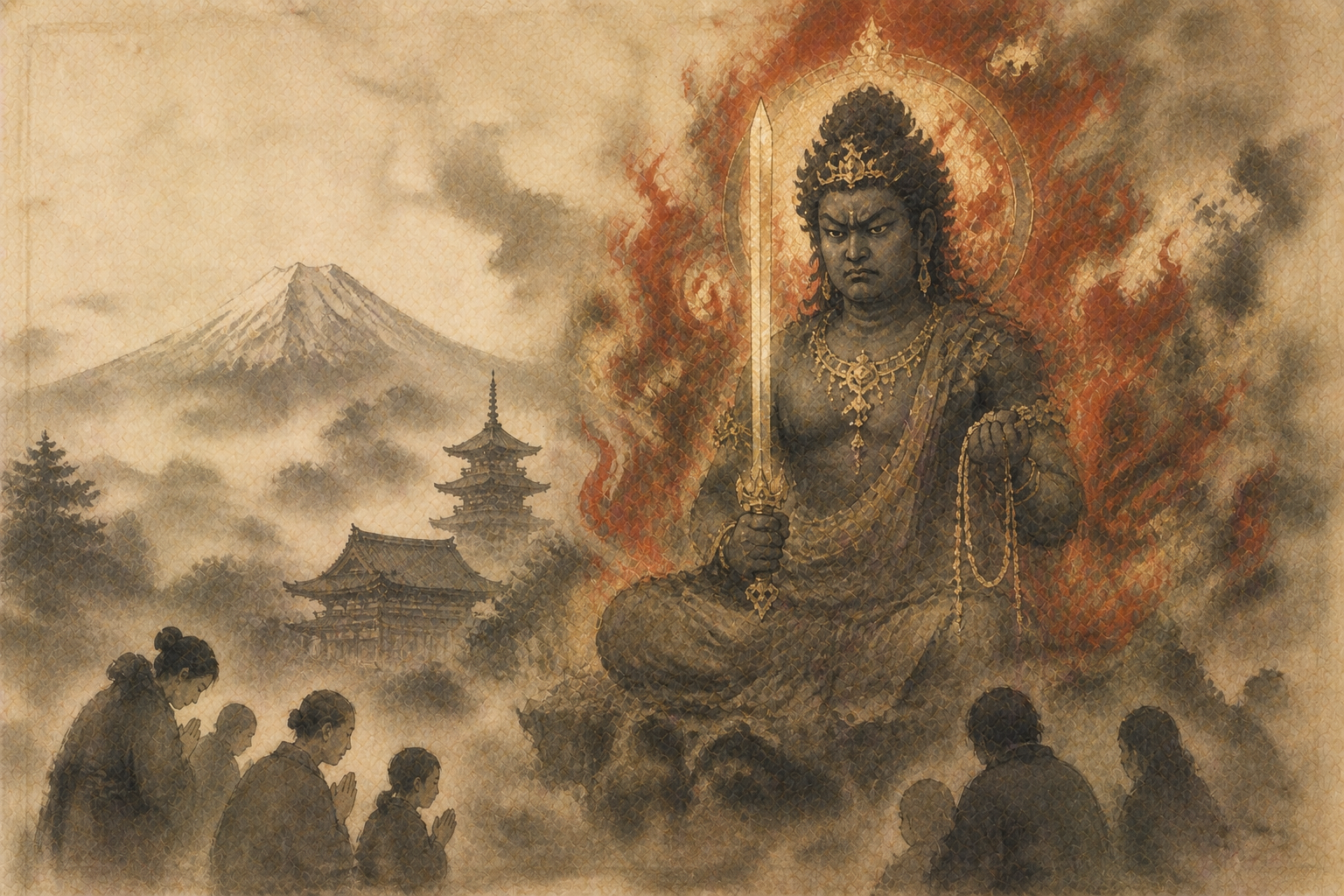
- Iconic details—flames, sword, and rope—point to transformation, discernment, and restraint of what harms.
- Fierce compassion can look intense because it prioritizes what helps over what feels pleasant.
- Seeing Fudo Myoo as “mad” is a common misread; the imagery is symbolic and practical.
- His face can be used as a mirror for your own reactions: where you need steadiness, boundaries, and courage.
Why His Face Can Feel So Confronting at First
You’re looking at Fudo Myoo and thinking: why does he look so angry—teeth bared, eyes intense, surrounded by flames—when Buddhism is supposed to be about peace and compassion. That confusion is reasonable, and it’s also the point: his image is designed to interrupt the mind’s habit of equating “kind” with “soft” and “helpful” with “pleasant.” At Gassho, we focus on translating Buddhist symbols into clear, everyday understanding without requiring insider knowledge.
Fudo Myoo’s fierce appearance isn’t a contradiction of compassion; it’s a depiction of compassion that refuses to negotiate with what causes harm. The face is a visual shorthand for a protective force that doesn’t hesitate, doesn’t flatter, and doesn’t get distracted by appearances.
If you’ve ever needed someone to stop you from making a mistake you were determined to make, you already understand the emotional logic behind this iconography. The energy that prevents harm can look “angry” from the outside, especially when it blocks what the ego wants in the moment.
GASSHO
Ask and learn about Buddhism in daily life.
GASSHO is a Buddhist community app where you can learn Buddhist teachings and ask questions to the head priest of Kongosanmaiin Temple on Mount Koya.
A Clear Lens: Fierce Compassion Instead of Personal Anger
A useful way to understand why Fudo Myoo looks angry is to treat the image as a lens for reading inner life, not as a portrait of a moody deity. The “anger” is symbolic: it represents a forceful compassion that confronts confusion directly, the way a bright light can feel harsh when your eyes are adjusted to darkness.
Personal anger usually has a story attached: “I was wronged,” “I need to win,” “I can’t stand this.” It narrows attention and seeks release. Fudo Myoo’s fierceness points in the opposite direction: attention becomes steady, the aim is protection, and the energy is directed toward what reduces harm.
That’s why the face is intense. It communicates decisiveness—no bargaining with self-deception, no indulgence of cruelty, no romanticizing of destructive impulses. In symbolic terms, the expression says: “Stop. Not this. Not now.”
Even the surrounding imagery supports this lens. Flames suggest transformation rather than punishment; a sword suggests discernment rather than violence; a rope suggests restraint rather than domination. The overall message is not “be afraid,” but “be protected—and be honest.”
How the Fierce Expression Shows Up in Ordinary Life
In daily experience, the “angry-looking” quality of Fudo Myoo can resemble the moment you finally notice you’re about to repeat a familiar mistake. It’s not a gentle realization. It can feel sharp, like waking up mid-sentence and hearing yourself say something you don’t actually want to say.
You might recognize it when you’re tempted to send a message you’ll regret. There’s a split second where you can feel two forces: the urge to discharge emotion, and the steadier impulse that says, “Pause.” That pause can feel stern. It isn’t cruel; it’s protective.
It also shows up when you’re rationalizing something you already know is unhelpful—another drink, another scroll, another avoidance. The mind produces convincing arguments. The “fierce” energy is the part that sees through the argument without needing to debate it for an hour.
Sometimes it appears as boundary energy. Not the brittle kind that comes from fear, but the clean kind that comes from clarity: “I’m not available for this conversation,” “I won’t participate in gossip,” “I’m going to leave now.” From the outside, that can look cold. From the inside, it can feel like relief.
It can also be the experience of being corrected by someone who cares about you. The correction may sting because it touches pride. Yet later you realize the person wasn’t attacking you; they were protecting what matters—your integrity, your relationships, your future.
Even self-compassion can take a fierce form. If you’ve ever said to yourself, “Enough. I’m done treating myself this way,” you’ve felt the same direction of energy. It’s not self-hatred; it’s the refusal to continue a pattern that hurts.
Seen this way, Fudo Myoo’s face becomes less like “anger” and more like unwavering attention. It’s the look of a mind that won’t look away from what’s true, even when what’s true is uncomfortable.
Misreadings That Make His Anger Seem Literal
One common misunderstanding is assuming the image is meant to depict a being who is emotionally furious. But religious art often uses exaggeration to communicate function. The fierce face is a visual language: it tells you what kind of help is being offered—direct, protective, and not easily swayed.
Another misreading is thinking “fierce” means “violent.” In symbolic terms, the sword is about cutting through delusion, and the rope is about binding what causes harm. These are images of restraint and clarity, not permission to act aggressively.
People also confuse intensity with negativity. A calm face can hide avoidance; a fierce face can hide deep care. Fudo Myoo’s intensity is meant to be reliable—like a guardrail on a mountain road. The guardrail isn’t “nice,” but it keeps you alive.
Finally, it’s easy to project personal experiences onto the icon. If you’ve been around uncontrolled anger, any fierce expression can feel unsafe. In that case, it can help to approach the image slowly and focus on the theme of protection: the fierceness is directed at confusion and harm, not at you as a person.
What His Fierceness Offers When You’re Stuck
Fudo Myoo matters because many of our problems aren’t solved by more soothing. Sometimes what’s needed is steadiness that can withstand discomfort without collapsing into denial or reactivity. His “angry” face represents that steadiness in a form you can’t easily ignore.
When you’re caught in a loop—overthinking, people-pleasing, procrastinating, self-sabotaging—gentle advice can bounce off. Fierce compassion is the inner voice that says, “We’re not doing this again,” and then follows through with one small, concrete action.
In relationships, the same principle shows up as honest speech and clean boundaries. Not harshness for its own sake, but the willingness to be clear even when clarity risks disapproval. The icon reminds you that protecting what’s wholesome sometimes looks stern.
In ethical life, his imagery can be a reminder that “non-harming” is active, not passive. It can require saying no, stepping in, or stopping yourself mid-impulse. The fierce face is a symbol of that active responsibility.
Conclusion: The Anger Is a Mask for Protection
Fudo Myoo looks angry because the tradition uses fierce imagery to portray a compassion that protects without hesitation. The flames, the intense gaze, and the bared teeth are not about hatred; they’re about the energy it takes to cut through confusion and prevent harm.
If you let the image work on you a little, it can become less intimidating and more clarifying. It asks a simple question: where in your life do you need a compassion that is strong enough to say “stop”?
Ask a Buddhist priest
Have a question about Buddhism?
In the GASSHO app, you can ask questions about Buddhist teachings, daily concerns, and how to understand Buddhism in everyday life.
Frequently Asked Questions
- FAQ 1: Why does Fudo Myoo look angry if he represents compassion?
- FAQ 2: Is Fudo Myoo actually angry, or is it just artistic style?
- FAQ 3: What does Fudo Myoo’s angry face mean spiritually?
- FAQ 4: Why does Fudo Myoo show his teeth and glare so intensely?
- FAQ 5: Why does Fudo Myoo look angry while surrounded by flames?
- FAQ 6: Does Fudo Myoo’s angry look mean he punishes people?
- FAQ 7: Why does Fudo Myoo look angry compared to calmer Buddhist figures?
- FAQ 8: What is the purpose of making Fudo Myoo look angry in temples and statues?
- FAQ 9: Why does Fudo Myoo look angry even though Buddhism teaches non-anger?
- FAQ 10: Is Fudo Myoo’s angry face meant to scare away evil?
- FAQ 11: Why does Fudo Myoo look angry with one eye narrowed and one eye wide?
- FAQ 12: Why does Fudo Myoo look angry while holding a sword?
- FAQ 13: Why does Fudo Myoo look angry while holding a rope?
- FAQ 14: Why does Fudo Myoo look angry to modern viewers in particular?
- FAQ 15: How should I relate to the fact that Fudo Myoo looks angry when I feel uneasy about it?
FAQ 1: Why does Fudo Myoo look angry if he represents compassion?
Answer: His “angry” face is a symbolic way to show fierce compassion—help that protects and corrects without hesitation. The intensity communicates resolve against confusion and harmful impulses, not hatred toward people.
Takeaway: His expression is protective energy, not personal rage.
FAQ 2: Is Fudo Myoo actually angry, or is it just artistic style?
Answer: It’s primarily symbolic iconography rather than a literal emotional state. The fierce features are a visual language meant to convey power, clarity, and the ability to confront what causes suffering.
Takeaway: The “anger” is a teaching symbol, not a mood.
FAQ 3: What does Fudo Myoo’s angry face mean spiritually?
Answer: It points to unwavering determination to cut through delusion and protect what is wholesome. The face signals “no compromise” with harmful patterns, which can look fierce even when the intention is compassionate.
Takeaway: Fierceness can be a form of mercy that doesn’t enable harm.
FAQ 4: Why does Fudo Myoo show his teeth and glare so intensely?
Answer: Bared teeth and a penetrating gaze emphasize strength and immediacy—like a guardian who is fully alert. The imagery is meant to stop complacency and signal that protection is active, not passive.
Takeaway: The intensity is meant to wake you up, not scare you for its own sake.
FAQ 5: Why does Fudo Myoo look angry while surrounded by flames?
Answer: The flames commonly symbolize purification and transformation—burning away confusion, not burning people out of spite. Combined with the fierce face, the message is: strong energy can transform what’s harmful.
Takeaway: Fire plus fierceness points to transformation, not cruelty.
FAQ 6: Does Fudo Myoo’s angry look mean he punishes people?
Answer: In symbolic terms, his role is protective and corrective rather than punitive. The “wrath” is directed at ignorance and destructive forces, not at ordinary people as targets of revenge.
Takeaway: The anger-like imagery is about stopping harm, not punishing out of spite.
FAQ 7: Why does Fudo Myoo look angry compared to calmer Buddhist figures?
Answer: Different images emphasize different functions. Calm figures highlight serenity and openness; Fudo Myoo highlights protection, decisiveness, and the power to confront what doesn’t yield to gentle encouragement.
Takeaway: His fierceness represents a different kind of help.
FAQ 8: What is the purpose of making Fudo Myoo look angry in temples and statues?
Answer: The fierce appearance serves as a reminder and a psychological prompt: wake up, be honest, and don’t drift into harmful habits. It also conveys a sense of guardianship—an image of protection that feels strong and reliable.
Takeaway: The look is meant to function as a wake-up call and a guardian symbol.
FAQ 9: Why does Fudo Myoo look angry even though Buddhism teaches non-anger?
Answer: The teaching is about not being driven by reactive anger, not about erasing intensity or firmness. Fudo Myoo’s expression symbolizes controlled, compassionate force—energy used to protect and clarify rather than to lash out.
Takeaway: The image distinguishes fierce clarity from reactive rage.
FAQ 10: Is Fudo Myoo’s angry face meant to scare away evil?
Answer: Yes, in symbolic terms his fierceness is often understood as protective—an image that repels harmful influences and strengthens resolve. The “scaring” is less about intimidation and more about establishing a boundary against what harms.
Takeaway: The fearsome look represents protection and boundaries.
FAQ 11: Why does Fudo Myoo look angry with one eye narrowed and one eye wide?
Answer: The asymmetry is commonly read as heightened vigilance and penetrating awareness—seeing clearly in more than one way at once. It reinforces the theme that his fierceness is alert, intentional, and focused on cutting through confusion.
Takeaway: The unusual gaze emphasizes wakefulness and discernment.
FAQ 12: Why does Fudo Myoo look angry while holding a sword?
Answer: The sword is a symbol of discernment—cutting through delusion, excuses, and self-deception. The fierce face matches that function: it shows the determination required to sever what keeps suffering going.
Takeaway: Sword plus fierce face symbolizes decisive clarity.
FAQ 13: Why does Fudo Myoo look angry while holding a rope?
Answer: The rope often symbolizes binding or restraining what is harmful—compulsions, destructive impulses, or forces that lead to suffering. The “angry” look underscores firmness: compassion sometimes restrains rather than indulges.
Takeaway: The rope points to restraint; the fierce face points to firmness.
FAQ 14: Why does Fudo Myoo look angry to modern viewers in particular?
Answer: Many modern cultures read bared teeth and intense eyes as personal hostility. In religious iconography, those same features can be symbolic—communicating protective power and uncompromising clarity rather than emotional aggression.
Takeaway: The “angry” reading often comes from cultural assumptions about facial expressions.
FAQ 15: How should I relate to the fact that Fudo Myoo looks angry when I feel uneasy about it?
Answer: Try viewing the expression as directed at confusion and harm, not at you personally. If it helps, reflect on where you need strong protection or firm boundaries in your own life; the image can be a mirror for that kind of steady resolve.
Takeaway: Let the fierceness point you toward clarity and protection, not fear.