



What Does Gokuraku Mean? Pure Land, Paradise, and Everyday Bliss
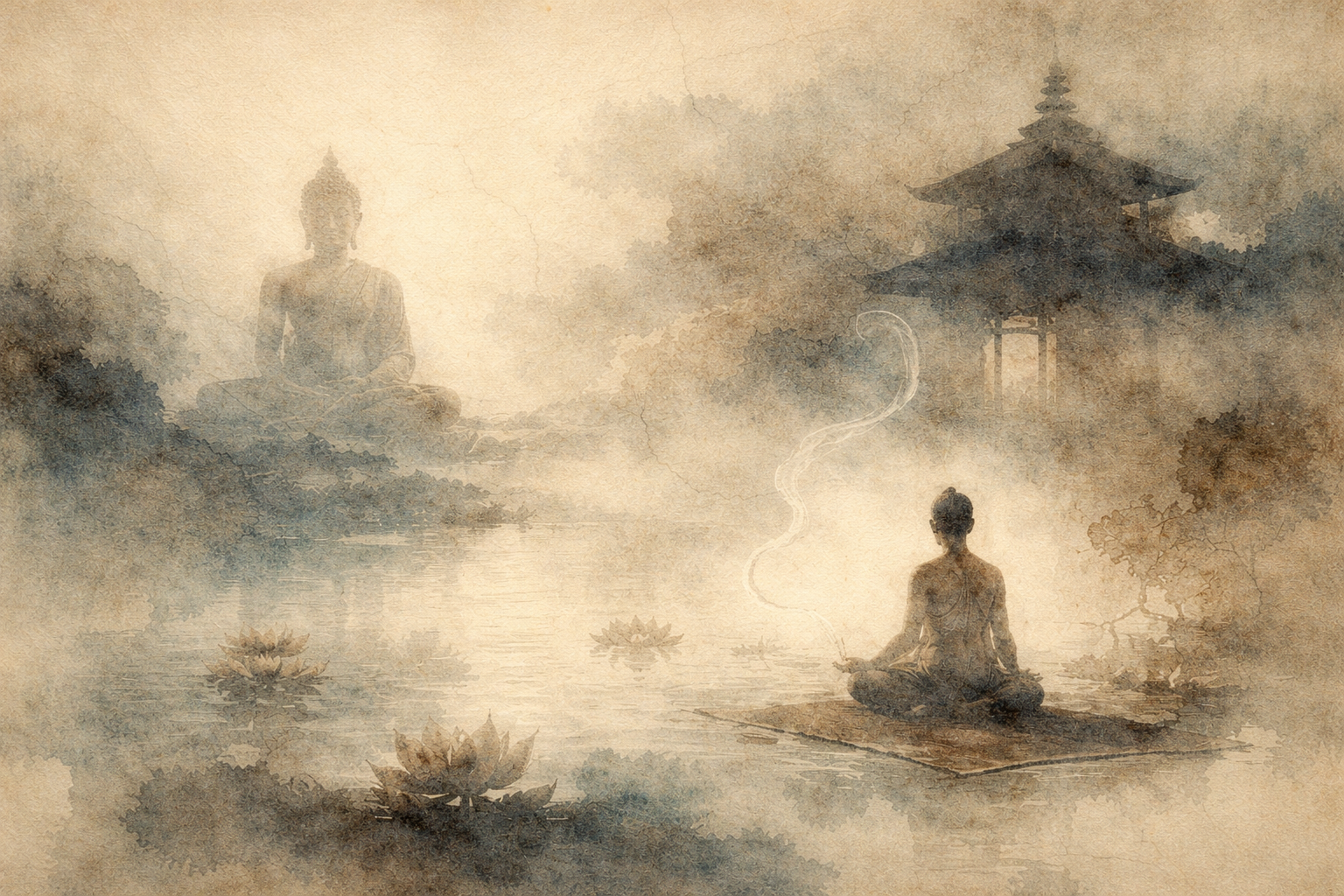
Quick Summary
- Gokuraku (極楽) literally means “ultimate bliss” or “extreme comfort,” and it’s commonly used for “paradise.”
- In Japanese Buddhist language, it most often points to the Pure Land—a realm associated with ease, clarity, and supportive conditions.
- In everyday Japanese, gokuraku can also mean simple pleasure: a hot bath, good food, or a moment of relief.
- The word carries a contrast: gokuraku (bliss) is often paired with jigoku (hell) in idioms and storytelling.
- As a lens, “gokuraku” can be read as the felt experience of less grasping, not just a distant afterlife idea.
- It’s easy to misunderstand it as “constant happiness”; traditionally it’s more about conditions that reduce confusion and reactivity.
- Knowing the nuance helps you read Japanese culture and Buddhist references without flattening them into “heaven.”
Introduction: Why “Gokuraku” Feels Hard to Translate
You see “gokuraku” translated as “paradise,” but then you hear someone say a hot bath is “gokuraku,” and suddenly the word feels slippery: is it a Buddhist realm, a poetic mood, or just “this is awesome”? The honest answer is that it’s all of those, and the meaning depends on whether you’re reading a religious context, a cultural reference, or casual speech. Gassho is a Zen/Buddhism site focused on clear, practical language rather than mystifying jargon.
The key is to treat “gokuraku” less like a single English equivalent and more like a cluster of meanings: “ultimate ease,” “bliss,” “paradise,” and “a state where suffering is not being manufactured moment to moment.” Once you see that cluster, the word becomes much easier to understand in both Buddhist and everyday Japanese settings.
The Core Meaning of Gokuraku as a Way of Seeing
Gokuraku (極楽) is built from goku (極, “ultimate,” “extreme,” “furthest”) and raku (楽, “ease,” “comfort,” “pleasure”). Put together, it points to “ultimate ease” or “supreme bliss.” In Buddhist Japanese, that “ultimate ease” is often associated with a “pure” environment—one where the usual triggers for confusion, craving, and fear are softened.
As a lens for understanding experience, “gokuraku” can be read as the opposite of the inner mechanics that create misery: tightening around what you want, resisting what you dislike, and narrating everything as a threat or a lack. In that sense, “gokuraku” isn’t just a place; it’s a name for what life feels like when the mind is not constantly adding friction.
This doesn’t require you to adopt a fixed belief about the cosmos. You can understand the word in a grounded way: “gokuraku” points to conditions—internal and external—that make it easier to respond wisely. When conditions are supportive, attention steadies, reactivity drops, and compassion becomes less of a heroic act and more of a natural option.
So “gokuraku meaning” is best held as a spectrum: from the everyday “this is heavenly” feeling, to a religious image of paradise, to a practical pointer toward ease that comes from less grasping and less resistance.
GASSHO
Ask and learn about Buddhism in daily life.
GASSHO is a Buddhist community app where you can learn Buddhist teachings and ask questions to the head priest of Kongosanmaiin Temple on Mount Koya.
How “Gokuraku” Shows Up in Ordinary Life
Think of a moment when you finally stop arguing with reality: the train is late, you notice the irritation rising, and then something releases. The situation hasn’t improved, but the inner pressure drops. That drop—small, ordinary, repeatable—is a taste of what “gokuraku” points toward as ease.
Or consider the difference between pleasure that tightens and pleasure that softens. Sometimes you enjoy something while already worrying it will end, or while comparing it to something better. The enjoyment is real, but it’s mixed with strain. “Gokuraku” in everyday speech often refers to the cleaner kind: a simple comfort that doesn’t immediately recruit anxiety.
You can also notice “gokuraku” by contrast. When you’re caught in resentment, the mind rehearses the same story, sharpening it each time. Even if nothing is happening externally, the inner world becomes cramped. When that rehearsal stops—maybe through a breath, a pause, or a change of attention—space returns. The relief is not dramatic; it’s just less self-made heat.
In relationships, “gokuraku” can look like dropping the need to win. You still speak clearly, you still set boundaries, but you’re not feeding the extra layer of “I must be right so I can feel safe.” The conversation becomes simpler. The body feels less armored.
Even sensory comfort can teach something here. A hot bath, warm sunlight, or a quiet room can feel like “gokuraku” because the nervous system stops bracing. The point isn’t to chase comfort forever; it’s to notice how quickly the mind can stop fighting when it feels safe enough.
And sometimes “gokuraku” is just the absence of unnecessary commentary. You eat, you walk, you wash dishes, and for a few seconds there’s no inner judge, no scoreboard, no “should.” It’s not a special state. It’s ordinary life without the extra burden.
Seen this way, “gokuraku” becomes a practical reference point: not “perfect happiness,” but “less friction, more ease,” right in the middle of normal days.
Common Misunderstandings About Gokuraku
Misunderstanding 1: “Gokuraku just means heaven.” “Heaven” is sometimes a workable translation, but it can smuggle in assumptions—like a creator deity, eternal reward, or a purely moral scoreboard. “Gokuraku” is closer to “paradise of ease” or “ultimate bliss,” and in Buddhist usage it’s tied to liberation from suffering rather than divine approval.
Misunderstanding 2: “It means constant pleasure.” The “raku” in gokuraku is ease, but not necessarily nonstop excitement. It’s more like the absence of the mental habits that keep generating dissatisfaction. That’s why the word can point both to a realm of supportive conditions and to a simple moment of relief.
Misunderstanding 3: “It’s only a religious term.” In modern Japanese, people use “gokuraku” casually to describe comfort (“This bath is gokuraku”). That everyday usage doesn’t cancel the Buddhist meaning; it shows how deeply the imagery of “ultimate ease” has entered the language.
Misunderstanding 4: “If it’s paradise, it must be escapism.” It can be used escapistically, but it doesn’t have to be. As a lens, “gokuraku” can highlight what reduces reactivity and what increases it—so you can live with more clarity here and now, not just fantasize about elsewhere.
Why the Meaning of Gokuraku Still Matters Today
Understanding “gokuraku meaning” matters because it changes how you interpret both Buddhist references and everyday Japanese culture. When a film, song, or conversation uses “gokuraku,” it may be pointing to more than “nice vibes”—it can imply a contrast with suffering, confusion, or the heaviness of ordinary life.
It also gives you a surprisingly practical question to carry into daily life: “What am I doing right now that adds friction?” If “gokuraku” is ultimate ease, then the path toward it—psychologically speaking—often looks like subtracting what’s unnecessary: extra stories, extra resistance, extra self-attack.
Finally, the word can soften the way you relate to “paradise” language. Instead of treating it as either literal geography or pure metaphor, you can treat it as a pointer: a name for conditions (inner and outer) that make wise action more likely. That’s a grounded, humane way to read a powerful term without forcing it into a single box.
Conclusion: Gokuraku as “Ultimate Ease,” Not Just a Distant Paradise
“Gokuraku” means “ultimate bliss” or “supreme ease,” and depending on context it can refer to a Buddhist paradise, a cultural image of the Pure Land, or the simple relief of comfort in everyday life. The most useful way to hold the term is as a pointer toward reduced friction: less grasping, less resistance, and more room to respond clearly. When you understand that, “gokuraku” stops being a vague translation problem and becomes a precise word for a very human experience.
Ask a Buddhist priest
Have a question about Buddhism?
In the GASSHO app, you can ask questions about Buddhist teachings, daily concerns, and how to understand Buddhism in everyday life.
Frequently Asked Questions
- FAQ 1: What is the literal gokuraku meaning in Japanese?
- FAQ 2: Does gokuraku mean “paradise” in Buddhism?
- FAQ 3: Is gokuraku the same as the Pure Land?
- FAQ 4: How is gokuraku different from “heaven”?
- FAQ 5: Can gokuraku mean simple comfort in everyday Japanese?
- FAQ 6: What does gokuraku imply emotionally—happiness, pleasure, or peace?
- FAQ 7: Is gokuraku a place, a state of mind, or both?
- FAQ 8: What is the difference between gokuraku and nirvana in meaning?
- FAQ 9: Why is gokuraku often contrasted with jigoku?
- FAQ 10: Is gokuraku a common word in modern Japanese?
- FAQ 11: How do you pronounce gokuraku?
- FAQ 12: What kanji are used for gokuraku and what do they mean?
- FAQ 13: Does gokuraku always refer to the afterlife?
- FAQ 14: Is it accurate to translate gokuraku as “Elysium” or “utopia”?
- FAQ 15: What is the simplest way to remember the gokuraku meaning?
FAQ 1: What is the literal gokuraku meaning in Japanese?
Answer: Literally, gokuraku (極楽) combines “goku” (ultimate/extreme) and “raku” (ease/comfort/pleasure), so it means “ultimate ease” or “supreme bliss.”
Takeaway: The core gokuraku meaning is “ultimate ease,” which can be translated as bliss or paradise depending on context.
FAQ 2: Does gokuraku mean “paradise” in Buddhism?
Answer: Yes, in Buddhist contexts gokuraku is commonly used to mean “paradise,” especially as a Japanese term pointing to the Pure Land as a realm of ease and supportive conditions.
Takeaway: In Buddhist usage, gokuraku often functions as “paradise,” but the nuance is “a place/state of ease.”
FAQ 3: Is gokuraku the same as the Pure Land?
Answer: In many Japanese Buddhist references, gokuraku is used as a shorthand for the Pure Land (often described as a realm of peace and clarity). Strictly speaking, “Pure Land” is the doctrinal label, while “gokuraku” emphasizes the felt quality of bliss/ease.
Takeaway: Gokuraku is often used to refer to the Pure Land, highlighting its “ultimate ease” aspect.
FAQ 4: How is gokuraku different from “heaven”?
Answer: “Heaven” can be a convenient translation, but it may imply ideas not necessarily built into gokuraku—like a creator deity or eternal reward. Gokuraku more directly means “ultimate bliss/ease,” and in Buddhist framing it relates to freedom from suffering and confusion.
Takeaway: “Heaven” is approximate; “ultimate ease/bliss” is closer to the gokuraku meaning.
FAQ 5: Can gokuraku mean simple comfort in everyday Japanese?
Answer: Yes. People may say something is gokuraku to mean it feels “heavenly” or deeply comfortable—like soaking in a hot bath or finally resting after a long day.
Takeaway: Gokuraku meaning includes everyday “this is bliss” comfort, not only religious paradise.
FAQ 6: What does gokuraku imply emotionally—happiness, pleasure, or peace?
Answer: It can imply all three, but the center of gravity is “ease”: pleasure that relaxes rather than agitates, and peace that comes from reduced inner friction. Context decides whether it leans more sensual (“so comfortable”) or spiritual (“paradise”).
Takeaway: The emotional flavor of gokuraku is ease—comfort and peace more than excitement.
FAQ 7: Is gokuraku a place, a state of mind, or both?
Answer: In Buddhist language it’s often described as a realm (a “place” of supportive conditions), while in everyday speech it can describe a state of comfort. Many readers find it helpful to treat it as both: an image of ideal conditions and a pointer to the experience of ease.
Takeaway: Gokuraku meaning can be read as both a realm of paradise and the felt state of deep ease.
FAQ 8: What is the difference between gokuraku and nirvana in meaning?
Answer: Gokuraku emphasizes bliss/ease and is often used for “paradise” imagery, while “nirvana” points to liberation—often described as the extinguishing of the causes of suffering. They can overlap in tone, but they are not the same word or concept.
Takeaway: Gokuraku is “ultimate ease/paradise”; nirvana is “liberation,” so they’re related but not identical.
FAQ 9: Why is gokuraku often contrasted with jigoku?
Answer: In Japanese, gokuraku (ultimate bliss) and jigoku (hell) form a vivid contrast used in stories, idioms, and moral imagery. The pairing highlights extremes of ease versus torment.
Takeaway: The gokuraku meaning becomes clearer when seen as the opposite pole of jigoku (hell).
FAQ 10: Is gokuraku a common word in modern Japanese?
Answer: It’s recognizable and still used, though it can sound a bit dramatic or literary depending on tone. You’ll see it in set phrases, cultural references, and casual exaggerations about comfort.
Takeaway: Gokuraku is not obscure; it’s a living word with both cultural and Buddhist resonance.
FAQ 11: How do you pronounce gokuraku?
Answer: It’s pronounced go-ku-ra-ku (five syllables), with a fairly even rhythm in Japanese. In romanization you’ll usually see “gokuraku.”
Takeaway: Pronounce it clearly as go-ku-ra-ku to match the Japanese rhythm.
FAQ 12: What kanji are used for gokuraku and what do they mean?
Answer: The kanji are 極楽. 極 means “ultimate/extreme,” and 楽 means “ease/comfort/pleasure.” Together they express “ultimate ease” or “supreme bliss.”
Takeaway: The kanji reinforce that gokuraku meaning is about the highest degree of ease.
FAQ 13: Does gokuraku always refer to the afterlife?
Answer: No. While it can refer to a paradise realm in Buddhist contexts, it’s also used in everyday life to describe a blissful, comfortable experience right now.
Takeaway: Gokuraku meaning is not limited to the afterlife; it can describe present-moment comfort too.
FAQ 14: Is it accurate to translate gokuraku as “Elysium” or “utopia”?
Answer: Sometimes, but those translations can shift the tone. “Elysium” captures “paradise,” and “utopia” suggests an ideal society, which isn’t always what gokuraku implies. “Paradise” or “ultimate bliss/ease” is usually closer and more flexible.
Takeaway: Use “paradise” or “ultimate ease” for gokuraku meaning unless a literary translation is needed.
FAQ 15: What is the simplest way to remember the gokuraku meaning?
Answer: Remember it as “ultimate ease.” From there, you can expand by context: in Buddhist writing it often means “paradise/Pure Land,” and in daily speech it can mean “this feels heavenly.”
Takeaway: “Ultimate ease” is the simplest, most reliable memory hook for gokuraku meaning.