



How Was Buddhism Incorporated into the State in the Nara Period?
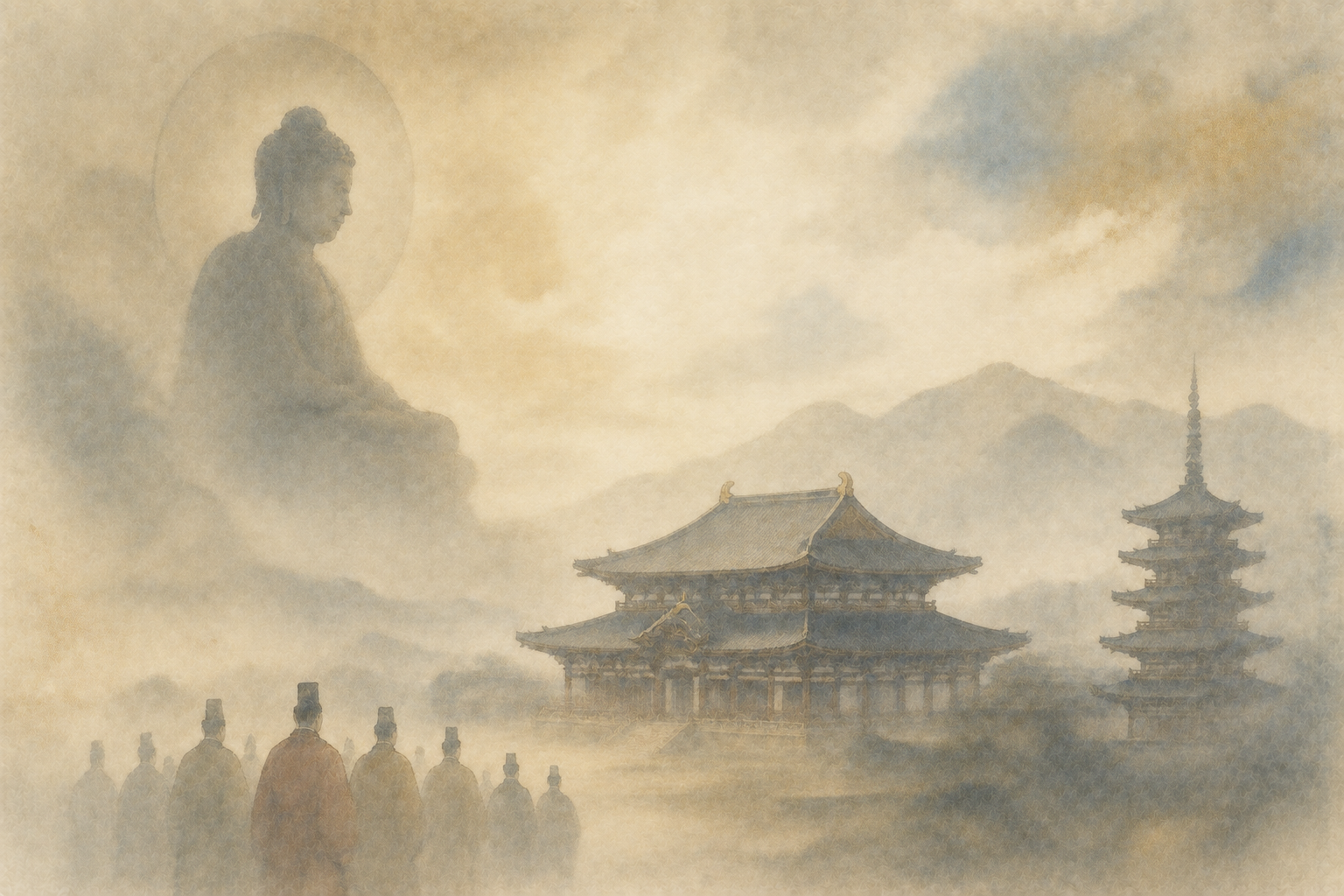
Quick Summary
- In the Nara period, the court treated Buddhism as public infrastructure for protection, legitimacy, and social order.
- State sponsorship built major temples, standardized rituals, and funded large-scale projects like the Great Buddha at Tōdai-ji.
- Monks and nuns were regulated through licensing, ordination controls, and administrative offices tied to government.
- Rituals, sutra recitations, and repentance ceremonies were deployed to address epidemics, disasters, and political instability.
- Provincial temple networks extended the capital’s authority into the countryside through worship, record-keeping, and labor mobilization.
- Buddhism’s incorporation was not purely spiritual; it was also fiscal, legal, and bureaucratic.
- The arrangement created benefits and tensions: cultural flourishing alongside heavy costs and power struggles.
Introduction
If you’re stuck on the phrase “Buddhism was incorporated into the state” in the Nara period, the confusion is usually this: was it about personal faith, or was it basically government policy with temples attached? In Nara Japan, it was largely policy—Buddhist institutions, rituals, and personnel were woven into the machinery of rule to stabilize the realm and justify authority, and that practical purpose shaped almost everything that followed. This explanation is written for Gassho readers who want historically grounded clarity without turning the topic into either propaganda or cynicism.
The Nara period (710–794) was the first era in which Japan’s central government tried to govern in a visibly “state-like” way: fixed capital, codified law, taxation, and a bureaucracy modeled in part on continental examples. Buddhism arrived earlier, but in Nara it became something the court could organize, fund, and deploy—especially in response to crises like epidemics, famine, and political conflict.
So when historians ask how Buddhism was incorporated into the state in the Nara period, they’re pointing to concrete mechanisms: state-built temples, government-supervised ordinations, public rites for national protection, and a temple network that extended administrative reach. The result was a form of Buddhism that functioned as both religion and public institution.
A Clear Lens: Buddhism as Public Protection and Political Order
A useful way to see Nara Buddhism is as a “public protection system” rather than a private path. The court treated Buddhist rites and institutions as tools that could help keep the realm intact: calming unrest, responding to disease, and reinforcing the idea that the ruler’s authority was aligned with a larger moral order.
This doesn’t mean people lacked sincere devotion. It means the state’s primary interest was collective outcomes—peace, harvests, legitimacy—so it invested in Buddhism where it could be organized at scale. Large temples were not only places of worship; they were also hubs of labor, resources, literacy, and prestige.
Incorporation happened through structure. The government supported certain temples, appointed or approved clerics, and standardized ceremonies that could be performed “for the nation.” In practice, this made Buddhism legible to the state: countable, fundable, and administratively manageable.
Seen through this lens, the famous monuments of the era—like Tōdai-ji and the Great Buddha—are not just religious art. They are state projects: statements that the court could mobilize resources, unify provinces, and present itself as the guardian of the people’s welfare.
GASSHO
Ask and learn about Buddhism in daily life.
GASSHO is a Buddhist community app where you can learn Buddhist teachings and ask questions to the head priest of Kongosanmaiin Temple on Mount Koya.
How State Buddhism Shows Up in Ordinary Human Experience
Even if you never step into an eighth-century temple, the Nara pattern is familiar: when uncertainty rises, people look for systems that promise stability. In daily life, that often shows up as a quiet tightening in the chest—an urge to find something official, sanctioned, and dependable.
Imagine hearing that illness is spreading, crops are failing, or rumors of conflict are circulating. Attention narrows. The mind searches for a lever that can be pulled. In Nara Japan, state-sponsored Buddhist rites offered a lever: public ceremonies that said, “We are doing something, together, under authority.”
There’s also the experience of reassurance through repetition. Sutra recitations, repentance rituals, and temple calendars create a rhythm. When life feels chaotic, rhythm can feel like relief—less because it proves anything metaphysical, more because it organizes fear into a shared routine.
Then there’s the social effect of visible commitment. When leaders fund temples, commission images, and sponsor ceremonies, people notice. The mind reads it as investment: “They are responsible; they are protecting us.” Whether that protection is real or symbolic, the psychological impact can be immediate.
At the same time, incorporation can create mixed feelings. When a religious institution becomes part of governance, it can feel both comforting and heavy. Comforting because it provides meaning and services; heavy because it can demand labor, taxes, and conformity. That ambivalence—relief and burden at once—is a very human response to any large system.
Notice, too, how quickly “spiritual” language can become administrative language. A vow becomes a policy. A ritual becomes a scheduled public function. A cleric becomes a regulated professional. In ordinary experience, this is the moment when something intimate becomes official—and the mind reacts by either trusting it more or doubting it more.
Finally, there’s the quiet internal shift that happens when authority and meaning merge. When the state frames certain rites as necessary for the nation, people may feel less permission to question them. The mind learns a habit: equating social order with moral order. That habit is one of the most enduring “lived” outcomes of Nara-style incorporation.
Common Misunderstandings About Nara State Buddhism
One common misunderstanding is that incorporation means “the whole country became Buddhist.” In reality, religious life was layered. Local practices continued, and devotion varied widely. What changed most clearly was the state’s relationship to Buddhist institutions: funding, regulation, and use in public policy.
Another misunderstanding is that state involvement automatically made Buddhism “fake” or purely political. State sponsorship can be strategic and still be sincerely religious for many participants. The key point is not to judge motives from a distance, but to see how incentives and structures shaped what Buddhism looked like in public life.
It’s also easy to assume temples were only spiritual centers. In Nara, major temples were economic and administrative actors: they held land, managed labor, produced texts, trained specialists, and interacted with officials. That institutional reality is central to understanding incorporation.
Finally, people sometimes reduce the story to one monument or one ruler. The Great Buddha project matters, but incorporation was broader: legal controls on ordination, networks of provincial temples, and recurring national rites. It was a system, not a single event.
Why This History Still Matters
The Nara period shows how quickly a tradition can change when it becomes part of governance. Once a religion is tasked with protecting the state, it tends to develop public-facing rituals, administrative hierarchies, and measurable outputs—things a government can recognize and reward.
It also clarifies a modern confusion: “religion” is not always separate from “public life.” Nara Japan reminds us that institutions often carry multiple roles at once—spiritual, cultural, educational, and political—and those roles can support each other or collide.
On a personal level, this history helps you notice when you’re seeking certainty through official structures. That’s not a flaw; it’s a human reflex. Seeing it clearly gives you more choice: you can appreciate the stability institutions provide without surrendering your capacity to question and observe.
And for anyone studying Buddhism today, Nara is a reminder that “Buddhism” is not one static thing. It is a living set of practices and institutions that can be shaped by the needs of a court, a community, or a household—sometimes all at once.
Conclusion
Buddhism was incorporated into the state in the Nara period through deliberate, practical integration: the court funded temples, regulated clergy, standardized national rites, and built networks that extended authority across provinces. The goal was not only devotion, but stability—protecting the realm, legitimizing rule, and organizing society in a time of real vulnerability.
If you keep one idea, let it be this: Nara Buddhism became “state Buddhism” not because spirituality disappeared, but because institutions, budgets, and bureaucracy gave religious practice a public job to do.
Ask a Buddhist priest
Have a question about Buddhism?
In the GASSHO app, you can ask questions about Buddhist teachings, daily concerns, and how to understand Buddhism in everyday life.
Frequently Asked Questions
- FAQ 1: How was Buddhism incorporated into the state in the Nara period in practical terms?
- FAQ 2: Why did the Nara court want Buddhism tied to the state?
- FAQ 3: What role did Tōdai-ji and the Great Buddha play in incorporating Buddhism into the state?
- FAQ 4: How did the government regulate monks and nuns in the Nara period?
- FAQ 5: What were provincial temples, and how did they support state incorporation of Buddhism?
- FAQ 6: Were Buddhist rituals used as a form of public policy in the Nara period?
- FAQ 7: Did incorporating Buddhism into the state change what Buddhism looked like in Nara Japan?
- FAQ 8: How did law and bureaucracy help incorporate Buddhism into the Nara state?
- FAQ 9: Was Nara “state Buddhism” mainly about controlling people?
- FAQ 10: How did state sponsorship affect temple wealth and land in the Nara period?
- FAQ 11: Did the Nara state favor certain temples as “official” centers?
- FAQ 12: How did Buddhism help legitimize the ruler during the Nara period?
- FAQ 13: Did ordinary people experience state incorporation of Buddhism directly in the Nara period?
- FAQ 14: What tensions arose from incorporating Buddhism into the Nara state?
- FAQ 15: What is the simplest way to explain how Buddhism was incorporated into the state in the Nara period?
FAQ 1: How was Buddhism incorporated into the state in the Nara period in practical terms?
Answer: It was incorporated through state funding of major temples, government regulation of ordination and clergy, and the use of Buddhist rituals as public services for national protection, legitimacy, and crisis response.
Takeaway: In Nara Japan, Buddhism became part of governance through money, rules, and public ritual.
FAQ 2: Why did the Nara court want Buddhism tied to the state?
Answer: The court saw Buddhism as a stabilizing force that could protect the realm through rites, support centralized authority, and provide a prestigious cultural framework aligned with a strong bureaucratic state.
Takeaway: The motive was stability and legitimacy as much as devotion.
FAQ 3: What role did Tōdai-ji and the Great Buddha play in incorporating Buddhism into the state?
Answer: They functioned as state-sponsored symbols and institutions: massive public works that mobilized resources, unified provincial participation, and presented the ruler as a protector acting for the nation’s welfare through Buddhism.
Takeaway: Monumental temple projects were also political and administrative projects.
FAQ 4: How did the government regulate monks and nuns in the Nara period?
Answer: The state controlled ordinations and often required official permission, monitored clerical status, and used administrative offices to manage the recognized clergy, limiting unauthorized religious activity.
Takeaway: Clergy were treated as regulated personnel within a state system.
FAQ 5: What were provincial temples, and how did they support state incorporation of Buddhism?
Answer: Provincial temple networks extended state-backed Buddhism beyond the capital, creating standardized sites for rituals, education, and administration that reinforced central authority across regions.
Takeaway: Temple networks helped the state reach the provinces.
FAQ 6: Were Buddhist rituals used as a form of public policy in the Nara period?
Answer: Yes. Sutra recitations, repentance rites, and other ceremonies were sponsored to address epidemics, disasters, and unrest, functioning as official responses meant to restore order and protection.
Takeaway: Ritual was treated as a public tool for managing crisis.
FAQ 7: Did incorporating Buddhism into the state change what Buddhism looked like in Nara Japan?
Answer: It encouraged large institutions, standardized ceremonies, and a focus on nation-protecting functions, because those were the aspects the government could fund, measure, and organize.
Takeaway: State needs shaped public Buddhism’s priorities and scale.
FAQ 8: How did law and bureaucracy help incorporate Buddhism into the Nara state?
Answer: Legal codes and bureaucratic offices made Buddhism administratively legible: they defined recognized clerical status, regulated ordination, and coordinated temple responsibilities with government aims.
Takeaway: Incorporation depended on paperwork and governance structures, not only belief.
FAQ 9: Was Nara “state Buddhism” mainly about controlling people?
Answer: Control was part of it, but not the whole story. The state sought order and legitimacy, while many participants sought merit, protection, and meaning; incorporation created a shared system that served multiple interests.
Takeaway: It was both governance and religion, with overlapping goals.
FAQ 10: How did state sponsorship affect temple wealth and land in the Nara period?
Answer: State support could increase temple resources through grants, labor, and privileges, which in turn made major temples powerful institutions with economic influence as well as religious authority.
Takeaway: Incorporation often meant temples gained material power alongside spiritual prestige.
FAQ 11: Did the Nara state favor certain temples as “official” centers?
Answer: Yes. The court supported prominent temples in and around the capital and used them for major rites and projects, effectively creating a set of institutions closely tied to state priorities.
Takeaway: Some temples functioned as semi-official arms of the court.
FAQ 12: How did Buddhism help legitimize the ruler during the Nara period?
Answer: By sponsoring grand temples and national rites, the ruler could present themselves as a moral protector of the realm, aligning political authority with a widely respected religious framework.
Takeaway: Public Buddhist projects strengthened the image of rightful rule.
FAQ 13: Did ordinary people experience state incorporation of Buddhism directly in the Nara period?
Answer: Often indirectly—through provincial temples, public ceremonies, taxation and labor demands for temple projects, and the growing presence of state-backed rituals in community life.
Takeaway: Even without elite access, people felt the system through local institutions and obligations.
FAQ 14: What tensions arose from incorporating Buddhism into the Nara state?
Answer: Tensions included the high cost of temple building, competition for influence between religious institutions and political actors, and disputes over clerical authority and state control.
Takeaway: Integration brought stability aims, but also power struggles and financial strain.
FAQ 15: What is the simplest way to explain how Buddhism was incorporated into the state in the Nara period?
Answer: The government treated Buddhism as a national resource: it built and funded temples, regulated clergy, and sponsored rituals meant to protect and unify the country under centralized rule.
Takeaway: Nara incorporation means Buddhism became part of the state’s operating system.