



Why Buddhist Observances Still Matter Today
Quick Summary
- Buddhist observances still matter today because they turn values into repeatable actions, not just good intentions.
- They create “pause points” that interrupt autopilot reactions and make room for wiser choices.
- Observances work as social and ethical guardrails, especially when modern life rewards speed and self-focus.
- They help people relate to stress, grief, and uncertainty with steadier attention and less reactivity.
- Even simple rituals can strengthen gratitude, restraint, and compassion without requiring special beliefs.
- Modern practice can be flexible: the point is consistency and sincerity, not perfect performance.
- When done thoughtfully, observances support both personal clarity and healthier communities.
Why this question keeps coming up now
You can respect Buddhism and still feel unsure why observances—precepts, holy days, chanting, offerings, mindful eating, periods of silence—should matter in a world of calendars, apps, and constant urgency. It can look like extra “religious stuff” layered on top of an already busy life, or like tradition for tradition’s sake. At Gassho, we focus on what these practices actually do in lived experience, not on winning an argument about them.
Many people try to keep only the parts that feel immediately useful (like mindfulness) and quietly drop the rest, then wonder why their practice becomes vague, inconsistent, or overly self-referential. Observances can look optional until you notice how quickly modern life trains attention to chase stimulation, avoid discomfort, and justify small harms. The question isn’t whether you can be a decent person without observances; it’s whether observances provide a reliable structure for becoming decent on the days you least feel like it.
GASSHO
Ask and learn about Buddhism in daily life.
GASSHO is a Buddhist community app where you can learn Buddhist teachings and ask questions to the head priest of Kongosanmaiin Temple on Mount Koya.
A practical lens: observances as training, not decoration
A helpful way to understand Buddhist observances is to see them as training environments for the mind and heart. They are not primarily statements of identity (“I am this kind of person”) or attempts to earn spiritual points. They are repeatable forms that make certain inner movements more likely: pausing before acting, noticing craving, remembering others, and choosing restraint when impulse is loud.
In modern life, most of our “forms” are already chosen for us: notifications, deadlines, consumption habits, and social comparison. Those forms shape attention and behavior whether we call them spiritual or not. Observances matter because they intentionally replace some of that default shaping with a different kind of shaping—one that emphasizes awareness, non-harming, and responsibility.
Another way to say it: observances externalize what we say we value. Compassion stays abstract until it becomes a concrete practice: a day of extra care, a vow to avoid certain speech, a moment of gratitude before eating, a deliberate act of giving. The form is not the goal; the form is the container that makes the goal more possible.
Finally, observances matter because they are designed for ordinary people. You do not need special experiences to benefit from a simple commitment kept over time. The steadiness of the form is often what carries you when motivation fluctuates.
How observances show up in everyday experience
On a normal morning, the mind often starts by scanning for problems: messages, tasks, worries, and unfinished conversations. An observance as small as a brief bow, a few lines of recitation, or a moment of silence changes the first move. It doesn’t erase stress; it interrupts the reflex to be owned by it.
Later, when irritation appears—someone cuts you off, a coworker is dismissive, a family member repeats the same pattern—an ethical observance (like a commitment to avoid harsh speech) becomes a live experiment. You feel the heat of the reaction, notice the urge to strike back, and recognize that you have options. The observance doesn’t make you “better”; it makes the moment more visible.
During meals, a mindful eating observance can reveal how quickly the mind reaches for more: more flavor, more distraction, more speed. You may notice the subtle anxiety underneath rushing, or the way scrolling while eating dulls both taste and gratitude. The practice is not about being strict; it is about seeing clearly what is happening.
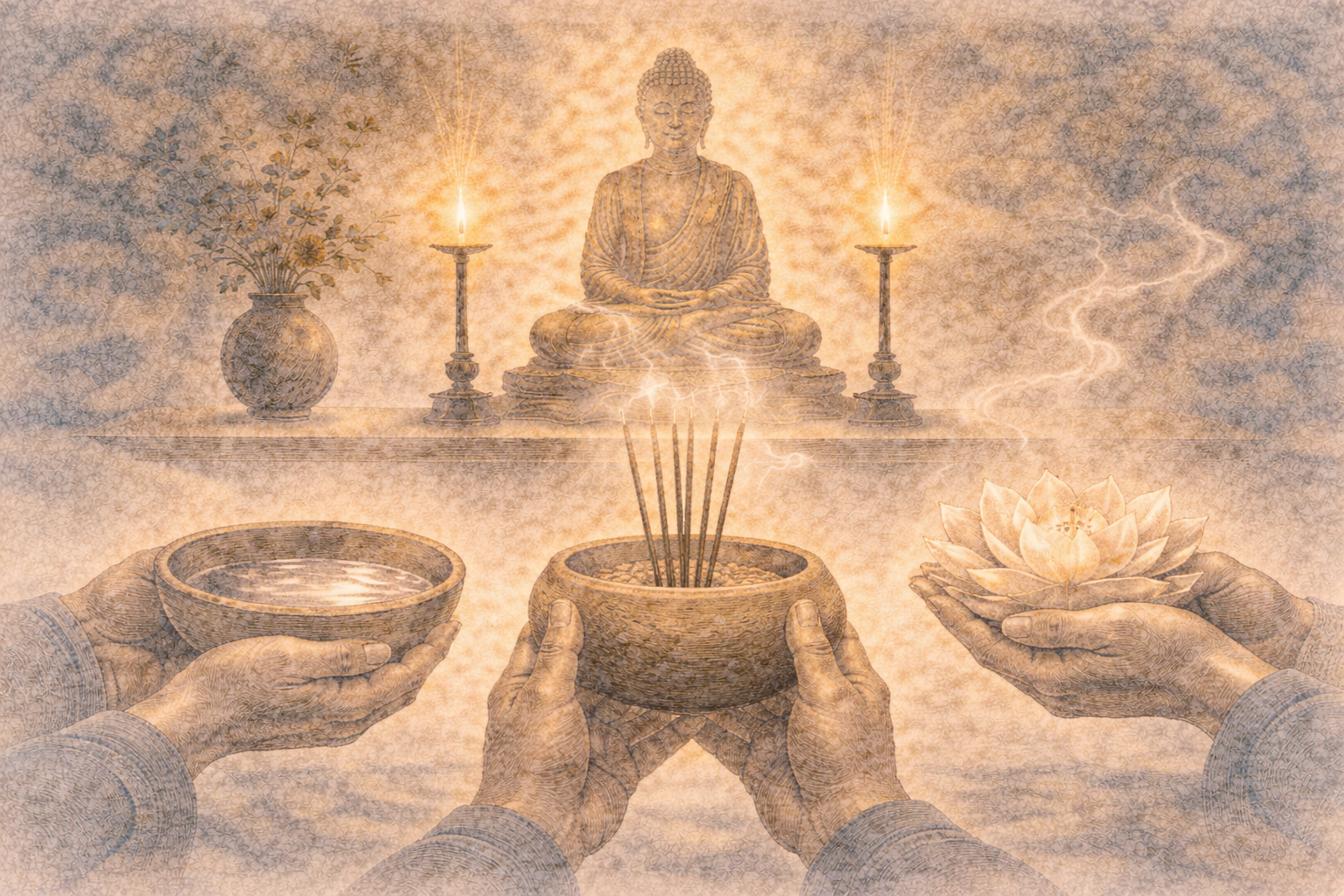
On days of grief or uncertainty, observances can function like handrails. Lighting a candle, offering a few words of dedication, or keeping a day of simplicity can give shape to feelings that otherwise spill everywhere. The form doesn’t solve loss; it gives the heart a way to hold it without collapsing into numbness or drama.
In relationships, observances often show up as repair. A regular reflection on conduct can make it harder to rationalize small betrayals: the “harmless” lie, the passive-aggressive comment, the quiet resentment. You notice the cost sooner. You may still make mistakes, but you become quicker to acknowledge them.
In a consumer culture, observances around generosity and contentment can feel surprisingly modern. A planned act of giving, a day of reduced consumption, or a practice of gratitude exposes how often buying is used to manage mood. You see the difference between genuine need and emotional purchasing, not as a moral failure but as a pattern.
Over time, the most noticeable shift is often simple: more pauses. Not constant calm, not permanent clarity—just more moments where you catch yourself before you harden into a story, a judgment, or a compulsion. Observances matter today because modern life is engineered to remove those pauses.
Common misunderstandings that make observances feel irrelevant
“Observances are just cultural leftovers.” Some forms are culturally specific, but the function is not: creating rhythm, accountability, and remembrance. You can adapt the outer shape while keeping the inner purpose intact.
“If it’s not spontaneous, it’s not sincere.” Modern culture often equates sincerity with whatever you feel in the moment. Observances assume something different: feelings change, and practice is what you do when feelings are unreliable. Consistency can be a form of honesty.
“Observances are about being perfect.” In practice, they are about noticing cause and effect. When you break an observance, the point is not shame; it’s learning: what conditions led to it, what it cost, and what support you need next time.
“Ethics are private; observances are unnecessary.” Private ethics often collapse under pressure. Observances make ethics public to your own awareness through repetition. They also connect you to a wider human project: reducing harm, not just feeling good.
“Ritual is irrational.” Ritual can be irrational, but it can also be psychologically precise. Humans learn through repetition, symbols, and embodied cues. A small ritual can remind you of what you forget when you’re tired, busy, or defensive.
Why observances still matter in modern life
Modern life is not neutral; it trains the mind toward speed, comparison, and consumption. Buddhist observances still matter today because they offer counter-training: slowing down, seeing consequences, and remembering what you actually care about when no one is watching.
They also matter because they are scalable. You can keep a small daily observance in a crowded schedule, or a deeper one during a retreat, illness, or a life transition. The point is not to add pressure; it is to add structure that supports clarity.
Observances matter socially as well. A community that shares ethical commitments and regular remembrance tends to be less driven by charisma and more grounded in conduct. Even when practiced alone, observances connect you to a wider field of human intention: to live with less harm and more care.
Finally, observances matter because they keep practice from becoming purely self-improvement. When your practice includes generosity, restraint, and remembrance of others, it naturally points beyond the self’s preferences. That outward orientation is one of the most relevant medicines for our time.
Conclusion
Buddhist observances still matter today because they make the invisible visible: the moment before speech, the urge before purchase, the story before judgment, the habit before harm. They are not relics to admire or rules to fear; they are practical forms that help you remember, in real time, how you want to live.
If you feel skeptical, that’s workable. Try approaching observances as experiments in attention and ethics: choose one small form, keep it gently for a few weeks, and observe what it changes in your day. The value is not in the label “Buddhist,” but in the steadier mind and kinder conduct the observance makes more likely.
Ask a Buddhist priest
Have a question about Buddhism?
In the GASSHO app, you can ask questions about Buddhist teachings, daily concerns, and how to understand Buddhism in everyday life.
Frequently Asked Questions
- FAQ 1: Why do Buddhist observances still matter today if I’m not religious?
- FAQ 2: What counts as a Buddhist observance in modern life?
- FAQ 3: Why do Buddhist observances still matter today when mindfulness alone seems enough?
- FAQ 4: Are Buddhist observances just rituals, and do rituals still matter today?
- FAQ 5: Why do Buddhist observances still matter today in a fast, digital culture?
- FAQ 6: Do Buddhist observances still matter today if I practice alone?
- FAQ 7: Why do Buddhist observances still matter today for mental health and stress?
- FAQ 8: Are Buddhist observances still relevant if they feel outdated or culturally specific?
- FAQ 9: Why do Buddhist observances still matter today for ethics and relationships?
- FAQ 10: Do Buddhist observances still matter today if I can’t keep them perfectly?
- FAQ 11: Why do Buddhist observances still matter today if they feel like rules?
- FAQ 12: How can I start Buddhist observances in a simple, modern way?
- FAQ 13: Why do Buddhist observances still matter today for community and society?
- FAQ 14: Are Buddhist observances still meaningful if I don’t chant or use traditional language?
- FAQ 15: Why do Buddhist observances still matter today when life is already overwhelming?
FAQ 1: Why do Buddhist observances still matter today if I’m not religious?
Answer: They matter because they function as practical habits that train attention, restraint, and compassion, regardless of belief. Observances create repeatable “pause points” that help you notice impulses and choose responses more deliberately.
Takeaway: You can treat observances as training tools, not as a religious identity test.
FAQ 2: What counts as a Buddhist observance in modern life?
Answer: Common observances include keeping ethical precepts, marking special days with extra practice or simplicity, chanting or recitation, offerings or acts of generosity, mindful eating, and periods of intentional silence. The modern form can be simple as long as the intention is clear.
Takeaway: Observances are structured actions that express values through repetition.
FAQ 3: Why do Buddhist observances still matter today when mindfulness alone seems enough?
Answer: Mindfulness helps you notice what’s happening, but observances help shape what you do next through ethical and communal structure. Without observances, mindfulness can drift into self-optimization; with observances, it stays connected to non-harming and responsibility.
Takeaway: Observances anchor mindfulness in conduct, not just awareness.
FAQ 4: Are Buddhist observances just rituals, and do rituals still matter today?
Answer: Some observances are ritualized, but their purpose is often psychological and ethical: to remind, steady, and reorient attention. Ritual still matters today because humans learn through repetition and embodied cues, especially when stressed or distracted.
Takeaway: Ritual can be a practical reminder system, not empty performance.
FAQ 5: Why do Buddhist observances still matter today in a fast, digital culture?
Answer: Digital life trains constant switching, comparison, and impulsive reaction. Observances introduce deliberate slowness and reflection, creating space to respond rather than react and to remember long-term values over short-term stimulation.
Takeaway: Observances counterbalance the attention-fragmenting pull of modern life.
FAQ 6: Do Buddhist observances still matter today if I practice alone?
Answer: Yes. Even in solitude, observances provide accountability to your own intentions and reduce the tendency to practice only when it feels convenient. They also connect you to a wider ethical orientation, even without a formal group.
Takeaway: Observances can support consistency and integrity in solo practice.
FAQ 7: Why do Buddhist observances still matter today for mental health and stress?
Answer: Observances don’t replace professional care, but they can reduce stress reactivity by building regular moments of pausing, grounding, and ethical clarity. Many people find that consistent observances reduce rumination and regret because actions become more intentional.
Takeaway: Observances can support steadier coping by training pause and choice.
FAQ 8: Are Buddhist observances still relevant if they feel outdated or culturally specific?
Answer: The outer form can be culturally shaped, but the inner function—remembrance, restraint, gratitude, generosity—remains relevant. You can adapt language and style while keeping the core intention and consistency.
Takeaway: Keep the function, adapt the form.
FAQ 9: Why do Buddhist observances still matter today for ethics and relationships?
Answer: Observances make ethics actionable: they bring attention to speech, honesty, and harm in the moments they arise. In relationships, this often shows up as fewer impulsive words, quicker repair, and clearer boundaries around harmful habits.
Takeaway: Observances translate “be kind” into repeatable relational behavior.
FAQ 10: Do Buddhist observances still matter today if I can’t keep them perfectly?
Answer: Yes. Observances are not primarily about perfection; they are about learning cause and effect in real time. When you fall short, the practice is to notice conditions, make amends where needed, and recommit without self-punishment.
Takeaway: Consistent returning matters more than flawless performance.
FAQ 11: Why do Buddhist observances still matter today if they feel like rules?
Answer: They can feel like rules when approached as external demands. When approached as chosen training, they become supports that protect what you value—like guardrails that reduce regret and harm when emotions run high.
Takeaway: Observances work best when held as voluntary supports, not punishments.
FAQ 12: How can I start Buddhist observances in a simple, modern way?
Answer: Start small and specific: choose one daily observance (a brief moment of gratitude, a short recitation, or a clear speech commitment) and one weekly observance (extra generosity, reduced consumption, or a period of silence). Keep it realistic so consistency is possible.
Takeaway: One small daily form plus one weekly form is a strong beginning.
FAQ 13: Why do Buddhist observances still matter today for community and society?
Answer: Observances reinforce shared ethical norms and reduce practice becoming personality-driven. They also encourage generosity and non-harming, which have real social effects: less exploitation, more care, and more willingness to repair harm.
Takeaway: Observances support healthier communities by making ethics communal and repeatable.
FAQ 14: Are Buddhist observances still meaningful if I don’t chant or use traditional language?
Answer: Yes. Chanting is one form of observance, but the deeper point is regular remembrance and intention. You can use plain language, silent reflection, or short readings as long as the practice reliably reorients your mind toward non-harming and clarity.
Takeaway: Traditional language is optional; consistent remembrance is not.
FAQ 15: Why do Buddhist observances still matter today when life is already overwhelming?
Answer: When life is overwhelming, willpower and inspiration are least reliable. Observances matter because they provide a small, steady structure that can hold you through fatigue and uncertainty, helping you act with fewer regrets even under pressure.
Takeaway: Observances are most valuable when you’re least able to “wing it.”