



How Does Buddhism View Ancestors? A Beginner-Friendly Answer
Quick Summary
- Buddhism tends to view “ancestors” less as distant authorities and more as part of an ongoing web of causes and conditions that shaped your life.
- Respect for ancestors is often expressed through gratitude, ethical living, and remembrance rather than fear or obligation.
- Rituals for the dead can be meaningful as ways to steady the heart, honor relationships, and support communal grieving.
- Offerings and prayers are commonly understood as symbolic acts that cultivate generosity and care, not as “payments” to spirits.
- There isn’t one universal Buddhist rule about ancestor veneration; practices vary widely by culture and family tradition.
- You can engage ancestors in a Buddhist way without adopting supernatural claims you don’t believe.
- The practical question is: does your relationship to ancestors reduce harm and increase clarity, kindness, and responsibility?
Introduction
If you’re trying to figure out how Buddhism views ancestors, you’re probably stuck between two extremes: either “Buddhists worship ancestors” or “Buddhism rejects ancestors as superstition.” Both miss the point. A beginner-friendly way to approach it is to treat ancestors as a real part of your life story—biologically, emotionally, culturally—while keeping the focus on how you relate to that story right now. I’m writing from the perspective of Gassho, a Zen/Buddhism site focused on practical understanding over dogma.
In many Buddhist contexts, honoring ancestors is less about proving what happens after death and more about training the heart: gratitude instead of entitlement, responsibility instead of blame, and remembrance instead of avoidance.
That means you can hold your ancestors close without turning them into gods, and you can question rituals without dismissing the human needs those rituals serve.
A grounded Buddhist lens on ancestors
A simple Buddhist lens starts with this: your life is not isolated. You are the result of countless conditions—family choices, inherited habits, social history, and the care (or lack of care) that reached you long before you had a say. “Ancestors” names that reality in a personal way. It points to the fact that you didn’t appear from nowhere, and you won’t disappear without leaving traces.
From this angle, honoring ancestors is not primarily a belief about invisible beings. It’s a way of acknowledging interdependence: you received life, language, values, wounds, opportunities, and limitations through a chain of people. Some of that chain is beautiful; some is painful. Buddhism tends to ask you to see both clearly, without romanticizing or demonizing.
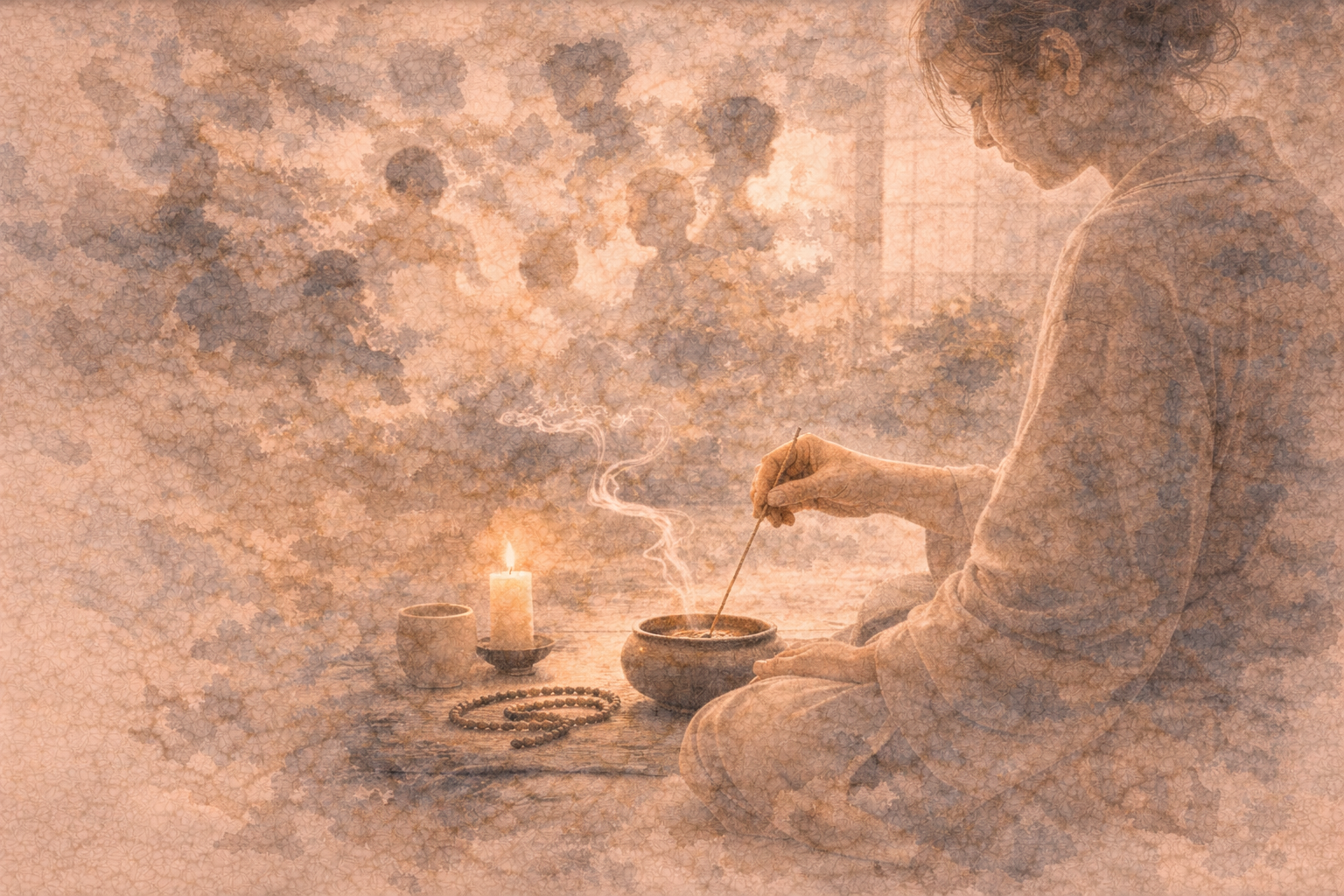
Another key piece is intention. When people light incense, bow, speak names, or offer food, the most accessible meaning is inner training: remembering what matters, softening resentment, and strengthening gratitude. Even if different communities explain these actions differently, the beginner-friendly takeaway is that the practice is meant to shape your mind and conduct—how you live, how you treat others, and how you carry loss.
Finally, Buddhism often emphasizes ethical cause and effect: what you do matters, and it ripples outward. In that sense, the most “Buddhist” way to relate to ancestors is not to obsess over them, but to live in a way that doesn’t pass harm forward. You can’t rewrite the past, but you can stop certain patterns from becoming your legacy.
GASSHO
Ask and learn about Buddhism in daily life.
GASSHO is a Buddhist community app where you can learn Buddhist teachings and ask questions to the head priest of Kongosanmaiin Temple on Mount Koya.
How ancestor respect shows up in everyday experience
You notice your ancestors when you catch yourself repeating a family phrase in the same tone your parent used—especially when you don’t like that tone. In that moment, “ancestor practice” can be as simple as pausing, feeling the impulse, and choosing a different response. The point isn’t to judge your family; it’s to see conditioning in real time.
You also notice ancestors when gratitude appears unexpectedly: a recipe you learned, a work ethic you inherited, a small kindness that shaped your standards for love. A Buddhist approach doesn’t require you to inflate this into a sacred story. It just asks you to let gratitude land fully, without immediately moving on.
Grief is another doorway. After someone dies, the mind often searches for certainty: “Where are they now?” Buddhism doesn’t force a single emotional script. Instead, it invites you to stay close to what is actually happening—sadness, longing, relief, regret—without turning those feelings into a permanent identity.
In families, ancestor topics can trigger conflict: siblings disagree about funerals, parents expect certain rituals, partners come from different traditions. A Buddhist-flavored response is to notice the heat in the body, the urge to win, and the fear underneath (fear of disrespect, fear of being controlled, fear of losing connection). Then you speak from care rather than from reflex.
Sometimes the “ancestor” you’re dealing with is not a person you met, but a pattern you inherited: silence around emotions, addiction, harsh criticism, or chronic overwork. Here, honoring ancestors can look like telling the truth gently: “This was passed down, and it hurt people.” Not to shame anyone, but to stop pretending it’s normal.
At other times, you may feel a quiet wish to do something small—light a candle, place flowers, say a name out loud. In a Buddhist frame, that can be a skillful act of remembrance: it gathers attention, steadies the mind, and makes room for love and loss to coexist.
And sometimes nothing mystical happens at all. You do the ritual, and it feels ordinary. Buddhism can make room for that too. The value may be in the simplicity: showing up, marking what matters, and letting the heart be human.
Common misunderstandings about Buddhism and ancestors
Misunderstanding 1: “Buddhists worship ancestors like gods.” In many places, ancestor rites look devotional, so it’s easy to label them as worship. But a common Buddhist-friendly interpretation is respect and gratitude, not declaring ancestors all-powerful. The outer form can resemble worship; the inner intention is often remembrance, humility, and care.
Misunderstanding 2: “If you don’t believe in spirits, you can’t do ancestor practices.” Many people participate in rituals as meaningful symbols: they express love, acknowledge death, and strengthen family bonds. You can treat offerings as a practice of generosity and recollection without forcing yourself into beliefs that don’t fit.
Misunderstanding 3: “Honoring ancestors means excusing harm.” Respect does not require denial. A Buddhist approach can include clear-eyed honesty: some ancestors were kind; some caused damage; most were mixed. You can hold compassion and boundaries at the same time.
Misunderstanding 4: “Buddhism says you must do specific rituals.” There are common customs, but there isn’t one universal checklist. What matters most is whether your actions reduce suffering and increase responsibility, kindness, and clarity in your actual relationships.
Misunderstanding 5: “Ancestor rituals are only for the dead.” In practice, they often serve the living: they help people grieve, repair family ties, and remember values. Even when a ritual is framed as benefiting ancestors, it can simultaneously train the mind of the person performing it.
Why this view can change your daily life
When you relate to ancestors through a Buddhist lens, you stop treating your life as a solo project. That shift can soften self-blame (“Why am I like this?”) without turning into excuse-making (“It’s just my family”). You begin to see patterns as conditioned—and therefore workable.
It can also make gratitude more specific. Instead of vague appreciation, you notice concrete inheritances: someone’s sacrifice, someone’s patience, someone’s decision to move countries, someone’s choice to get sober. Gratitude becomes less sentimental and more motivating.
This view can reduce family conflict by changing the goal. The goal becomes neither “obey tradition” nor “reject tradition,” but “act from care.” That might mean participating in a memorial to support a parent, or setting limits when rituals are used to control you. Either way, the measure is harm reduction and honesty.
It can also clarify legacy. Buddhism often points you back to conduct: what you do today becomes someone else’s inheritance tomorrow. Ancestors aren’t only behind you; in a sense, you are an ancestor-in-training for whoever comes after—family, students, friends, community.
Most of all, it offers a sane middle path: you can honor the dead without being haunted by them, and you can remember where you came from without getting stuck there.
Conclusion
So, how does Buddhism view ancestors? Less as supernatural authorities you must appease, and more as a living reality of connection, conditioning, gratitude, and responsibility. Ancestor practices—whether simple remembrance or formal rituals—can be used to train attention, soften the heart, and support ethical living.
If you’re new to this, start small: remember one ancestor (by blood or by influence), name one gift you received, name one pattern you don’t want to pass on, and let that shape one ordinary choice today.
Ask a Buddhist priest
Have a question about Buddhism?
In the GASSHO app, you can ask questions about Buddhist teachings, daily concerns, and how to understand Buddhism in everyday life.
Frequently Asked Questions
- FAQ 1: How does Buddhism view ancestors—are they worshipped?
- FAQ 2: How does Buddhism view ancestors in relation to karma?
- FAQ 3: How does Buddhism view ancestors after death?
- FAQ 4: How does Buddhism view ancestors if you don’t believe in spirits?
- FAQ 5: How does Buddhism view ancestors compared to praying to them?
- FAQ 6: How does Buddhism view ancestors when family traditions feel compulsory?
- FAQ 7: How does Buddhism view ancestors who caused harm?
- FAQ 8: How does Buddhism view ancestors in terms of gratitude?
- FAQ 9: How does Buddhism view ancestors and offerings like food or incense?
- FAQ 10: How does Buddhism view ancestors during funerals and memorials?
- FAQ 11: How does Buddhism view ancestors in daily practice without formal rituals?
- FAQ 12: How does Buddhism view ancestors and the idea of lineage?
- FAQ 13: How does Buddhism view ancestors if you feel nothing when honoring them?
- FAQ 14: How does Buddhism view ancestors in blended or adoptive families?
- FAQ 15: How does Buddhism view ancestors when you disagree with your family’s beliefs?
FAQ 1: How does Buddhism view ancestors—are they worshipped?
Answer: Buddhism generally frames ancestors as worthy of respect and gratitude, not as gods to be worshipped. Many ancestor rituals are understood as remembrance and ethical reflection—ways to cultivate humility, care, and responsibility in the living.
Takeaway: Ancestors are often honored, but not necessarily treated as deities.
FAQ 2: How does Buddhism view ancestors in relation to karma?
Answer: A common Buddhist-friendly view is that ancestors influence you through conditions they helped create—family habits, opportunities, and wounds—while your present choices still matter. Karma is less about inheriting “fate” and more about how actions and patterns continue unless they’re understood and changed.
Takeaway: Ancestors shape conditions, but your actions remain central.
FAQ 3: How does Buddhism view ancestors after death?
Answer: Buddhism includes a range of cultural interpretations about what happens after death, but a beginner-friendly approach is to focus on what is verifiable: death changes the relationship, yet memory, influence, and love continue to affect the living. Many practices emphasize compassion and remembrance rather than certainty.
Takeaway: The emphasis is often on compassionate remembrance, not forced certainty.
FAQ 4: How does Buddhism view ancestors if you don’t believe in spirits?
Answer: You can still engage ancestor practices as symbolic and psychological acts: expressing gratitude, processing grief, and reaffirming values. Buddhism can be approached as a training in attention and ethics, so rituals can be meaningful even without supernatural beliefs.
Takeaway: Ancestor respect can be practiced as remembrance and gratitude.
FAQ 5: How does Buddhism view ancestors compared to praying to them?
Answer: In many Buddhist communities, speaking to ancestors or offering prayers is less about asking for favors and more about expressing care, repentance, gratitude, and connection. The inner function is often to steady the mind and open the heart, rather than to negotiate outcomes.
Takeaway: “Prayer” can function as a practice of the heart, not a transaction.
FAQ 6: How does Buddhism view ancestors when family traditions feel compulsory?
Answer: A Buddhist lens prioritizes intention and reducing harm. If rituals are used to pressure or control, you can aim for a respectful middle path: participate where it supports connection and grieving, and set boundaries where it creates resentment or dishonesty.
Takeaway: Respect and boundaries can coexist.
FAQ 7: How does Buddhism view ancestors who caused harm?
Answer: Buddhism doesn’t require you to idealize ancestors. You can acknowledge harm clearly while also recognizing that people act from their own conditioning. Compassion, in this context, doesn’t mean excusing abuse; it means seeing the truth without hatred and choosing not to pass the harm forward.
Takeaway: Honesty about harm is compatible with compassion.
FAQ 8: How does Buddhism view ancestors in terms of gratitude?
Answer: Gratitude is often central: you received life, care, language, and countless supports through others. Ancestor remembrance can be a structured way to notice what you’ve been given and to respond by living ethically and generously.
Takeaway: Ancestor respect often expresses gratitude through how you live.
FAQ 9: How does Buddhism view ancestors and offerings like food or incense?
Answer: Offerings are commonly treated as gestures of generosity and remembrance. Even when explained in spiritual terms, they can be understood practically: you pause, you give, you remember, and you cultivate a mind that values connection over consumption.
Takeaway: Offerings can be meaningful as training in generosity and remembrance.
FAQ 10: How does Buddhism view ancestors during funerals and memorials?
Answer: Funerals and memorials are often seen as supports for the living: they acknowledge impermanence, allow grief to be shared, and encourage reflection on what matters. Honoring ancestors in these settings can be a way to hold love and loss with steadiness.
Takeaway: Memorials often function as care for the living and respect for the dead.
FAQ 11: How does Buddhism view ancestors in daily practice without formal rituals?
Answer: You can honor ancestors through ordinary actions: speaking truthfully, repairing relationships, caring for elders, and refusing to repeat harmful family patterns. In this sense, “ancestor practice” is ethical and relational, not dependent on ceremonies.
Takeaway: Daily conduct can be a direct form of ancestor respect.
FAQ 12: How does Buddhism view ancestors and the idea of lineage?
Answer: In a broad, beginner-friendly sense, lineage can mean the human chain of influence—what you received and what you pass on. Buddhism often encourages you to examine that chain carefully and to choose actions that reduce suffering for those who come after you.
Takeaway: Lineage can be understood as influence and responsibility, not status.
FAQ 13: How does Buddhism view ancestors if you feel nothing when honoring them?
Answer: Feeling “nothing” can be normal, especially if grief is delayed, family relationships are complicated, or you’re simply not emotionally expressive. Buddhism doesn’t require a specific feeling; it emphasizes sincerity and awareness—showing up without forcing an experience.
Takeaway: The practice doesn’t depend on producing a particular emotion.
FAQ 14: How does Buddhism view ancestors in blended or adoptive families?
Answer: Ancestors can be understood as anyone who meaningfully contributed to your life and values—biological, adoptive, or chosen family. A Buddhist approach can honor real relationships and real care, rather than limiting “ancestor” to genetics alone.
Takeaway: Ancestor respect can include adoptive and chosen family influences.
FAQ 15: How does Buddhism view ancestors when you disagree with your family’s beliefs?
Answer: Buddhism often points to skillful means: choose what reduces harm and increases understanding. You might participate in certain ancestor customs out of respect for family and the dead, while privately holding your own interpretation—focusing on gratitude, remembrance, and ethical living rather than on claims you can’t accept.
Takeaway: You can honor ancestors respectfully without abandoning your integrity.