



What Makes Shojin Ryori Different From Ordinary Vegetarian Food?
Quick Summary
- Shojin ryori is not just “vegetarian Japanese food”; it’s a way of cooking shaped by restraint, attention, and respect for ingredients.
- The goal is balance and clarity rather than imitation of meat or maximizing stimulation.
- Traditional shojin ryori often avoids pungent alliums (like garlic and onions), which many ordinary vegetarian diets freely use.
- Seasonality, simplicity, and minimal waste are central—what you don’t do matters as much as what you do.
- Technique emphasizes bringing out natural flavors (dashi alternatives, careful cutting, gentle simmering) instead of heavy seasoning.
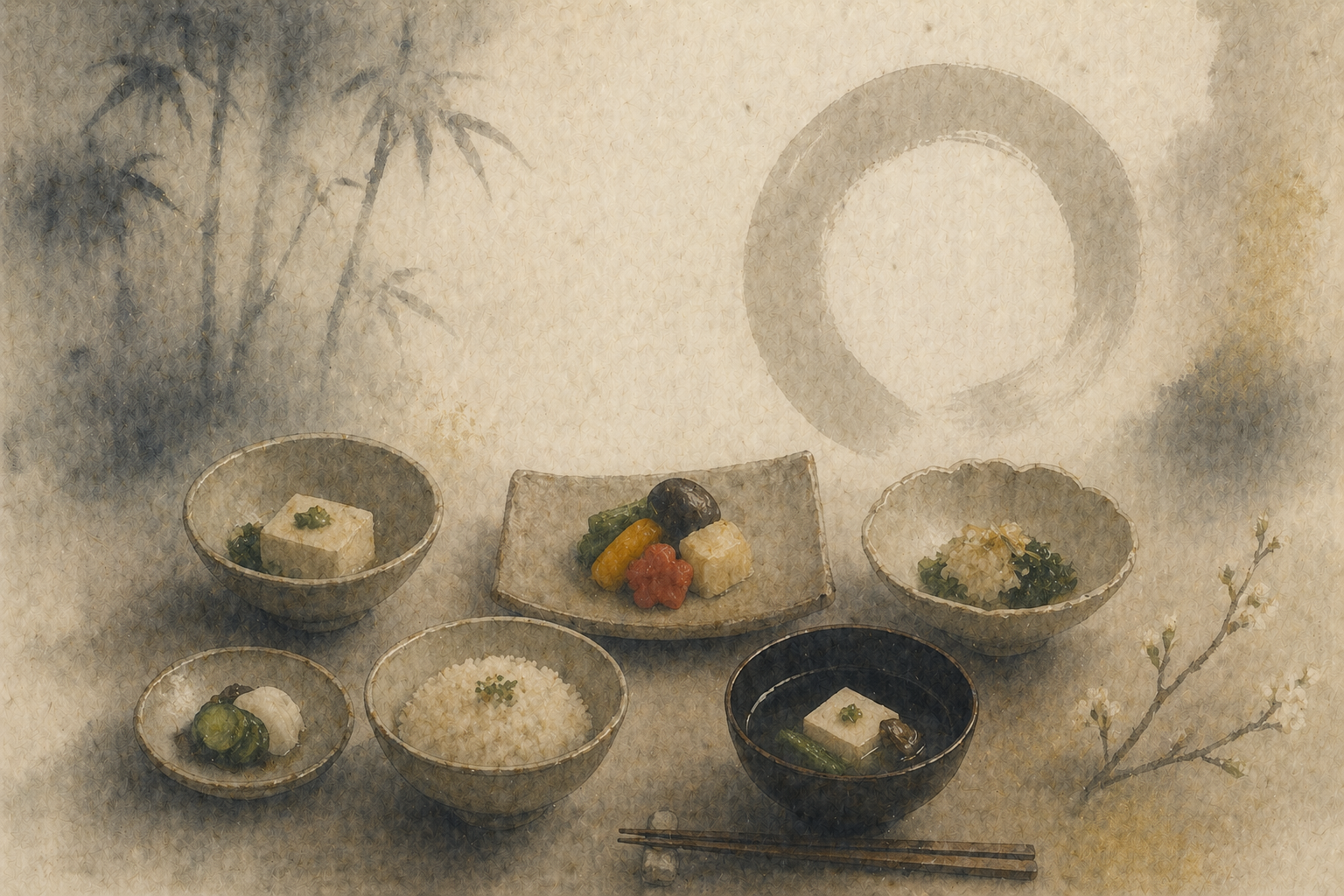
- Presentation is part of the practice: portions, color, and arrangement aim for calm harmony, not spectacle.
- Ordinary vegetarian food is defined mainly by ingredients; shojin ryori is defined by intention, method, and a specific culinary ethic.
Introduction
If you’ve eaten vegetarian meals and then tried shojin ryori, the confusion is understandable: both can be plant-based, yet they feel completely different—lighter, quieter, less “busy,” and oddly more satisfying without trying to be exciting. The difference isn’t a secret ingredient; it’s the whole orientation of the meal, from what gets excluded to how flavors are built and why the food is prepared in the first place. At Gassho, we write about Zen-influenced living in a practical way, including how food can shape attention and everyday conduct.
“Ordinary vegetarian food” is a broad category: it can be comfort food, fitness food, ethical food, budget food, or simply “no meat today.” Shojin ryori is narrower and more deliberate. It’s a cuisine with a particular sense of restraint—less about personal preference and more about cooking in a way that supports steadiness, reduces excess, and honors what’s available.
That’s why two meals can share the same headline—vegetables, tofu, rice—and still land differently in the body and mind. Shojin ryori tends to avoid pushing the palate hard. Instead, it leans into subtlety: clean broths, careful textures, and a kind of quiet completeness that doesn’t depend on richness.
The lens that makes shojin ryori its own thing
A useful way to understand what makes shojin ryori different from ordinary vegetarian food is to treat it as a lens rather than a label. Vegetarianism usually answers a question of ingredients: “Does this contain meat, fish, or animal products?” Shojin ryori answers a different question: “How can a meal be prepared with simplicity, care, and minimal disturbance—while still being complete?”
This lens changes what “good” means. In many vegetarian cuisines, “good” can mean bold flavor, clever substitutions, or recreating familiar meat-centered dishes. In shojin ryori, “good” often means balanced and unobtrusive: flavors that don’t shout over each other, portions that don’t tip into heaviness, and a sense that nothing is wasted or forced.
It also changes the role of the cook. The cook isn’t primarily trying to impress or entertain; the cook is trying to be accurate—responding to season, ingredient quality, and what the meal is meant to support. That can look plain from the outside, but it’s a disciplined plainness: the kind that requires attention to timing, knife work, soaking, simmering, and seasoning with a light hand.
Finally, shojin ryori tends to be defined as much by what it avoids as by what it includes. Beyond being plant-based, it traditionally avoids certain pungent ingredients (commonly garlic, onions, chives, leeks, and scallions). Ordinary vegetarian food rarely has that constraint, and that single difference alone can change the entire flavor architecture of a dish.
GASSHO
Ask and learn about Buddhism in daily life.
GASSHO is a Buddhist community app where you can learn Buddhist teachings and ask questions to the head priest of Kongosanmaiin Temple on Mount Koya.
How the difference shows up when you actually eat it
You notice it first in the pacing. Ordinary vegetarian food can be designed for quick satisfaction—big flavors up front, strong aromatics, rich sauces. Shojin ryori often unfolds more slowly. The first bite may seem mild, and then you start noticing texture, temperature, and the way one dish sets up the next.
Then there’s the absence of “flavor noise.” Without relying on heavy garlic-onion bases or aggressive seasoning, the meal leaves more room for small differences: the sweetness of a simmered carrot, the clean bite of lightly pickled vegetables, the softness of tofu that hasn’t been drowned in sauce. You may catch yourself paying attention without trying to.
Because the food isn’t constantly pushing for your reaction, your own habits become easier to see. Reaching for more salt. Wanting a stronger hit of spice. Looking for a “main” that dominates the plate. Shojin ryori quietly exposes those reflexes, not as a moral lesson, but as a simple fact of how appetite works.
You also feel the meal’s structure. Shojin ryori is often arranged to create balance across colors, cooking methods, and textures—something like a conversation rather than a monologue. A crisp element beside a soft one. A warm dish beside a cool one. A little bitterness to keep sweetness from becoming cloying.
Even the way you finish the meal can feel different. Ordinary vegetarian food can leave a strong aftertaste—garlic lingering, chili heat hanging on, a rich sauce coating the mouth. Shojin ryori tends to end cleaner. That “clean finish” is not an accident; it’s part of the restraint that runs through the cuisine.
And there’s a subtle psychological shift: you may feel less like you “treated yourself” and more like you were “taken care of.” Not because the food is luxurious, but because it’s coherent. When nothing is trying too hard, the meal can feel surprisingly complete.
None of this requires special beliefs. It’s closer to noticing how certain choices—lighter seasoning, seasonal ingredients, careful portions—affect attention and reactivity. The difference is experiential: the meal doesn’t just feed you; it changes the tone of the moment you’re in.
Common mix-ups that blur the distinction
Misunderstanding 1: “Shojin ryori is just Japanese vegan food.” It can be vegan, but the defining feature isn’t only the absence of animal products. The defining feature is the disciplined approach to flavor, restraint, and the ethic of not over-stimulating the palate. Plenty of Japanese vegan dishes are delicious and creative while still being far from shojin in spirit.
Misunderstanding 2: “It’s bland by design.” Shojin ryori is often subtle, but subtle isn’t the same as bland. Bland is what happens when flavor is missing. Subtle is what happens when flavor is present but not amplified. Good shojin ryori has clarity: you can taste the ingredient, not just the seasoning.
Misunderstanding 3: “The no-garlic rule is the whole point.” Avoiding pungent alliums is one visible difference, but it’s not the entire difference. Shojin ryori is also about seasonality, minimal waste, balanced composition, and cooking methods that respect the ingredient’s natural character.
Misunderstanding 4: “It’s only for special occasions.” Shojin ryori can be served in formal settings, but its principles translate well to everyday meals: simpler seasoning, fewer processed substitutes, more attention to what’s in season, and less reliance on “cravings engineering.”
Misunderstanding 5: “It’s a strict purity test.” In practice, many people borrow shojin principles without trying to be perfectly traditional. The value is in the direction: less excess, more care. Treating it as a purity contest usually misses the point and makes cooking tense.
Why this difference matters in daily life
Understanding what makes shojin ryori different from ordinary vegetarian food helps you choose the right meal for the right moment. If you want comfort, celebration, or high stimulation, ordinary vegetarian cooking can do that beautifully. If you want steadiness—food that supports a calmer baseline—shojin ryori offers a tested template.
It also changes how you shop and cook. Instead of chasing novelty, you start asking simpler questions: What’s in season? What can I use completely? What cooking method will bring out sweetness without adding sugar? Those questions tend to reduce waste and reduce decision fatigue at the same time.
For many people, the biggest practical benefit is that shojin-style meals can reset the palate. When you step back from heavy aromatics and constant intensity, you often regain sensitivity to small flavors. That makes everyday ingredients—rice, greens, mushrooms, tofu—feel less boring without needing to “upgrade” them.
Finally, shojin ryori can make eating feel less like a battle between discipline and indulgence. The meal is designed to be satisfying without being aggressive. Over time, that can support a more stable relationship with appetite: not suppressing it, not inflaming it, just feeding it well.
Conclusion
What makes shojin ryori different from ordinary vegetarian food isn’t a single rule—it’s the overall intention and method. Ordinary vegetarian food is defined mainly by what it excludes (meat, fish, sometimes dairy and eggs). Shojin ryori is defined by how it includes: seasonal ingredients, restrained seasoning, careful balance, minimal waste, and a preference for clarity over intensity.
If you approach shojin ryori expecting a plant-based version of rich restaurant food, it may seem underwhelming. If you approach it as a cuisine designed to support steadiness and attention, it starts to make sense—quietly, bite by bite.
Ask a Buddhist priest
Have a question about Buddhism?
In the GASSHO app, you can ask questions about Buddhist teachings, daily concerns, and how to understand Buddhism in everyday life.
Frequently Asked Questions
- FAQ 1: What makes shojin ryori different from ordinary vegetarian food at the most basic level?
- FAQ 2: Is shojin ryori always vegan, or just vegetarian?
- FAQ 3: Why does shojin ryori often avoid garlic and onions when ordinary vegetarian food uses them?
- FAQ 4: Does shojin ryori try to imitate meat the way some vegetarian food does?
- FAQ 5: How is the flavor-building in shojin ryori different from ordinary vegetarian cooking?
- FAQ 6: Is shojin ryori healthier than ordinary vegetarian food?
- FAQ 7: What role does seasonality play in what makes shojin ryori different from ordinary vegetarian food?
- FAQ 8: Why does shojin ryori often feel “lighter” than ordinary vegetarian food?
- FAQ 9: Is shojin ryori the same as eating “clean” vegetarian food?
- FAQ 10: How does the meal structure differ between shojin ryori and ordinary vegetarian food?
- FAQ 11: What ingredients are typical in shojin ryori that might not show up in ordinary vegetarian food?
- FAQ 12: Can ordinary vegetarian recipes be adapted to be more like shojin ryori?
- FAQ 13: Is shojin ryori supposed to be bland compared to ordinary vegetarian food?
- FAQ 14: What makes shojin ryori different from ordinary vegetarian food in terms of cooking mindset?
- FAQ 15: If I’m already vegetarian, why would I choose shojin ryori instead of ordinary vegetarian food?
FAQ 1: What makes shojin ryori different from ordinary vegetarian food at the most basic level?
Answer: Ordinary vegetarian food is primarily defined by avoiding meat (and sometimes other animal products). Shojin ryori is defined by a broader cooking ethic: simplicity, balance, seasonality, minimal waste, and a restrained approach to flavor that aims for clarity rather than intensity.
Takeaway: Shojin ryori is a cuisine with a specific intention, not just a meat-free menu.
FAQ 2: Is shojin ryori always vegan, or just vegetarian?
Answer: Shojin ryori is typically plant-based and often aligns with vegan eating, but the key difference from ordinary vegetarian food is not the label—it’s the traditional approach to ingredients and seasoning. In practice, you may see variations depending on the cook and setting.
Takeaway: The “shojin” difference is more about method and restraint than a modern dietary category.
FAQ 3: Why does shojin ryori often avoid garlic and onions when ordinary vegetarian food uses them?
Answer: Many shojin ryori traditions avoid pungent alliums (commonly garlic, onions, chives, leeks, and scallions) because the cuisine emphasizes calm, clean flavors and a less stimulating palate. Ordinary vegetarian cooking usually has no reason to avoid them and often relies on them for boldness.
Takeaway: The allium restriction is one practical way shojin ryori stays “quiet” in flavor.
FAQ 4: Does shojin ryori try to imitate meat the way some vegetarian food does?
Answer: Generally, no. Ordinary vegetarian food sometimes focuses on substitutes and familiar meat-like textures. Shojin ryori more often highlights what ingredients already are—tofu as tofu, mushrooms as mushrooms—using technique to bring out natural depth rather than mimicry.
Takeaway: Shojin ryori tends to emphasize authenticity of ingredients over substitution.
FAQ 5: How is the flavor-building in shojin ryori different from ordinary vegetarian cooking?
Answer: Shojin ryori commonly builds flavor through careful preparation (soaking, simmering, light seasoning, texture contrast) and plant-based sources of umami rather than heavy aromatics, rich fats, or strong spice. Ordinary vegetarian food may use any of those tools freely depending on the cuisine.
Takeaway: Shojin ryori aims for depth without loudness.
FAQ 6: Is shojin ryori healthier than ordinary vegetarian food?
Answer: Not automatically. Shojin ryori often ends up lighter and less processed because of its restraint and simplicity, but “healthier” depends on portions, ingredients, and individual needs. Ordinary vegetarian food can be very healthy or very indulgent; shojin ryori can also vary.
Takeaway: Shojin ryori often supports a lighter pattern, but health depends on the whole diet.
FAQ 7: What role does seasonality play in what makes shojin ryori different from ordinary vegetarian food?
Answer: Seasonality is central in shojin ryori: the meal is often designed around what’s available and at its peak, with minimal forcing. Ordinary vegetarian food may be seasonal, but it’s not usually a defining rule; it’s more often a preference or a budget choice.
Takeaway: Shojin ryori treats seasonality as a guiding principle, not an optional feature.
FAQ 8: Why does shojin ryori often feel “lighter” than ordinary vegetarian food?
Answer: It often uses less oil, fewer heavy sauces, and fewer intensely pungent ingredients, and it emphasizes balance across multiple small dishes. Ordinary vegetarian meals can be built around rich mains, cheese, cream, or deep-fried elements (depending on the style), which changes how heavy the meal feels.
Takeaway: The lightness usually comes from restrained seasoning, fat, and portion structure.
FAQ 9: Is shojin ryori the same as eating “clean” vegetarian food?
Answer: They can overlap, but they’re not the same. “Clean eating” is a modern wellness idea with flexible definitions. Shojin ryori is a traditional culinary approach with specific habits—like simplicity, minimal waste, and often avoiding pungent alliums—that go beyond modern nutrition trends.
Takeaway: Shojin ryori is a distinct tradition, not a rebrand of wellness dieting.
FAQ 10: How does the meal structure differ between shojin ryori and ordinary vegetarian food?
Answer: Shojin ryori commonly emphasizes a balanced set of small dishes with varied cooking methods and colors, creating harmony across the tray or table. Ordinary vegetarian food is often organized around a single main dish with sides, especially in Western-style meals.
Takeaway: Shojin ryori often prioritizes overall balance across dishes rather than a dominant centerpiece.
FAQ 11: What ingredients are typical in shojin ryori that might not show up in ordinary vegetarian food?
Answer: While there’s overlap, shojin ryori commonly features tofu in many forms, sesame (goma), seasonal mountain vegetables, sea vegetables, mushrooms, and simple pickles, often prepared to highlight natural taste. Ordinary vegetarian food varies widely and may lean more on dairy, eggs, legumes, or meat substitutes depending on the culture and preference.
Takeaway: Shojin ryori tends to center traditional Japanese plant ingredients and techniques.
FAQ 12: Can ordinary vegetarian recipes be adapted to be more like shojin ryori?
Answer: Yes. You can reduce reliance on garlic/onion, simplify seasoning, use seasonal produce, aim for gentle cooking methods, and build umami with plant-based stocks, mushrooms, kombu, and sesame. The shift is less about “Japanese-ifying” the dish and more about adopting restraint and balance.
Takeaway: Shojin style is often a change in approach, not a strict set of recipes.
FAQ 13: Is shojin ryori supposed to be bland compared to ordinary vegetarian food?
Answer: No—its flavors are usually subtler, not absent. Shojin ryori often avoids overwhelming the palate so that sweetness, bitterness, and umami from the ingredients can be noticed. Ordinary vegetarian food may aim for bigger, faster impact through spice, aromatics, and rich sauces.
Takeaway: Shojin ryori is about clarity and balance, not flavorlessness.
FAQ 14: What makes shojin ryori different from ordinary vegetarian food in terms of cooking mindset?
Answer: Ordinary vegetarian cooking can be driven by convenience, ethics, fitness goals, or taste preferences. Shojin ryori is typically driven by a mindful, careful mindset: use what’s available, waste little, keep flavors harmonious, and cook in a way that supports a calm, steady meal experience.
Takeaway: The mindset—restraint, care, and harmony—is a major part of the difference.
FAQ 15: If I’m already vegetarian, why would I choose shojin ryori instead of ordinary vegetarian food?
Answer: You might choose shojin ryori when you want a meal that feels simpler, more balanced, and less stimulating—something that highlights natural flavors and supports a calmer pace of eating. Ordinary vegetarian food is broader and can be anything from hearty comfort food to highly spiced cuisine; shojin ryori is a specific, restrained style within that larger world.
Takeaway: Shojin ryori offers a distinct “quiet” style of vegetarian eating, not just another meat-free option.