



What Is Shojin Ryori? A Beginner-Friendly Introduction
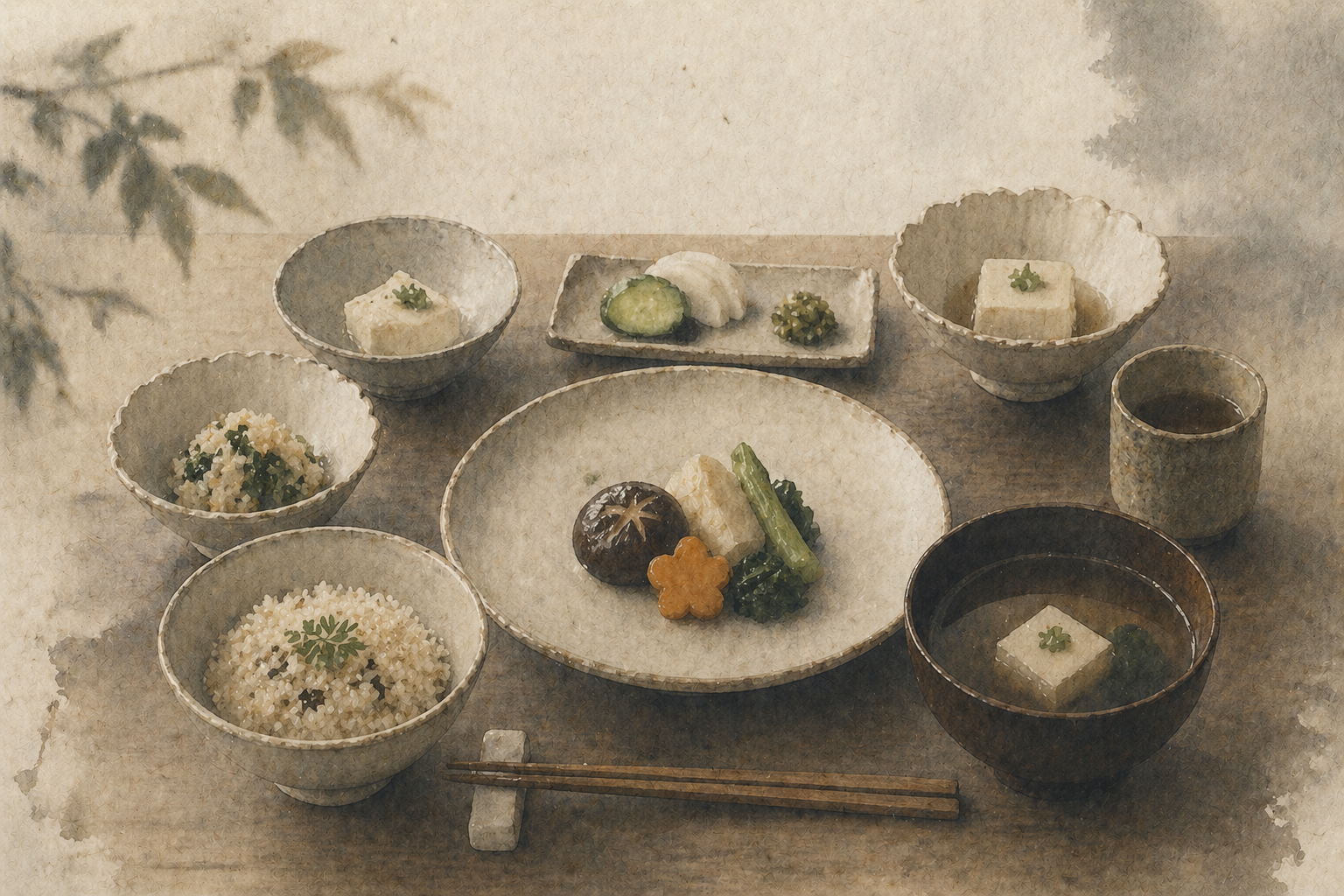
Quick Summary
- Shojin ryori is a Japanese style of plant-based temple cooking shaped by mindfulness, restraint, and respect for ingredients.
- It’s less about “diet rules” and more about a way of relating to food: simple, seasonal, and attentive.
- Common features include vegetables, tofu, beans, seaweed, grains, and careful use of broth and seasoning.
- Flavor is built through technique (soaking, simmering, roasting, fermentation) rather than heavy fats or strong stimulants.
- Presentation matters: balance of colors, textures, and cooking methods is part of the practice.
- You can try shojin ryori at home without perfection—start with one calm, plant-based meal.
- It’s often confused with “just vegan food,” but its intention and approach are what make it distinct.
Introduction
If you’re searching “what is shojin ryori,” you’re probably stuck between two unsatisfying explanations: either it’s described as “Buddhist vegan food” (too shallow), or it’s treated like an exotic, rule-heavy tradition (too intimidating). Shojin ryori is best understood as a practical way of cooking and eating that trains attention, reduces excess, and lets ingredients speak clearly—without requiring you to adopt an identity or a strict lifestyle. At Gassho, we focus on grounded Zen-informed practice in everyday life, including how food can support a steadier mind.
The phrase shojin ryori is commonly translated as “devotion cuisine” or “food of sincere effort,” and that points to the heart of it: the meal is not a performance, and it’s not a shortcut to purity. It’s an invitation to cook with care, waste less, and notice how craving and impatience show up in the kitchen.
In practical terms, shojin ryori is plant-based Japanese cooking associated with temples, often using seasonal vegetables, tofu, beans, mushrooms, seaweed, and grains. The food tends to be light but satisfying, with flavors built through broth, fermentation, and patient preparation rather than heavy seasoning.
A Clear Lens for Understanding Shojin Ryori
A helpful way to understand shojin ryori is to treat it as a lens: “How would I cook if I wanted to reduce harm, reduce waste, and reduce mental agitation—while still making something genuinely delicious?” It’s not a belief system you have to sign up for. It’s a set of choices that make your relationship with food more deliberate.
That lens naturally leads to plant-based ingredients, because they’re widely available, flexible, and generally lighter on the body and the environment. But the defining feature isn’t the ingredient list—it’s the intention to meet the moment with sincerity: selecting what’s in season, preparing it carefully, and not covering it up with excess.
Shojin ryori also emphasizes balance. Not “perfect nutrition” in a modern, obsessive sense, but a balanced meal experience: a mix of colors, textures, temperatures, and cooking methods. A simple bowl of rice becomes more complete when paired with a clear soup, a simmered vegetable, a small pickle, and a tofu dish—each one modest, together satisfying.
Finally, it values restraint as a form of clarity. Restraint here doesn’t mean deprivation; it means not automatically reaching for the loudest flavor, the biggest portion, or the fastest method. When you cook this way, you start to notice how often “more” is used to hide inattention.
GASSHO
Ask and learn about Buddhism in daily life.
GASSHO is a Buddhist community app where you can learn Buddhist teachings and ask questions to the head priest of Kongosanmaiin Temple on Mount Koya.
How Shojin Ryori Feels in Ordinary Life
You notice it first in the shopping. Instead of scanning for the most exciting thing, you look for what’s fresh, what’s local, what’s already good. The mind that usually rushes ahead—planning, comparing, craving—gets pulled back into simple observation.
Then it shows up in prep work. Washing greens, slicing carrots, soaking dried mushrooms: these are repetitive actions, and repetition is where impatience becomes obvious. Shojin ryori doesn’t “fix” impatience; it gives you a clean place to see it without drama.
As you cook, you start relying more on timing and heat than on forceful seasoning. A gentle simmer, a quick blanch, a careful roast—each method asks for attention. When attention drifts, the food tells you immediately: overcooked greens, broken tofu, muddy flavors.
You also begin to notice how craving works. When you’re used to strong flavors, the first bite of a simpler meal can feel “not enough.” If you pause, that reaction often softens. The sweetness of a carrot, the depth of kombu and shiitake broth, the clean richness of sesame—these become more vivid when you stop chasing intensity.
Eating becomes quieter. Not silent in a forced way, but less scattered. You can actually taste the transitions: crisp to tender, warm to cool, salty to mild. The meal feels like a sequence of small, clear moments rather than one big hit.
Portioning changes too. Shojin ryori tends to be served in smaller dishes, which subtly trains you to finish what you take. That’s not moralism; it’s feedback. When you over-serve, you see waste. When you serve modestly, you can always take more.
Afterward, the effect is often noticeable: less heaviness, less “food noise,” and a cleaner sense of being done. Not because the meal is magical, but because it was built around steadiness rather than stimulation.
Common Misunderstandings That Make It Seem Harder Than It Is
Misunderstanding 1: “Shojin ryori is just vegan Japanese food.” It can look similar on the plate, but shojin ryori is defined by its approach: simplicity, seasonality, and mindful preparation. You can cook vegan food in a rushed, indulgent, or wasteful way; shojin ryori points in the opposite direction.
Misunderstanding 2: “It’s bland.” Shojin ryori is often subtle, but subtle isn’t the same as flavorless. It leans on umami-rich ingredients (like kombu, mushrooms, miso, soy sauce, sesame, and roasted vegetables) and on techniques that concentrate flavor.
Misunderstanding 3: “You need rare ingredients and perfect knife skills.” Many temple-style meals are built from ordinary vegetables and pantry staples. Skill helps, but the baseline is sincerity: do what you can with what you have, and do it carefully.
Misunderstanding 4: “It’s a strict purity system.” People sometimes hear about avoiding certain pungent foods and assume shojin ryori is mainly about rules. In practice, the point is to reduce agitation and excess. If strictness makes you tense or performative, you’ve missed the direction.
Misunderstanding 5: “It’s only for temples or special occasions.” While it has temple roots, the spirit of shojin ryori fits everyday life: a simple soup, a seasonal vegetable, a bowl of rice, and a small pickle can be a complete practice meal on a weekday.
Why This Style of Eating Still Matters Today
Shojin ryori matters because it offers a practical antidote to modern eating habits that keep the mind restless: constant novelty, oversized portions, and food designed to override your natural sense of enough. This cuisine gently trains “enough” without turning the meal into a self-improvement project.
It also supports a more respectful relationship with resources. When you plan around what’s in season and use the whole ingredient—stems, peels (when appropriate), broth from scraps—you naturally waste less. That’s not just ethical; it’s calming. Waste often carries a subtle feeling of carelessness.
On a social level, shojin ryori can make hospitality simpler. A plant-based meal built around grains, vegetables, and tofu is often easier to share across preferences. The focus shifts from impressing people to nourishing them.
And for many people, it’s a gentle way to explore plant-based eating without the identity pressure. You don’t have to label yourself. You can just cook one meal with clarity and see what it does to your body and attention.
Conclusion
So, what is shojin ryori? It’s Japanese plant-based temple cooking, but more importantly it’s a calm method of relating to food: seasonal ingredients, careful technique, modest portions, and an intention to reduce excess. If you want to try it, start small—one simple soup, one vegetable dish, one bowl of rice—and treat the cooking itself as the practice.
If you keep the direction clear—less waste, less agitation, more attention—the details can evolve naturally with your kitchen, your budget, and your life.
Ask a Buddhist priest
Have a question about Buddhism?
In the GASSHO app, you can ask questions about Buddhist teachings, daily concerns, and how to understand Buddhism in everyday life.
Frequently Asked Questions
- FAQ 1: What is shojin ryori in simple terms?
- FAQ 2: Is shojin ryori always vegan?
- FAQ 3: What does “shojin” mean in shojin ryori?
- FAQ 4: What foods are commonly used in shojin ryori?
- FAQ 5: Does shojin ryori avoid garlic and onions?
- FAQ 6: How is shojin ryori different from regular Japanese vegetarian food?
- FAQ 7: Is shojin ryori healthy?
- FAQ 8: What does a typical shojin ryori meal look like?
- FAQ 9: What is the role of seasonality in shojin ryori?
- FAQ 10: Can I make shojin ryori at home without special ingredients?
- FAQ 11: Is shojin ryori the same as kaiseki?
- FAQ 12: Why is tofu so common in shojin ryori?
- FAQ 13: What is a plant-based dashi in shojin ryori?
- FAQ 14: Where can I eat authentic shojin ryori in Japan?
- FAQ 15: What is the main purpose of shojin ryori?
FAQ 1: What is shojin ryori in simple terms?
Answer: Shojin ryori is a Japanese style of plant-based cooking associated with temple meals, emphasizing simplicity, seasonality, and careful preparation. It’s less about strict dieting and more about cooking and eating with restraint and attention.
Takeaway: Shojin ryori is mindful, seasonal plant-based Japanese cuisine.
FAQ 2: Is shojin ryori always vegan?
Answer: It is typically plant-based and avoids meat and fish, so it’s often vegan in practice. However, the defining feature is the temple-style approach and intention; specific ingredients can vary by place and household, so it’s wise to ask when eating out.
Takeaway: Usually vegan, but confirm details when dining out.
FAQ 3: What does “shojin” mean in shojin ryori?
Answer: “Shojin” is commonly understood as sincere effort or devotion in practice, and in cooking it points to doing the work carefully and respectfully. It suggests a mindset of restraint and attentiveness rather than indulgence or showmanship.
Takeaway: “Shojin” points to sincere, careful effort in cooking and eating.
FAQ 4: What foods are commonly used in shojin ryori?
Answer: Common ingredients include seasonal vegetables, tofu, beans, mushrooms, seaweed, rice, sesame, miso, soy sauce, and pickles. Flavor often comes from plant-based broths and fermentation rather than animal products.
Takeaway: Vegetables, tofu, grains, seaweed, and fermented seasonings are central.
FAQ 5: Does shojin ryori avoid garlic and onions?
Answer: Many shojin ryori traditions avoid strong alliums (like garlic, onions, chives, and leeks) because they’re considered overly stimulating for a quiet mind. In home-style interpretations, some people follow this strictly while others adapt based on context and health needs.
Takeaway: Often avoided, but modern practice can be flexible.
FAQ 6: How is shojin ryori different from regular Japanese vegetarian food?
Answer: Shojin ryori is specifically shaped by a temple-style ethos: simplicity, minimal waste, seasonality, and balanced small dishes. Vegetarian Japanese food can be broader and may include eggs, dairy, or fish-based broth, depending on the dish and region.
Takeaway: Shojin ryori is a distinct temple-influenced approach, not just “vegetarian Japanese.”
FAQ 7: Is shojin ryori healthy?
Answer: It’s often nutrient-dense because it centers on vegetables, legumes, and whole foods, and it tends to be lower in heavy fats. “Healthy” still depends on your overall diet and needs, so it’s best viewed as a supportive style of eating rather than a cure-all.
Takeaway: Often supportive for health, but not a one-size-fits-all guarantee.
FAQ 8: What does a typical shojin ryori meal look like?
Answer: A common structure includes rice, a soup, and several small side dishes featuring different cooking methods (simmered, steamed, dressed, pickled). The goal is balance in taste, color, and texture without excess.
Takeaway: Expect rice, soup, and a few small, balanced plant-based dishes.
FAQ 9: What is the role of seasonality in shojin ryori?
Answer: Seasonality guides ingredient choice and cooking style—lighter preparations in warmer months, heartier simmered dishes in colder months. This keeps meals aligned with what’s freshest and reduces the need to force flavor with heavy seasoning.
Takeaway: Shojin ryori follows the seasons to keep food simple and vivid.
FAQ 10: Can I make shojin ryori at home without special ingredients?
Answer: Yes. Start with what you can access: rice or another grain, a simple vegetable soup, and one or two vegetable sides. If you can add basics like miso, soy sauce, sesame, and dried mushrooms or seaweed, it becomes easier to build depth.
Takeaway: You can begin with ordinary vegetables and a few pantry staples.
FAQ 11: Is shojin ryori the same as kaiseki?
Answer: They can look similar because both may use multiple small dishes and seasonal presentation, but they’re not the same. Shojin ryori is temple-rooted plant-based cuisine, while kaiseki is a broader multi-course Japanese dining style that often includes fish and other ingredients.
Takeaway: Similar presentation sometimes, but different origins and typical ingredients.
FAQ 12: Why is tofu so common in shojin ryori?
Answer: Tofu is versatile, affordable, and takes on flavor well, making it ideal for simple dishes that still feel satisfying. It can be served chilled, simmered, grilled, or dressed, fitting the balanced, minimal approach of shojin ryori.
Takeaway: Tofu provides flexible, gentle richness without heaviness.
FAQ 13: What is a plant-based dashi in shojin ryori?
Answer: It’s a broth made without fish, commonly using kombu (kelp) and dried mushrooms to create umami. This broth becomes the backbone for soups and simmered dishes while keeping the overall flavor clean and restrained.
Takeaway: Shojin ryori often uses kombu-and-mushroom broth for depth.
FAQ 14: Where can I eat authentic shojin ryori in Japan?
Answer: Shojin ryori is commonly served at temple lodgings and some dedicated restaurants, especially in areas known for temple culture. Menus vary, so it helps to confirm whether the meal is fully plant-based and whether alliums are used.
Takeaway: Look for temple meals and specialty restaurants, and confirm details.
FAQ 15: What is the main purpose of shojin ryori?
Answer: The main purpose is to support a calm, attentive way of living through food—reducing excess, respecting ingredients, and cooking with care. The meal becomes a practical training in simplicity rather than a display of luxury or intensity.
Takeaway: Shojin ryori uses cooking as a practice of simplicity and attention.