



Dependent Origination vs Interdependence: What’s the Difference?
Quick Summary
- Dependent origination points to a specific pattern: when certain conditions are present, certain experiences arise.
- Interdependence is a broader, everyday way to say “things rely on other things,” often emphasizing mutual influence.
- Dependent origination is most useful when you want to understand how stress forms in the mind, step by step.
- Interdependence is most useful when you want to remember context: relationships, systems, and support.
- They overlap, but they are not perfect synonyms; mixing them can blur what each is good at.
- Both perspectives reduce “it’s just me” thinking and make room for wiser choices.
- A practical test: if you’re tracing a reaction in real time, dependent origination is usually the sharper tool.
Introduction
You keep seeing “dependent origination” and “interdependence” used like they mean the same thing, and it gets frustrating fast: one sounds technical and psychological, the other sounds like a warm reminder that everything is connected, and yet both are presented as the key insight. At Gassho, we focus on clear, practice-friendly explanations that you can test in your own experience.
The difference matters because each term points your attention in a different direction: one toward conditional sequences (how something arises), the other toward mutual reliance (how things co-exist and influence each other). When you know which lens you’re using, you stop arguing with words and start noticing what actually happens.
Two Lenses, Two Jobs: What Each Term Is Pointing At
Dependent origination is a way of looking that asks: “What conditions are present right now that make this experience appear?” It’s less a grand statement about the universe and more a practical method for seeing causality and conditionality in immediate life—especially in the mind. When certain ingredients come together, a particular thought, emotion, or impulse shows up; when the ingredients change, the experience changes.
Interdependence is a wider-angle lens that asks: “What does this rely on, and what relies on this?” It highlights networks—social, ecological, relational, bodily. It’s often used to soften the sense of isolation and to reveal how much support and influence is always present, even when you feel alone.
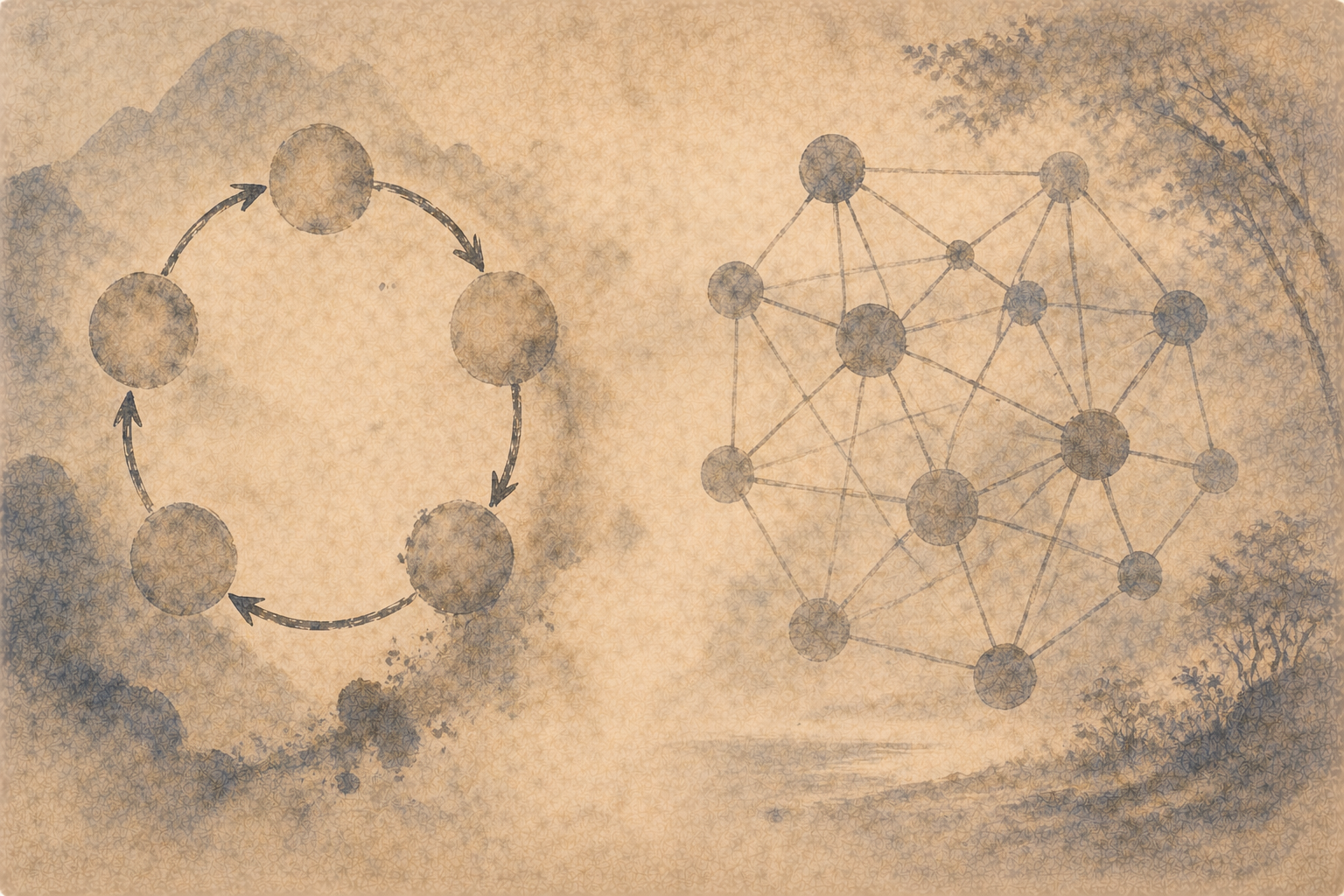
Where people get tangled is that both lenses undermine the idea of a completely independent, self-made “thing.” But they do it differently. Dependent origination is typically more precise about arising (conditions leading to an event), while interdependence is typically more intuitive about co-arising (mutual reliance within a web).
A helpful way to hold the distinction: dependent origination is like tracing the recipe and timing of a reaction, while interdependence is like seeing the whole kitchen—ingredients, tools, people, and supply chain. Both are true in their own way, but they answer different questions.
GASSHO
Ask and learn about Buddhism in daily life.
GASSHO is a Buddhist community app where you can learn Buddhist teachings and ask questions to the head priest of Kongosanmaiin Temple on Mount Koya.
How the Difference Shows Up in Ordinary Moments
Imagine you receive a short message that feels cold. Interdependence might show up first as context: the other person has their own pressures, your relationship has history, your day has been stressful, your body is tired. You see a web of influences, and the situation becomes less personal and less absolute.
Dependent origination zooms in closer: you notice the moment the eyes land on the words, the tightening in the chest, the quick story that forms (“They don’t respect me”), and the urge to reply sharply. You’re not analyzing the other person; you’re watching the conditional chain inside your own experience.
In a conversation, interdependence can be felt as the way tone, timing, and attention shape what’s possible. When you speak slowly, the other person relaxes; when you interrupt, they close down. You see that “my mood” and “their mood” are not sealed containers—they influence each other continuously.
Dependent origination in that same conversation is the micro-level noticing: a small flash of embarrassment leads to defensiveness; defensiveness leads to selective listening; selective listening leads to misunderstanding. When you catch one link early—say, the embarrassment—you may not need to follow the rest of the chain.
Even with something as simple as craving a snack, interdependence can remind you that appetite is shaped by sleep, stress, advertising, habits, and what food is available. That wider view reduces shame because it replaces “I’m weak” with “many conditions are at play.”
Dependent origination then becomes the practical lever: you notice the trigger (boredom), the image of the food, the pleasant anticipation, the reaching. If you can pause at the anticipation and feel it as sensation and thought, the compulsion often changes on its own because the conditions are no longer identical.
In daily life, the two lenses can alternate naturally: interdependence helps you hold complexity with humility, while dependent origination helps you see where a small shift in attention, interpretation, or action can change what happens next.
Common Mix-Ups That Make the Topic Harder Than It Is
Mix-up 1: Treating them as perfect synonyms. They overlap, but dependent origination is usually a more specific claim about conditional arising, while interdependence is a broader description of mutual reliance. If you collapse them into one idea, you lose the practical sharpness of dependent origination and the relational breadth of interdependence.
Mix-up 2: Turning interdependence into a vague slogan. “Everything is connected” can become a comforting phrase that doesn’t change how you relate to irritation, fear, or self-criticism. Interdependence becomes useful when it points to concrete influences: sleep, tone of voice, incentives, environment, history, and expectations.
Mix-up 3: Thinking dependent origination is only abstract philosophy. It can sound like a doctrine, but it’s more like a way to observe: “When this is present, that tends to appear.” You can test it in minutes by watching how a thought depends on attention, how anger depends on a story, or how anxiety depends on uncertainty plus mental rehearsal.
Mix-up 4: Assuming either view denies personal responsibility. Seeing conditions doesn’t mean “nothing matters” or “no one chooses.” It means choices are also conditioned—and that by changing conditions (speech, habits, boundaries, rest, attention), you change outcomes. Responsibility becomes more practical, not less.
Mix-up 5: Using interdependence to bypass feelings. Sometimes people jump to “we’re all connected” to avoid admitting they’re hurt or angry. Dependent origination can help here: it invites you to feel the actual sensations and see the story-building process without rushing to a spiritual conclusion.
Why This Distinction Helps in Real Life
When you’re stuck in a loop—rumination, resentment, compulsive checking—dependent origination gives you a map for intervention. You don’t need to “fix yourself”; you look for the conditions that keep the loop running: the repeated mental image, the self-judging phrase, the body tension, the avoidance behavior. Change one condition, and the loop often weakens.
When you’re stuck in a narrow story—“It’s all my fault,” “They’re just like that,” “Nothing will change”—interdependence widens the frame. It reminds you that outcomes are shaped by systems and relationships: incentives at work, family patterns, communication habits, and the environment you’re in. That wider view can reduce blame and open up more skillful options.
Together, they support a grounded kind of compassion. Interdependence helps you see that people act under pressures and influences; dependent origination helps you see exactly how your own reactions form, so compassion doesn’t turn into passivity. You can understand conditions and still set boundaries, speak clearly, or step away.
Most importantly, the distinction keeps your practice honest. Instead of collecting big ideas, you learn to ask two simple questions: “What is this depending on right now?” and “What else is involved here?” Those questions tend to produce calmer, more workable answers than self-judgment or certainty.
Conclusion
“Dependent origination vs interdependence” isn’t a debate about which word is correct; it’s about choosing the right lens for the moment. Use dependent origination when you want to see how a reaction is built from conditions in real time, and use interdependence when you need the wider context that softens isolation and blame.
If you keep both lenses available, you get something rare: a view that is both intimate (close enough to change a habit) and spacious (wide enough to include other people and circumstances). That combination is often where clarity becomes practical.
Ask a Buddhist priest
Have a question about Buddhism?
In the GASSHO app, you can ask questions about Buddhist teachings, daily concerns, and how to understand Buddhism in everyday life.
Frequently Asked Questions
- FAQ 1: Are dependent origination and interdependence the same thing?
- FAQ 2: What’s the simplest way to explain dependent origination vs interdependence?
- FAQ 3: Why do people use “interdependence” when they mean dependent origination?
- FAQ 4: Does dependent origination imply a linear chain, while interdependence implies a web?
- FAQ 5: Which is more useful for working with anxiety: dependent origination or interdependence?
- FAQ 6: Is interdependence just “everything is connected”?
- FAQ 7: Does dependent origination mean nothing has a single cause?
- FAQ 8: Can interdependence be true without dependent origination?
- FAQ 9: How do dependent origination and interdependence relate to the sense of “self”?
- FAQ 10: Is dependent origination mainly about the mind, while interdependence is about the world?
- FAQ 11: How can I test dependent origination vs interdependence in my own experience?
- FAQ 12: Does interdependence mean everyone is responsible for everything?
- FAQ 13: Does dependent origination deny free will?
- FAQ 14: When should I use the term “dependent origination” instead of “interdependence”?
- FAQ 15: What’s one practical benefit of understanding dependent origination vs interdependence?
FAQ 1: Are dependent origination and interdependence the same thing?
Answer: Not exactly. Dependent origination focuses on how specific experiences arise when specific conditions come together (“when this, then that”), while interdependence is a broader way of describing mutual reliance within a web of influences.
Takeaway: They overlap, but dependent origination is usually more precise about conditional arising.
FAQ 2: What’s the simplest way to explain dependent origination vs interdependence?
Answer: Dependent origination asks, “What conditions are producing this moment of experience?” Interdependence asks, “What does this rely on, and what relies on it?” One traces arising; the other highlights mutual context.
Takeaway: Dependent origination is a close-up lens; interdependence is a wide-angle lens.
FAQ 3: Why do people use “interdependence” when they mean dependent origination?
Answer: “Interdependence” is more familiar and sounds less technical, so it’s often used as a friendly shorthand. The tradeoff is that it can blur the step-by-step, conditional emphasis that dependent origination is especially good at revealing.
Takeaway: Interdependence is accessible language, but it can lose the causal clarity of dependent origination.
FAQ 4: Does dependent origination imply a linear chain, while interdependence implies a web?
Answer: Often, yes as a practical emphasis. Dependent origination is frequently used to track conditional sequences in experience, while interdependence naturally evokes mutual influence across many factors at once. In real life, both patterns can be present together.
Takeaway: Chain and web are helpful metaphors, but they describe different angles on the same conditional reality.
FAQ 5: Which is more useful for working with anxiety: dependent origination or interdependence?
Answer: Dependent origination is often more immediately useful for anxiety because it helps you notice the conditions that build the anxious episode (uncertainty, mental rehearsal, body tension, catastrophic interpretation). Interdependence can help too by adding context (sleep, workload, relationships), which reduces self-blame.
Takeaway: Use dependent origination to see the mechanism; use interdependence to hold the broader context.
FAQ 6: Is interdependence just “everything is connected”?
Answer: It can be said that way, but it becomes meaningful when it points to specific, observable dependencies—like how mood depends on sleep, how conversations depend on timing and tone, and how choices depend on available options and pressures.
Takeaway: Interdependence works best when it stays concrete, not slogan-like.
FAQ 7: Does dependent origination mean nothing has a single cause?
Answer: It points toward the idea that experiences arise from multiple conditions rather than one isolated cause. In practice, this helps you look for contributing factors instead of fixating on a single culprit—either “me” or “them.”
Takeaway: Dependent origination encourages multi-cause thinking grounded in conditions.
FAQ 8: Can interdependence be true without dependent origination?
Answer: As ways of speaking, you can emphasize one without the other, but they tend to support each other: interdependence highlights mutual reliance, and dependent origination explains how particular events arise based on conditions within that network.
Takeaway: They’re distinct lenses that usually fit together rather than compete.
FAQ 9: How do dependent origination and interdependence relate to the sense of “self”?
Answer: Interdependence softens the idea of a fully independent self by showing how identity and behavior are shaped by relationships and conditions. Dependent origination softens it by showing how “selfing” is constructed moment by moment through thoughts, feelings, and interpretations that depend on conditions.
Takeaway: Interdependence widens the context of self; dependent origination reveals how self-experience is assembled.
FAQ 10: Is dependent origination mainly about the mind, while interdependence is about the world?
Answer: That’s a common and sometimes useful simplification. Dependent origination is often applied to immediate experience (how reactions form), while interdependence is often applied to relationships and systems. But both can be applied internally and externally depending on what you’re examining.
Takeaway: The difference is emphasis, not a strict “mind vs world” split.
FAQ 11: How can I test dependent origination vs interdependence in my own experience?
Answer: For dependent origination, pick a small recurring reaction (irritation, checking your phone) and notice the conditions that precede it: sensation, thought, story, urge. For interdependence, list the broader influences around it: sleep, environment, social expectations, workload, and relationship dynamics.
Takeaway: Test dependent origination by tracing a sequence; test interdependence by mapping a context.
FAQ 12: Does interdependence mean everyone is responsible for everything?
Answer: No. Interdependence highlights influence and reliance, not total blame. It can help you see shared conditions and systemic pressures while still making clear, local choices about what you will do and what you will not do.
Takeaway: Interdependence expands context without requiring universal guilt.
FAQ 13: Does dependent origination deny free will?
Answer: It doesn’t need to be framed as a philosophical verdict. Practically, it shows that choices and impulses arise with conditions—habits, emotions, interpretations, and environment—so changing conditions can change what choices become available in the moment.
Takeaway: Dependent origination is most useful as a practical tool for changing conditions, not as a debate about metaphysics.
FAQ 14: When should I use the term “dependent origination” instead of “interdependence”?
Answer: Use “dependent origination” when you’re pointing to conditional arising in a specific process—especially when you’re tracing how a reaction, belief, or emotion forms. Use “interdependence” when you’re emphasizing mutual reliance across many factors, like relationships, communities, and environments.
Takeaway: Choose dependent origination for precision about arising; choose interdependence for breadth of context.
FAQ 15: What’s one practical benefit of understanding dependent origination vs interdependence?
Answer: You stop trying to solve every problem with one idea. Interdependence reduces isolation and blame by restoring context; dependent origination helps you interrupt unhelpful loops by identifying the conditions that keep them going.
Takeaway: The distinction makes your understanding more actionable and less vague.