



The 12 Links of Dependent Origination Explained Simply
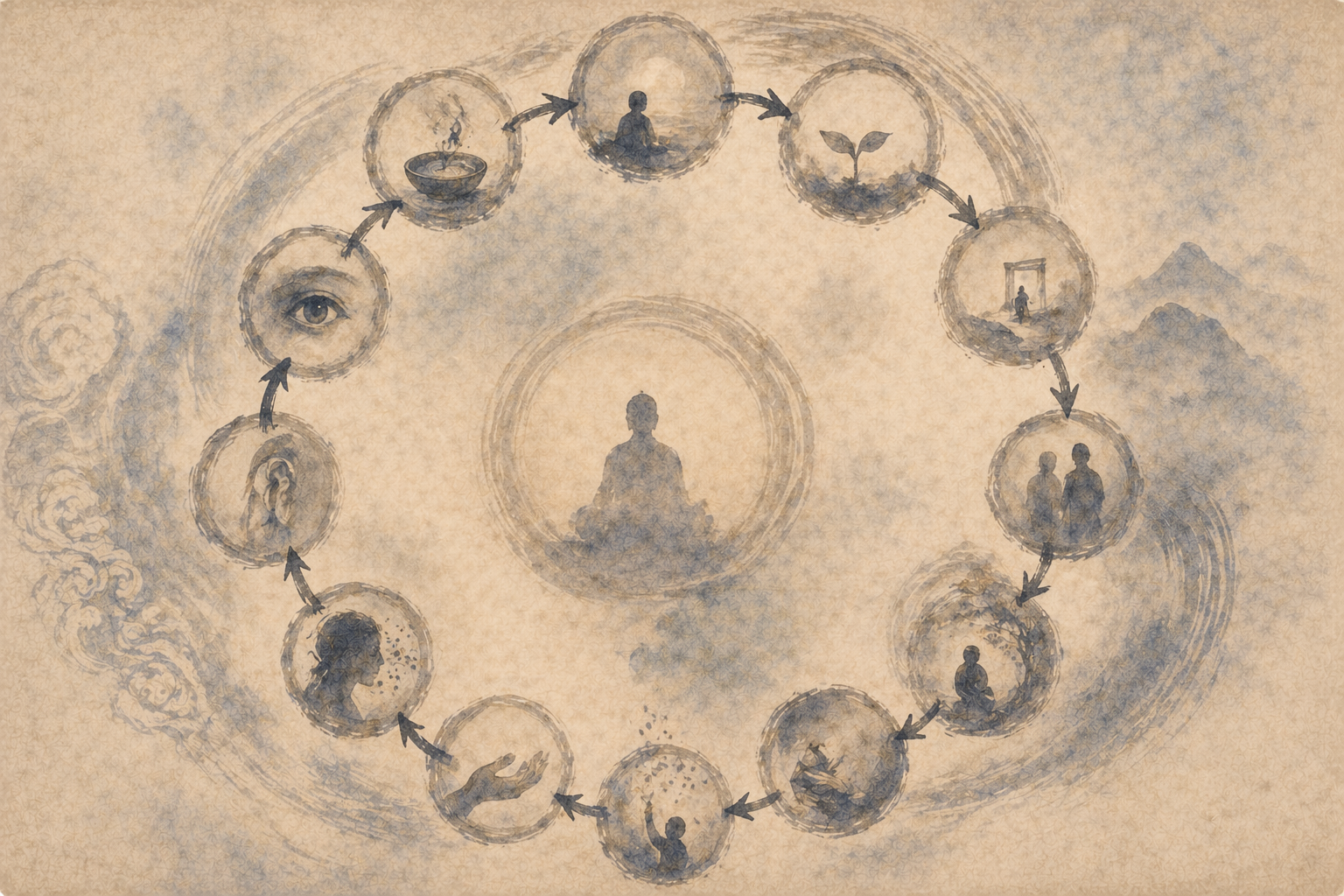
Quick Summary
- The 12 links of dependent origination describe how stress and dissatisfaction get built, moment by moment.
- They are best read as a practical chain of conditions, not a mythic story or a rigid timeline.
- You don’t need to “believe” them; you can test them by watching how reactions form in daily life.
- The links highlight where things feel automatic: contact, feeling tone, craving, and clinging.
- “Ignorance” here mainly means not noticing what’s happening while it’s happening.
- Breaking the chain doesn’t require perfection; it starts with seeing one link clearly.
- The point is relief: fewer compulsive loops, more choice, and kinder responses.
Introduction
The 12 links of dependent origination often feel like a confusing list you’re supposed to memorize, and that confusion usually comes from trying to read them as abstract philosophy instead of a simple description of how a reaction snowballs into a whole mood, a whole story, and sometimes a whole day. At Gassho, we focus on making Buddhist ideas usable in ordinary life without turning them into jargon.
When you hear “dependent origination,” think “this happens because that happened”—not fate, not a cosmic rule, and not a moral scorecard. The 12 links are one classic way of mapping the chain: how not seeing clearly leads to habitual reactions, how those reactions shape perception, and how perception turns into grasping and stress.
Used well, the list becomes a diagnostic tool. It helps you locate the exact moment where you still have a little room to breathe, soften, and choose a different next step.
A Clear Lens for the 12 Links
The central perspective behind the 12 links of dependent origination is simple: experience is constructed through conditions. Thoughts, emotions, and “who I am right now” don’t appear from nowhere; they arise when certain causes and triggers line up, and they fade when those conditions change.
That makes the 12 links less like a doctrine and more like a lens. Instead of asking, “Is this metaphysically true?” you ask, “What conditions are feeding this loop?” The links point to patterns that are easy to miss because they happen quickly: a sensation, a feeling tone, a reflexive want, a tightening of identity around the want.
In plain terms, the chain shows how “not noticing” becomes “reacting,” and reacting becomes “a world.” A small moment of discomfort can become a full narrative—about you, about them, about how things always go—because the mind stitches together contact, feeling, craving, and clinging into something that feels solid.
Most importantly, the links imply leverage. If suffering is dependently arisen, it can also be dependently eased. You don’t have to fix everything at once; you only need to see one link clearly enough that the next link doesn’t fire automatically.
GASSHO
Ask and learn about Buddhism in daily life.
GASSHO is a Buddhist community app where you can learn Buddhist teachings and ask questions to the head priest of Kongosanmaiin Temple on Mount Koya.
How the Chain Shows Up in Everyday Moments
Start with something ordinary: you read a message that feels slightly cold. That’s contact—an encounter between sense data (the words), attention, and consciousness. Immediately there’s a feeling tone: pleasant, unpleasant, or neutral. Here it’s unpleasant, even if it’s mild.
If the unpleasantness isn’t noticed clearly, the mind tends to move into craving: wanting the feeling to go away, wanting reassurance, wanting control, wanting a different outcome. Craving can be subtle; it might look like “just checking again” or “just drafting a better reply.”
Craving easily hardens into clinging. Now it’s not only “I want reassurance,” it’s “I need them to see me a certain way,” or “I can’t stand being misunderstood.” Clinging adds a sense of necessity and identity: this matters because it’s about me.
From clinging, the mind tends to build becoming: the momentum of a role, a stance, a storyline. You become the person who is being ignored, or the person who must fix this, or the person who is always treated unfairly. This is not mystical—it’s the felt sense of “this is what’s happening” solidifying.
Then comes birth: the moment the “self” and “world” of that storyline fully arrives. It can be as small as a spike of anxiety or as big as a full argument. The storyline is now alive, with a beginning, a middle, and a predicted end.
And with anything that is “born,” there is aging-and-death: the stress of maintaining it, the fear of losing it, the disappointment when it doesn’t deliver, and the aftertaste when it collapses. Even if nothing dramatic happens externally, internally there’s wear and tear—tension, rumination, and a narrowed view.
Seen this way, the 12 links are not far away from your life. They describe how a single moment of not-seeing can cascade into a whole constructed reality—and how a single moment of seeing can interrupt the cascade.
The 12 Links, Simply Listed (With Plain Meanings)
Here are the 12 links of dependent origination in a common order, with simple, practical meanings. Different translations exist, but the function is what matters.
- 1) Ignorance: not noticing clearly; misunderstanding what’s happening (especially impermanence and reactivity).
- 2) Formations (habitual impulses): conditioned tendencies—mental habits that prepare the next reaction.
- 3) Consciousness: the knowing of an object; attention landing and “lighting up” an experience.
- 4) Name-and-form: the mind labeling plus the body’s felt sense; the basic “this is that” structure.
- 5) Six sense bases: the channels of experience (sight, sound, smell, taste, touch, mind).
- 6) Contact: a sense base meets an object with consciousness—an encounter happens.
- 7) Feeling: the immediate tone—pleasant, unpleasant, or neutral.
- 8) Craving: wanting more, wanting less, wanting different; the urge to manage feeling tone.
- 9) Clinging: craving becomes gripping—identity, views, habits, and “this must be.”
- 10) Becoming: momentum of a self-story and behavior; a pattern taking shape and driving action.
- 11) Birth: the full arising of a particular “me in a world” moment—an episode is born.
- 12) Aging-and-death: the stress, decay, and ending of that episode—plus sorrow, lamentation, and dissatisfaction that come with it.
If this feels like a lot, focus on the middle: contact → feeling → craving → clinging. That’s where most people can actually observe the chain in real time.
Common Misunderstandings That Make It Harder Than It Is
Misunderstanding 1: “It’s a linear timeline I must find in order.” The links can be taught as a sequence, but in lived experience they behave more like a looping system. Several links can be present at once, and the mind can jump quickly from feeling to clinging without you noticing the steps.
Misunderstanding 2: “Ignorance means being stupid or uneducated.” In this context, ignorance is more like “not seeing clearly in the moment.” You can be highly intelligent and still miss the instant when discomfort turns into craving.
Misunderstanding 3: “Dependent origination is pessimistic.” It can sound bleak because it names how stress is produced. But the practical implication is optimistic: if stress is conditioned, then changing conditions changes outcomes. The map is meant to reveal options.
Misunderstanding 4: “This is only about rebirth, so it doesn’t apply to my day.” Some presentations connect the links to long arcs of life. Even if you set that aside, the chain still describes something immediate: how a self-sense and a problem-world are born from contact and reaction.
Misunderstanding 5: “If I understand the list, I’m done.” Conceptual understanding helps, but the relief comes from recognition: catching the chain while it’s forming, especially around feeling tone, craving, and clinging.
Why This Teaching Matters in Real Life
The 12 links matter because they make suffering feel less personal and less mysterious. When you can see that a mood is being assembled by conditions, you’re less likely to treat it as a fixed identity: “I’m just an anxious person” or “I’m always angry.” It becomes, “This is a chain doing what chains do.”
They also point to practical places to intervene. You may not control contact (what shows up), but you can often notice feeling tone sooner. You may not stop craving from arising, but you can recognize it as craving—an urge, not a command. And you can soften clinging by questioning the “must” in the mind.
Over time, this lens supports better relationships. When you see how quickly the mind turns discomfort into a story about the other person, you get a chance to pause before speaking from clinging. That pause is not passive; it’s the space where a wiser response can appear.
Finally, dependent origination is a compassion practice in disguise. If your reactions are conditioned, so are everyone else’s. That doesn’t excuse harm, but it reduces the fantasy that people act from pure malice or pure virtue. It brings you back to causes, conditions, and workable next steps.
Conclusion
The 12 links of dependent origination are a simple map of how experience gets built: not seeing clearly conditions habits, habits condition perception, and perception—through contact and feeling—tips into craving, clinging, and the stress of maintaining a constructed “me and my problem.” You don’t need to force the whole chain into your head; you only need to notice one link honestly, especially where feeling becomes wanting. That small clarity is often enough to loosen the next step.
Ask a Buddhist priest
Have a question about Buddhism?
In the GASSHO app, you can ask questions about Buddhist teachings, daily concerns, and how to understand Buddhism in everyday life.
Frequently Asked Questions
- FAQ 1: What are the 12 links of dependent origination in simple terms?
- FAQ 2: What is the standard list of the 12 links of dependent origination?
- FAQ 3: Do the 12 links describe one moment, one lifetime, or multiple lifetimes?
- FAQ 4: What does “ignorance” mean in the 12 links of dependent origination?
- FAQ 5: What are “formations” (saṅkhāra) in the 12 links?
- FAQ 6: What is “name-and-form” in dependent origination?
- FAQ 7: What are the “six sense bases” in the 12 links?
- FAQ 8: What is the difference between contact, feeling, and craving?
- FAQ 9: How is clinging different from craving in the 12 links of dependent origination?
- FAQ 10: What does “becoming” mean as the 10th link?
- FAQ 11: What are “birth” and “aging-and-death” in the 12 links?
- FAQ 12: Where can you “break” the 12 links of dependent origination?
- FAQ 13: Are the 12 links of dependent origination meant to be memorized?
- FAQ 14: Why are there exactly 12 links in dependent origination?
- FAQ 15: How do the 12 links of dependent origination relate to not-self?
FAQ 1: What are the 12 links of dependent origination in simple terms?
Answer: They are a step-by-step description of how a moment of not-seeing clearly can condition habits, shape perception, and then roll into feeling, craving, clinging, and the stress that comes with a constructed “me and my problem.” They’re meant as a practical map of cause-and-effect in experience.
Takeaway: Read the 12 links as a usable chain of conditions, not as a theory to memorize.
FAQ 2: What is the standard list of the 12 links of dependent origination?
Answer: A common list is: (1) ignorance, (2) formations, (3) consciousness, (4) name-and-form, (5) six sense bases, (6) contact, (7) feeling, (8) craving, (9) clinging, (10) becoming, (11) birth, (12) aging-and-death (often including sorrow and distress). Translations vary, but the sequence points to how suffering is conditioned.
Takeaway: Learn the list, but prioritize understanding what each link does.
FAQ 3: Do the 12 links describe one moment, one lifetime, or multiple lifetimes?
Answer: They can be interpreted in different scopes, but they are also directly observable as a moment-to-moment process: contact leads to feeling, feeling conditions craving, craving conditions clinging, and so on. Even if you set aside larger interpretations, the links still function as a practical map of how reactivity forms now.
Takeaway: You can apply the 12 links immediately without settling big metaphysical questions.
FAQ 4: What does “ignorance” mean in the 12 links of dependent origination?
Answer: Ignorance here mainly means not seeing clearly while experience is happening—missing impermanence, missing how reactions are conditioned, and mistaking a constructed story for something solid. It’s less about intelligence and more about momentary unawareness.
Takeaway: “Ignorance” is a description of not-noticing, not an insult.
FAQ 5: What are “formations” (saṅkhāra) in the 12 links?
Answer: Formations are conditioned impulses and tendencies—habit energy that shapes how you interpret and respond. They include mental patterns like defensiveness, people-pleasing, rumination, or the reflex to distract yourself when discomfort appears.
Takeaway: Formations are the “default settings” that push the chain forward.
FAQ 6: What is “name-and-form” in dependent origination?
Answer: “Name” points to labeling, recognition, and mental organization; “form” points to the bodily and material side of experience. Together, they describe how raw experience becomes a structured “something” you can think about and react to.
Takeaway: Name-and-form is where experience becomes “this specific thing” for you.
FAQ 7: What are the “six sense bases” in the 12 links?
Answer: They are the channels through which experience is known: sight, sound, smell, taste, touch, and mind (thoughts, images, memories). The “mind” sense base matters because thoughts can function like objects that trigger the same chain as external events.
Takeaway: The chain can start from a thought just as easily as from a sound or message.
FAQ 8: What is the difference between contact, feeling, and craving?
Answer: Contact is the meeting of a sense base, an object, and consciousness (an encounter). Feeling is the immediate tone of that encounter (pleasant, unpleasant, neutral). Craving is the urge that tries to manage that tone—grabbing pleasant, pushing away unpleasant, or seeking stimulation when neutral feels dull.
Takeaway: If you can spot feeling tone, you can often catch craving early.
FAQ 9: How is clinging different from craving in the 12 links of dependent origination?
Answer: Craving is the initial “wanting” response; clinging is the tightening and identification that follows—when wanting becomes “I need this,” “I can’t stand that,” or “this proves something about me.” Clinging tends to create stronger stories, stronger positions, and more suffering when things change.
Takeaway: Craving is an urge; clinging is the grip that turns it into identity.
FAQ 10: What does “becoming” mean as the 10th link?
Answer: Becoming is the momentum of a pattern taking shape—an enacted identity and storyline that drives speech and action. It’s the sense of “this is who I am in this situation” solidifying, along with the behaviors that keep it going.
Takeaway: Becoming is the chain turning into a lived role, not just a passing thought.
FAQ 11: What are “birth” and “aging-and-death” in the 12 links?
Answer: In a moment-to-moment reading, “birth” is when a full episode of self-and-world arises: the problem feels real, the identity feels set, the narrative feels true. “Aging-and-death” is the stress of maintaining that episode and the dissatisfaction when it changes, fades, or collapses—often leaving agitation or regret behind.
Takeaway: Birth and aging-and-death can describe the lifecycle of a reaction loop.
FAQ 12: Where can you “break” the 12 links of dependent origination?
Answer: Practically, many people find leverage around feeling → craving → clinging. Noticing feeling tone clearly can reduce the automatic jump into craving; recognizing craving as craving can prevent it from hardening into clinging. Any link you see clearly becomes a place where the chain can weaken.
Takeaway: You don’t need to stop the whole chain—interrupting one link helps.
FAQ 13: Are the 12 links of dependent origination meant to be memorized?
Answer: Memorizing can help you recognize the pattern, but it’s not the main point. The teaching becomes useful when you can identify the links in your own experience—especially contact, feeling, craving, and clinging—without turning it into a mental checklist.
Takeaway: Understanding beats recitation; recognition beats understanding.
FAQ 14: Why are there exactly 12 links in dependent origination?
Answer: The “12” is a traditional way of presenting a complete cycle that shows how suffering is conditioned from beginning to end. It’s not necessarily claiming only 12 causes exist; it’s a structured map that highlights key turning points in how experience becomes stressful.
Takeaway: The number is a teaching format—a complete cycle—rather than a claim about reality having only 12 steps.
FAQ 15: How do the 12 links of dependent origination relate to not-self?
Answer: The links show that what feels like a solid “self” is often a dependently arisen process: contact and feeling condition craving and clinging, and clinging conditions a sense of identity and storyline (“becoming,” “birth”). Seeing this doesn’t erase personality; it reduces the sense that a reactive story is a permanent, independent “me.”
Takeaway: The chain explains how “selfing” happens—and how it can loosen.