



Do Buddhist Offerings Have to Be Religious?
Quick Summary
- Buddhist offerings don’t have to be “religious” to be meaningful; intention matters more than belief.
- An offering can be a simple act of respect, gratitude, or remembering what you value.
- You can make offerings without praying to a deity or expecting anything in return.
- Offerings work as a practical cue: they train attention, humility, and generosity.
- It’s okay to keep it private, minimal, and non-supernatural.
- If you’re in a temple, follow local etiquette; at home, keep it simple and sincere.
- The most “Buddhist” offering is often the one that reduces grasping and increases care.
Introduction
You want to be respectful, but the moment you hear “offerings,” it can feel like you’re being asked to perform a religious act you don’t fully believe in—and that tension makes people either overthink it or avoid it entirely. At Gassho, we focus on grounded practice and clear language rather than pressure or dogma.
In many Buddhist contexts, an offering is less about declaring faith and more about shaping the heart-mind: noticing what you cling to, practicing generosity, and remembering what you’re orienting your life toward. If you can relate to those human aims, you can relate to offerings—even if you don’t identify as religious.
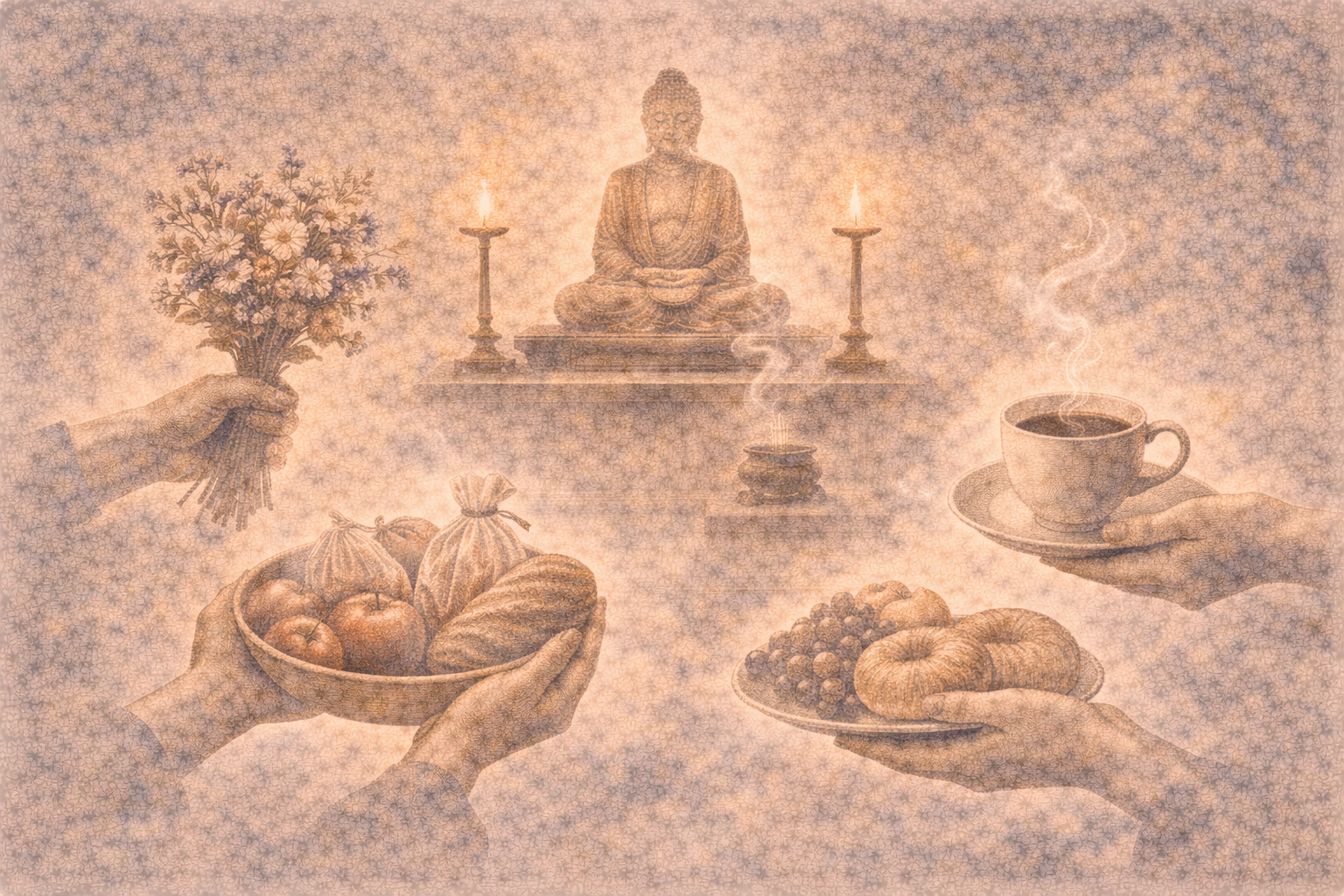
The key is to understand what an offering is doing in experience: it’s a small, deliberate gesture that interrupts self-centered momentum and replaces it with care, respect, and clarity. That can be expressed in traditional forms (incense, flowers, food) or in very simple, personal ways.
A Practical Lens: What an Offering Is Really For
Seen plainly, a Buddhist offering is a way of relating to life with less grasping. You place something down—an object, a moment of attention, a small act of service—and you do it without trying to purchase a result. That “not buying, not bargaining” quality is what makes the gesture psychologically clean.
This is why offerings don’t have to be religious in the sense of “I must believe X.” The offering can function as a lens: it helps you see how the mind reaches for control, recognition, or certainty, and it gives you a simple chance to release that reaching. You’re not proving devotion; you’re practicing letting go.
Offerings also work as a form of respect—toward teachings, toward the people who preserved them, and toward your own intention to live with more awareness. Respect doesn’t require supernatural belief. It can be as ordinary as taking your shoes off in someone’s home: a gesture that says, “I’m paying attention, and I’m not the center of everything right now.”
Finally, offerings can be understood as training in generosity. Generosity here isn’t only about money; it’s the willingness to give time, care, and presence. When the act is small and repeatable, it becomes a steady reminder that your life can be guided by values rather than impulses.
GASSHO
Ask and learn about Buddhism in daily life.
GASSHO is a Buddhist community app where you can learn Buddhist teachings and ask questions to the head priest of Kongosanmaiin Temple on Mount Koya.
How It Feels in Everyday Life
You light a candle or place a cup of water on a shelf, and the mind immediately comments: “Is this silly?” “Am I pretending?” “What if someone sees?” That inner commentary is not a failure; it’s the practice showing you the friction points—self-consciousness, doubt, the need to be certain.
If you stay with the gesture, something simple can happen: attention gathers. The body slows down. You notice the difference between doing something mechanically and doing it deliberately. The offering becomes less about the object and more about the quality of presence you bring to it.
Often, the strongest reaction is the urge to make the act “mean something” immediately. The mind wants a payoff: calm, luck, a sign, a feeling of being good. When you notice that urge and still offer without demanding a return, you’re practicing a very ordinary kind of freedom.
In a busy day, an offering can function like a reset. Before opening your laptop, you pause and place a flower in a small vase. Before eating, you take one breath and acknowledge the chain of effort that brought the food to you. These are not dramatic spiritual moments; they’re small interruptions of autopilot.
Sometimes the experience is emotional. You might offer in memory of someone, or in the middle of grief, or when you feel grateful but don’t know where to put that gratitude. The act gives the feeling a container—without needing to turn it into a belief statement.
And sometimes nothing special happens at all. The candle burns, the incense fades, the water sits quietly. That can be the point: you practiced sincerity without chasing an experience. The mind learns that meaning doesn’t have to be loud to be real.
Over time, you may notice a subtle shift: you become more willing to give, more able to pause, and less interested in performing spirituality for yourself or others. Not because you “advanced,” but because you repeated a small act that gently reoriented attention.
Common Misunderstandings That Make Offerings Feel Awkward
One common misunderstanding is that offerings are a transaction: “I give this, so I get that.” When offerings are treated like a bargain, they can feel superstitious or manipulative. A cleaner approach is to treat the act as practice—an expression of values, not a purchase.
Another misunderstanding is that you must believe in a particular metaphysical story for the offering to “count.” In practice, the offering can be honest even when your beliefs are undecided. You can simply acknowledge: “I’m doing this to cultivate gratitude and generosity,” and let that be enough.
People also assume offerings must be elaborate or expensive. That pressure turns a simple gesture into a performance. Traditionally, offerings are often intentionally modest—water, a single flower, a small light—because the point is sincerity and steadiness, not display.
Another snag is fear of cultural disrespect. The respectful move is not to avoid everything; it’s to be careful with context. In a temple, follow posted guidance and observe what others do. At home, keep it simple and avoid claiming authority you don’t have.
Finally, some people worry that making offerings means they are “joining a religion” against their will. But a gesture of respect doesn’t have to be an identity statement. You can participate as a human being practicing gratitude, without forcing a label onto yourself.
Why This Question Matters More Than It Seems
Whether Buddhist offerings have to be religious is really a question about how you relate to meaning. Many people want depth without dogma, ritual without pretending, and reverence without fear. Offerings can meet that need because they are concrete, repeatable, and honest when done with clear intention.
In daily life, we’re constantly “offering” attention to something—our phone, our worries, our ambitions. A deliberate offering is a way to choose what deserves your attention. It’s a small vote for the kind of person you want to be, expressed through action rather than self-talk.
Offerings also soften the habit of taking. Even if you’re not religious, the practice of giving—without keeping score—can change how you speak, how you listen, and how you move through shared spaces. It’s not mystical; it’s behavioral training with a gentle emotional tone.
And if you do have religious feelings, the same gesture can hold them without becoming rigid. The offering doesn’t need to be a test of purity. It can be a simple way to return to humility and care, again and again.
Conclusion
Buddhist offerings don’t have to be religious in the sense of requiring a fixed belief or a supernatural worldview. They can be a practical, human gesture: a way to practice generosity, respect, and letting go of the need to get something back.
If you’re unsure, start small: a moment of silence, a cup of water, a candle, a quiet “thank you” for the conditions that support your life. Keep the act honest, keep it simple, and let the offering do what it does best—turn attention from grasping toward care.
Ask a Buddhist priest
Have a question about Buddhism?
In the GASSHO app, you can ask questions about Buddhist teachings, daily concerns, and how to understand Buddhism in everyday life.
Frequently Asked Questions
- FAQ 1: Do Buddhist offerings have to be religious to be “valid”?
- FAQ 2: If I’m not Buddhist, is it inappropriate to make Buddhist offerings?
- FAQ 3: Do Buddhist offerings require prayer or worship?
- FAQ 4: Are Buddhist offerings basically superstition?
- FAQ 5: Can Buddhist offerings be done in a secular way?
- FAQ 6: What is the point of Buddhist offerings if no one “receives” them?
- FAQ 7: Do Buddhist offerings have to be traditional items like incense or flowers?
- FAQ 8: If I feel awkward making Buddhist offerings, should I stop?
- FAQ 9: Is it disrespectful to make Buddhist offerings if I don’t believe in karma or rebirth?
- FAQ 10: Do Buddhist offerings have to be made at an altar?
- FAQ 11: Are Buddhist offerings meant to ask for favors or protection?
- FAQ 12: Can I dedicate a Buddhist offering to someone without making it religious?
- FAQ 13: Do Buddhist offerings have to be done daily to count as practice?
- FAQ 14: Is it okay to make Buddhist offerings while treating Buddhism as philosophy, not religion?
- FAQ 15: What’s a simple non-religious way to do a Buddhist-style offering at home?
FAQ 1: Do Buddhist offerings have to be religious to be “valid”?
Answer: No. Offerings can be meaningful as a practice of gratitude, respect, and generosity even if you don’t hold religious beliefs; what matters most is the sincerity and non-transactional intention behind the act.
Takeaway: Offerings can be practical and sincere without being a declaration of faith.
FAQ 2: If I’m not Buddhist, is it inappropriate to make Buddhist offerings?
Answer: It’s usually not inappropriate if you approach the act as respectful participation rather than claiming authority or performing it as a spectacle. In shared spaces like temples, follow local etiquette and guidance.
Takeaway: Non-Buddhists can offer respectfully, especially when they follow context and etiquette.
FAQ 3: Do Buddhist offerings require prayer or worship?
Answer: Not necessarily. Many people pair offerings with a short dedication or reflection, but an offering can also be a quiet act of mindful respect without prayer or worship language.
Takeaway: You can offer with silence and intention, without worship.
FAQ 4: Are Buddhist offerings basically superstition?
Answer: They can look superstitious if treated like a bargain for luck, but they don’t have to be. Practiced as training in generosity and letting go, offerings are more like a deliberate habit that shapes attention and behavior.
Takeaway: Offerings aren’t inherently superstitious; the “transaction mindset” is the problem.
FAQ 5: Can Buddhist offerings be done in a secular way?
Answer: Yes. You can frame the act as gratitude for interdependence, respect for ethical ideals, or a reminder to live with care—without making claims about the supernatural.
Takeaway: A secular framing can still preserve the heart of the practice.
FAQ 6: What is the point of Buddhist offerings if no one “receives” them?
Answer: The point can be the effect on the giver: practicing generosity, humility, and remembrance. Even when offerings are symbolically directed toward awakened qualities, the practical training happens in your own mind and actions.
Takeaway: Offerings can be about inner training, not an external receiver.
FAQ 7: Do Buddhist offerings have to be traditional items like incense or flowers?
Answer: No. Traditional items are common because they’re simple and symbolic, but the essential element is the intention of giving and respect. Many people keep offerings minimal and ordinary.
Takeaway: Tradition can help, but simplicity and sincerity are enough.
FAQ 8: If I feel awkward making Buddhist offerings, should I stop?
Answer: Awkwardness is common, especially if you’re unsure about the “religious” aspect. You can simplify the gesture, do it privately, or replace it with a moment of silent gratitude until it feels honest.
Takeaway: Adjust the form so the act stays genuine rather than performative.
FAQ 9: Is it disrespectful to make Buddhist offerings if I don’t believe in karma or rebirth?
Answer: Not inherently. Respect is shown through your attitude and behavior—being careful, not mocking, and not treating the practice as a costume. Belief varies widely, and sincerity matters more than certainty.
Takeaway: Lack of specific beliefs doesn’t automatically make an offering disrespectful.
FAQ 10: Do Buddhist offerings have to be made at an altar?
Answer: No. While altars provide a dedicated place, an offering can be made anywhere as a deliberate act of respect and recollection—what matters is the mindful intention, not the furniture.
Takeaway: Place supports practice, but it isn’t a requirement.
FAQ 11: Are Buddhist offerings meant to ask for favors or protection?
Answer: They don’t have to be. Some cultures may include petitionary elements, but a grounded approach is to offer without bargaining—using the act to cultivate generosity, clarity, and ethical intention.
Takeaway: Offerings can be non-transactional and still deeply meaningful.
FAQ 12: Can I dedicate a Buddhist offering to someone without making it religious?
Answer: Yes. You can dedicate the gesture as a way of expressing care, remembrance, or goodwill, using simple language like “May this be for their benefit” without adding beliefs you don’t hold.
Takeaway: Dedication can be an expression of compassion, not a creed.
FAQ 13: Do Buddhist offerings have to be done daily to count as practice?
Answer: No. Consistency can help, but forcing a schedule can turn the act into a chore. It’s better to offer when you can do it with presence—whether that’s daily, weekly, or occasionally.
Takeaway: Frequency matters less than sincerity and mindful attention.
FAQ 14: Is it okay to make Buddhist offerings while treating Buddhism as philosophy, not religion?
Answer: Yes, if your approach is respectful. Many people relate to offerings as a philosophical or ethical practice—training generosity and humility—without adopting a religious identity.
Takeaway: Offerings can fit a philosophical relationship to Buddhism.
FAQ 15: What’s a simple non-religious way to do a Buddhist-style offering at home?
Answer: Keep it minimal: place a small cup of clean water, light a candle, or set down a flower, then pause for one breath and set an intention like “May I live with gratitude and care today.” No prayers are required.
Takeaway: A small, honest gesture can carry the essence without religious framing.