



Why Do Buddhists Offer Incense, Water, or Flowers? Meaning Explained
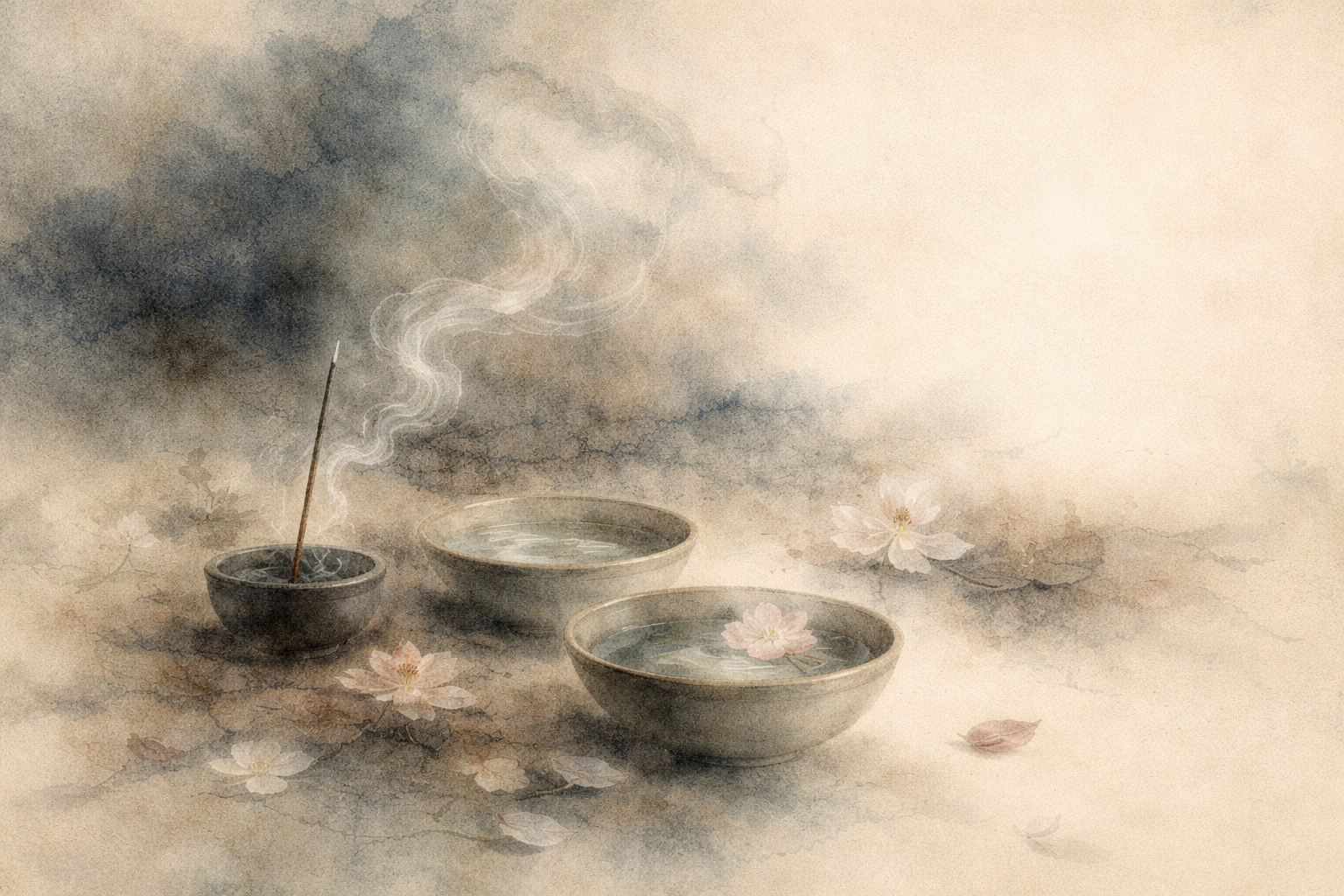
Quick Summary
- Buddhists offer incense, water, or flowers to express respect and to train attention, not to “feed” a statue.
- These offerings are reminders: fragrance fades, water is clear, flowers wither—everything changes.
- The act is a simple way to practice generosity and letting go in everyday life.
- Incense supports a calm atmosphere and can cue the mind to settle and become present.
- Water symbolizes clarity and sincerity; flowers symbolize beauty and impermanence.
- Offerings are meaningful even when small, inexpensive, or symbolic.
- The point is the intention and the moment of mindful care, not perfection or superstition.
Introduction
If incense, water, and flowers on a Buddhist altar look like “religious props” or a strange attempt to please a deity, you’re not alone—and that assumption misses what the practice is actually doing. In most Buddhist contexts, offerings are less about giving something to an external power and more about shaping the giver: attention becomes steadier, gratitude becomes explicit, and grasping loosens a little in the body and mind. Gassho is a Zen/Buddhism site focused on practical, grounded explanations of traditional practices.
A Practical Lens for Understanding Offerings
One helpful way to understand why Buddhists offer incense, water, or flowers is to treat the altar as a training space rather than a bargaining table. The objects are not “payment” for blessings; they are a deliberate gesture that turns ordinary materials into a moment of conscious intention.
Incense, water, and flowers are chosen because they speak in a simple, nonverbal language. Fragrance spreads and disappears. Water is clear, cool, and plain. Flowers are vivid and then they fade. Each offering quietly points to the same lesson: experience is immediate, beautiful, and unstable—so meet it with care rather than clinging.
Offerings also function as a form of generosity that is easy to practice. You give something up—however small—and you do it without expecting a return. That “no return” aspect matters: it trains the nervous system to relax its constant habit of measuring, earning, and controlling.
Seen this way, the altar is not a place where a statue “receives” objects. It is a place where a person rehearses respect, gratitude, and clarity—using the senses as allies rather than distractions.
GASSHO
Ask and learn about Buddhism in daily life.
GASSHO is a Buddhist community app where you can learn Buddhist teachings and ask questions to the head priest of Kongosanmaiin Temple on Mount Koya.
How the Practice Feels in Ordinary Life
In daily life, the mind often runs on autopilot: you wake up, check messages, rush, and carry a low-grade tension without noticing it. Making a small offering interrupts that momentum. You slow down, pick up an object, and place it carefully—already, attention has a new center.
Lighting incense is especially direct. The scent arrives, the smoke rises, and the room changes. You can feel how quickly the mind wants to label it—pleasant, unpleasant, too strong, not strong enough—and how quickly it wants to move on. The offering becomes a chance to notice reaction without being pushed around by it.
Offering water is quieter. Because it is so plain, it can highlight the urge to make things “special” or impressive. A simple cup of clean water asks for sincerity rather than performance. You can sense the difference between doing something to look spiritual and doing something to be present.
Flowers bring a different kind of honesty. They look fresh for a moment, then droop, then dry out. If you keep offering flowers, you repeatedly meet the fact that beauty doesn’t stay. That encounter can be gentle: instead of trying to freeze what you like, you practice appreciating it while it’s here.
Over time, the physical gestures can become cues for inner gestures. Placing an offering can mirror placing down a grudge. Straightening a vase can mirror straightening your intention. Cleaning the offering bowls can mirror cleaning up a messy mental story you’ve been rehearsing.
Even when you feel distracted, the practice still works in a modest way. You notice distraction, you return to the task, you complete it. That’s a small, repeatable pattern of returning—useful far beyond the altar.
And importantly, nothing mystical has to happen for the offering to be meaningful. The meaning is in the shift: from taking to giving, from rushing to pausing, from unconscious habit to deliberate care.
Common Misunderstandings About Incense, Water, and Flowers
“Buddhists are worshipping idols.” A statue or image is typically used as a focal point—like a mirror for values such as compassion and wisdom. The offering is directed toward what the image represents and toward the practitioner’s own intention, not toward a stone or metal object as a literal god.
“Offerings are meant to get favors or good luck.” Some people may approach offerings with that hope, but the deeper logic is training: practicing generosity, respect, and mindfulness. If you treat offerings as a transaction, you often strengthen craving and anxiety—the very patterns the practice is meant to soften.
“It’s wasteful or purely decorative.” Offerings can be extremely simple: a single flower, a small cup of water, a pinch of incense. The point is not luxury. It’s the deliberate act of giving and the reminder of impermanence, which can be done without excess.
“If I can’t do it perfectly, I shouldn’t do it.” Perfectionism turns a living practice into a performance. A sincere offering made with care—however modest—is closer to the heart of the tradition than an elaborate setup done with stress and comparison.
“Incense is required.” Incense is common, but not mandatory. Many people avoid it for health, scent sensitivity, or living situations. Water and flowers (or even a simple bow and a clean space) can carry the same intention.
Why This Ritual Still Matters Today
Modern life trains constant consumption: more input, more stimulation, more self-optimization. Offering incense, water, or flowers is a small counter-training. You practice giving rather than grabbing, and you do it in a way that is concrete enough to feel in your hands.
It also restores a sense of relationship with your own day. When you place water or flowers with care, you’re saying, “This moment is worth showing up for.” That attitude can spill into ordinary tasks—washing dishes, answering an email, speaking to a family member—without needing the altar present.
Finally, offerings make impermanence livable rather than theoretical. Flowers fade. Incense burns down. Water evaporates. Instead of treating change as a problem to solve, you practice meeting change as the normal texture of life—sometimes pleasant, sometimes not, always moving.
Conclusion
Why Buddhists offer incense, water, or flowers comes down to a simple, practical aim: to train the heart-mind through a sensory, repeatable gesture of respect, generosity, and remembrance. Incense steadies attention through scent and atmosphere, water expresses clarity and sincerity, and flowers teach beauty alongside impermanence. If you approach offerings as a way to practice presence and letting go—rather than a way to earn something—they become quietly powerful, even in the smallest form.
Ask a Buddhist priest
Have a question about Buddhism?
In the GASSHO app, you can ask questions about Buddhist teachings, daily concerns, and how to understand Buddhism in everyday life.
Frequently Asked Questions
- FAQ 1: Why do Buddhists offer incense, water, or flowers instead of something more valuable?
- FAQ 2: Are incense, water, and flowers meant to “feed” the Buddha or spirits?
- FAQ 3: What does incense symbolize when Buddhists offer it?
- FAQ 4: Why is water offered on Buddhist altars?
- FAQ 5: Why do Buddhists offer flowers if they will just wither?
- FAQ 6: Is offering incense, water, or flowers considered worship in Buddhism?
- FAQ 7: Do Buddhists believe offerings bring good luck or remove bad luck?
- FAQ 8: Can I offer only water or only flowers if I don’t have incense?
- FAQ 9: What matters most when offering incense, water, or flowers in Buddhism?
- FAQ 10: Why are offerings placed in front of a Buddha image if the Buddha doesn’t need them?
- FAQ 11: Is there a “right” way to offer incense, water, or flowers?
- FAQ 12: What should I do with the water after it has been offered?
- FAQ 13: What should I do with flowers after they wilt on the altar?
- FAQ 14: Why do some Buddhists offer incense even if they don’t meditate at that moment?
- FAQ 15: If I’m not Buddhist, is it respectful to offer incense, water, or flowers at a Buddhist temple?
FAQ 1: Why do Buddhists offer incense, water, or flowers instead of something more valuable?
Answer: Because the value is mainly in the intention and the training, not the price. Simple offerings are accessible, repeatable, and symbolically rich: incense shows fragrance and fading, water shows clarity and simplicity, and flowers show beauty and impermanence.
Takeaway: Offerings work through sincerity, not expense.
FAQ 2: Are incense, water, and flowers meant to “feed” the Buddha or spirits?
Answer: In most Buddhist practice, offerings are not literal feeding. They are gestures of respect and reminders that shape the practitioner’s mind—gratitude, generosity, and mindful attention—using sensory symbols placed before an image or altar.
Takeaway: The offering changes the giver more than it changes anything external.
FAQ 3: What does incense symbolize when Buddhists offer it?
Answer: Incense commonly symbolizes purification of intention, the spreading of goodwill, and the fleeting nature of experience. As it burns, it also serves as a sensory cue to settle, pause, and become present.
Takeaway: Incense is a reminder and a cue for attention.
FAQ 4: Why is water offered on Buddhist altars?
Answer: Water is offered because it is plain, clean, and honest—often associated with clarity, sincerity, and a mind that is not trying to impress. Its simplicity helps shift the focus from performance to genuine presence.
Takeaway: Water offerings emphasize clarity and sincerity.
FAQ 5: Why do Buddhists offer flowers if they will just wither?
Answer: Precisely because they wither. Flowers make impermanence visible and tangible: beauty is real, and it doesn’t last. Offering flowers becomes a gentle practice of appreciation without clinging.
Takeaway: Flowers teach impermanence in a direct, everyday way.
FAQ 6: Is offering incense, water, or flowers considered worship in Buddhism?
Answer: It can look like worship from the outside, but many Buddhists understand it as veneration and training: expressing respect for awakened qualities and cultivating those qualities in oneself through repeated, mindful gestures.
Takeaway: Offerings are often practice-oriented rather than deity-oriented.
FAQ 7: Do Buddhists believe offerings bring good luck or remove bad luck?
Answer: Some people may hope for good outcomes, but the core purpose is usually inner cultivation—generosity, gratitude, and steadiness. When offerings are treated as a transaction for luck, the practice can drift into anxiety and bargaining.
Takeaway: The deeper aim is transformation of habits, not luck management.
FAQ 8: Can I offer only water or only flowers if I don’t have incense?
Answer: Yes. Many people offer just water or flowers depending on health, living space, or preference. The heart of the practice is mindful giving and respect; the specific item is secondary.
Takeaway: One sincere offering is enough.
FAQ 9: What matters most when offering incense, water, or flowers in Buddhism?
Answer: The quality of mind: care, gratitude, and a willingness to let go of self-centeredness. A small offering placed attentively can be more aligned with the practice than an elaborate offering done mechanically.
Takeaway: Intention and attention are the core.
FAQ 10: Why are offerings placed in front of a Buddha image if the Buddha doesn’t need them?
Answer: The image functions as a focal point for remembrance and aspiration. Placing incense, water, or flowers there organizes attention and makes inner values concrete through a visible, repeatable act.
Takeaway: The image supports focus; the offering supports practice.
FAQ 11: Is there a “right” way to offer incense, water, or flowers?
Answer: Customs vary, but a respectful, safe, and simple approach is generally appropriate: keep the space clean, offer what you can, and place it with calm attention. The “right way” is the way that supports sincerity rather than stress.
Takeaway: Keep it respectful, safe, and sincere.
FAQ 12: What should I do with the water after it has been offered?
Answer: Many people refresh it regularly and dispose of the old water respectfully—such as pouring it onto soil or down the sink mindfully—without treating it as magical. The key is care and cleanliness, not superstition.
Takeaway: Refresh and dispose of offered water respectfully and simply.
FAQ 13: What should I do with flowers after they wilt on the altar?
Answer: Remove them when they fade and compost them or discard them respectfully. The wilting is part of the teaching: you notice change, you care for what’s present, and you let go when it’s time.
Takeaway: Let the flowers teach impermanence, then let them go.
FAQ 14: Why do some Buddhists offer incense even if they don’t meditate at that moment?
Answer: Offerings are not only a pre-meditation step; they can be a standalone ritual of recollection and gratitude. Lighting incense can mark a pause in the day, re-centering attention and intention even without a longer sit.
Takeaway: Incense can be a brief practice of presence on its own.
FAQ 15: If I’m not Buddhist, is it respectful to offer incense, water, or flowers at a Buddhist temple?
Answer: Yes, if you follow the local instructions and approach it as a gesture of respect rather than a joke or a test. Keep it simple, observe what others do, and let the offering be an act of quiet courtesy.
Takeaway: Respectful intention and following temple guidance are what matter.