



What Buddhist Spaces in Japan Teach Without Words
Quick Summary
- Buddhist spaces in Japan often “teach” through layout, rhythm, and restraint rather than explanations.
- Silence isn’t empty; it highlights small cues—light, sound, scent, and distance—that shape attention.
- Thresholds, shoes-off customs, and slow pathways train the body to arrive before the mind starts narrating.
- Ritual objects and simple gestures communicate care, impermanence, and humility without needing doctrine.
- Gardens, gravel, and weathered wood model change as normal, not as a problem to solve.
- The “lesson” is usually practical: notice reactivity, soften grasping, and relate more gently to experience.
- You don’t need to be Buddhist to receive the message; you only need to slow down and look.
Introduction
You can walk into a temple hall or a mossy courtyard in Japan and feel something shift—then immediately get stuck trying to name it, as if the place owes you an explanation. The confusion is understandable: many Buddhist spaces in Japan communicate through atmosphere, etiquette, and design choices that work on you before you can translate them into concepts. At Gassho, we focus on how Buddhist practice shows up in real experience, not just in words.
This matters because “wordless teaching” isn’t mystical; it’s a practical way of guiding attention. Instead of telling you what to think, the space nudges you toward noticing how you think—how quickly you judge, how tightly you hold preferences, and how rarely you let a moment be simple.
A Lens for Understanding Wordless Teaching
When people ask what Buddhist spaces in Japan teach without words, it helps to treat the space as a kind of gentle instruction manual for attention. The “teaching” is not a hidden message you decode; it’s the way the environment shapes your posture, pace, and perception. You learn by being guided into a different quality of seeing.
These places often reduce excess: fewer signs, fewer bright distractions, fewer demands to perform. That reduction isn’t about being austere for its own sake. It creates room for subtle information—footsteps on stone, incense fading, wind in bamboo, the unevenness of old wood—to become noticeable again.
Another key lens is that the space doesn’t argue with you. It doesn’t try to win your agreement. It simply presents conditions where grasping feels slightly out of place: you can’t rush comfortably, you can’t consume the experience quickly, and you can’t control the weathering of things. The environment quietly suggests that reality is already moving, already changing, and your job is to meet it.
Finally, wordless teaching is relational. A hall, a gate, a garden path, a bell—these are not just objects; they are invitations to respond with care. The space trains a kind of respect that isn’t about status. It’s about recognizing that your actions land somewhere, even when nobody is praising or correcting you.
GASSHO
Ask and learn about Buddhism in daily life.
GASSHO is a Buddhist community app where you can learn Buddhist teachings and ask questions to the head priest of Kongosanmaiin Temple on Mount Koya.
How the Message Lands in Ordinary Experience
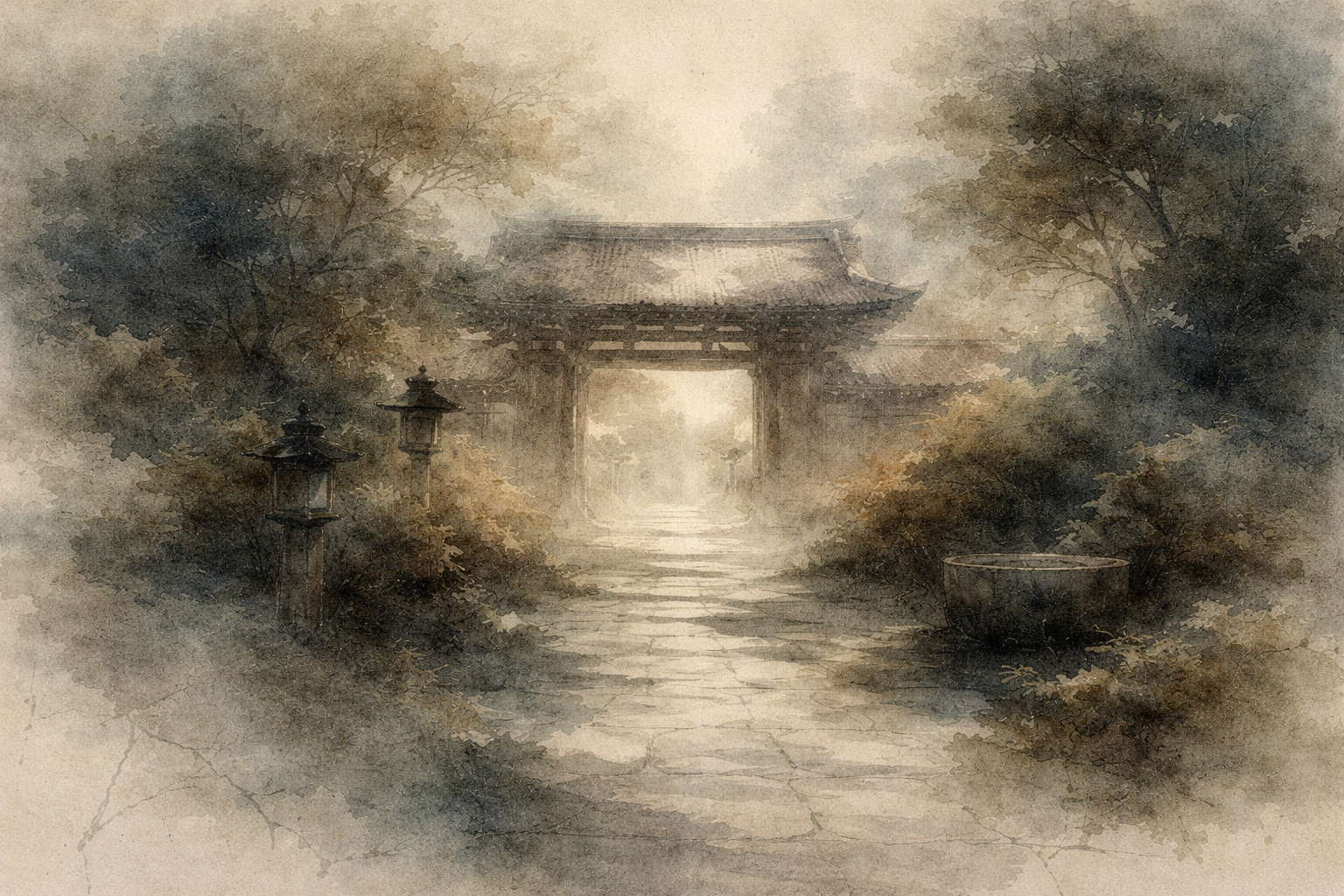
You notice it first at the threshold. Taking off your shoes, stepping up onto wood, or passing through a gate changes your body’s sense of “inside” and “outside.” Without anyone lecturing you, the transition asks for a small pause, and that pause interrupts autopilot.
Then your attention starts to reorganize. In a quieter space, the mind’s usual habit—commentary, comparison, planning—becomes louder by contrast. You may realize you’ve been narrating everything, even peace. The space doesn’t stop the narration; it makes it easier to hear it as narration.
Small forms of etiquette do similar work. Bowing, walking along the side, waiting your turn, keeping your voice low—these aren’t only “rules.” They reveal how quickly irritation appears when you can’t do exactly what you want, exactly when you want it. The teaching is the moment you catch that irritation forming.
Gardens and courtyards often bring up preference in a clean way. You like one angle, dislike another; you want the perfect photo; you want the light to cooperate. When a cloud passes or a drizzle starts, the scene changes and your mind reacts. The space makes impermanence feel ordinary, not dramatic.
Sound is another teacher. A bell, distant chanting, the hush of a hall, even the scrape of gravel underfoot can pull attention into the present without forcing it. You may notice how the body settles when it stops chasing stimulation, and how quickly it tenses again when you reach for your phone or your next thought.
Objects that look “simple” can expose the urge to over-interpret. A single flower offering, a plain candle, a worn threshold—your mind may hunt for symbolism. Sometimes the more honest experience is: “This is here. It’s cared for. It will pass.” That’s not an idea; it’s a felt recognition.
Over time—sometimes within minutes—you may sense a different kind of dignity. Not the dignity of being special, but the dignity of being careful. The space teaches that attention itself is an ethical act: how you step, how you look, how you handle silence, how you share a room with others.
Common Misreadings of Silent Instruction
One misunderstanding is thinking the space is trying to make you feel a particular emotion—calm, bliss, or awe. Sometimes you will feel calm; sometimes you will feel restless or bored. The wordless teaching isn’t “be calm.” It’s “see what arises when conditions change, and don’t immediately obey it.”
Another misreading is assuming you need insider knowledge to “get it.” You don’t need to know terminology to notice how a slow walkway slows you, or how a quiet hall amplifies your inner noise. The space is designed to be legible to the body and senses, not only to the intellect.
People also confuse restraint with coldness. Minimal decoration and quiet etiquette can look severe from the outside. But often the restraint is a form of care: it reduces friction between people, protects shared attention, and makes room for what is already present.
Finally, it’s easy to romanticize these spaces as “timeless” and forget they are lived-in places with schedules, maintenance, and community norms. The teaching is not that life should be perfectly serene. It’s that ordinary life—dust, weather, footsteps, aging wood—can be met without constant complaint.
Why This Wordless Learning Matters After You Leave
The most useful takeaway is portable: you can recreate the lesson without recreating the architecture. A temple space shows how quickly attention stabilizes when you reduce inputs and stop multitasking. At home, that might mean eating one meal without screens, or taking a short walk without audio.
It also reframes etiquette as mindfulness in action. Holding a door, lowering your voice, putting something back carefully—these are small, nonverbal ways of saying, “I’m not the only person here.” Buddhist spaces in Japan make that message feel normal rather than moralistic.
Perhaps most importantly, these spaces teach you to trust direct experience a little more than your commentary about it. When you notice the mind rushing to label, optimize, or capture, you gain the option to pause. That pause is where choice appears.
And because the teaching is nonverbal, it can meet you on difficult days when you can’t “think your way” into clarity. You can simply stand, breathe, listen, and let the environment remind you: life is already happening; you can stop fighting the fact of it for a moment.
Conclusion
What Buddhist spaces in Japan teach without words is not a secret doctrine—it’s a way of relating to experience. Through thresholds, quiet, rhythm, and care, they train attention to become less grabby and more honest. If you leave with anything, let it be this: the space didn’t demand belief; it offered conditions where you could notice your mind and soften your grip.
Ask a Buddhist priest
Have a question about Buddhism?
In the GASSHO app, you can ask questions about Buddhist teachings, daily concerns, and how to understand Buddhism in everyday life.
Frequently Asked Questions
- FAQ 1: What does it mean when people say Buddhist spaces in Japan “teach without words”?
- FAQ 2: Which features of Buddhist spaces in Japan most commonly communicate wordlessly?
- FAQ 3: How do Japanese temple gardens teach without words in a Buddhist context?
- FAQ 4: Why is silence so central to what Buddhist spaces in Japan teach without words?
- FAQ 5: Do Buddhist spaces in Japan teach without words even if you don’t know any Buddhist teachings?
- FAQ 6: What do temple thresholds and gates teach without words?
- FAQ 7: How do bells and chanting function as wordless teaching in Buddhist spaces in Japan?
- FAQ 8: What do offerings and simple altar arrangements teach without words?
- FAQ 9: Is the “wordless teaching” in Japanese Buddhist spaces meant to make you feel calm?
- FAQ 10: What do Buddhist spaces in Japan teach without words about impermanence?
- FAQ 11: How does etiquette in Japanese Buddhist spaces teach without words?
- FAQ 12: What do minimalist interiors in Buddhist spaces in Japan teach without words?
- FAQ 13: Can crowded or tourist-heavy Buddhist spaces in Japan still teach without words?
- FAQ 14: How can you receive what Buddhist spaces in Japan teach without words if you only visit briefly?
- FAQ 15: How can you bring home what Buddhist spaces in Japan teach without words?
FAQ 1: What does it mean when people say Buddhist spaces in Japan “teach without words”?
Answer: It means the environment guides attention through silence, layout, and simple etiquette rather than through explanations. You learn by noticing how your mind and body respond to the conditions the space creates.
Takeaway: The “teaching” is experiential—how the space shapes awareness.
FAQ 2: Which features of Buddhist spaces in Japan most commonly communicate wordlessly?
Answer: Thresholds (gates, steps, shoes-off areas), quiet halls, bells, incense, garden paths, and uncluttered rooms are common elements that slow you down and make subtle sensations more noticeable.
Takeaway: Design and rhythm often do the “speaking.”
FAQ 3: How do Japanese temple gardens teach without words in a Buddhist context?
Answer: Gardens highlight change—light shifts, leaves fall, moss grows, gravel patterns blur—so you directly experience impermanence and the mind’s preference-making without needing a lecture.
Takeaway: The garden trains you to see change as normal.
FAQ 4: Why is silence so central to what Buddhist spaces in Japan teach without words?
Answer: Silence reduces competing signals, so inner commentary becomes easier to notice. It also makes small sounds and movements feel meaningful, encouraging carefulness and presence.
Takeaway: Silence isn’t emptiness; it’s a clearer mirror for attention.
FAQ 5: Do Buddhist spaces in Japan teach without words even if you don’t know any Buddhist teachings?
Answer: Yes. The instruction is largely sensory and behavioral—pace, posture, quiet, and shared etiquette—so it can be felt without background knowledge.
Takeaway: You don’t need concepts to receive a wordless lesson.
FAQ 6: What do temple thresholds and gates teach without words?
Answer: They create a deliberate transition that interrupts rushing. Crossing a threshold can cue a pause, a breath, and a shift from “doing” to “noticing.”
Takeaway: A boundary can train arrival and attention.
FAQ 7: How do bells and chanting function as wordless teaching in Buddhist spaces in Japan?
Answer: Their timing and tone organize the atmosphere and gather scattered attention. Even without understanding words, sound can signal “listen,” “pause,” and “be here.”
Takeaway: Sound can guide attention without explanation.
FAQ 8: What do offerings and simple altar arrangements teach without words?
Answer: They communicate care, gratitude, and the reality of passing time—flowers wilt, incense burns down, candles end. The lesson is visible and immediate.
Takeaway: Small acts show impermanence and respect in plain sight.
FAQ 9: Is the “wordless teaching” in Japanese Buddhist spaces meant to make you feel calm?
Answer: Calm can happen, but it’s not the only point. The deeper lesson is noticing reactivity—restlessness, impatience, grasping—and learning to pause before acting it out.
Takeaway: The goal is clarity about the mind, not a guaranteed mood.
FAQ 10: What do Buddhist spaces in Japan teach without words about impermanence?
Answer: Weathered wood, seasonal gardens, fading incense, and shifting light all show that change is constant and not personal. You see it rather than merely agree with it.
Takeaway: Impermanence is taught through what the senses can’t deny.
FAQ 11: How does etiquette in Japanese Buddhist spaces teach without words?
Answer: Quiet voices, patient waiting, and careful movement reduce friction and highlight interdependence. You learn that your presence affects others even when no one comments on it.
Takeaway: Etiquette becomes a nonverbal training in consideration.
FAQ 12: What do minimalist interiors in Buddhist spaces in Japan teach without words?
Answer: Minimalism lowers distraction and makes subtle details more vivid. It can reveal how quickly the mind seeks stimulation and how settling can occur when there’s less to consume.
Takeaway: Less visual noise can expose the mind’s habits.
FAQ 13: Can crowded or tourist-heavy Buddhist spaces in Japan still teach without words?
Answer: Yes, though the lesson may shift. Crowds can teach patience, humility, and awareness of comparison and irritation—still wordless, still immediate.
Takeaway: The teaching can be about your reactions, not perfect quiet.
FAQ 14: How can you receive what Buddhist spaces in Japan teach without words if you only visit briefly?
Answer: Slow down on purpose: pause at thresholds, walk a little more quietly, listen for ambient sound, and notice preference and judgment as they arise. Even a few minutes can be instructive.
Takeaway: A short visit can work if attention is deliberate.
FAQ 15: How can you bring home what Buddhist spaces in Japan teach without words?
Answer: Create small “wordless cues” in daily life: a device-free corner, a short silent walk, a simple routine done carefully, or a moment of pause before entering your home. The point is to shape conditions that support noticing.
Takeaway: You can translate the space into habits that train attention.