



What Is the Earth-Touching Mudra? Meaning and “Earth Witness” Explained
Quick Summary
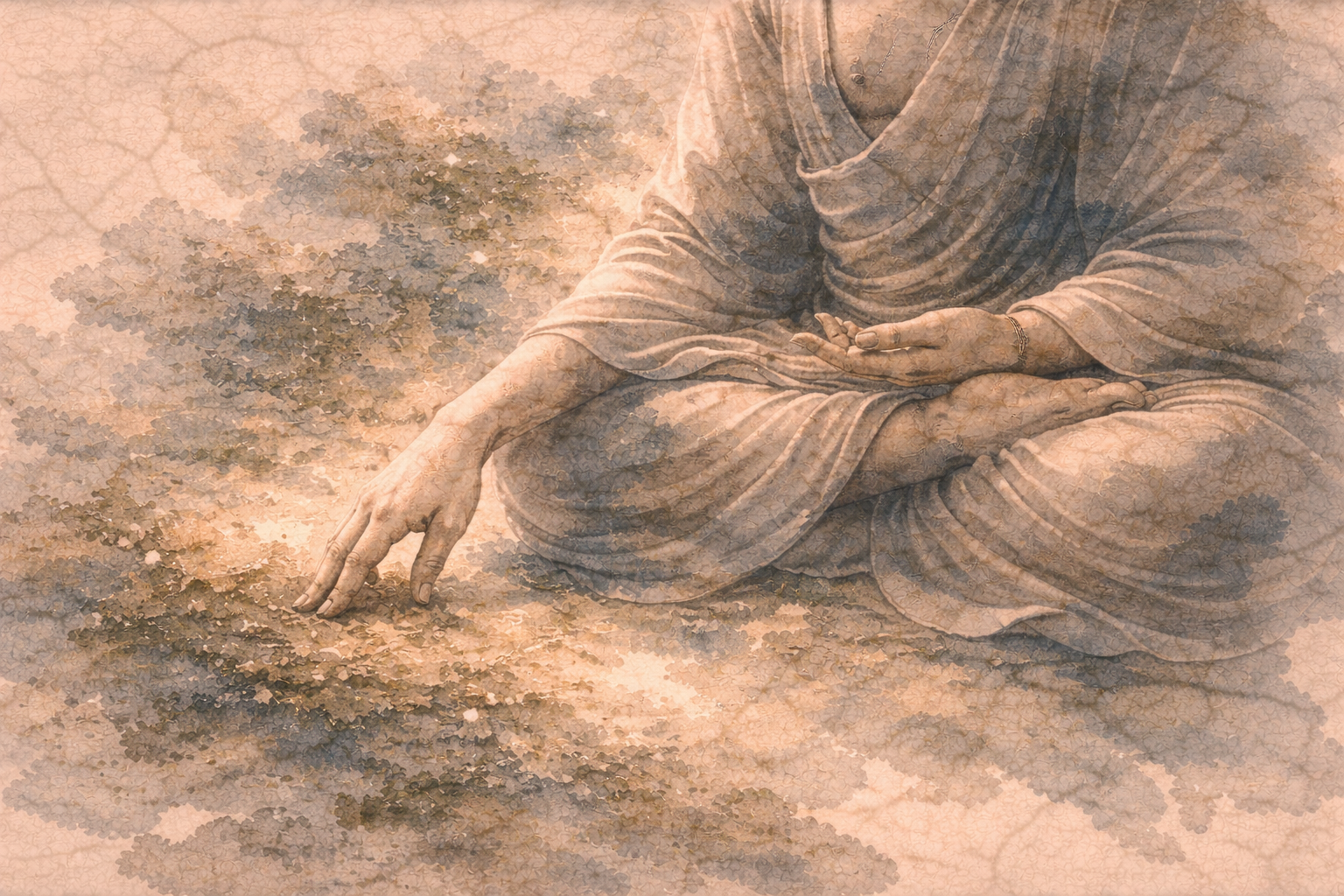
- The earth-touching mudra shows the Buddha’s right hand reaching down to the ground, palm inward, fingers extended.
- In Buddhist art, it signals steadiness under pressure: staying present when challenged.
- It’s closely tied to the moment of awakening imagery: “calling the earth to witness” one’s resolve.
- Artists use it to communicate meaning quickly—before you read any inscription or know any story.
- Small details matter: which hand touches the earth, how the fingers angle, and what the left hand is doing.
- It’s not a magic gesture; it’s a visual shorthand for grounded clarity and accountability.
- Knowing this mudra changes how you “read” statues, murals, and paintings in temples and museums.
Introduction
If you’ve looked at a Buddha statue with one hand reaching down and thought, “What exactly is that gesture supposed to mean—and why is it everywhere?”, you’re not alone. The earth-touching mudra can feel oddly specific, yet it’s one of the clearest visual cues in Buddhist art once you know what you’re seeing, and we write about these symbols every day at Gassho.
When art is doing its job, it communicates before it explains. Mudras—hand gestures—are part of that visual language: compact, repeatable, and designed to carry meaning across centuries, regions, and materials. The earth-touching mudra is especially direct because it points to something ordinary and undeniable: the ground beneath us.
This matters because Buddhist images aren’t just portraits; they’re instruction in form. A single gesture can tell you what kind of moment is being depicted, what inner quality is being emphasized, and how the viewer is meant to relate to the figure—without needing a caption.
A Clear Lens for Understanding the Earth-Touching Mudra
The earth-touching mudra is best understood as a lens for reading experience: when the mind is pressured, it looks for something solid to stand on. In art, the Buddha’s right hand reaches down toward the earth as a way of expressing groundedness—an unshowy confidence that doesn’t depend on winning an argument or impressing anyone.
Visually, it’s simple: the right hand extends over the knee, fingers pointing down, as if making contact with the ground. The left hand often rests in the lap, palm up, suggesting composure and collectedness. Together, the posture communicates a balance between stillness (left hand) and contact with reality (right hand).
As a perspective, it points to accountability rather than ideology. “Earth as witness” is a way of saying: let reality confirm what’s true. Not through dramatic signs, but through the plain fact of what is. In that sense, the gesture is less about claiming special status and more about refusing to be moved by doubt, fear, or provocation.
In Buddhist art, this is why the mudra reads as calm strength. The hand doesn’t grasp; it touches. It doesn’t point outward at an enemy; it points downward at what’s stable. The image suggests that clarity is not an escape from the world—it’s contact with it.
GASSHO
Ask and learn about Buddhism in daily life.
GASSHO is a Buddhist community app where you can learn Buddhist teachings and ask questions to the head priest of Kongosanmaiin Temple on Mount Koya.
How the Gesture Shows Up in Ordinary Inner Life
Even if you’ve never studied Buddhist symbolism, you already know the feeling this mudra points to: the moment you stop spinning and return to what’s right in front of you. It can be as small as noticing your feet on the floor when your thoughts are racing.
When you’re criticized, the mind often tries to defend itself by building a case. The earth-touching mudra, as an image, suggests a different move: pause, feel the weight of the body, and let the situation be witnessed by something more basic than your story about it.
When you’re anxious, attention tends to jump ahead, rehearsing outcomes. “Touching earth” is like returning attention to what is actually happening now—breath moving, hands resting, sounds arriving and leaving—without needing to force reassurance.
When you’re tempted to perform—say the right thing, look composed, appear wise—the gesture quietly undercuts that impulse. It’s not a display of power. It’s a refusal to inflate. The hand goes down, not up.
In conflict, we often want a final verdict: who’s right, who’s wrong. The earth-touching mudra points to a slower kind of confirmation: let actions, time, and consequences reveal what’s true. That doesn’t mean passivity; it means not substituting heat for clarity.
In moments of doubt—about your choices, your practice, your direction—there’s a familiar urge to seek a sign. The image suggests something more practical: return to what you can verify. What are you doing? What is the quality of your attention? What happens when you act from steadiness rather than reactivity?
That’s why the mudra works so well in art. It mirrors a human pattern: when the mind is pulled into drama, the body can remind it of the ground. The gesture is a picture of that reminder.
Common Misreadings That Flatten Its Meaning
One common misunderstanding is treating the earth-touching mudra as a “good luck” sign or a mystical seal that automatically produces awakening. In art, it’s not presented as a trick; it’s presented as a statement—an image of steadiness and truthfulness under pressure.
Another misreading is assuming it’s simply decorative or interchangeable with other hand gestures. Mudras are not random. Artists use them like verbs: they tell you what kind of moment is being depicted. If you swap the earth-touching mudra for a different gesture, you change the scene’s meaning.
People also sometimes interpret “earth as witness” as a supernatural courtroom scene. In many artworks, it’s more grounded than that: the earth stands for reality itself—what can’t be argued away. The gesture says, in effect, “Let what is real confirm what is real.”
Finally, viewers may miss how precise the iconography can be. Which hand reaches down matters. The angle of the fingers matters. The presence of a throne, a tree, or surrounding figures can shift the emphasis. The mudra is a key, but it’s not the whole sentence.
Why This Mudra Matters in Buddhist Art
Buddhist art is often encountered out of context: a statue in a museum, a photo online, a small figure on a shelf. The earth-touching mudra gives you immediate context. It tells you the image is pointing toward a moment of unshakable presence—an answer to doubt that doesn’t rely on aggression or spectacle.
It also shows how Buddhist images teach through the body. The gesture is not an abstract symbol floating above life; it’s a posture you can feel. Even as a viewer, you can sense the downward movement, the contact, the simplicity. That bodily readability is part of why the motif travels so well across cultures.
For artists, the mudra is a compositional anchor. The downward hand creates a line to the base, the pedestal, the earth—visually stabilizing the figure. For viewers, that same line becomes a cue: return to what’s stable, return to what’s here.
And for anyone trying to understand Buddhist imagery without memorizing a textbook, this mudra is one of the most practical entry points. Once you recognize it, you start noticing how often Buddhist art emphasizes groundedness over drama, and clarity over display.
Conclusion
The earth-touching mudra explained in plain terms is this: a visual statement of grounded resolve. In Buddhist art, it marks a moment where steadiness is tested and confirmed—not by argument, but by contact with reality.
When you learn to read this gesture, statues and paintings stop being generic “Buddha images” and start becoming specific messages. The hand reaching down is not a flourish; it’s the point: stay close to what’s true, especially when the mind wants to drift into doubt or performance.
Ask a Buddhist priest
Have a question about Buddhism?
In the GASSHO app, you can ask questions about Buddhist teachings, daily concerns, and how to understand Buddhism in everyday life.
Frequently Asked Questions
- FAQ 1: What is the earth-touching mudra, explained simply?
- FAQ 2: Why is the earth-touching mudra so common in Buddhist statues?
- FAQ 3: What does “calling the earth to witness” mean in the earth-touching mudra explained?
- FAQ 4: Which hand touches the earth in the earth-touching mudra?
- FAQ 5: How can I recognize the earth-touching mudra in a painting or sculpture?
- FAQ 6: Is the earth-touching mudra only about the Buddha’s awakening?
- FAQ 7: What is the difference between the earth-touching mudra and the meditation mudra?
- FAQ 8: Does the earth-touching mudra have to show the fingers actually touching the ground?
- FAQ 9: What does the earth-touching mudra symbolize in Buddhist art?
- FAQ 10: Is the earth-touching mudra a protective gesture?
- FAQ 11: Can the earth-touching mudra be shown while the Buddha is standing?
- FAQ 12: Why do some earth-touching mudra statues look slightly different from each other?
- FAQ 13: Is the earth-touching mudra the same as “Bhumisparsha mudra”?
- FAQ 14: What should I pay attention to when viewing the earth-touching mudra in a museum?
- FAQ 15: How does the earth-touching mudra explained help me understand Buddhist art more deeply?
FAQ 1: What is the earth-touching mudra, explained simply?
Answer: The earth-touching mudra is a hand gesture where the Buddha’s right hand reaches down toward the ground, fingers extended, as if touching the earth. In Buddhist art it signals grounded steadiness and the “earth as witness” theme—reality confirming resolve.
Takeaway: It’s a visual shorthand for being unshaken and grounded.
FAQ 2: Why is the earth-touching mudra so common in Buddhist statues?
Answer: It’s common because it instantly identifies a specific meaning and moment in Buddhist visual storytelling: calm resolve under challenge. Artists use it as a clear, widely recognized cue that doesn’t require text to understand.
Takeaway: The gesture is popular because it communicates meaning fast and clearly.
FAQ 3: What does “calling the earth to witness” mean in the earth-touching mudra explained?
Answer: “Calling the earth to witness” means appealing to what is undeniable and real rather than relying on debate, display, or approval. In art, the downward hand expresses that truth is confirmed by reality itself—by what stands up to pressure.
Takeaway: The “witness” is a symbol of reality, not a demand for spectacle.
FAQ 4: Which hand touches the earth in the earth-touching mudra?
Answer: In standard Buddhist iconography, it is the right hand that reaches down to touch the earth, while the left hand often rests in the lap. This right-hand detail is one of the main identifiers of the mudra in art.
Takeaway: Look for the right hand extended downward as the key marker.
FAQ 5: How can I recognize the earth-touching mudra in a painting or sculpture?
Answer: Look for a seated Buddha with the right arm extended over the knee, fingers pointing down toward the base or ground. The left hand is typically relaxed in the lap, creating a calm, stable composition.
Takeaway: Downward right-hand contact is the easiest visual clue.
FAQ 6: Is the earth-touching mudra only about the Buddha’s awakening?
Answer: It’s strongly associated with awakening imagery in Buddhist art, but its meaning is broader: groundedness, steadiness, and truthfulness under pressure. Even when the full narrative isn’t shown, the gesture still carries that “unmoved by doubt” message.
Takeaway: It points to awakening imagery, but it also communicates a general quality of grounded clarity.
FAQ 7: What is the difference between the earth-touching mudra and the meditation mudra?
Answer: The earth-touching mudra features the right hand reaching down toward the earth, while the meditation mudra typically shows both hands resting in the lap. In art, the first emphasizes “grounded witness,” while the second emphasizes stillness and collected attention.
Takeaway: Earth-touching adds a clear downward gesture; meditation mudra stays fully in the lap.
FAQ 8: Does the earth-touching mudra have to show the fingers actually touching the ground?
Answer: Not always. In some artworks the fingers appear to touch the base, pedestal, or ground; in others they hover just above it. The meaning is carried by the intention of the gesture—reaching down to “earth”—more than literal contact.
Takeaway: The downward reach matters more than perfect physical contact.
FAQ 9: What does the earth-touching mudra symbolize in Buddhist art?
Answer: Symbolically, it represents grounded resolve, stability, and the confirmation of truth by reality itself. It’s often read as a refusal to be shaken by fear, doubt, or provocation, expressed through a simple downward touch.
Takeaway: The symbol is steadiness verified by reality, not by performance.
FAQ 10: Is the earth-touching mudra a protective gesture?
Answer: In art it can feel protective because it conveys unshakable calm, but it’s not primarily a “warding off” sign. Its emphasis is grounding and witnessing—standing on what is true—rather than pushing something away.
Takeaway: It protects by grounding, not by aggression.
FAQ 11: Can the earth-touching mudra be shown while the Buddha is standing?
Answer: It is most commonly shown with a seated Buddha because the gesture naturally connects the hand to the earth near the knee. Standing depictions exist in some traditions and regions, but they are less typical; the seated form is the standard visual grammar.
Takeaway: Seated images are the norm for this mudra, with standing versions being less common.
FAQ 12: Why do some earth-touching mudra statues look slightly different from each other?
Answer: Variations come from regional styles, time periods, materials, and artistic conventions—such as finger spacing, wrist angle, or how the left hand rests. Even with differences, the core identifier remains the right hand reaching down toward earth.
Takeaway: Style changes, but the essential downward right-hand gesture stays consistent.
FAQ 13: Is the earth-touching mudra the same as “Bhumisparsha mudra”?
Answer: Yes. “Bhumisparsha” is a traditional term often translated as “touching the earth,” and it refers to the same earth-touching mudra seen in Buddhist art where the right hand reaches down toward the ground.
Takeaway: Earth-touching mudra and Bhumisparsha mudra refer to the same gesture.
FAQ 14: What should I pay attention to when viewing the earth-touching mudra in a museum?
Answer: Notice the right hand’s position (over the knee, fingers down), the left hand’s calm placement, and the surrounding elements like a tree, throne, or attendants. These details help you read whether the artwork is emphasizing grounded resolve, a specific narrative moment, or a broader symbolic message.
Takeaway: Read the mudra together with posture and context clues in the scene.
FAQ 15: How does the earth-touching mudra explained help me understand Buddhist art more deeply?
Answer: Once you know what the gesture signifies, you can identify the mood and message of an image quickly: steadiness, truthfulness, and grounded presence. That recognition turns a statue from a generic icon into a specific visual teaching you can “read” with your eyes and body.
Takeaway: Understanding the mudra gives you a reliable key for interpreting Buddhist imagery.