



The Fearlessness Mudra Explained: Meaning and Symbolism
Quick Summary
- The fearlessness mudra is the open-palm gesture that communicates “stop, you are safe” and “I will not harm you.”
- Its symbolism points to steadiness in the middle of uncertainty, not the absence of fear.
- The raised hand can be read as protection, reassurance, and ethical restraint all at once.
- In Buddhist art, it often appears with a calm stance to show confidence without aggression.
- You can use the gesture as a simple cue for relaxing the body and softening reactivity.
- Common mistakes include treating it like a magic sign or forcing yourself to “feel brave.”
- The most practical meaning: meet fear with clarity, boundaries, and kindness.
Introduction
You’ve seen the raised open palm in statues and images and wondered what it actually means—whether it’s a blessing, a warning, a promise of protection, or just “a Buddhist hand sign.” The fearlessness mudra explained plainly is this: it’s a visual language for safety and steadiness, meant to settle the viewer and remind the practitioner how to relate to fear without being pushed around by it. At Gassho, we focus on practical symbolism you can recognize in your own mind and body.
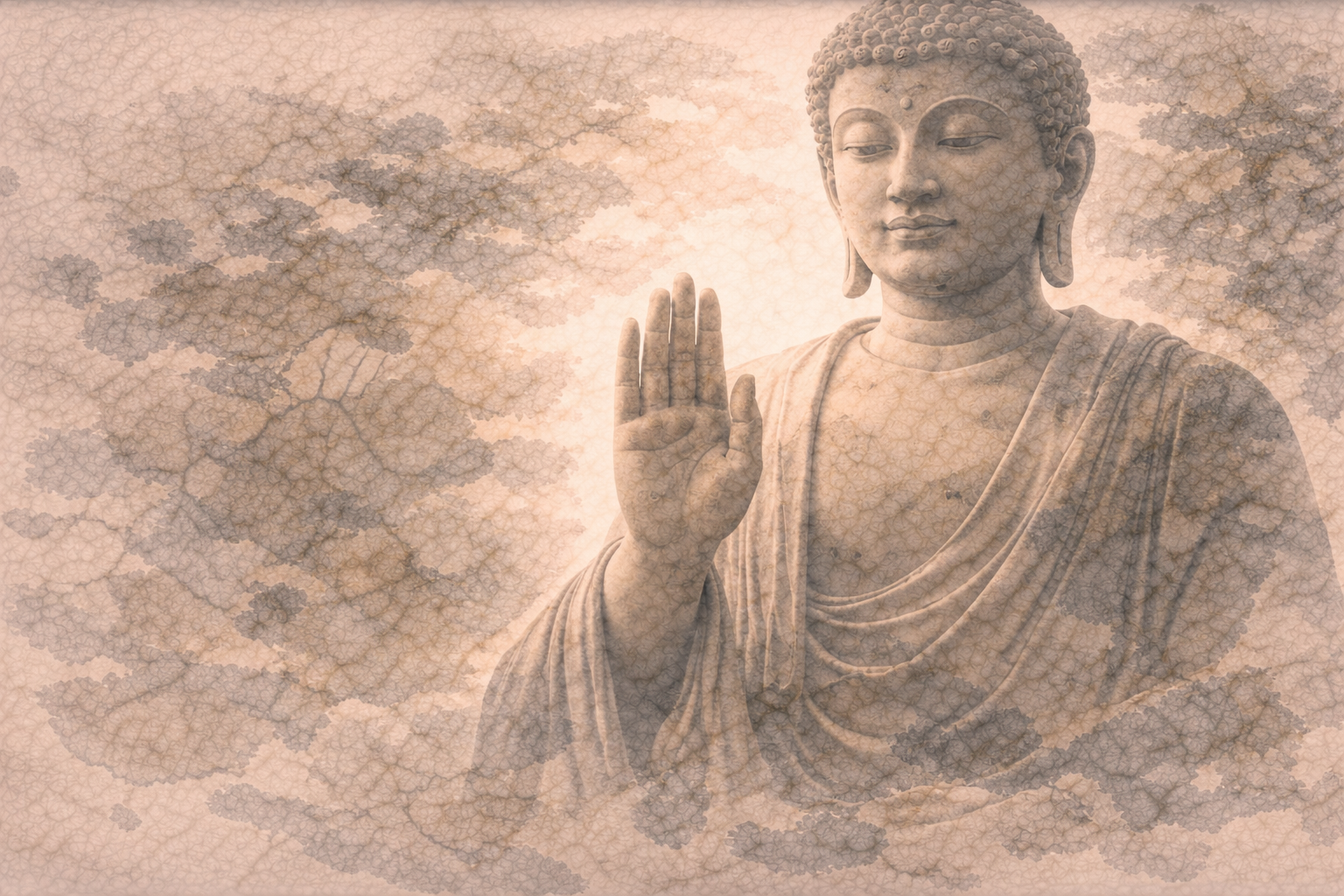
The term “mudra” refers to a meaningful gesture, often of the hands, used in Buddhist and broader Indian religious art and practice. The fearlessness mudra is commonly shown as one hand raised to about shoulder height, palm facing outward, fingers naturally extended upward.
Because it’s so simple, it’s easy to miss how layered it is. The same open palm can communicate reassurance to someone who’s frightened, restraint to someone who expects harm, and inner confidence to someone who doubts themselves.
A Clear Lens for Understanding the Fearlessness Mudra
The fearlessness mudra is best understood as a relational gesture: it’s not only about what someone “has inside,” but what they offer outwardly. The open palm says, “I am not a threat,” and at the same time, “You can pause.” It’s a calm interruption of panic and escalation.
Symbolically, fearlessness here doesn’t mean fear never arises. It points to a capacity to stay present when fear appears—without immediately turning it into avoidance, aggression, or collapse. The gesture is steady, not tense; open, not clenched.
As a lens for experience, the mudra highlights a simple shift: from being driven by fear to relating to fear. When fear is driving, the body contracts, the mind narrows, and everything becomes urgent. When fear is related to, it can be felt as sensation, recognized as a protective impulse, and met with wise boundaries.
That’s why the palm faces outward. It’s a visible “no” to harm and a visible “yes” to clarity. The gesture doesn’t argue with fear; it sets a tone—grounded, non-reactive, and humane.
GASSHO
Ask and learn about Buddhism in daily life.
GASSHO is a Buddhist community app where you can learn Buddhist teachings and ask questions to the head priest of Kongosanmaiin Temple on Mount Koya.
How the Gesture Shows Up in Ordinary Moments
Imagine you’re about to speak in a meeting and your chest tightens. The mind starts forecasting embarrassment. In that moment, “fearlessness” isn’t a pep talk; it’s the ability to notice the tightening and not treat it as an emergency.
If you quietly form the fearlessness mudra—hand raised, palm open—you give your nervous system a simple cue: open rather than brace. The gesture can invite the shoulders to drop, the jaw to unclench, and the breath to return to a more natural rhythm.
Or consider a tense conversation. Fear often disguises itself as certainty: the need to be right, the need to win, the need to end discomfort fast. The open palm is a reminder to slow down the reflex to strike or defend, and to re-enter the conversation with less heat.
Sometimes fear appears as people-pleasing. You say yes when you mean no, because you fear disapproval. The fearlessness mudra can be read as a boundary symbol: not a wall, but a clear line. “Stop” can be compassionate.
Sometimes fear appears as numbness. You scroll, snack, or distract because feeling is too much. The open palm can be a gentle invitation back into contact—one small willingness to feel what’s here without dramatizing it.
Even when you’re alone, the gesture can change the inner posture. Instead of fighting fear (“I shouldn’t feel this”), you acknowledge it (“this is fear”), and you offer reassurance (“I can stay with this for one breath”). The mudra becomes a physical shorthand for that inner dialogue.
Over time, you may notice the most important “symbolism” is behavioral: less rushing, less harshness, fewer impulsive words. Not because you forced courage, but because you created a pause where wisdom can fit.
Common Misreadings of the Fearlessness Mudra
One misunderstanding is to treat the fearlessness mudra like a supernatural shield. In traditional imagery it can represent protection, but in lived practice it’s more helpful to see it as a reminder: protection begins with non-harming, clarity, and steady attention.
Another common mistake is to equate fearlessness with bravado. The open palm is not a fist. It doesn’t signal domination or denial; it signals composure. If you use the symbol to pressure yourself into “being fearless,” you may end up suppressing fear rather than understanding it.
People also confuse it with a greeting or a generic blessing. While it can feel welcoming, its specific message is reassurance and restraint: “No threat here,” and “Let’s not escalate.” That specificity is what makes the symbol useful.
Finally, some assume the gesture only belongs in temples or art. But mudras are body-language tools. If a symbol can help you pause before reacting, it’s already doing its job—quietly, without needing ceremony.
Why This Symbol Still Matters in Daily Life
Modern life trains constant low-grade alarm: notifications, uncertainty, social comparison, and pressure to perform. The fearlessness mudra matters because it points to a different kind of strength—strength that doesn’t require hardening.
As symbolism, the raised open palm is a public ethic: non-harming and protection. As practice, it’s a private cue: soften the body, widen attention, and choose the next action deliberately.
It also reframes courage as something ordinary. Fearlessness can mean telling the truth gently, setting a boundary without contempt, or staying present with discomfort long enough to learn what it’s asking for.
When you remember the gesture, you remember the option to pause. And that pause is often the difference between repeating an old pattern and responding with care.
Conclusion
The fearlessness mudra explained simply is an open hand that communicates safety, restraint, and steady presence. Its meaning isn’t “you will never feel fear,” but “fear can be met without harm.” When you treat it as a lens for your own reactions—tightening, rushing, defending—you can use the symbol to create a small, workable gap where clarity and kindness can appear.
Ask a Buddhist priest
Have a question about Buddhism?
In the GASSHO app, you can ask questions about Buddhist teachings, daily concerns, and how to understand Buddhism in everyday life.
Frequently Asked Questions
- FAQ 1: What is the fearlessness mudra, explained in simple terms?
- FAQ 2: Why is it called the “fearlessness” mudra?
- FAQ 3: What does the raised open palm symbolize in the fearlessness mudra?
- FAQ 4: Is the fearlessness mudra a blessing, a greeting, or a warning?
- FAQ 5: Which hand is used for the fearlessness mudra?
- FAQ 6: How do you physically do the fearlessness mudra correctly?
- FAQ 7: What is the deeper symbolism behind “fearlessness” in this mudra?
- FAQ 8: Is the fearlessness mudra meant to protect the viewer or the person making it?
- FAQ 9: Does the fearlessness mudra mean “no fear at all”?
- FAQ 10: How is the fearlessness mudra different from other open-palm gestures?
- FAQ 11: Can I use the fearlessness mudra as a mindfulness cue during stress?
- FAQ 12: What are common mistakes when the fearlessness mudra is explained online?
- FAQ 13: Is the fearlessness mudra connected to non-violence or non-harming?
- FAQ 14: Why do some statues show the fearlessness mudra with a calm facial expression?
- FAQ 15: What is the simplest way to remember the fearlessness mudra explained in one line?
FAQ 1: What is the fearlessness mudra, explained in simple terms?
Answer: The fearlessness mudra is a hand gesture shown with an open palm facing outward, usually raised around shoulder height. It symbolizes reassurance, protection, and a calm “stop” that prevents fear and conflict from escalating.
Takeaway: Think “open palm = safety and steadiness,” not a complicated secret sign.
FAQ 2: Why is it called the “fearlessness” mudra?
Answer: It’s called “fearlessness” because the gesture represents meeting fear without being controlled by it. The symbolism points to composure and non-harming rather than the total absence of fear.
Takeaway: Fearlessness here means steadiness with fear, not zero fear.
FAQ 3: What does the raised open palm symbolize in the fearlessness mudra?
Answer: The raised open palm commonly symbolizes “do not fear,” “you are safe,” and “I will not harm you.” It can also imply ethical restraint—choosing not to act from aggression or panic.
Takeaway: The palm outward is a visible message of reassurance and restraint.
FAQ 4: Is the fearlessness mudra a blessing, a greeting, or a warning?
Answer: It can look like a greeting, but its core meaning is reassurance and protection. It’s less “hello” and more “pause—there is no threat here,” which can feel like a blessing because it calms fear.
Takeaway: Its main function is calming and de-escalating, not social greeting.
FAQ 5: Which hand is used for the fearlessness mudra?
Answer: In many depictions it’s the right hand, but you will also see variations depending on the figure and context. For personal use, the key is the quality of the gesture—open, relaxed, and steady—more than strict handedness.
Takeaway: The symbolism matters more than picking the “correct” hand.
FAQ 6: How do you physically do the fearlessness mudra correctly?
Answer: Raise one hand to about shoulder level, palm facing outward, fingers naturally extended upward without stiffness. Keep the wrist and shoulders relaxed so the gesture reads as calm openness rather than force.
Takeaway: Relaxation is part of the meaning—don’t turn it into a rigid pose.
FAQ 7: What is the deeper symbolism behind “fearlessness” in this mudra?
Answer: The deeper symbolism is the ability to remain present and non-harming when fear arises. It suggests a mind that can pause, see clearly, and respond wisely instead of reacting automatically.
Takeaway: The mudra points to a pause that makes wise response possible.
FAQ 8: Is the fearlessness mudra meant to protect the viewer or the person making it?
Answer: Symbolically, it does both. Outwardly it reassures others (“you are safe with me”); inwardly it reminds the practitioner to embody calm restraint and not be driven by fear or aggression.
Takeaway: It’s both an outward message and an inward reminder.
FAQ 9: Does the fearlessness mudra mean “no fear at all”?
Answer: No. In most practical readings, it means fear can arise without taking over. The gesture symbolizes steadiness, clarity, and non-harming in the presence of fear.
Takeaway: It’s about relating to fear differently, not erasing it.
FAQ 10: How is the fearlessness mudra different from other open-palm gestures?
Answer: Many open-palm gestures can signal greeting or blessing, but the fearlessness mudra is specifically associated with reassurance, protection, and de-escalation. The context—calm posture, palm outward, steady presence—helps clarify the meaning.
Takeaway: Context and intent distinguish “fearlessness” from a generic wave.
FAQ 11: Can I use the fearlessness mudra as a mindfulness cue during stress?
Answer: Yes. Forming the gesture gently can remind you to soften the body, widen attention, and pause before reacting. It works best as a simple cue for steadiness rather than a demand to “be brave.”
Takeaway: Use it to create a pause, not to pressure yourself.
FAQ 12: What are common mistakes when the fearlessness mudra is explained online?
Answer: Common mistakes include presenting it as a magical protection sign, insisting on overly rigid rules, or equating fearlessness with toughness and denial. A grounded explanation emphasizes calm reassurance, ethical restraint, and non-reactivity.
Takeaway: Avoid “magic” and macho interpretations; keep it calm and practical.
FAQ 13: Is the fearlessness mudra connected to non-violence or non-harming?
Answer: Yes, its open palm can be read as a sign of non-harming: no weapon, no clenched fist, no threat. The symbolism supports de-escalation and protection through restraint and clarity.
Takeaway: The gesture communicates safety through non-harming.
FAQ 14: Why do some statues show the fearlessness mudra with a calm facial expression?
Answer: The calm expression reinforces the meaning: reassurance is credible when it’s steady, not performative. In symbolism, the face and posture support the open palm by showing composure rather than agitation.
Takeaway: The whole image teaches steadiness, not just the hand position.
FAQ 15: What is the simplest way to remember the fearlessness mudra explained in one line?
Answer: It’s the open palm that says: “Stop—be at ease; no harm here,” while reminding you to meet fear with steady presence.
Takeaway: Open palm, steady mind: reassurance without aggression.