



Why Buddha Statues Have Different Hand Gestures: The Role of Mudras
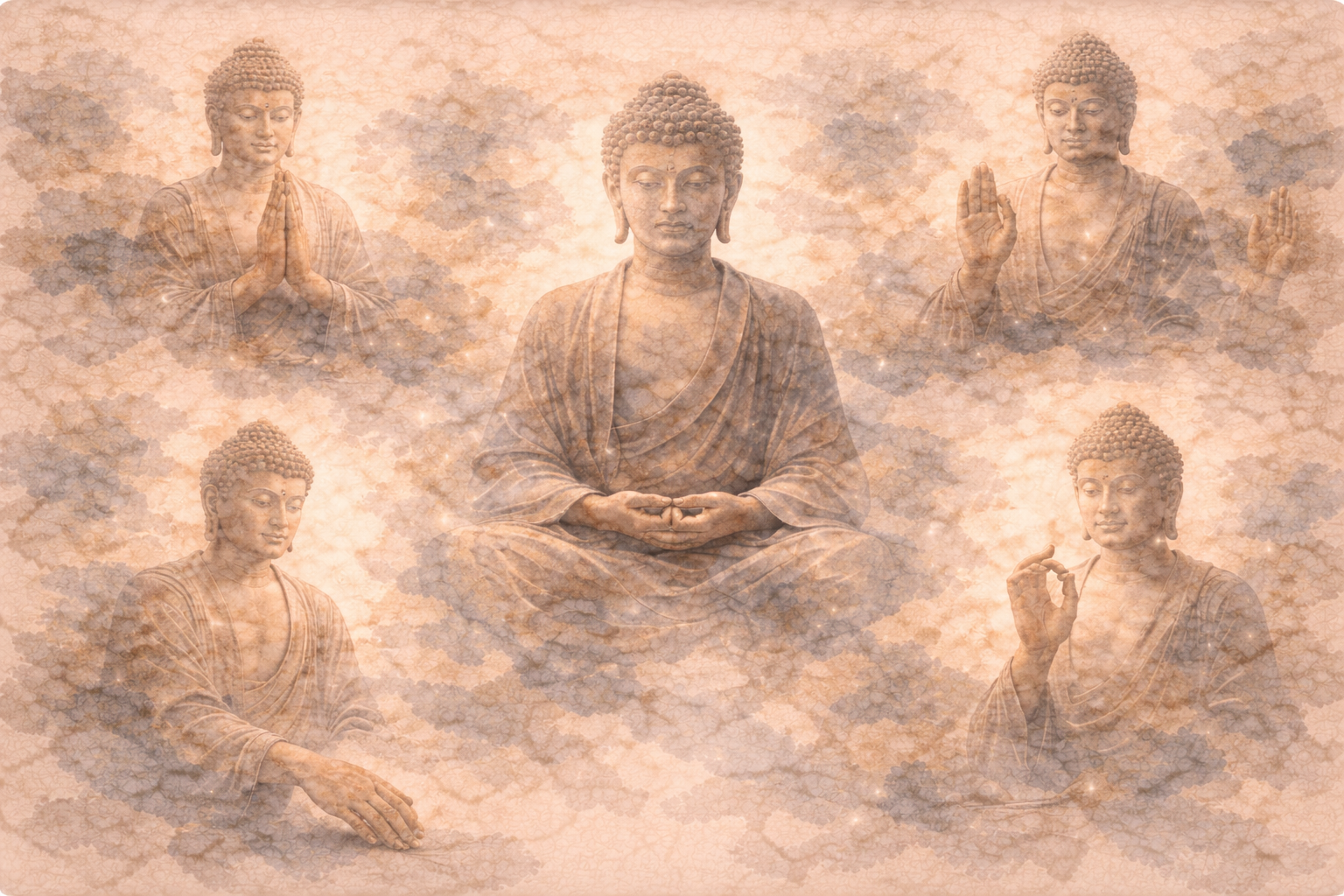
Quick Summary
- Buddha statues use hand gestures (mudras) as a visual “language” that points to qualities like calm, teaching, protection, and generosity.
- Different gestures don’t mean “different Buddhas” as much as different moments, functions, or emphases being highlighted.
- Small details matter: palm direction, finger position, and whether one or both hands are used can change the meaning.
- Some gestures are tied to well-known scenes (meditation, teaching, reassurance), while others reflect regional art traditions.
- Artists and communities standardized certain mudras over time so viewers could recognize the statue’s intention at a glance.
- You don’t need to “decode” perfectly—mudras are meant to shape how you look, pause, and relate.
- Learning a few common mudras makes museums, temples, and home altars feel far less confusing.
Why the Hands Are What Confuse People First
You can look at two Buddha statues with the same calm face and robe, yet the hands tell two completely different stories—and that mismatch is exactly what makes people feel lost. The gestures aren’t random decoration; they’re the main way the statue communicates what it’s “doing” and what kind of attention it’s inviting from you. At Gassho, we focus on practical Buddhist symbolism in plain language, grounded in how people actually encounter images in daily life.
In many forms of Buddhist art, the hands function like captions. A raised palm can signal reassurance. A hand touching the earth can point to steadiness and resolve. Hands resting together can emphasize collectedness. Once you see the hands as the message, the variety starts to make sense: different hand gestures exist because different human needs are being addressed.
GASSHO
Ask and learn about Buddhism in daily life.
GASSHO is a Buddhist community app where you can learn Buddhist teachings and ask questions to the head priest of Kongosanmaiin Temple on Mount Koya.
A Simple Lens: Mudras as Visual Instructions for the Mind
The most helpful way to understand why Buddha statues have different hand gestures is to treat them as visual instructions rather than secret codes. A statue is not only a portrait; it’s a cue for how to relate—how to stand, how to soften, how to listen, how to steady yourself. The hands are the clearest part of that cue because hands are what we use to act, to offer, to protect, and to teach.
In ordinary life, you read hand signals constantly without thinking: a wave, a stop sign, an open hand asking for patience. Mudras work similarly. They compress a whole attitude into a single, repeatable form. That repeatability matters: when a community sees the same gesture again and again, the meaning becomes shared and stable.
This is also why the same Buddha can appear with different mudras. The statue isn’t trying to pin down one fixed “identity.” It’s highlighting a particular function—teaching, reassurance, meditation, giving—depending on where the statue is placed and what the viewer is meant to remember in that setting.
Seen this way, the variety of hand gestures is not a contradiction. It’s a practical vocabulary: different situations call for different reminders, and the hands deliver those reminders quickly, quietly, and without words.
How These Gestures Land in Everyday Attention
When you first notice a Buddha statue, you usually register the face and posture. Then your eyes drop to the hands, and something subtle happens: you start to feel what the gesture is asking for. A raised palm can make you slow down. An open hand can make you feel welcomed rather than judged.
If the hands are held in the lap, you may find your own breathing becomes more obvious. The gesture doesn’t force calm, but it makes calm easier to consider. It’s like seeing a tidy room: you don’t instantly become organized, yet you sense what “organized” feels like.
If one hand reaches down toward the ground, the image can pull your attention out of spinning thoughts and into something more concrete. You might notice your feet, your weight, the simple fact of being supported. The gesture points to groundedness without needing you to agree with any doctrine.
If the hands form a teaching gesture, you may naturally shift into listening mode. Not “listening” for supernatural messages, but listening in the human way: becoming a little less reactive, a little more willing to take in what’s here.
In a home setting, the same statue can work like a steadying reference point. You pass by, you see the hands, and you remember a basic option you always have: pause before speaking, soften the grip of irritation, choose a simpler response.
In a museum, the gestures can do something different. They can interrupt the habit of treating everything as “just art.” You might still appreciate craftsmanship, but you also sense that the object was designed to shape attention, not merely to be admired.
Over time, you may notice that you don’t need to name the mudra to feel its effect. The hands communicate through familiarity with human signals: offering, protecting, indicating, resting. The meaning lands first as a mood, then as understanding.
Common Misunderstandings About Buddha Hand Gestures
Mistake 1: Assuming each hand gesture means a different “type” of Buddha. Sometimes a gesture is associated with a particular figure in Buddhist iconography, but often the mudra is simply emphasizing a quality or a scene. Two statues can represent the same Buddha while highlighting different aspects of practice and life.
Mistake 2: Thinking there is one universal, fixed dictionary. Many meanings are widely shared, but regional art styles and historical periods can shift emphasis. The same basic gesture may be rendered differently, and some local traditions developed their own conventions.
Mistake 3: Treating mudras as magical hand signs. Mudras are symbolic and communicative. They can be used in ritual contexts, but in statues they primarily function as visual teaching tools—reminders that shape perception and attitude.
Mistake 4: Ignoring the rest of the statue. The hands are crucial, but they work with posture, facial expression, seat (standing, seated, walking), and accompanying objects. A raised hand paired with a forward step reads differently than the same hand on a still, seated figure.
Mistake 5: Believing you must decode it perfectly to “get it right.” The point is not to pass a test. The point is to let the image do what it was made to do: invite steadiness, clarity, and a less reactive way of being.
Why Knowing Mudras Changes How You Relate to Buddhist Art
Understanding why Buddha statues have different hand gestures makes temples and museums feel less like a wall of unfamiliar symbols and more like a set of human messages. You stop asking, “Which one is correct?” and start asking, “What is this image emphasizing?” That shift alone reduces confusion.
It also changes how you use a statue in daily life. Instead of treating it as a decoration, you can treat it as a cue. A gesture of reassurance can remind you to unclench. A gesture of giving can remind you to be less guarded. A gesture of teaching can remind you to listen before reacting.
And there’s a quiet ethical benefit: mudras point to qualities that are hard to hold onto in a busy day—patience, steadiness, openness. The statue doesn’t demand those qualities; it simply keeps them visible.
Finally, learning mudras helps you respect cultural context without becoming rigid. You can appreciate that meanings developed over time, in real communities, to meet real needs—while still letting the gesture speak to your own life in a straightforward way.
Conclusion: Different Hands, Different Reminders
Buddha statues have different hand gestures because the hands are the statue’s clearest way of communicating intention. Mudras are a visual vocabulary: they highlight reassurance, teaching, meditation, generosity, groundedness, and other human-facing qualities that matter in ordinary life.
You don’t need to memorize every term to benefit. Start by noticing what the gesture is doing—offering, calming, indicating, protecting—and let that simple message shape how you pause and respond.
Ask a Buddhist priest
Have a question about Buddhism?
In the GASSHO app, you can ask questions about Buddhist teachings, daily concerns, and how to understand Buddhism in everyday life.
Frequently Asked Questions
- FAQ 1: Why do Buddha statues have different hand gestures?
- FAQ 2: What are the hand gestures on Buddha statues called?
- FAQ 3: Do different Buddha hand gestures mean different Buddhas?
- FAQ 4: What does the raised hand gesture on Buddha statues mean?
- FAQ 5: Why do some Buddha statues touch the ground with one hand?
- FAQ 6: What does it mean when Buddha statues have hands in the lap?
- FAQ 7: Why do some Buddha statues show a teaching gesture with the fingers?
- FAQ 8: Do Buddha hand gestures have one universal meaning everywhere?
- FAQ 9: Why do Buddha statues sometimes have one hand up and one hand down?
- FAQ 10: Does the right hand versus left hand matter in Buddha statue gestures?
- FAQ 11: Why do some Buddha statues have hands that look like they’re giving something?
- FAQ 12: Are Buddha statue hand gestures meant to be copied by viewers?
- FAQ 13: Why do Buddha statues sometimes have different hand gestures even in the same temple?
- FAQ 14: Can I identify a Buddha statue just by the hand gesture?
- FAQ 15: What’s the best way to learn why Buddha statues have different hand gestures without memorizing everything?
FAQ 1: Why do Buddha statues have different hand gestures?
Answer: They use different mudras (symbolic hand positions) to communicate different intentions—such as reassurance, teaching, meditation, or generosity—so viewers can “read” the statue’s emphasis without words.
Takeaway: Different hand gestures are a visual language, not random variation.
FAQ 2: What are the hand gestures on Buddha statues called?
Answer: They’re commonly called mudras, a term used for symbolic hand positions in Buddhist (and broader Indian) religious art and practice.
Takeaway: “Mudra” is the standard name for these symbolic gestures.
FAQ 3: Do different Buddha hand gestures mean different Buddhas?
Answer: Not always. Sometimes a mudra helps identify a specific figure in iconography, but often it simply highlights a quality or scene (like teaching or meditation) even when the figure is understood as the Buddha in general.
Takeaway: A mudra can indicate identity, but it often indicates emphasis.
FAQ 4: What does the raised hand gesture on Buddha statues mean?
Answer: A raised palm commonly signals reassurance, protection, or “do not fear.” The exact meaning can vary by depiction, but it usually communicates calming and safety.
Takeaway: A raised palm typically points to reassurance and steadiness.
FAQ 5: Why do some Buddha statues touch the ground with one hand?
Answer: This gesture often represents calling the earth as witness—symbolizing grounded resolve and unwavering presence. In art, it’s a way to show firmness and stability rather than mere decoration.
Takeaway: The earth-touching hand emphasizes groundedness and resolve.
FAQ 6: What does it mean when Buddha statues have hands in the lap?
Answer: Hands resting in the lap often indicate meditation, composure, and collected attention. The calm symmetry reinforces the sense of stillness and inward steadiness.
Takeaway: Hands in the lap usually highlight meditation and calm.
FAQ 7: Why do some Buddha statues show a teaching gesture with the fingers?
Answer: Teaching mudras visually signal explanation, guidance, and communication of insight. They help viewers recognize the statue as emphasizing instruction and listening rather than protection or meditation.
Takeaway: Finger positions can mark the statue’s “teaching” emphasis.
FAQ 8: Do Buddha hand gestures have one universal meaning everywhere?
Answer: Many meanings are widely shared, but there isn’t a single global dictionary. Regions and historical periods can interpret, stylize, or prioritize gestures differently while keeping the general intent recognizable.
Takeaway: Mudra meanings are consistent in spirit, but not always identical in detail.
FAQ 9: Why do Buddha statues sometimes have one hand up and one hand down?
Answer: Mixed hand positions can combine messages—such as reassurance with offering, or protection with generosity—so the statue communicates a broader, more relational stance toward the viewer.
Takeaway: Two different hand positions can express two complementary qualities at once.
FAQ 10: Does the right hand versus left hand matter in Buddha statue gestures?
Answer: It can. Some traditions and artistic conventions assign different roles to each side, and certain iconic scenes are typically shown with a specific hand. Still, context and overall depiction matter more than a single rule.
Takeaway: Handedness can be meaningful, but it’s not the only clue.
FAQ 11: Why do some Buddha statues have hands that look like they’re giving something?
Answer: An open palm facing outward or downward can symbolize giving, generosity, and support. In statue form, it’s a visual reminder of openness rather than grasping.
Takeaway: “Giving” hands usually point to generosity and openness.
FAQ 12: Are Buddha statue hand gestures meant to be copied by viewers?
Answer: They can be, but they don’t have to be. In many contexts the mudra is primarily symbolic—meant to communicate an attitude—while in other contexts people may adopt similar hand positions as a supportive reminder.
Takeaway: Mudras can be symbolic cues, whether or not you physically imitate them.
FAQ 13: Why do Buddha statues sometimes have different hand gestures even in the same temple?
Answer: A temple may include images emphasizing different functions—teaching, compassion, protection, or meditation—so visitors encounter multiple reminders suited to different moments and needs within the same space.
Takeaway: Multiple mudras in one place often reflect multiple intended messages.
FAQ 14: Can I identify a Buddha statue just by the hand gesture?
Answer: Sometimes, but it’s not reliable on its own. Identification usually depends on a combination of features: hand gesture, posture, facial style, accompanying objects, and the cultural context of the statue.
Takeaway: Mudras help identification, but they work best with other visual clues.
FAQ 15: What’s the best way to learn why Buddha statues have different hand gestures without memorizing everything?
Answer: Start with a few common categories—reassurance (raised palm), meditation (hands in lap), teaching (instructional finger gesture), grounded resolve (hand touching earth), and giving (open palm). Then look at each statue and ask what attitude the hands are inviting in you right now.
Takeaway: Learn a few core mudras and focus on the gesture’s practical message.