



Common Buddhist Mudras and What They Mean
Quick Summary
- Mudras are intentional hand gestures used in Buddhist art and practice to express a specific quality of mind.
- The same mudra can carry slightly different meanings depending on context, but the “core message” is usually consistent.
- Common mudras include meditation (dhyana), earth-touching (bhumisparsha), teaching (dharmachakra), fearlessness (abhaya), giving (varada), and discussion (vitarka).
- Mudras are best read as a cue for attention and intention, not as a magical code you must decode perfectly.
- You can use a simple mudra to steady posture, soften reactivity, and remember your purpose while sitting or walking.
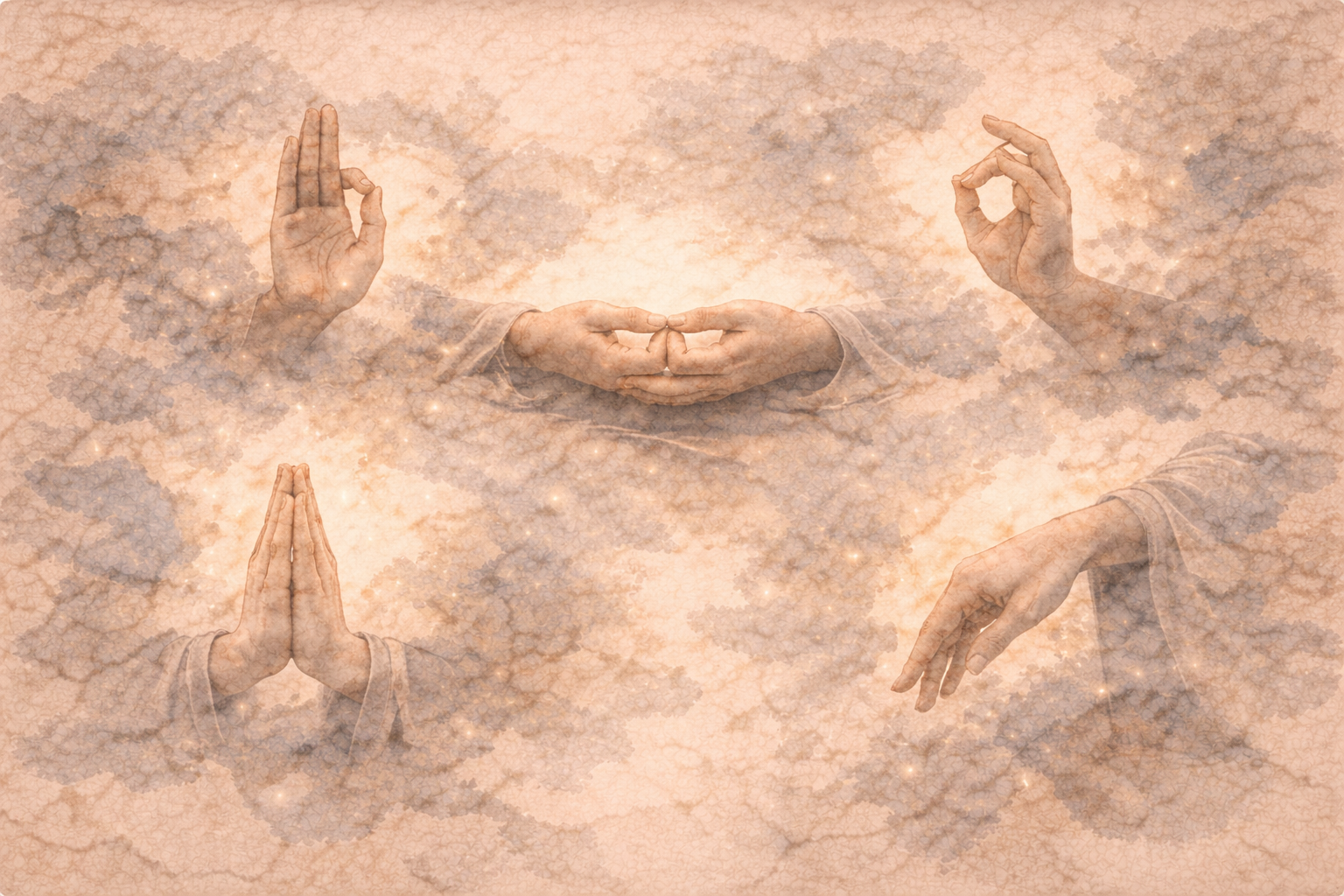
- When viewing statues, look at palm direction, finger contact, and where the hands rest to identify the gesture.
- If a mudra feels forced or performative, simplify: relaxed hands with clear intention is already the point.
Introduction
If you’ve searched for common Buddhist mudras and what they mean, you’ve probably run into two problems at once: lists that contradict each other, and explanations that feel mystical when you just want something practical and clear. Mudras aren’t secret hand signs; they’re a visual language for qualities like steadiness, openness, protection, and clarity—and you can understand them without memorizing a textbook. At Gassho, we focus on plain-language Buddhist practice and symbolism with an emphasis on what you can actually notice in your own experience.
A mudra is simply a deliberate arrangement of the hands. In Buddhist imagery, mudras help you “read” what a figure embodies. In practice, they can help you “set” the mind: not by force, but by giving the body a simple, repeatable shape that supports attention.
Below you’ll find a grounded way to understand the most common mudras, how to recognize them, and how to relate to their meaning without turning it into superstition or performance.
A Clear Lens for Understanding Mudras
The most helpful way to understand mudras is to treat them as “embodied reminders.” The hands are visible to you, sensitive, and easy to position—so they become a natural place to anchor intention. A mudra is less like a password and more like a posture of the mind expressed through the body.
When you see a mudra on a statue or painting, it’s doing something similar: it’s communicating a quality at a glance. A raised palm can signal reassurance; a hand touching the earth can signal groundedness; hands forming a circle can signal teaching or transmission. The gesture points to a human experience you already know, like calming down, offering help, or staying steady under pressure.
Meanings can vary by region and artistic convention, so it’s normal to find slightly different labels. Instead of hunting for a single “correct” definition, look for the stable core: what direction is the palm facing, what are the fingers doing, and what emotional tone does the gesture convey?
If you want a broader method for reading Buddhist imagery without memorizing isolated definitions, see Why Buddhist Symbols Are Easier to Understand Through Patterns.
Finally, mudras work best when they stay simple. If a gesture makes your hands tense or your shoulders tighten, it’s no longer supporting the mind. In that case, soften the grip, reduce the complexity, and keep the meaning as a gentle orientation rather than a rigid rule.
GASSHO
Ask and learn about Buddhism in daily life.
GASSHO is a Buddhist community app where you can learn Buddhist teachings and ask questions to the head priest of Kongosanmaiin Temple on Mount Koya.
How Mudras Show Up in Ordinary Experience
When you place your hands in a calm, stable position, you may notice the mind follows. Not dramatically, but subtly: less fidgeting, fewer micro-decisions, and a slightly easier time returning to what you meant to do.
For example, the meditation mudra (hands resting, one palm on the other) often makes it easier to feel the breath in the belly and to notice restlessness before it turns into action. The hands become a quiet “home base” you can return to without thinking.
A gesture like fearlessness (palm facing outward) can be surprisingly practical off the cushion, too. You might not hold your hand up in public, but you can feel the internal version of it: the willingness to pause, to not escalate, to meet a moment without bracing.
Giving (palm open downward) can highlight another everyday shift: moving from tightness to generosity. That generosity might be literal—helping someone—or it might be internal, like giving yourself permission to start again after you’ve been distracted.
Teaching or discussion mudras (hands forming a circle with thumb and index finger) can mirror what happens when you try to be precise without being aggressive. You’re not trying to “win” a point; you’re trying to express something clearly and listen for what’s true.
Even the earth-touching gesture has an everyday echo. When you feel spun up—too much thinking, too much story—there’s value in remembering what’s immediate: contact, weight, temperature, the simple fact of being here. The body’s steadiness becomes a reference point.
In all cases, the mudra isn’t the achievement. It’s a cue. You notice the cue, you notice your state, and you gently re-orient—again and again, without drama.
Common Buddhist Mudras and What They Mean
Here are several of the most common Buddhist mudras you’ll see in statues, paintings, and practice settings. Think of these meanings as reliable “center points,” with room for context.
Meditation Mudra (Dhyana): Settling and Unifying the Mind
What it looks like: Hands rest in the lap; typically the right hand rests on the left, palms up, with thumbs lightly touching to form an oval.
What it means: Stillness, collectedness, and a mind that’s gathered rather than scattered. It’s a visual shorthand for meditation itself—stable attention, balanced effort, and quiet presence.
How to use it: Let the hands be heavy and relaxed. If the thumbs press hard, the mind is often trying too much; if they droop far apart, you may be drifting. Use that feedback gently, not as a test.
Earth-Touching Mudra (Bhumisparsha): Grounded Resolve
What it looks like: One hand reaches down with fingers extended to touch the earth; the other hand often rests in the lap.
What it means: Steadiness, commitment, and calling on what is real and immediate. In imagery, it often symbolizes unwavering resolve in the face of inner turmoil.
How to use it: You don’t need to literally touch the floor in daily practice. The functional meaning is “return to contact”: feel your feet, your seat, your breath, and the simplest facts of the moment.
Fearlessness Mudra (Abhaya): Reassurance and Non-Reactivity
What it looks like: One hand raised to shoulder height, palm facing outward, fingers pointing up.
What it means: Protection, reassurance, and the willingness to meet experience without panic. It can also suggest ethical confidence: not bravado, but steadiness.
How to use it: Internally, it’s the pause before reacting. Externally, it can be a reminder to soften the face, unclench the jaw, and let the breath come back.
Giving Mudra (Varada): Generosity and Welcome
What it looks like: One hand extended downward, palm open (often facing outward), fingers relaxed.
What it means: Offering, generosity, kindness, and a readiness to help. In art, it often pairs with fearlessness: one hand reassures, the other offers.
How to use it: Notice where you hold back unnecessarily—time, attention, patience. The mudra points to a simple question: “What would openness look like right now?”
Teaching Mudra (Dharmachakra): Sharing What Leads to Clarity
What it looks like: Both hands held near the chest, with thumb and index finger touching to form circles; the hands face each other or outward depending on depiction.
What it means: Teaching, communication, and pointing toward understanding. The circular shape often suggests completeness and continuity—like a principle that can be applied again and again.
How to use it: Let it remind you that “teaching” can be simple: speaking carefully, listening well, and choosing words that reduce confusion rather than increase it.
Discussion Mudra (Vitarka): Inquiry and Clear Explanation
What it looks like: Thumb and index finger touch to form a circle, with the other fingers extended; usually one hand is raised.
What it means: Reasoned explanation, inquiry, and the act of clarifying. It’s less about authority and more about careful articulation.
How to use it: When you feel certain but not clear, slow down. The mudra’s “meaning” can be practiced as: define what you mean, check your assumptions, and stay kind.
Gesture of Greeting and Respect (Anjali): Reverence and Sincerity
What it looks like: Palms pressed together at the chest (or sometimes at the forehead), fingers pointing upward.
What it means: Respect, gratitude, and sincerity. It can be directed toward a person, a symbol, or the intention to live with care.
How to use it: Keep the pressure light. The point is not strain; it’s alignment—bringing scattered energy into a single, respectful gesture.
Gesture of Protection (Karana): Cutting Through Disturbance
What it looks like: Often depicted with index and little finger extended, middle and ring fingers folded, thumb holding them (visual forms vary).
What it means: Warding off obstacles or disturbances. In a practical reading, it points to the capacity to interrupt unhelpful momentum.
How to use it: Rather than treating it as a “spell,” treat it as a reminder: notice what’s pulling you off-center and choose a clean stop—one breath, one step, one reset.
Common Misunderstandings That Make Mudras Confusing
Mistake 1: Assuming every mudra has one fixed meaning. Many gestures have a stable core meaning, but details can shift by region, era, and artistic convention. If two sources differ slightly, it doesn’t mean one is “fake”; it often means the gesture is doing more than one job.
Mistake 2: Treating mudras as supernatural shortcuts. Mudras can support attention and intention, but they don’t replace practice. If you’re using a gesture to avoid feeling something difficult, the gesture becomes another form of tension.
Mistake 3: Making the hands rigid. Over-precision often shows up as tight fingers, lifted shoulders, or held breath. A mudra should feel sustainable and calm. If it’s not, soften it until it is.
Mistake 4: Ignoring context in Buddhist art. The same figure may hold different objects, sit in a different posture, or appear with different companions—those details can influence how the mudra is interpreted. Use the mudra as a clue, not the entire answer.
Why These Hand Gestures Matter in Daily Life
Mudras matter because they make intention tangible. When your day is noisy—notifications, conversations, decisions—your hands can become a quiet reminder of how you want to meet the next moment: steady, open, and less reactive.
They also offer a simple way to work with habit energy. If your default is to clench, point, grab, or fidget, a calm gesture interrupts that pattern. You’re not suppressing anything; you’re giving the nervous system a different option.
And when you encounter Buddhist images, knowing common mudras and what they mean turns a statue from decoration into guidance. You can read the message quickly: reassurance, groundedness, generosity, clarity—then check whether that quality is present in you right now.
Most importantly, mudras keep practice human-sized. You don’t need special conditions to remember what matters. You can place your hands, feel your breath, and begin again.
Conclusion
Common Buddhist mudras are best understood as a practical visual language: the hands express a quality of mind you can recognize immediately—stillness, resolve, reassurance, generosity, and clarity. If you keep the gestures relaxed and treat their meanings as gentle cues rather than rigid definitions, mudras become both easier to understand in art and more useful in everyday practice.
If you want one simple starting point, use the meditation mudra for steadiness, and let everything else be an occasional reminder: open the hand, soften the grip, return to what’s real.
Ask a Buddhist priest
Have a question about Buddhism?
In the GASSHO app, you can ask questions about Buddhist teachings, daily concerns, and how to understand Buddhism in everyday life.
Frequently Asked Questions
- FAQ 1: What are the most common Buddhist mudras and what do they mean?
- FAQ 2: What does the meditation mudra (dhyana mudra) mean in Buddhism?
- FAQ 3: What does the earth-touching mudra (bhumisparsha) mean?
- FAQ 4: What does the fearlessness mudra (abhaya) mean?
- FAQ 5: What does the giving mudra (varada) mean in Buddhist iconography?
- FAQ 6: What does the teaching mudra (dharmachakra mudra) mean?
- FAQ 7: What does the vitarka mudra mean, and how is it different from dharmachakra?
- FAQ 8: What does the anjali mudra (palms together) mean in Buddhism?
- FAQ 9: Why do different sources give different meanings for the same Buddhist mudra?
- FAQ 10: How can I identify common Buddhist mudras when looking at a statue?
- FAQ 11: Do I need to form Buddhist mudras “perfectly” for their meaning to apply?
- FAQ 12: Are Buddhist mudras only for meditation, or do they have meanings outside formal practice?
- FAQ 13: What does it mean when a Buddha statue shows two different mudras at once?
- FAQ 14: What is the karana mudra, and what does it mean in Buddhism?
- FAQ 15: Is there a simple way to remember common Buddhist mudras and what they mean?
FAQ 1: What are the most common Buddhist mudras and what do they mean?
Answer: The most commonly seen mudras include dhyana (meditation and collectedness), bhumisparsha (earth-touching and grounded resolve), abhaya (fearlessness and reassurance), varada (giving and generosity), dharmachakra (teaching and sharing clarity), vitarka (discussion and explanation), and anjali (greeting and respect). Exact nuances vary, but these “core meanings” are widely consistent across Buddhist art.
Takeaway: Learn a small set of common mudras and their core message, then use context for finer detail.
FAQ 2: What does the meditation mudra (dhyana mudra) mean in Buddhism?
Answer: The dhyana mudra generally represents meditation, inner stillness, and a unified mind. It’s commonly shown as hands resting in the lap, palms up, often with thumbs lightly touching to form an oval—suggesting balance and steady attention.
Takeaway: Dhyana mudra points to steadiness and collected attention.
FAQ 3: What does the earth-touching mudra (bhumisparsha) mean?
Answer: Bhumisparsha mudra is associated with grounded resolve and calling on what is real and immediate. In images, it’s often depicted as one hand reaching down to touch the earth, signaling unwavering steadiness in the face of inner disturbance.
Takeaway: Earth-touching emphasizes grounding and firm intention.
FAQ 4: What does the fearlessness mudra (abhaya) mean?
Answer: Abhaya mudra typically means fearlessness, protection, and reassurance. It’s commonly shown as a raised hand with the palm facing outward, conveying “do not fear” and encouraging a non-reactive, steady presence.
Takeaway: Abhaya mudra signals calm reassurance and the choice not to escalate.
FAQ 5: What does the giving mudra (varada) mean in Buddhist iconography?
Answer: Varada mudra generally represents giving, generosity, compassion, and welcome. It’s often shown as an open hand extended downward, suggesting offering help or blessings in a practical, approachable way.
Takeaway: Varada mudra points to generosity—materially, emotionally, or in attention.
FAQ 6: What does the teaching mudra (dharmachakra mudra) mean?
Answer: Dharmachakra mudra is commonly associated with teaching and communicating what leads to clarity. It’s often depicted with both hands near the chest, thumb and index finger forming circles, suggesting the “turning” or ongoing application of insight in life.
Takeaway: Dharmachakra mudra is a symbol of teaching and clear communication.
FAQ 7: What does the vitarka mudra mean, and how is it different from dharmachakra?
Answer: Vitarka mudra is often linked with discussion, explanation, and inquiry—clarifying a point through reasoned communication. Dharmachakra mudra more specifically emphasizes teaching in a broader sense. Visually, both may use a thumb-index circle, but dharmachakra typically uses both hands in a more formal “teaching” arrangement.
Takeaway: Vitarka leans toward explanation and inquiry; dharmachakra leans toward formal teaching.
FAQ 8: What does the anjali mudra (palms together) mean in Buddhism?
Answer: Anjali mudra generally expresses respect, reverence, gratitude, and sincerity. It’s used as a greeting and as a gesture of acknowledgment—toward people, symbols, or one’s own intention to practice with care.
Takeaway: Anjali mudra is a simple, widely used gesture of respect and sincerity.
FAQ 9: Why do different sources give different meanings for the same Buddhist mudra?
Answer: Meanings can vary because mudras are interpreted through different artistic conventions, languages, and historical contexts. Often the “core meaning” stays stable (for example, reassurance for abhaya), while secondary meanings shift depending on the figure, setting, and accompanying symbols.
Takeaway: Look for the core message first, then refine with context.
FAQ 10: How can I identify common Buddhist mudras when looking at a statue?
Answer: Start with three cues: (1) palm direction (outward, upward, downward), (2) finger contact (thumb-index circle, palms together, fingers extended), and (3) hand placement (lap, chest, raised, touching the ground). These features usually narrow the mudra to a small set of common possibilities.
Takeaway: Palm direction, finger shape, and hand position are the fastest way to identify mudras.
FAQ 11: Do I need to form Buddhist mudras “perfectly” for their meaning to apply?
Answer: No. Mudras are meant to support intention and attention, not create anxiety about correctness. If your hands are tense or strained, soften the gesture. A relaxed, sustainable shape with a clear intention is closer to the point than a rigid “perfect” form.
Takeaway: The meaning of a mudra is expressed through relaxed intention, not forced precision.
FAQ 12: Are Buddhist mudras only for meditation, or do they have meanings outside formal practice?
Answer: Mudras appear both in meditation contexts and in Buddhist art as symbolic communication. Their meanings can also be applied informally: fearlessness as a reminder to pause before reacting, giving as a reminder to be generous, and meditation mudra as a cue to settle and return to the present.
Takeaway: Mudras are symbolic and practical—use them as reminders in everyday moments.
FAQ 13: What does it mean when a Buddha statue shows two different mudras at once?
Answer: Two mudras can communicate complementary qualities—such as reassurance (abhaya) paired with generosity (varada). In many depictions, the combination is intentional: one hand addresses fear or reactivity, while the other expresses openness, help, or offering.
Takeaway: Paired mudras often show two related qualities working together.
FAQ 14: What is the karana mudra, and what does it mean in Buddhism?
Answer: Karana mudra is commonly understood as a gesture of protection or warding off disturbance. While depictions vary, its general meaning is “cutting through” what disrupts clarity—read practically as interrupting unhelpful momentum and re-centering attention.
Takeaway: Karana mudra points to protection and the ability to stop what pulls you off-center.
FAQ 15: Is there a simple way to remember common Buddhist mudras and what they mean?
Answer: Yes: link each mudra to a plain human verb. Dhyana = “settle,” bhumisparsha = “ground,” abhaya = “reassure,” varada = “offer,” dharmachakra = “teach,” vitarka = “explain,” anjali = “respect.” This keeps the meanings usable rather than purely academic.
Takeaway: Remember mudras by simple verbs that match their core message.