



Who Was Padmasambhava? The Figure Linked to Tibetan Buddhism
Quick Summary
- Padmasambhava is remembered as the key figure linked to the establishment of Buddhism in Tibet, often called “Guru Rinpoche.”
- Historical sources and later biographies blend together, so “who he was” includes both history and sacred story.
- He is associated with bringing practical methods for transforming fear, conflict, and confusion into clarity.
- Many stories emphasize taming harmful forces, which can be read as working with inner reactivity as much as outer obstacles.
- He is linked to the first major monastic center in Tibet and to translating and adapting teachings for a new culture.
- His legacy includes “hidden teachings” said to be revealed later when people are ready for them.
- Understanding Padmasambhava is less about proving a timeline and more about seeing what his figure points to in lived practice.
Introduction: Why Padmasambhava Still Confuses People
You’re trying to pin down a simple answer to “who was Padmasambhava,” and you keep running into two versions that don’t neatly match: a historical teacher connected to Tibet’s early Buddhist period, and a larger-than-life figure surrounded by miracles, prophecies, and symbolic imagery. Both versions matter, and treating one as “real” while dismissing the other usually makes the topic harder, not clearer. At Gassho, we focus on clear, grounded explanations of Buddhist figures and ideas without assuming prior background.
Padmasambhava is commonly known by the honorific “Guru Rinpoche,” meaning “Precious Teacher,” and he is widely credited with helping establish Buddhism in Tibet during a formative era. Depending on what you read, he appears as a scholar, a ritual specialist, a translator, a meditator, a cultural bridge-builder, and a fierce protector against forces that threatened the new tradition.
It helps to start with a practical framing: “Padmasambhava” is both a person in history and a spiritual archetype used to communicate how transformation works. When you read his stories this way, the question “who was he?” becomes less like a trivia quiz and more like a lens for understanding why Tibetan Buddhism developed the tone and tools it did.
A Clear Lens for Understanding Padmasambhava
A grounded way to approach Padmasambhava is to see him as a symbol of skillful adaptation: taking a set of teachings and methods and making them workable in a new environment, with new languages, customs, and fears. That doesn’t require you to decide, upfront, which stories are literal history and which are devotional narrative. It asks a simpler question: what human problems are these stories trying to address?
Many accounts portray him meeting resistance—political resistance, cultural resistance, and “spiritual” resistance. Read plainly, this mirrors what happens whenever people try to change deeply rooted habits: confusion pushes back, old identities push back, and communities push back. In that sense, Padmasambhava represents the capacity to stay steady and creative when the mind (and the world) doesn’t cooperate.
Another useful lens is to treat the dramatic elements—taming hostile forces, subduing obstacles, revealing hidden teachings—as a language for inner life. Fear can feel like an external enemy. Shame can feel like a curse. Anger can feel like a possession. The Padmasambhava stories often communicate that these forces are workable: they can be met directly, understood, and transformed rather than merely suppressed.
So “who was Padmasambhava?” can be held in two hands at once: a historically influential teacher connected with Tibet’s early Buddhist consolidation, and a narrative figure used to express how awakening is not separate from the messy realities of culture, emotion, and conflict.
GASSHO
Ask and learn about Buddhism in daily life.
GASSHO is a Buddhist community app where you can learn Buddhist teachings and ask questions to the head priest of Kongosanmaiin Temple on Mount Koya.
How His Story Shows Up in Ordinary Life
Even if you never read a traditional biography, you’ve probably experienced the basic pattern his stories point to: you decide to change something—your reactivity, your speech, your compulsive scrolling, your tendency to shut down—and then the mind produces a surprisingly intense counterargument. It can feel like an “outside force,” but it’s often just the momentum of habit.
In that moment, the most common move is to fight yourself: clamp down, judge, force. The Padmasambhava theme is different. The emphasis is on meeting what arises without flinching, naming it clearly, and responding with precision rather than panic. That’s not mystical; it’s a practical shift in attention.
Consider a small conflict: a sharp email, a dismissive comment, a misunderstanding that spirals. The body tightens, the mind rehearses speeches, and you start collecting evidence. If you watch closely, the “enemy” is often the story you’re building in real time. The Padmasambhava-style lesson is to recognize the story as a story before it becomes your personality for the day.
Or take fear. Fear rarely arrives as a neat sentence; it arrives as urgency, as a need to control outcomes, as a refusal to feel uncertainty. The stories of confronting obstacles can be read as training in staying present with that urgency without immediately obeying it. You don’t have to like uncertainty to stop being pushed around by it.
Another everyday parallel is the idea of “hidden teachings.” In ordinary terms, some insights simply aren’t available until you’ve lived enough, grieved enough, failed enough, or softened enough. You can hear good advice a hundred times and only understand it on the hundred-and-first time, when your life finally matches the lesson.
Padmasambhava is also linked with translation and adaptation, and that shows up in how we practice anything meaningful. You can borrow a method, but you still have to translate it into your own nervous system: your schedule, your relationships, your limits, your temperament. The point isn’t to imitate a distant ideal; it’s to make the practice real where you actually live.
When you read his figure this way, the question “who was Padmasambhava” becomes intimate: he represents the part of you that can face what feels overwhelming, without turning it into either a war or a fantasy.
Common Misunderstandings That Flatten the Topic
Mistake 1: Thinking you must choose between “historical” and “mythical.” With Padmasambhava, sources include early records, later biographies, and devotional literature. It’s normal that these layers don’t read like a modern academic profile. You can respect history while also recognizing that sacred biography often teaches through symbol and story.
Mistake 2: Treating miracles as the only point. If you fixate on whether every dramatic episode “really happened,” you can miss what the stories are doing: describing how obstacles are met, how fear is worked with, and how compassion can take fierce forms when gentleness fails.
Mistake 3: Reducing him to a mascot for exotic spirituality. Padmasambhava is sometimes presented in striking imagery—lotus birth, intense gaze, symbolic implements. If you stop at the aesthetics, you lose the practical message: disciplined attention, ethical restraint, and the willingness to face the mind’s darker corners.
Mistake 4: Assuming “taming demons” means endorsing superstition. Traditional language often externalizes inner forces. Whether you interpret these accounts literally or psychologically, the functional point is similar: what feels hostile can be met, understood, and integrated rather than denied.
Mistake 5: Expecting a single, universally agreed biography. Different communities preserve different emphases—teacher, magician, translator, protector, visionary. Instead of demanding one final version, it can be more honest to ask what each portrayal is trying to protect, transmit, or clarify.
Why Knowing Who Padmasambhava Was Can Actually Help
First, it gives context for why Tibetan Buddhism often feels unusually practical about difficulty. The tradition doesn’t only talk about peace; it talks about what to do with rage, dread, obsession, and the sense that life is spiritually “too messy.” Padmasambhava’s stories normalize the mess and insist it can be worked with.
Second, it offers a mature model of change. Instead of imagining transformation as becoming a different person overnight, the Padmasambhava theme is more like: meet what arises, learn its patterns, and respond with skill. That’s a daily-life approach—useful in parenting, work stress, grief, and conflict.
Third, it can soften the modern tendency to demand certainty before practice. If you’re stuck on proving every detail, you may never engage the methods that could help you. Understanding Padmasambhava as both historical influence and teaching-symbol lets you learn without forcing premature conclusions.
Finally, his figure highlights a compassionate realism: sometimes kindness looks gentle, and sometimes it looks like a firm boundary, a clear “no,” or a decisive interruption of harmful momentum. That’s not about drama; it’s about care that’s willing to be effective.
Conclusion: A Useful Answer to “Who Was Padmasambhava?”
Padmasambhava was a pivotal figure linked to the early establishment of Buddhism in Tibet, remembered as a teacher who helped translate, adapt, and stabilize a new spiritual culture under real-world pressure. At the same time, the stories told about him function as a practical language for inner transformation—how to meet fear, resistance, and confusion without being ruled by them.
If you hold both dimensions together, the question stops being a tug-of-war between history and legend. It becomes a clearer inquiry: what does this figure teach about working with the mind, especially when life is not calm?
Ask a Buddhist priest
Have a question about Buddhism?
In the GASSHO app, you can ask questions about Buddhist teachings, daily concerns, and how to understand Buddhism in everyday life.
Frequently Asked Questions
- FAQ 1: Who was Padmasambhava in Tibetan Buddhism?
- FAQ 2: Is Padmasambhava considered a historical person or a legendary figure?
- FAQ 3: What does the name “Padmasambhava” mean?
- FAQ 4: Why is Padmasambhava called Guru Rinpoche?
- FAQ 5: When did Padmasambhava live?
- FAQ 6: Where was Padmasambhava from?
- FAQ 7: What did Padmasambhava do in Tibet?
- FAQ 8: What is Padmasambhava’s connection to Samye Monastery?
- FAQ 9: Why do stories say Padmasambhava “tamed demons”?
- FAQ 10: Did Padmasambhava write any texts?
- FAQ 11: What are “hidden teachings” associated with Padmasambhava?
- FAQ 12: How is Padmasambhava usually depicted in art?
- FAQ 13: Is Padmasambhava the same as the Buddha?
- FAQ 14: Why do accounts of who Padmasambhava was differ so much?
- FAQ 15: What is the simplest accurate way to answer “who was Padmasambhava”?
FAQ 1: Who was Padmasambhava in Tibetan Buddhism?
Answer: Padmasambhava, often called Guru Rinpoche (“Precious Teacher”), is remembered as a foundational figure associated with bringing and establishing Buddhism in Tibet, especially through teaching, adapting practices to local conditions, and overcoming resistance to the new tradition.
Takeaway: Padmasambhava is central because he represents Buddhism taking root in Tibet.
FAQ 2: Is Padmasambhava considered a historical person or a legendary figure?
Answer: He is treated as both: there are historical claims placing him in Tibet’s early Buddhist period, and there are also devotional biographies filled with symbolic and miraculous narratives. Many readers hold these as different layers rather than mutually exclusive options.
Takeaway: “Who was Padmasambhava?” often includes history and sacred story together.
FAQ 3: What does the name “Padmasambhava” mean?
Answer: “Padmasambhava” is commonly explained as “Lotus-born” or “Born from a lotus,” reflecting a traditional story of his extraordinary birth and also functioning as symbolic language for purity and awakening arising within the world.
Takeaway: His name itself carries both narrative and symbolic meaning.
FAQ 4: Why is Padmasambhava called Guru Rinpoche?
Answer: “Guru Rinpoche” is an honorific title meaning “Precious Teacher,” used to express reverence for Padmasambhava’s role as an exemplary guide and transmitter of methods believed to be especially effective in difficult times.
Takeaway: The title highlights his role as a revered teacher, not a separate person.
FAQ 5: When did Padmasambhava live?
Answer: Traditional accounts often place Padmasambhava in the 8th century, connected with Tibet’s early imperial period. Exact dates are difficult to confirm because later biographies and oral traditions shaped the timeline and details over centuries.
Takeaway: The commonly cited timeframe is the 8th century, with historical uncertainty.
FAQ 6: Where was Padmasambhava from?
Answer: Many traditional sources associate Padmasambhava with a region called Oddiyana (often linked by scholars to areas in or near the Swat Valley). The exact identification is debated, but the consistent theme is that he came from outside Tibet and helped transmit teachings across cultures.
Takeaway: His origin is traditionally “Oddiyana,” though the precise location is debated.
FAQ 7: What did Padmasambhava do in Tibet?
Answer: He is credited with helping establish Buddhist practice in Tibet by teaching, advising, and addressing obstacles that threatened the stability of early Buddhist institutions. Stories often describe him “taming” disruptive forces, which can be read as both cultural-political and inner-spiritual challenges.
Takeaway: He is remembered for making Buddhism workable and stable in Tibet.
FAQ 8: What is Padmasambhava’s connection to Samye Monastery?
Answer: Padmasambhava is traditionally linked to the founding of Samye, often described as Tibet’s first major monastery, and to the broader effort of establishing a durable Buddhist presence through translation, training, and community support.
Takeaway: Samye is a key landmark in the story of who Padmasambhava was in Tibet.
FAQ 9: Why do stories say Padmasambhava “tamed demons”?
Answer: In traditional narratives, “demons” can refer to obstructive forces—whether understood literally as spirits or symbolically as fear, aggression, and chaos that disrupt practice and community life. The theme emphasizes meeting obstacles directly and transforming them rather than simply avoiding them.
Takeaway: “Taming demons” points to transforming what blocks clarity and stability.
FAQ 10: Did Padmasambhava write any texts?
Answer: Many teachings are attributed to Padmasambhava in later tradition, including instructions said to have been concealed for future discovery. From a historical standpoint, attribution can be complex, but devotionally these texts express what communities understood his role and message to be.
Takeaway: Numerous works are attributed to him, though authorship is historically complicated.
FAQ 11: What are “hidden teachings” associated with Padmasambhava?
Answer: “Hidden teachings” are instructions and texts said to have been intentionally concealed to be revealed later when conditions are suitable. In the Padmasambhava tradition, this expresses the idea that guidance can appear at the right time, not only when it is first composed.
Takeaway: Hidden teachings are part of how Padmasambhava’s influence is understood to continue.
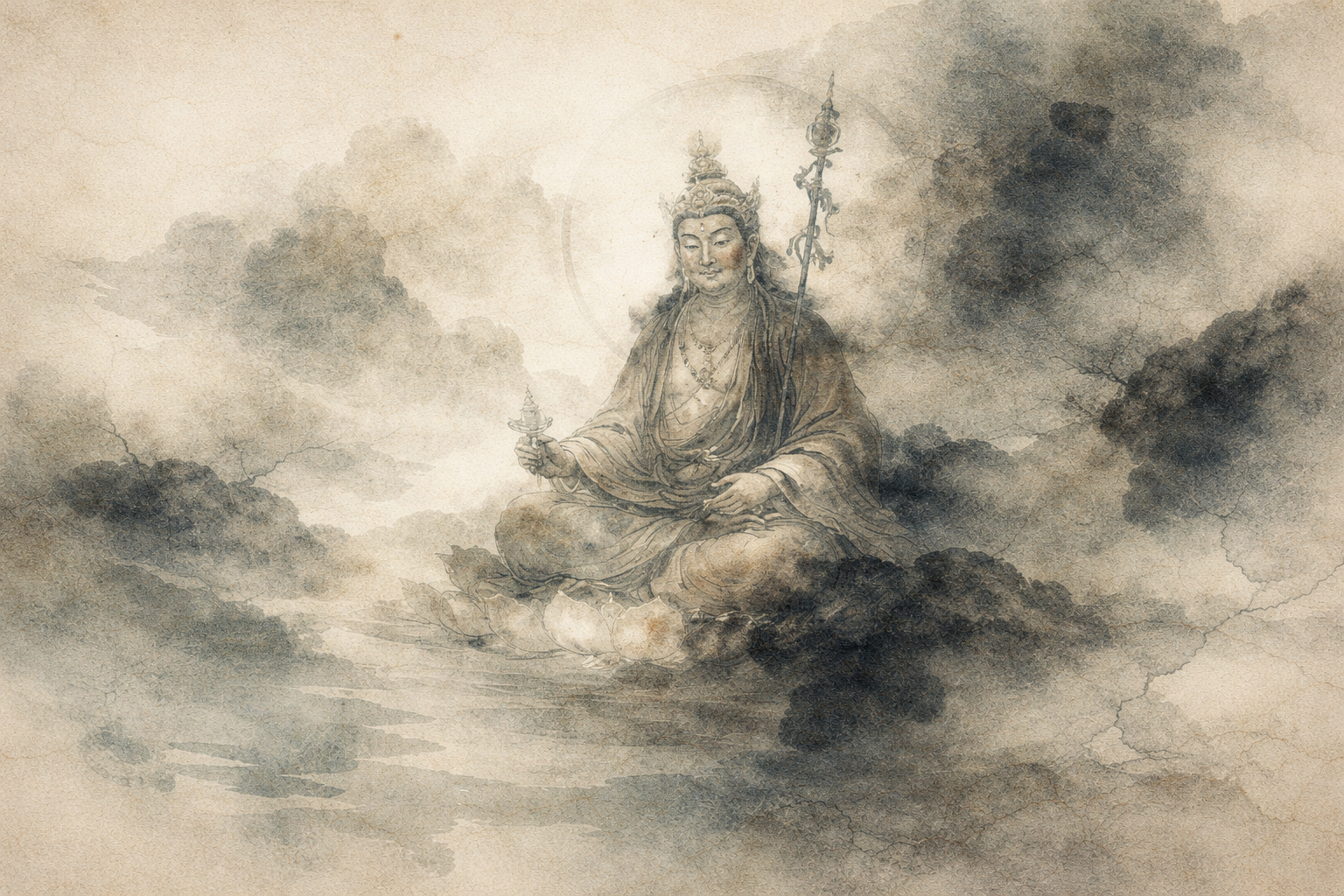
FAQ 12: How is Padmasambhava usually depicted in art?
Answer: Padmasambhava is often shown as a dignified teacher figure with symbolic items and distinctive clothing, conveying qualities like fearlessness, clarity, and compassionate power. These images are meant to communicate teachings visually, not just to decorate.
Takeaway: His iconography is symbolic, pointing to qualities he represents.
FAQ 13: Is Padmasambhava the same as the Buddha?
Answer: Padmasambhava is not the historical Buddha (Siddhartha Gautama). He is revered as an extraordinary teacher and, in some devotional contexts, regarded as embodying awakened qualities, but he is still discussed as a distinct figure with a specific role in Tibet’s Buddhist history and imagination.
Takeaway: He is a separate figure from the Buddha, though highly revered.
FAQ 14: Why do accounts of who Padmasambhava was differ so much?
Answer: The differences come from multiple layers of sources—early records, oral traditions, later biographies, and devotional literature—each written for different purposes (history, inspiration, instruction, community identity). These layers naturally produce varied portraits.
Takeaway: Divergent accounts reflect different source types and aims, not just “contradictions.”
FAQ 15: What is the simplest accurate way to answer “who was Padmasambhava”?
Answer: The simplest accurate answer is that Padmasambhava (Guru Rinpoche) is the figure most strongly linked to establishing Buddhism in Tibet, remembered through a blend of historical memory and sacred biography that emphasizes transforming obstacles into the path.
Takeaway: He is best understood as both an influential teacher and a teaching-symbol of transformation.