



What Are You Supposed to Think About During Meditation?
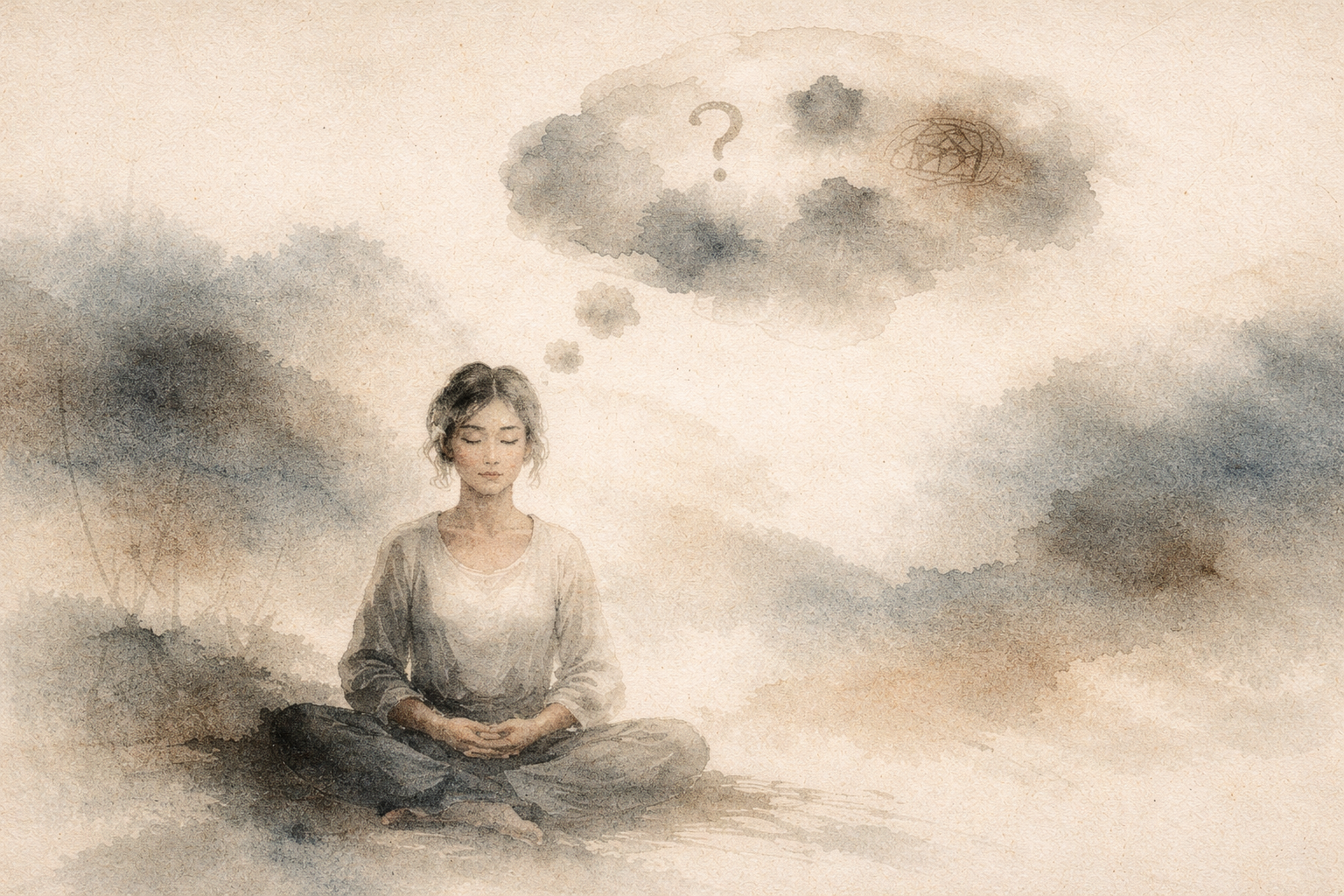
Quick Summary
- If you’re wondering what to think during meditation, the practical answer is: think less on purpose, and relate differently to whatever shows up.
- You don’t need to “empty your mind”; you need a simple home base (like breath or sound) and a gentle way to return.
- Thoughts are not the enemy—getting pulled into them automatically is the issue you’re training to notice.
- A helpful mental cue is: “thinking” (label it), then come back to direct sensation.
- If you use a phrase or intention, keep it light—meditation isn’t a debate you win with better arguments.
- Restlessness, planning, and replaying conversations are normal; the practice is returning without self-criticism.
- What you “think about” matters less than how quickly you notice and how kindly you return.
Introduction
You sit down to meditate and immediately hit the same question: what are you supposed to think about during meditation—nothing, your breath, a mantra, your problems, gratitude? The confusion usually comes from treating meditation like a task where the “right” thought earns a good session, when the real skill is learning how to stop being yanked around by whatever thought appears. At Gassho, we focus on simple, grounded meditation instructions that work in ordinary life, not just in ideal conditions.
So the goal here isn’t to hand you a perfect script to repeat in your head. It’s to give you a clear way to relate to thinking itself: how to notice it, how to let it be, and how to return to something steadier without turning meditation into a fight.
A Clear Lens: You’re Training Relationship, Not Content
When people ask what to think during meditation, they’re usually asking for the correct content—like choosing the right radio station. A more useful lens is that meditation trains your relationship to experience: sensations, emotions, sounds, and yes, thoughts. The “content” will vary wildly day to day, but the training stays consistent.
From this perspective, you’re not trying to manufacture a blank mind. You’re practicing recognizing what’s happening (including thinking), and returning to a chosen anchor with less drama. The anchor can be the breath, the feeling of the body sitting, ambient sound, or a short phrase—something simple and repeatable.
Thoughts aren’t mistakes. They’re part of the mind doing what minds do: predicting, remembering, evaluating, planning. The shift is learning to see thoughts as events—like a sound or a sensation—rather than as commands you must follow or stories you must finish.
So what are you “supposed” to think about? Ideally, nothing in particular. Practically, you’ll think about plenty. The practice is to notice thinking sooner, get less entangled, and return—again and again—without treating each return as a failure.
GASSHO
Ask and learn about Buddhism in daily life.
GASSHO is a Buddhist community app where you can learn Buddhist teachings and ask questions to the head priest of Kongosanmaiin Temple on Mount Koya.
What It Feels Like in Real Time When You Sit
You begin with an intention: “For the next few minutes, I’ll stay close to the breath.” That intention is a thought, and it’s fine. Then you feel one inhale, one exhale—simple, physical, present.
Within seconds, the mind offers something else: a plan for later, a memory, a worry, a comment like “I’m doing this wrong.” Often you don’t notice the moment it starts. You notice after you’ve been gone for a while—half a minute, two minutes, ten minutes. That noticing is not a problem; it’s the practice showing up.
At the moment you realize you’ve been thinking, you have a choice. You can scold yourself and tighten up, or you can do the simpler thing: acknowledge it. A quiet mental label like “thinking” or “planning” can help. Not to judge it—just to name what’s happening.
Then you return to the anchor. Not by pushing the thought away, but by giving your attention a clear place to land: the coolness of the inhale, the warmth of the exhale, the rise and fall of the belly, the contact of feet with the floor, the weight of hands. Returning is an action, not an argument.
Sometimes the thought doesn’t leave. It repeats, or it stays loud in the background. You can still return. Meditation isn’t “no thoughts”; it’s “not automatically following.” You may feel the breath while the mind continues to chatter. That’s not failure—that’s a realistic session.
Other times, you’ll get pulled into emotion: irritation, sadness, excitement. The mind will try to explain it, justify it, fix it. In that moment, “what to think” becomes less important than “what to do with attention.” You can include the emotion as sensation—tightness in the chest, heat in the face—without needing a storyline to validate it.
And sometimes you’ll have a quiet stretch. The temptation then is to congratulate yourself or to fear losing it. Both are just more thinking. The same instruction applies: notice, soften, return. The steadiness comes from repetition, not from holding a special state.
Common Misunderstandings That Make Meditation Harder
Misunderstanding 1: “I’m supposed to think about nothing.” If “nothing” means you’re trying to force the mind into silence, you’ll likely create tension. A more workable aim is to keep returning to a simple anchor and let thoughts come and go without chasing them.
Misunderstanding 2: “If I’m thinking, I’m failing.” Thinking is inevitable. The training is noticing and returning. In fact, the moment you realize you’ve been lost in thought is a moment of mindfulness—not a mistake.
Misunderstanding 3: “I need the perfect mantra or affirmation.” A phrase can help, but it’s not magic. If you use words, keep them simple and steady, and don’t turn the session into a performance where you grade yourself on focus.
Misunderstanding 4: “Meditation is for solving my problems.” Insight can happen, but if you sit down to think your way out of life, you’ll often just rehearse the same loops. Meditation is more like learning to see the loop clearly, so you’re not compelled to run it every time.
Misunderstanding 5: “I should only focus on positive thoughts.” Forcing positivity can become another form of avoidance. A calmer approach is allowing whatever appears—pleasant, unpleasant, neutral—while practicing a steady return to the present.
Why This Changes More Than Your Meditation Session
Learning what to think during meditation is really learning when you don’t have to think. That matters because so much stress comes from automatic mental behavior: rehearsing arguments, predicting disasters, replaying regrets, narrating every moment. Meditation gives you a small, repeatable way to interrupt that automation.
When you practice returning to an anchor, you’re also practicing returning in daily life. You notice you’re spiraling, you feel your feet, you take one real breath, you soften the jaw. The content of the thought may still be there, but you’re less owned by it.
This also changes how you relate to emotions. Instead of immediately explaining, fixing, or acting them out, you can pause and feel what’s actually happening in the body. That pause often creates better choices—more patience in conversation, less reactivity in conflict, more clarity when you’re tired.
And it can make ordinary moments feel less rushed. When attention isn’t constantly consumed by commentary, simple experiences become more available: washing dishes, walking to the car, listening to someone without planning your reply. The benefit isn’t mystical; it’s practical.
Conclusion
If you’re asking what you’re supposed to think about during meditation, the most helpful answer is: you’re not supposed to think about the “right” thing—you’re supposed to notice thinking and return. Choose a simple anchor, expect the mind to wander, label it gently, and come back without punishment. Over time, that humble loop—notice, return, soften—becomes a reliable way to meet your own mind with more steadiness.
If you want a single sentence to carry into your next sit, try this: “Whatever I’m thinking is okay; I’m practicing coming back.”
Ask a Buddhist priest
Have a question about Buddhism?
In the GASSHO app, you can ask questions about Buddhist teachings, daily concerns, and how to understand Buddhism in everyday life.
Frequently Asked Questions
- FAQ 1: What should I think about during meditation?
- FAQ 2: Am I supposed to think about nothing during meditation?
- FAQ 3: What do I do when I can’t stop thinking during meditation?
- FAQ 4: Should I focus on my breath or on my thoughts during meditation?
- FAQ 5: Is it okay to think about my problems during meditation?
- FAQ 6: What should I think when I notice I’m distracted in meditation?
- FAQ 7: Should I repeat a mantra, or is that too much thinking?
- FAQ 8: What should I think about when meditating on anxiety?
- FAQ 9: What should I think about when meditating before sleep?
- FAQ 10: What should I think about when meditating in the morning?
- FAQ 11: Should I think positive thoughts during meditation?
- FAQ 12: What should I think about when meditating with eyes open?
- FAQ 13: What should I think about when I feel bored during meditation?
- FAQ 14: What should I think about when painful memories come up in meditation?
- FAQ 15: How do I know if I’m thinking the “right” thing during meditation?
FAQ 1: What should I think about during meditation?
Answer: Aim to think about one simple anchor (like the physical sensations of breathing) and, when thoughts arise, notice them and return. You don’t need special thoughts; you need a steady way to come back.
Takeaway: Choose an anchor and practice returning, not perfect thinking.
FAQ 2: Am I supposed to think about nothing during meditation?
Answer: Not in the sense of forcing a blank mind. Thoughts will appear; the practice is to not follow them automatically and to keep returning to your anchor with a relaxed attitude.
Takeaway: “No thoughts” isn’t required—less entanglement is the point.
FAQ 3: What do I do when I can’t stop thinking during meditation?
Answer: Stop trying to stop thoughts. Label what’s happening (“thinking,” “planning,” “remembering”), feel one full breath, and return again. Repeating this is the training.
Takeaway: The skill is noticing and returning, even if thinking continues.
FAQ 4: Should I focus on my breath or on my thoughts during meditation?
Answer: Use the breath (or another simple sensation) as your main focus, and treat thoughts as passing events you notice briefly. You can acknowledge thoughts without making them the main object.
Takeaway: Anchor on breath; relate to thoughts lightly.
FAQ 5: Is it okay to think about my problems during meditation?
Answer: It’s normal if problems appear, but meditation usually works better when you don’t deliberately problem-solve. If problem thoughts arise, notice them and return to your anchor rather than building the whole storyline.
Takeaway: Let problems appear, but don’t turn the sit into a planning session.
FAQ 6: What should I think when I notice I’m distracted in meditation?
Answer: Think something simple and neutral like “thinking” or “back,” then gently return to the breath. Avoid adding commentary like “I’m bad at this,” which is just another distraction.
Takeaway: Use a brief label, then return—no self-judgment needed.
FAQ 7: Should I repeat a mantra, or is that too much thinking?
Answer: Repeating a short phrase can be a valid focus because it simplifies attention. The key is to use it gently as an anchor, not as a way to force the mind into silence or to “win” against thoughts.
Takeaway: A mantra is fine if it steadies attention without strain.
FAQ 8: What should I think about when meditating on anxiety?
Answer: Instead of thinking your way through anxiety, focus on direct sensations (tightness, heat, fluttering) and the breath. If anxious thoughts arise, label them “worry” and return to what you can feel right now.
Takeaway: With anxiety, prioritize sensation and returning over analysis.
FAQ 9: What should I think about when meditating before sleep?
Answer: Keep it simple and low-effort: feel the breath, scan body sensations, or count a few breaths. Avoid stimulating topics like planning tomorrow or reviewing the day in detail.
Takeaway: Before sleep, choose calming anchors and skip mental projects.
FAQ 10: What should I think about when meditating in the morning?
Answer: Morning meditation often works best with a straightforward anchor (breath or body) and a light intention like “steady and kind.” If the mind starts planning, notice “planning” and return without negotiating with the to-do list.
Takeaway: In the morning, keep the mind from turning meditation into a schedule review.
FAQ 11: Should I think positive thoughts during meditation?
Answer: You don’t have to. Forcing positivity can create tension. If you want, you can include a brief kind intention, but the core practice is staying present and returning when the mind wanders—whatever the mood.
Takeaway: Positivity is optional; presence and returning are central.
FAQ 12: What should I think about when meditating with eyes open?
Answer: The same principles apply: keep attention on an anchor. With eyes open, you can rest attention on breath and include a soft awareness of the visual field without analyzing what you see.
Takeaway: Eyes open doesn’t change what to think—anchor and return.
FAQ 13: What should I think about when I feel bored during meditation?
Answer: Boredom is often a mix of thoughts (“this is pointless”) and sensations (heaviness, restlessness). Label “bored,” feel the body and breath, and notice the urge to seek stimulation without immediately obeying it.
Takeaway: Treat boredom as an experience to notice, not a reason to quit.
FAQ 14: What should I think about when painful memories come up in meditation?
Answer: You don’t need to force a story or push it away. Acknowledge “remembering,” return to the breath, and keep attention grounded in present sensations. If it feels overwhelming, shorten the session and consider support from a qualified professional.
Takeaway: Name the memory, ground in the present, and prioritize safety.
FAQ 15: How do I know if I’m thinking the “right” thing during meditation?
Answer: A useful measure is not the thought content but the process: did you notice wandering and return without harshness? If yes, you practiced well—even if the mind was busy the whole time.
Takeaway: “Right thinking” is noticing and returning, not having perfect thoughts.