



Sacred Animal Symbols in Buddhism: Meaning and Spiritual Symbolism
Quick Summary
- Sacred animal symbols in Buddhism are teaching tools: they point to qualities of mind and conduct, not “holy animals” to worship.
- Common symbols include the lion (fearless clarity), elephant (steadiness), deer (peaceful listening), and garuda (freedom from fixation).
- Animals often appear as “supports” around awakened figures—thrones, mounts, guardians—showing how qualities support practice.
- Meanings shift by region and art style, so context matters more than one fixed definition.
- These symbols can be used as gentle prompts for attention, restraint, compassion, and courage in daily life.
- Misreadings happen when people treat symbols as superstition, or as literal claims about animals.
- A respectful approach protects both the tradition and real animals: symbolism should not justify harm or exploitation.
Introduction
You keep seeing lions, elephants, deer, and strange bird-like beings in Buddhist art and temples, and the explanations online feel either overly mystical or frustratingly vague. Sacred animal symbols in Buddhism are usually simpler than they look: they’re visual shorthand for how the mind behaves and how it can be trained, not a demand to believe in something exotic. At Gassho, we focus on practical Buddhist symbolism as a way to clarify attention and ethics without turning it into superstition.
When you read these animals as “qualities in motion” rather than as decorations, the imagery becomes surprisingly useful: it helps you notice fear, pride, distraction, tenderness, and steadiness as they arise in ordinary life.
A Clear Lens for Reading Animal Symbols
In Buddhism, sacred animal symbols function like a compact language. An animal image points to a recognizable human pattern—how we react, what we cling to, what we avoid—and offers a direction for practice. The goal isn’t to label an animal as “divine,” but to use a familiar form to communicate an inner quality quickly and memorably.
This is why the same animal can appear in different roles: as a guardian at a gate, as a throne support beneath a figure, or as a companion in a story. Each placement changes the emphasis. A guardian suggests protection of boundaries and values; a throne support suggests stability and dignity; a story suggests cause-and-effect in behavior.
It also helps to remember that Buddhist art is designed to be read by ordinary people, not only scholars. A lion communicates confidence and command; an elephant communicates weight and steadiness; a deer communicates gentleness and alert listening. You don’t need specialized vocabulary to get the basic message.
Finally, meanings are not always single and fixed. Regions, languages, and artistic conventions shape what an animal “says.” A good approach is to hold the symbol lightly: ask what quality it highlights here, in this scene, and how that quality relates to your own mind.
GASSHO
Ask and learn about Buddhism in daily life.
GASSHO is a Buddhist community app where you can learn Buddhist teachings and ask questions to the head priest of Kongosanmaiin Temple on Mount Koya.
How These Symbols Show Up in Everyday Experience
Think of a lion image as a mirror for the moment you hesitate to speak honestly. The symbol isn’t pushing you to be loud; it’s pointing to a clean kind of courage—saying what needs to be said without adding aggression. When you notice your voice shrinking, the lion becomes a cue to stand upright inside.
An elephant symbol can land differently: it highlights the mind’s capacity to stay. In daily life, “staying” might mean finishing a difficult conversation without escaping into your phone, or returning to a task after a mistake without spiraling into self-judgment. The elephant points to steadiness that doesn’t need drama.
Deer imagery often evokes quiet sensitivity. In practice terms, that can look like listening without rehearsing your reply, or noticing the first flicker of irritation before it becomes a sharp comment. The deer doesn’t force passivity; it suggests alert gentleness—present, responsive, and not easily startled into harm.
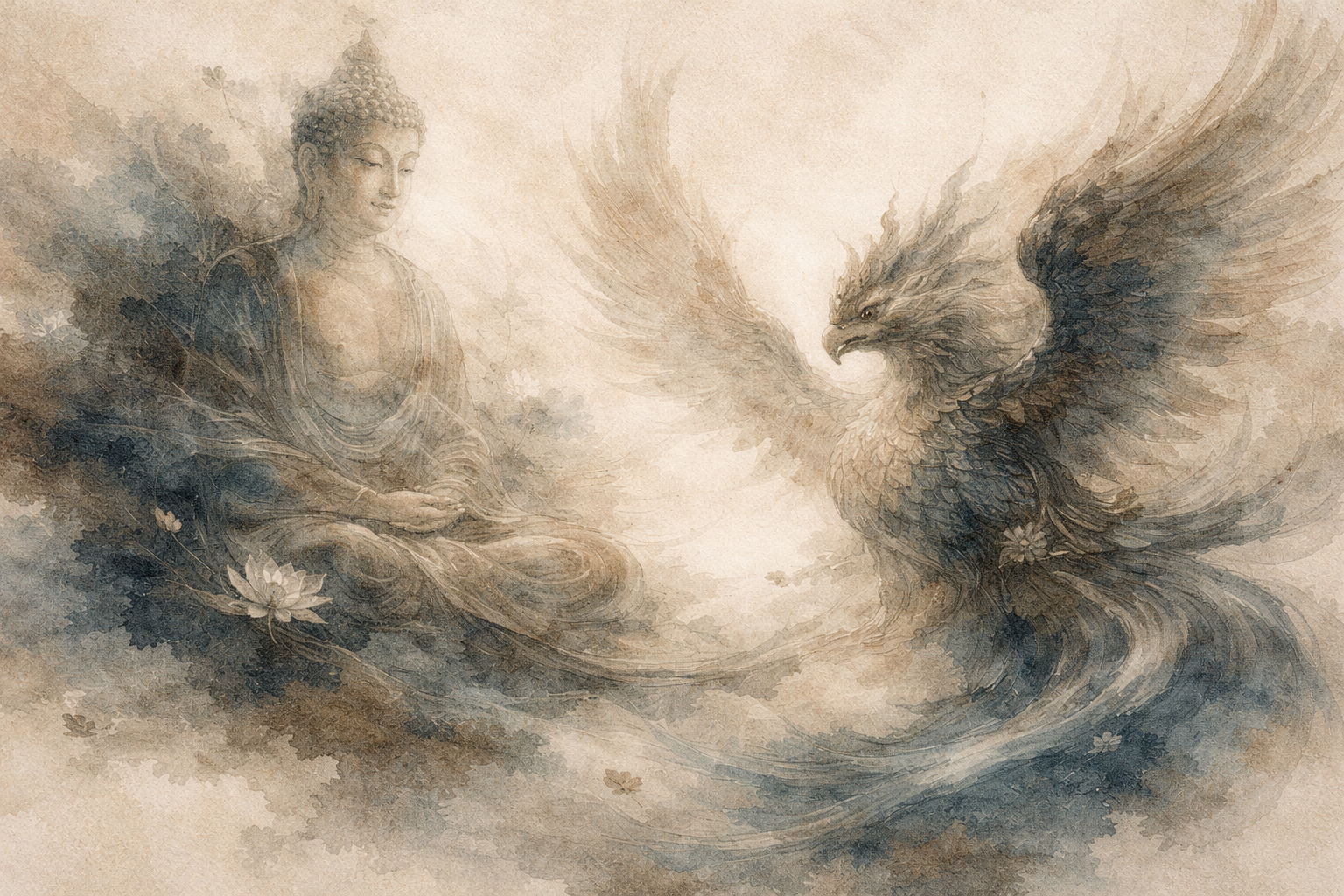
When you see birds like the garuda, the emphasis is frequently on release from fixation. In ordinary terms, fixation is the loop you can’t stop replaying: the argument, the regret, the craving, the comparison. The symbol becomes a reminder to widen attention—feel your feet, notice your breath, and let the loop be a loop without feeding it.
Serpents and nāgas can reflect the mind’s relationship with power and protection. Sometimes you feel protective in a clean way—setting a boundary, refusing to participate in gossip. Sometimes protection turns into control—tightening, gripping, needing certainty. The symbol can help you notice the difference in your body: open firmness versus clenched fear.
Even the simple act of seeing an animal symbol can become a small training moment. You notice the image, you notice your reaction (attraction, skepticism, curiosity), and you return to the question: “What quality is being pointed to right now?” That return is the practice—quiet, repeatable, and available anywhere.
Over time, the symbols stop being “about Buddhism out there” and start functioning as prompts for self-observation. Not as a test of belief, but as a way to recognize what’s happening in the mind before it hardens into speech and action.
Common Misreadings and How to Avoid Them
One common misunderstanding is treating sacred animal symbols in Buddhism as proof of superstition. But symbolism is not the same as literalism. A lion doesn’t require you to believe in a magical lion; it invites you to examine fear and confidence as lived experiences.
Another misreading is assuming every animal has one universal meaning. In reality, context matters: where the animal appears, what it accompanies, and what story or ritual it belongs to. If you want accuracy, look at the whole scene rather than isolating a single figure.
People also sometimes confuse “sacred symbol” with “permission to use.” Using animal imagery as a brand aesthetic while ignoring the ethical dimension can flatten the tradition. In Buddhism, symbols are tied to conduct—how you speak, consume, and treat living beings.
Finally, there’s a subtle trap: using symbols as identity badges. If an animal symbol becomes a way to feel special (“I’m a lion type”), it can reinforce the very self-centered habits the teachings aim to soften. A healthier use is humble and functional: “What does this image remind me to practice today?”
Why Animal Symbols Still Matter Today
Modern life is saturated with abstract information, but the mind often learns through images. Sacred animal symbols in Buddhism offer a non-technical way to remember what matters: courage without cruelty, steadiness without rigidity, gentleness without avoidance, freedom without numbness.
They also help bridge ethics and attention. When an image reminds you to pause before reacting, it protects relationships. When it reminds you to loosen fixation, it protects mental health. When it reminds you to respect life, it protects the world you live in.
Used well, these symbols don’t pull you away from reality. They bring you closer to it—closer to what you’re actually doing with your mind in the moments that shape your day.
Conclusion
Sacred animal symbols in Buddhism are best understood as practical pointers. They translate inner qualities into visible forms so you can recognize them quickly: fearlessness, steadiness, sensitivity, protection, and release. If you hold the meanings lightly, pay attention to context, and apply the symbol to your own reactions, the imagery stops being confusing and starts becoming quietly useful.
Ask a Buddhist priest
Have a question about Buddhism?
In the GASSHO app, you can ask questions about Buddhist teachings, daily concerns, and how to understand Buddhism in everyday life.
Frequently Asked Questions
- FAQ 1: What does “sacred animal symbols in Buddhism” actually mean?
- FAQ 2: Are animals worshiped in Buddhism because they appear in sacred imagery?
- FAQ 3: What does the lion symbolize in Buddhist art?
- FAQ 4: What does the elephant represent as a sacred animal symbol in Buddhism?
- FAQ 5: Why are deer important symbols in Buddhism?
- FAQ 6: What is the meaning of the garuda in Buddhist symbolism?
- FAQ 7: What do nāgas (serpent beings) symbolize in Buddhism?
- FAQ 8: Why do some Buddhist images show animals supporting a throne or seat?
- FAQ 9: Do sacred animal symbols in Buddhism have one fixed meaning everywhere?
- FAQ 10: How can I interpret sacred animal symbols in Buddhism without overthinking them?
- FAQ 11: Are sacred animal symbols in Buddhism meant to be taken literally?
- FAQ 12: What does the horse symbolize in Buddhist imagery?
- FAQ 13: What is the symbolism of birds in Buddhism beyond the garuda?
- FAQ 14: Is it disrespectful to wear jewelry or clothing with sacred animal symbols in Buddhism?
- FAQ 15: How can sacred animal symbols in Buddhism support daily practice without becoming superstition?
FAQ 1: What does “sacred animal symbols in Buddhism” actually mean?
Answer: It refers to animals used in Buddhist stories, art, and temple imagery as symbols of qualities like courage, steadiness, compassion, protection, or freedom from fixation. “Sacred” here usually means “meaningful and instructive,” not that the animal is worshiped as a god.
Takeaway: Animal symbols are visual teachings, not a requirement to worship animals.
FAQ 2: Are animals worshiped in Buddhism because they appear in sacred imagery?
Answer: Generally, no. Animals appear as symbolic supports and teaching devices. Respect for life is emphasized, but the presence of animal symbols is usually about pointing to mental qualities and ethical behavior rather than animal worship.
Takeaway: Symbolic presence is different from worship.
FAQ 3: What does the lion symbolize in Buddhist art?
Answer: The lion commonly symbolizes fearless clarity, dignity, and the confident expression of truth (often described as a “lion’s roar”). In practice terms, it can point to courage without aggression and steadiness under pressure.
Takeaway: The lion points to clean courage and confident clarity.
FAQ 4: What does the elephant represent as a sacred animal symbol in Buddhism?
Answer: The elephant often represents stability, strength, patience, and a mind that can be trained—powerful but guided. It can also suggest grounded presence and the ability to carry responsibility without collapsing.
Takeaway: The elephant symbolizes steady strength and trainable power.
FAQ 5: Why are deer important symbols in Buddhism?
Answer: Deer are frequently associated with gentleness, peace, and attentive listening. They also appear in connection with teaching settings, emphasizing receptivity and calm awareness rather than force.
Takeaway: Deer imagery highlights gentle alertness and receptivity.
FAQ 6: What is the meaning of the garuda in Buddhist symbolism?
Answer: The garuda, a powerful bird-like figure, often symbolizes freedom, vast perspective, and the ability to overcome constricting forces like fear or fixation. In a practical sense, it can point to loosening mental loops and widening awareness.
Takeaway: The garuda points to liberation from constriction and fixation.
FAQ 7: What do nāgas (serpent beings) symbolize in Buddhism?
Answer: Nāgas commonly symbolize protection, hidden power, and guardianship of teachings or sacred places. Symbolically, they can also reflect how energy can protect wisely when guided, or become controlling when driven by fear.
Takeaway: Nāgas often represent protective power and guardedness.
FAQ 8: Why do some Buddhist images show animals supporting a throne or seat?
Answer: Animals beneath or around a throne typically symbolize qualities that “support” awakened conduct—such as stability, courage, or vigilance. The placement is part of the visual grammar: it shows what holds the posture of wisdom in place.
Takeaway: Throne animals are symbolic supports for inner qualities.
FAQ 9: Do sacred animal symbols in Buddhism have one fixed meaning everywhere?
Answer: Not always. Meanings can shift by region, language, and artistic tradition, and also by the specific scene. It’s best to read the symbol in context—what figure it accompanies, what gesture is shown, and what story is being referenced.
Takeaway: Context matters more than a single universal definition.
FAQ 10: How can I interpret sacred animal symbols in Buddhism without overthinking them?
Answer: Start with the simplest human quality the animal evokes (steadiness, gentleness, fearlessness), then ask how that quality applies to your current behavior—speech, attention, and choices. If multiple meanings fit, hold them lightly rather than forcing one “correct” answer.
Takeaway: Use the symbol as a practical prompt, not a puzzle to solve.
FAQ 11: Are sacred animal symbols in Buddhism meant to be taken literally?
Answer: Usually they are not literal claims; they are symbolic communication. Even when stories include extraordinary animals, the function is commonly to highlight ethical cause-and-effect, attention, compassion, or the consequences of craving and fear.
Takeaway: The main purpose is teaching through imagery, not literal zoology.
FAQ 12: What does the horse symbolize in Buddhist imagery?
Answer: The horse can symbolize energy, movement, and the capacity to carry intention forward. In some contexts it suggests disciplined momentum—going in the right direction steadily rather than being dragged by impulse.
Takeaway: The horse often points to directed energy and forward movement.
FAQ 13: What is the symbolism of birds in Buddhism beyond the garuda?
Answer: Birds in Buddhist symbolism often suggest perspective, lightness, and the mind’s ability to rise above narrow fixation. Depending on the specific bird and scene, they may also point to communication, harmony, or the fleeting nature of thoughts.
Takeaway: Bird symbols commonly emphasize perspective and mental spaciousness.
FAQ 14: Is it disrespectful to wear jewelry or clothing with sacred animal symbols in Buddhism?
Answer: It depends on intention and context. If the symbol is used thoughtfully and respectfully—without mocking, sexualizing, or commercializing sacred imagery—it’s often fine. When in doubt, learn the symbol’s basic meaning and avoid placing sacred images in disrespectful locations or situations.
Takeaway: Respect comes from informed, careful use rather than trend-driven display.
FAQ 15: How can sacred animal symbols in Buddhism support daily practice without becoming superstition?
Answer: Treat the animal as a reminder to notice a specific quality in real time—courage when you want to avoid, gentleness when you want to snap, steadiness when you want to quit. Keep the focus on observable behavior and attention, not on magical thinking or lucky charms.
Takeaway: Use animal symbols as cues for awareness and ethics, not as supernatural guarantees.