



The Mandala Symbol in Buddhism Explained
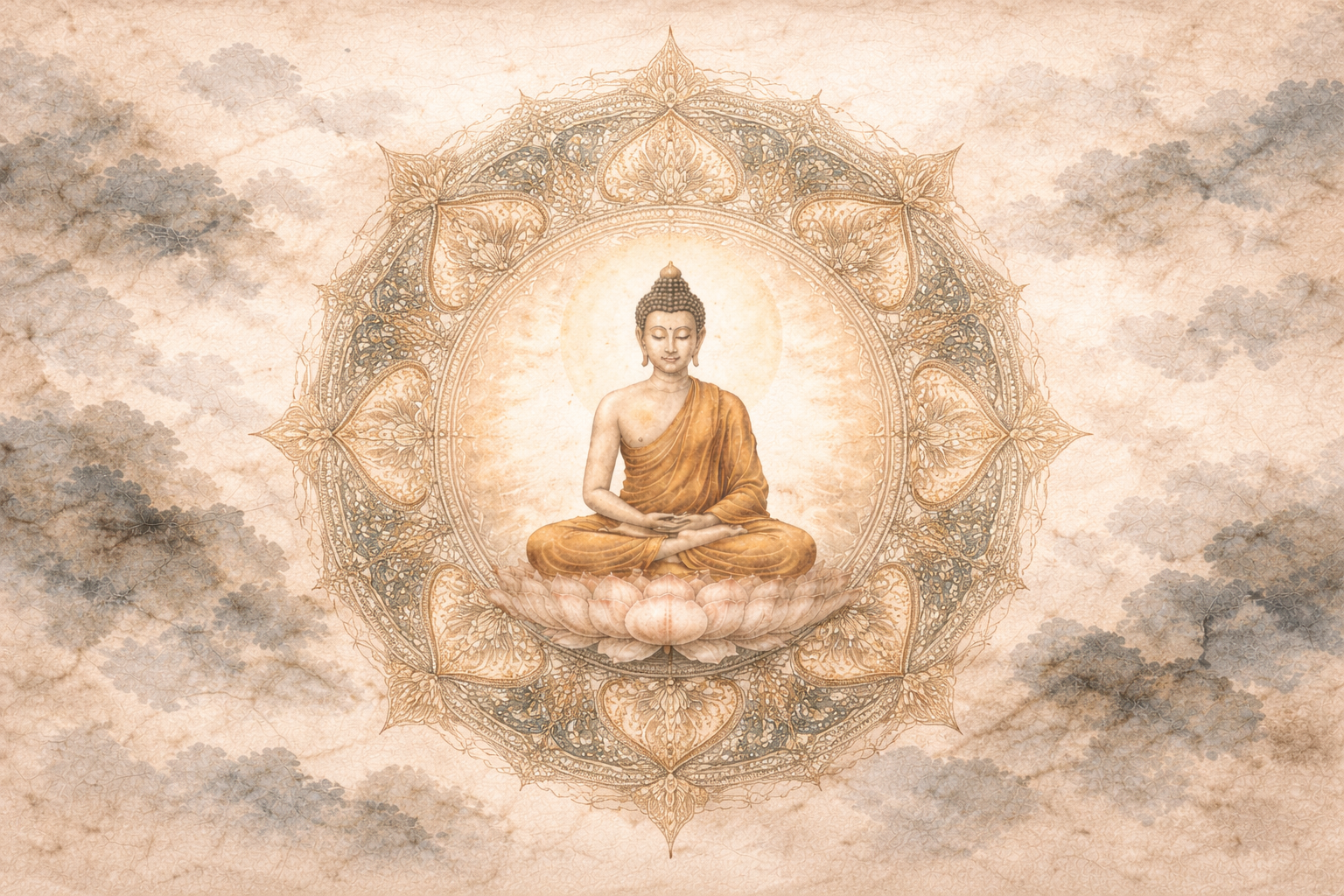
Quick Summary
- The mandala symbol in Buddhism is best understood as a map of mind and a mirror of experience, not just decorative art.
- Its structure (center, circles, squares, gates, symmetry) trains attention to move from distraction toward clarity.
- Many mandalas depict an “ordered world” where every element has a place, helping the viewer relate differently to inner chaos.
- Using a mandala can be as simple as looking carefully, noticing reactions, and returning to the center again and again.
- Common misunderstandings include treating mandalas as universal “good luck” symbols or as secret codes you must decode.
- In daily life, mandala thinking supports steadiness: center yourself, recognize the pattern, and respond rather than react.
- Respect matters: context, intention, and careful use are more important than owning a “perfect” mandala image.
Introduction
If “the mandala symbol in Buddhism” feels confusing, it’s usually because you’ve seen mandalas used as everything at once—art print, coloring page, spiritual logo, or mysterious diagram—so the meaning gets flattened into vague “balance” talk. A Buddhist mandala is more practical than that: it’s a way to organize attention, showing how the mind can move from scattered edges to a stable center, and back into the world with more care. At Gassho, we focus on clear, grounded explanations of Buddhist symbols without hype or gatekeeping.
In plain terms, a mandala is a structured image that invites you to relate to experience differently. Instead of chasing every thought, you learn to see patterns, recognize what pulls you off-center, and return—gently, repeatedly—to what is steady.
That’s why mandalas show up in Buddhist contexts as more than “pretty geometry.” They function like a visual practice: a container for attention, a reminder of order, and a training tool for how to meet complexity without being overwhelmed by it.
A Clear Lens for Understanding Buddhist Mandalas
The mandala symbol in Buddhism can be approached as a lens: it frames experience as something you can enter, observe, and navigate. The outer forms—circles, squares, repeating motifs—aren’t there to impress you; they create a stable field where attention can settle. When attention settles, you can notice what the mind is doing rather than being dragged around by it.
Most mandalas emphasize a center. That center is not a “magic point” but a practical reference: a place to return when the mind wanders. The edges represent the many pulls of life—sensations, worries, plans, memories—while the center represents collectedness and clarity. The image quietly teaches a skill: return to center without fighting the edges.
Many Buddhist mandalas also suggest an ordered world where every element has a relationship to every other element. This is less about believing in a cosmic diagram and more about training perception: instead of seeing your inner life as random noise, you learn to see it as patterned activity—habits, triggers, preferences, fears—arising and passing in a recognizable way.
Seen this way, a mandala is not asking you to “think spiritual thoughts.” It’s asking you to look carefully, stay present, and let the mind become less reactive. The symbol works because it gives attention something coherent to do.
GASSHO
Ask and learn about Buddhism in daily life.
GASSHO is a Buddhist community app where you can learn Buddhist teachings and ask questions to the head priest of Kongosanmaiin Temple on Mount Koya.
How Mandalas Show Up in Ordinary Experience
Imagine you’re looking at a mandala and your eyes keep jumping to one bright detail. That’s not a problem; it’s information. You’re seeing how attention behaves—how it grabs, prefers, and fixates. The mandala gives you a safe, simple situation to notice that movement.
Then you remember the center and let your gaze return. Again, nothing mystical: it’s the same basic gesture you use when you come back to a conversation after drifting, or when you return to a task after checking your phone. The mandala makes that “returning” visible and repeatable.
Sometimes the mind reacts emotionally to a mandala: comfort, irritation, boredom, fascination. You might think, “This is beautiful,” or “This is too busy,” or “I don’t get it.” In Buddhist use, those reactions are part of the practice. The point is not to force a positive feeling, but to notice the reaction clearly and not be owned by it.
In daily life, we often live at the edges—pulled by notifications, deadlines, and other people’s moods. A mandala’s symmetry can feel like a quiet counterweight. When you spend a few minutes with a stable pattern, you may notice the nervous system settling simply because it has fewer surprises to manage.
You may also notice how quickly the mind turns a mandala into a project: “I should understand this,” “I should interpret every symbol,” “I should feel something profound.” That pressure is another edge. The mandala gives you a chance to recognize the pressure and soften it, returning to simple seeing.
Even without formal practice, mandala imagery can highlight a basic truth about attention: it moves in loops. You drift, you notice, you return. The mandala doesn’t demand perfection; it quietly rewards repetition.
Over time, the most useful “mandala moment” is not a special vision—it’s the ordinary recognition that you’re off-center, followed by a small, kind correction. That’s the symbol doing its job in real life.
Common Misunderstandings About the Mandala Symbol
One common misunderstanding is treating the mandala symbol in Buddhism as a generic sign of “peace” or “good vibes.” Mandalas can certainly feel calming, but in Buddhist contexts they are primarily functional: they structure attention and represent an ordered field of experience. Reducing them to a mood-board symbol misses their purpose.
Another misunderstanding is assuming every mandala is the same. Some are simple and geometric; others are highly detailed and filled with figures and architectural forms. The shared thread is not a single “meaning,” but the way the image organizes perception around a center and a coherent pattern.
People also get stuck thinking they must decode a mandala like a secret puzzle. While specific mandalas can have precise symbolic elements, you don’t need to “solve” it to benefit from it. The basic practice is straightforward: look, notice, return, and let the mind become less scattered.
Finally, there’s a tendency to treat mandalas as purely external objects—something you buy, display, or post. In Buddhist use, the deeper point is internal: the mandala is a prompt to recognize how experience is arranged, how attention moves, and how you can relate to that movement with more steadiness.
Why the Mandala Still Matters in Daily Life
The mandala symbol in Buddhism matters because it offers a simple, repeatable way to practice being less reactive. When life feels messy, the mind often tries to fix everything at once. A mandala suggests a different approach: find the center first, then relate to the edges from that steadier place.
This can translate into small, practical habits. Before responding to a tense message, you pause and “return to center” by feeling your breath or your posture. When you’re overwhelmed by choices, you identify the central value that matters most right now. When you’re caught in rumination, you notice the loop and gently come back to what’s actually happening.
Mandalas also remind us that complexity can be held without being collapsed. A well-made mandala contains many elements without becoming chaotic. That’s a useful model for modern life: you can have many responsibilities and emotions and still meet them with structure, patience, and clarity.
Most importantly, mandalas encourage a respectful relationship with symbols. Instead of using spiritual imagery as decoration or identity, you can use it as a mirror: “What is my mind doing right now?” That question is simple, and it changes things.
Conclusion
The mandala symbol in Buddhism is not just an attractive pattern—it’s a disciplined way of seeing. It gathers attention, highlights the pull of the “edges,” and offers a steady center you can return to without drama. If you approach a mandala as a practice of noticing rather than a puzzle to solve, it becomes immediately relevant: a quiet training in clarity, balance, and humane response.
When you meet a mandala, try the simplest experiment: look carefully, notice what pulls you, and return to the center. That small gesture is the symbol’s living meaning.
Ask a Buddhist priest
Have a question about Buddhism?
In the GASSHO app, you can ask questions about Buddhist teachings, daily concerns, and how to understand Buddhism in everyday life.
Frequently Asked Questions
- FAQ 1: What is the mandala symbol in Buddhism?
- FAQ 2: What does a mandala represent in Buddhist symbolism?
- FAQ 3: Why are Buddhist mandalas often circular?
- FAQ 4: What is the meaning of the center in a Buddhist mandala?
- FAQ 5: Are mandalas in Buddhism meant to be “decoded” like a secret message?
- FAQ 6: How is a Buddhist mandala used in practice?
- FAQ 7: What is the difference between a mandala and a yantra in a Buddhist context?
- FAQ 8: Do all Buddhist traditions use mandalas the same way?
- FAQ 9: What is a sand mandala in Buddhism, and what does it symbolize?
- FAQ 10: Is the mandala symbol in Buddhism the same as a “flower of life” pattern?
- FAQ 11: What do the gates or square boundaries in some Buddhist mandalas mean?
- FAQ 12: Can a mandala in Buddhism be used as a mindfulness tool without religious belief?
- FAQ 13: Is it disrespectful to display a Buddhist mandala as home decor?
- FAQ 14: What should I pay attention to when looking at a Buddhist mandala?
- FAQ 15: What is the simplest way to explain the mandala symbol in Buddhism to a beginner?
FAQ 1: What is the mandala symbol in Buddhism?
Answer: In Buddhism, a mandala is a structured symbolic image—often circular and centered—used to organize attention and represent an ordered field of experience. It functions as a visual support for contemplation, helping the viewer relate to complexity by returning again and again to a stable center.
Takeaway: A Buddhist mandala is a practical symbol for centering attention, not just decoration.
FAQ 2: What does a mandala represent in Buddhist symbolism?
Answer: A mandala commonly represents a coherent “world” of relationships: center and periphery, order and multiplicity, stability and movement. Rather than a single fixed definition, it points to how experience can be held in awareness without getting lost in the outer distractions.
Takeaway: Mandalas symbolize organized experience—many elements held around a center.
FAQ 3: Why are Buddhist mandalas often circular?
Answer: The circle naturally emphasizes wholeness and a center point, making it ideal for training attention to return and settle. Circular forms also guide the eye in a continuous movement, which supports steady looking rather than fragmented scanning.
Takeaway: The circle helps the mind practice returning to a stable center.
FAQ 4: What is the meaning of the center in a Buddhist mandala?
Answer: The center is a visual anchor that represents collectedness—what it feels like when attention is less scattered. Practically, it gives you a reference point: when the mind drifts to the “edges” (thoughts, reactions, preferences), you can return to the center and begin again.
Takeaway: The center is a training point for steadiness and return.
FAQ 5: Are mandalas in Buddhism meant to be “decoded” like a secret message?
Answer: Not necessarily. Some mandalas have specific symbolic elements that can be studied, but the basic function doesn’t require decoding. Simply observing carefully—seeing how attention moves and returning to the center—is already a meaningful way to engage the mandala symbol in Buddhism.
Takeaway: You can benefit from a mandala through careful looking, even without detailed interpretation.
FAQ 6: How is a Buddhist mandala used in practice?
Answer: A mandala may be used as a visual focus for contemplation: you look steadily, notice distraction or emotional reactions, and return to the image’s center and structure. The practice is less about imagination and more about training attention, patience, and non-reactivity while engaging a complex symbol.
Takeaway: Mandalas are used to stabilize attention and observe the mind’s habits.
FAQ 7: What is the difference between a mandala and a yantra in a Buddhist context?
Answer: “Mandala” generally refers to a symbolic “circle” or structured field organized around a center, often depicting an ordered world. “Yantra” typically emphasizes a geometric diagram used as a focusing device. In practice, the terms can overlap, but “mandala” more often implies a complete symbolic environment rather than only geometry.
Takeaway: Mandalas often present a whole symbolic world; yantras are usually more strictly geometric focus-diagrams.
FAQ 8: Do all Buddhist traditions use mandalas the same way?
Answer: No. The mandala symbol in Buddhism appears in different forms and with different emphases depending on context—ranging from simple geometric patterns to highly detailed symbolic layouts. What tends to remain consistent is the mandala’s role in organizing attention around a coherent structure.
Takeaway: Mandalas vary widely, but they commonly function as structured supports for contemplation.
FAQ 9: What is a sand mandala in Buddhism, and what does it symbolize?
Answer: A sand mandala is a mandala carefully created from colored sand and then dismantled. It highlights impermanence in a direct, visible way: even a beautiful, painstakingly made form is not held onto. The symbolism is less about loss and more about learning non-clinging and perspective.
Takeaway: Sand mandalas emphasize impermanence and the practice of letting go.
FAQ 10: Is the mandala symbol in Buddhism the same as a “flower of life” pattern?
Answer: No. While both can look geometric and symmetrical, the “flower of life” is a modern popular motif with its own history and uses. A Buddhist mandala is defined by its role and context in Buddhist symbolism and practice, not by any single geometric pattern.
Takeaway: Similar-looking geometry doesn’t mean the symbol is Buddhist or has the same meaning.
FAQ 11: What do the gates or square boundaries in some Buddhist mandalas mean?
Answer: Square boundaries and gate-like openings often suggest entering a defined space of contemplation. Visually, they create a sense of orientation—outside and inside, periphery and center—helping attention move deliberately rather than randomly across the image.
Takeaway: Boundaries and gates guide attention into a focused symbolic space.
FAQ 12: Can a mandala in Buddhism be used as a mindfulness tool without religious belief?
Answer: Yes. You can engage the mandala symbol in Buddhism as a practical exercise in attention: observe details, notice distraction, and return to the center. Doing so doesn’t require adopting beliefs; it requires willingness to look carefully and relate to your reactions honestly.
Takeaway: Mandalas can support mindful attention even for non-religious viewers.
FAQ 13: Is it disrespectful to display a Buddhist mandala as home decor?
Answer: It depends on intention and placement. If you treat the mandala symbol in Buddhism as a meaningful image—kept clean, placed thoughtfully, and not used in trivial or degrading ways—it can be respectful. Problems usually arise when it’s used as a trend object with no care for context.
Takeaway: Respect comes from intention, context, and how you treat the image.
FAQ 14: What should I pay attention to when looking at a Buddhist mandala?
Answer: Start with structure: the center, the symmetry, and the movement from outer areas inward. Then notice your own mind—where your gaze gets pulled, what emotions arise, and how it feels to return to the center. The mandala is doing its work when it helps you see attention and reaction clearly.
Takeaway: Watch both the mandala’s structure and your mind’s response to it.
FAQ 15: What is the simplest way to explain the mandala symbol in Buddhism to a beginner?
Answer: A Buddhist mandala is a centered, organized image that helps you practice returning from distraction to clarity. It’s like a visual map that trains attention: you notice the pull of the edges, and you come back to the center—again and again—without forcing anything.
Takeaway: A mandala is a beginner-friendly symbol for practicing “returning to center.”