



The Ancient Meaning of the Swastika in Buddhism
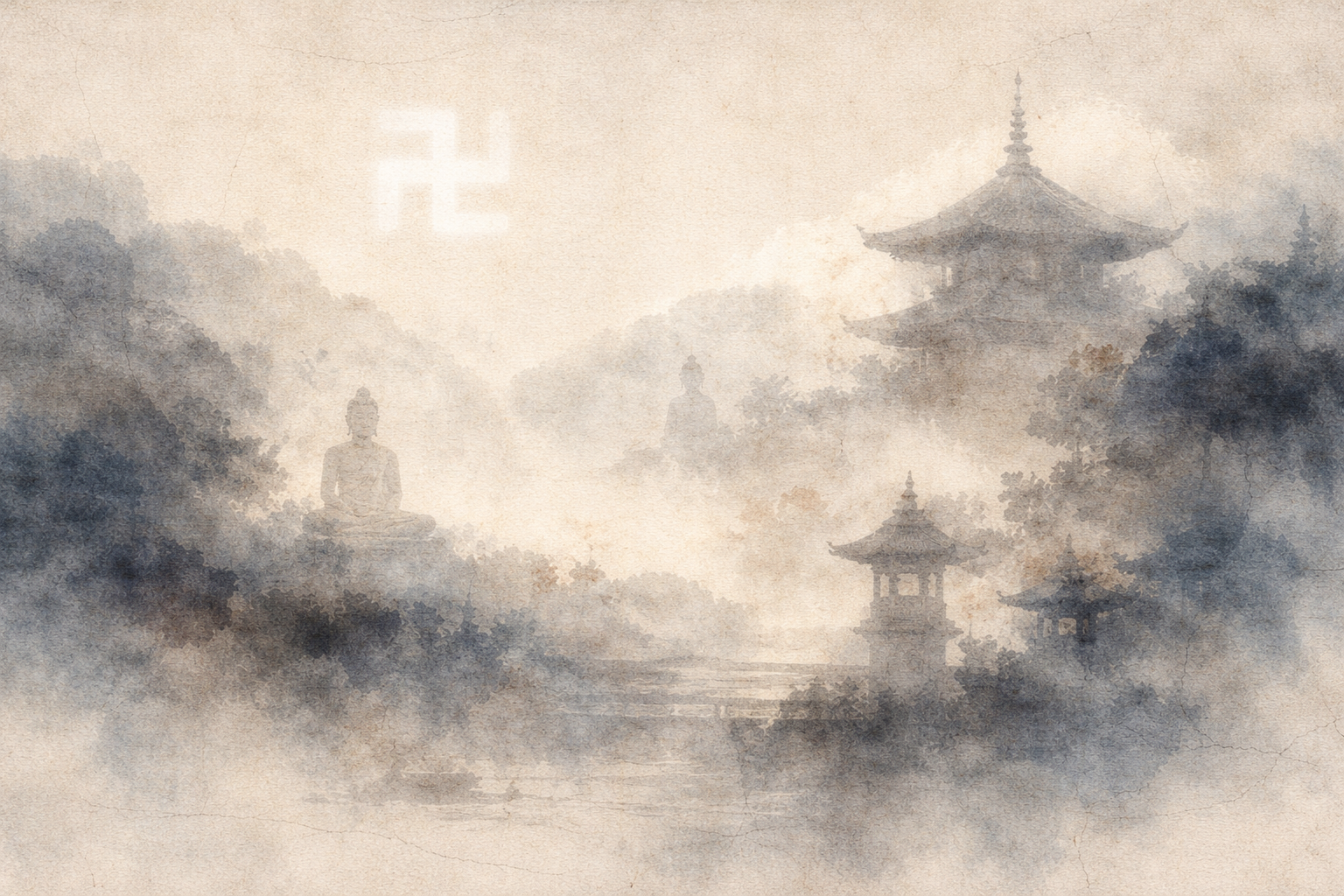
Quick Summary
- In Buddhism, the swastika is an ancient auspicious sign linked to well-being, completeness, and the “good” (svasti).
- Its meaning in Buddhist contexts is not political; it functions as a visual shorthand for beneficial qualities and the Buddha’s presence.
- You’ll see it on statues, temple maps, manuscripts, and art—often marking sacred space or the Buddha’s virtues.
- Direction (clockwise vs. counterclockwise) varies by region and usage; it doesn’t automatically signal “good” vs. “bad.”
- Modern trauma around the symbol is real; understanding the ancient meaning doesn’t erase the harm of later misuse.
- Context is everything: where it appears, how it’s drawn, and what tradition uses it shapes how it should be read.
- A careful approach helps you recognize Buddhist symbolism without minimizing history or causing avoidable distress.
The Ancient Meaning of the Swastika in Buddhism
You’re not confused for no reason: seeing a swastika in a Buddhist context can feel like a moral alarm bell, even when you’re looking at a temple, a statue, or a map that clearly has nothing to do with modern hate movements. The hard part is holding two truths at once—its ancient Buddhist meaning is auspicious and sacred, and its modern Western associations are painful and politically charged. I write about Buddhist symbols and how they function in real-world practice and culture at Gassho.
GASSHO
Ask and learn about Buddhism in daily life.
GASSHO is a Buddhist community app where you can learn Buddhist teachings and ask questions to the head priest of Kongosanmaiin Temple on Mount Koya.
A Symbol of Auspiciousness, Wholeness, and the Buddha’s Presence
The ancient meaning of the swastika in Buddhism is best understood as a lens for reading intention and context, not as a “belief you must accept.” In many Buddhist settings, the symbol points toward what is beneficial: good fortune, well-being, protection, and the sense that life can be oriented toward what is skillful and life-giving.
Even the word roots matter. The Sanskrit term svastika is commonly connected to svasti, a sense of “well-being” or “it is good.” In that older cultural world, the sign functioned like a compact visual blessing—less a statement and more a mark that says, “May things go well; may what is wholesome increase.”
Within Buddhist art and iconography, the swastika often appears as a sign associated with the Buddha and awakened qualities—sometimes depicted on the chest, feet, or palms in stylized ways, or used as a motif in temple decoration. In that role, it’s not asking you to think about ideology; it’s pointing you back to qualities like steadiness, generosity, and a mind that is not pulled apart by craving and aversion.
It also works as a practical marker. On maps in parts of Asia, the symbol can indicate a Buddhist temple the way a cross might indicate a church on a Western map. That usage is mundane and functional, but it still rests on the older meaning: “this is a place connected to the Buddha’s path and community.”
How the Meaning Shows Up When You Actually Notice It
Imagine you’re walking through a neighborhood and you spot the symbol on a sign or a building. Before you can “think,” your body may react—tightness in the stomach, heat in the face, a quick scan for danger. That reaction is not irrational; it’s learned from modern history and the way the symbol has been used in the last century.
Then the mind starts narrating. It may jump to certainty (“This is hateful”) or to dismissal (“It’s just a symbol”). Neither move is very accurate. The more helpful move is to slow down and look for context: Where is it placed? What else is around it? Is it on a temple gate, a statue, a map legend, a manuscript reproduction, or a political banner?
In a Buddhist context, the symbol often sits quietly among other cues: lotus imagery, statues, incense burners, prayer halls, or signage that clearly identifies a temple. When you take those cues in, the nervous system can begin to reclassify what it’s seeing—not by forcing comfort, but by updating the meaning based on evidence.
You may also notice a second layer: the mind’s urge to make the symbol “one thing.” But symbols rarely stay one thing across time and cultures. Seeing that complexity can be uncomfortable, yet it’s also clarifying. It allows you to acknowledge harm without rewriting ancient Buddhist usage into something it never was.
Sometimes the detail that catches attention is direction: clockwise or counterclockwise. People often assume one direction is “Buddhist” and the other is “Nazi,” but real-world usage is more varied. Different regions, artistic conventions, and contexts can influence how it’s drawn, and you can’t reliably read moral intent from direction alone.
What tends to shift the experience most is not winning an argument in your head, but practicing a simple sequence: notice the reaction, name the association, check the context, and choose a response that reduces harm. That might mean asking a respectful question, stepping away if you feel overwhelmed, or learning the local convention before making a public claim.
Over time, you may find you can hold a more precise view: the ancient meaning of the swastika in Buddhism can be honored as a symbol of auspiciousness and awakened qualities, while the modern Western meaning—shaped by genocide and propaganda—remains something to treat with gravity. Precision is not coldness; it’s care.
Common Misunderstandings That Create Unnecessary Harm
Mistake 1: “Buddhists adopted a Nazi symbol.” Historically, it’s the other way around: the symbol existed across many ancient cultures long before the 20th century, and it appears in Buddhist contexts as an auspicious sign with its own established meanings. The later political appropriation does not define the symbol’s entire history.
Mistake 2: “If it’s present, the place is endorsing hate.” In many Asian countries, the symbol is still used in its older, non-political sense—on temples, maps, and art. Assuming malicious intent without context can lead to false accusations and real harm to minority religious communities.
Mistake 3: “Direction tells you everything.” While people often use direction as a quick rule, it’s not a universal decoder. Artistic style, regional convention, and the specific tradition can all affect how it’s depicted. Contextual cues matter more than a single visual feature.
Mistake 4: “Explaining the ancient meaning excuses modern atrocities.” Clarifying Buddhist symbolism is not the same as minimizing history. A mature approach can acknowledge the symbol’s ancient auspicious meaning in Buddhism while also recognizing why many people feel fear or disgust when they see it today.
Mistake 5: “We should erase it everywhere to avoid discomfort.” Removing the symbol from Buddhist heritage can become a kind of cultural flattening—especially when it pressures Asian communities to conform to Western associations. Sensitivity is important, but so is respecting living traditions and their symbols.
Why This Symbol Still Matters in Daily Life
The ancient meaning of the swastika in Buddhism matters because symbols shape how we interpret people before we speak to them. If we misread a Buddhist temple’s iconography as extremist propaganda, we can turn ordinary religious life into a target of suspicion. That’s not just a misunderstanding; it can become discrimination.
It also matters because many of us live in multicultural spaces where meanings overlap. Learning to ask, “What does this mean here?” is a practical skill. It reduces reactive certainty and increases the chance of a respectful conversation—especially when the symbol triggers strong emotions.
On a personal level, encountering the symbol can become a moment to practice a basic human discipline: separating immediate association from careful seeing. That doesn’t mean suppressing your response. It means letting your response inform your attention rather than control it.
Finally, it matters for Buddhist communities navigating public perception. Some temples choose to explain the symbol openly; others adapt signage to avoid distress. There isn’t one perfect solution, but clarity helps: the ancient Buddhist meaning is auspicious, and modern viewers may need context to recognize that.
Conclusion
The ancient meaning of the swastika in Buddhism is rooted in auspiciousness, well-being, and the presence of awakened qualities—not in modern political ideology. The difficulty today is that many people encounter the symbol through the lens of 20th-century violence, and that lens is emotionally powerful. When you hold context carefully—without denial and without accusation—you can understand what the symbol has meant in Buddhism for centuries while still respecting why it can be painful to see.
Ask a Buddhist priest
Have a question about Buddhism?
In the GASSHO app, you can ask questions about Buddhist teachings, daily concerns, and how to understand Buddhism in everyday life.
Frequently Asked Questions
- FAQ 1: What is the ancient meaning of the swastika in Buddhism?
- FAQ 2: How is the Buddhist swastika different from the Nazi swastika?
- FAQ 3: Why does a swastika appear on Buddhist temples and statues?
- FAQ 4: Does the direction (clockwise vs. counterclockwise) change the ancient meaning of the swastika in Buddhism?
- FAQ 5: What does the word “swastika” mean in relation to Buddhism?
- FAQ 6: Is the swastika considered a sacred symbol in Buddhism?
- FAQ 7: What does the swastika symbolize on the Buddha’s body in Buddhist art?
- FAQ 8: Why do some maps use a swastika to mark Buddhist temples?
- FAQ 9: Is it accurate to say Buddhism “uses” the swastika?
- FAQ 10: Does the ancient Buddhist meaning of the swastika conflict with modern reactions to it?
- FAQ 11: Should Buddhist temples stop displaying the swastika because of its modern associations?
- FAQ 12: How can I tell if a swastika I’m seeing is being used in a Buddhist sense?
- FAQ 13: Is the swastika’s ancient meaning in Buddhism the same across all Buddhist cultures?
- FAQ 14: Is it disrespectful to ask a Buddhist community about the swastika’s meaning?
- FAQ 15: What is the simplest way to explain the ancient meaning of the swastika in Buddhism to someone who is alarmed by it?
FAQ 1: What is the ancient meaning of the swastika in Buddhism?
Answer: In Buddhist contexts, the swastika is traditionally an auspicious sign associated with well-being, beneficial fortune, and the presence of the Buddha’s qualities. It functions as a symbolic “mark” of what is wholesome and worthy of reverence rather than a political statement.
Takeaway: In Buddhism, the swastika’s ancient meaning is primarily auspicious and devotional.
FAQ 2: How is the Buddhist swastika different from the Nazi swastika?
Answer: The Buddhist swastika predates Nazism by many centuries and appears in religious art, temple signage, and sacred contexts as a symbol of auspiciousness. The Nazi swastika is a modern political appropriation tied to racist ideology and mass violence; its meaning is historically specific to that movement and its crimes.
Takeaway: Same basic shape, radically different historical context and intent.
FAQ 3: Why does a swastika appear on Buddhist temples and statues?
Answer: It’s used as an iconographic sign that points to the Buddha’s virtues and to auspiciousness—often marking a sacred space or a depiction of the Buddha. In some places it also serves a practical purpose, identifying a Buddhist temple on signs or maps.
Takeaway: On temples and statues, it usually signals sacredness and beneficial meaning.
FAQ 4: Does the direction (clockwise vs. counterclockwise) change the ancient meaning of the swastika in Buddhism?
Answer: Direction can vary by region and artistic convention, and it may carry different symbolic associations in different contexts. However, you generally cannot determine intent or “good vs. bad” meaning from direction alone; the surrounding context is more reliable.
Takeaway: Direction matters sometimes, but context matters more.
FAQ 5: What does the word “swastika” mean in relation to Buddhism?
Answer: The term is commonly linked to the Sanskrit root svasti, conveying well-being or “it is good.” In Buddhist usage, that linguistic background aligns with the symbol’s role as an auspicious sign and a visual blessing.
Takeaway: The word itself points toward well-being and auspiciousness.
FAQ 6: Is the swastika considered a sacred symbol in Buddhism?
Answer: In many Buddhist cultures it is treated as a meaningful religious sign, often appearing in sacred art and temple settings. “Sacred” here doesn’t mean magical; it means the symbol is used to represent and evoke revered qualities and the Buddha’s presence.
Takeaway: Yes—often sacred in function, representing revered qualities.
FAQ 8: Why do some maps use a swastika to mark Buddhist temples?
Answer: In some countries, the symbol is a conventional map icon indicating a Buddhist temple, similar to how other religions may have their own map markers. This usage reflects the symbol’s long-standing association with Buddhist sacred sites rather than political ideology.
Takeaway: On maps, it can be a neutral, conventional marker for temples.
FAQ 9: Is it accurate to say Buddhism “uses” the swastika?
Answer: It’s more accurate to say the swastika has been part of Buddhist visual culture in many regions for a very long time, carrying auspicious meanings. Buddhism didn’t invent the symbol, but it integrated it into its own iconography and public signage in ways that became culturally established.
Takeaway: Buddhism didn’t create it, but it has long used it in established symbolic ways.
FAQ 10: Does the ancient Buddhist meaning of the swastika conflict with modern reactions to it?
Answer: The meanings don’t “conflict” so much as they belong to different historical layers. The ancient Buddhist meaning is auspicious; modern Western reactions are shaped by the symbol’s 20th-century appropriation and the trauma attached to it. Both realities can be acknowledged without collapsing one into the other.
Takeaway: Ancient meaning and modern trauma can both be real at the same time.
FAQ 11: Should Buddhist temples stop displaying the swastika because of its modern associations?
Answer: There’s no single answer that fits every community. Some temples keep it as part of living heritage and provide explanation; others adjust public-facing displays to reduce distress. Any approach benefits from clarity: the ancient meaning in Buddhism is auspicious, while modern viewers may need context to understand that.
Takeaway: Communities balance heritage and public sensitivity in different ways.
FAQ 12: How can I tell if a swastika I’m seeing is being used in a Buddhist sense?
Answer: Look for contextual cues: placement on a temple, statue, altar, religious signage, or a map legend indicating a temple; accompanying Buddhist imagery (lotus motifs, Buddha figures, temple names); and the overall setting. Avoid relying on a single feature like direction alone.
Takeaway: Identify Buddhist usage by surrounding context, not quick assumptions.
FAQ 13: Is the swastika’s ancient meaning in Buddhism the same across all Buddhist cultures?
Answer: The broad theme of auspiciousness is common, but details of depiction and emphasis can vary by region, language, and artistic convention. What stays consistent is that, in Buddhist settings, it generally functions as a positive religious sign rather than a political emblem.
Takeaway: Shared auspicious theme, with cultural variations in how it’s shown.
FAQ 14: Is it disrespectful to ask a Buddhist community about the swastika’s meaning?
Answer: Not inherently—if asked with care. A respectful question focuses on understanding the ancient meaning of the swastika in Buddhism and acknowledges modern associations without accusing the community. Tone and timing matter, especially in public or ceremonial settings.
Takeaway: Asking is fine when it’s curious, contextual, and non-accusatory.
FAQ 15: What is the simplest way to explain the ancient meaning of the swastika in Buddhism to someone who is alarmed by it?
Answer: You can say: “In Buddhism, this is an ancient auspicious symbol connected to well-being and the Buddha’s qualities; it existed long before the Nazis, who later appropriated it for hateful purposes.” Then, if needed, add where it’s commonly seen (temples, statues, maps) and why context matters.
Takeaway: A short, contextual explanation can reduce confusion without minimizing history.