



Buddhist Swastika Meaning: How It Differs from the Nazi Symbol
Quick Summary
- In Buddhism, the swastika is an ancient symbol of auspiciousness, well-being, and good fortune.
- Its meaning in Buddhist contexts is historically separate from the Nazi appropriation in the 20th century.
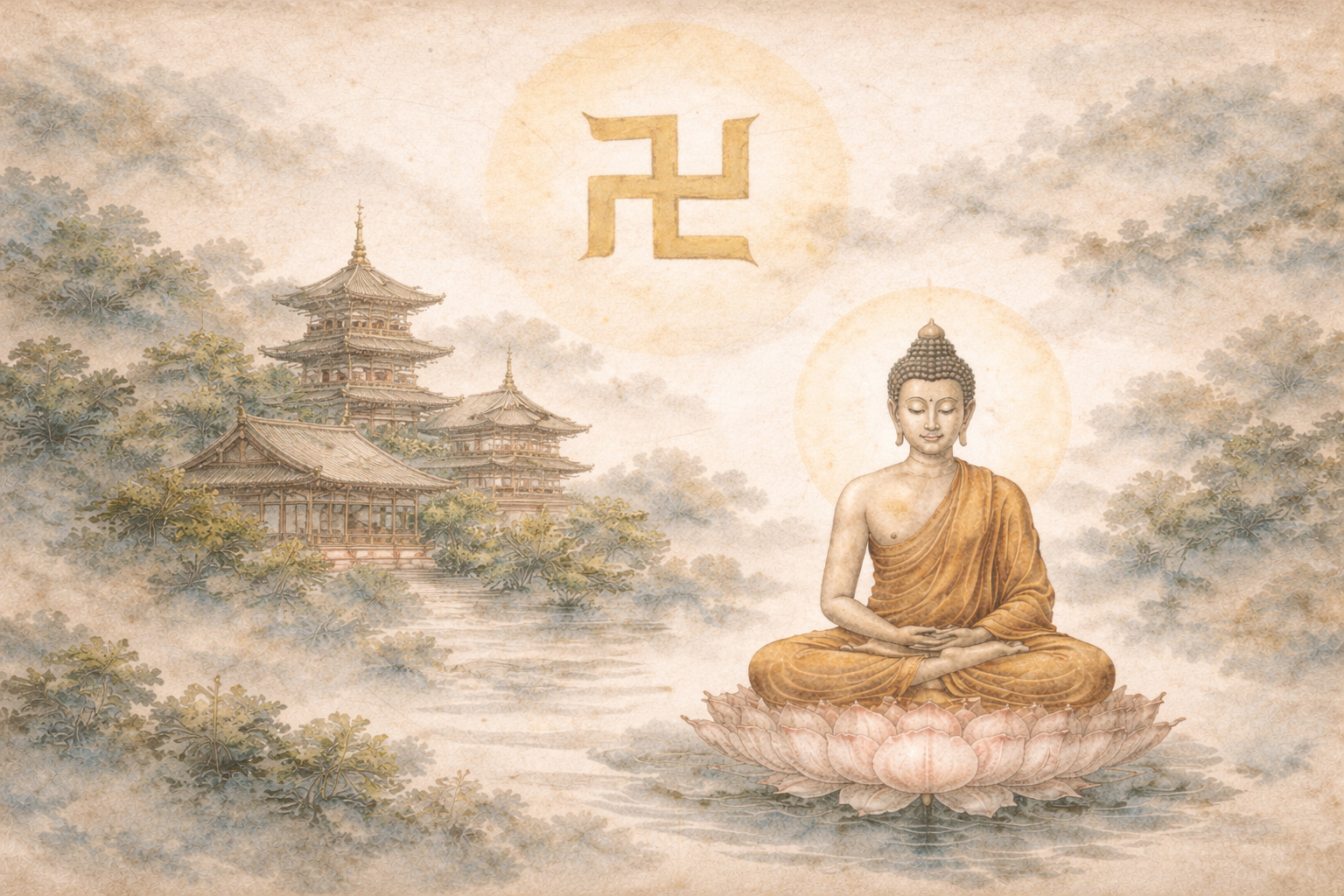
- You’ll see it on statues, temple maps, manuscripts, and art as a sign of the Buddha’s virtues and the Dharma.
- Direction matters: in many East Asian settings the left-facing form is common, but usage varies by region and tradition.
- In Japan, it’s widely used on maps to mark Buddhist temples (manji), though some maps now offer alternate icons for visitors.
- Context is everything: placement, surrounding imagery, and cultural setting usually make the intended meaning clear.
- A respectful response balances historical truth with sensitivity to people harmed by the symbol’s modern misuse.
Introduction
If you’ve seen the swastika symbol in a Buddhist temple, on a statue, or even on a map in Asia, the reaction can be immediate: confusion, alarm, or the feeling that something is “wrong.” That reaction makes sense in a world shaped by 20th-century history, but it can also hide a simpler truth: in Buddhism, this symbol has long meant something closer to blessing and wholeness than hatred. At Gassho, we focus on clear, historically grounded explanations that respect both Buddhist culture and modern trauma.
The swastika is one of those symbols where meaning isn’t a private opinion—it’s carried by time, place, and use. In Buddhist contexts, it appears as a visual shorthand for what is considered fortunate, stable, and life-affirming: the flourishing of wisdom and compassion, the continuity of teachings, and the wish that beings be well.
At the same time, it’s impossible to talk about the swastika symbol in Buddhism without acknowledging the Nazi appropriation and the harm associated with it. A mature understanding holds both realities: the symbol’s ancient, widespread auspicious meaning and its modern weaponization in the West.
A Clear Lens for Understanding the Buddhist Swastika
A helpful way to understand the swastika symbol in Buddhism is to treat it as a cultural “signpost,” not a doctrinal test. It points toward qualities Buddhism values—well-being, stability, and the wish for things to go well for living beings—without requiring you to adopt a belief or join a group.
In many Buddhist settings, the symbol functions like other auspicious marks found across Asian art: it signals blessing, protection, and the presence of something revered. When it appears on the chest, feet, or palms of a Buddha image, it often indicates an auspicious mark associated with awakened qualities—less a “logo,” more a visual reminder of what the figure represents.
This lens also keeps the conversation grounded: meaning is not only in the shape, but in the context. A swastika carved among lotus motifs, placed on a temple sign, or printed in a sutra carries a different message than the same shape used as a political emblem. Buddhism doesn’t ask you to ignore context; it asks you to see clearly what’s actually happening.
Finally, this perspective makes room for complexity. A symbol can be ancient and beneficial in one setting and deeply painful in another. Understanding the swastika symbol in Buddhism doesn’t require minimizing anyone’s suffering; it requires accuracy about history and care in how we relate to what we see.
GASSHO
Ask and learn about Buddhism in daily life.
GASSHO is a Buddhist community app where you can learn Buddhist teachings and ask questions to the head priest of Kongosanmaiin Temple on Mount Koya.
How the Symbol Shows Up in Ordinary Experience
Imagine walking into a temple courtyard and noticing the symbol on a sign or lantern. The mind often moves fast: recognition, association, judgment. Before you even decide what you think, your body may tighten and your attention may narrow.
In that moment, it can be useful to notice the difference between “seeing” and “concluding.” Seeing is the raw perception: a geometric form. Concluding is the story that arrives a split second later: what it must mean, what it says about the place, what it implies about the people there.
When you slow down, context starts to come back into view. What else is present? A Buddha statue, incense, chanting, offerings, families visiting quietly. The environment may not match the story your mind initially produced, and that mismatch is informative.
It’s also common to feel two things at once: “I understand this is a Buddhist symbol” and “I still feel unsettled.” That’s not hypocrisy; it’s how conditioning works. Associations can be strong even when your reasoning is clear.
From there, a practical inner move is possible: you can let the reaction be present without letting it drive the whole experience. Instead of forcing yourself to be comfortable, you can allow discomfort while staying curious about what the symbol means here, in this place, for these people.
If you’re traveling, you might notice another everyday layer: translation. Locals may not anticipate the Western reaction because, for them, the symbol has never primarily meant what it came to mean in Europe and North America. That gap can feel jarring, but it’s also a real-world lesson in how symbols live inside cultures.
And if you’re practicing in a diverse community, you may notice the social dimension: some people want to explain, some want to avoid the topic, some feel hurt, some feel defensive. The symbol becomes a mirror for how we handle tension—whether we can stay honest, kind, and precise at the same time.
Common Confusions and Pain Points
Misunderstanding 1: “A swastika is always a Nazi symbol.” Historically, no. The swastika existed for centuries across many cultures, including Buddhist cultures, long before the Nazi party adopted a version of it. The Nazi use is real and horrific, but it is not the symbol’s only history.
Misunderstanding 2: “Buddhists are using it to be provocative.” In most Buddhist contexts, the symbol is used because it is traditional and auspicious, not because it is meant to shock. In many places in Asia, it is as ordinary as seeing a cross on a church sign in the West.
Misunderstanding 3: “Direction proves intent.” People often hear that one direction is “Buddhist” and the other is “Nazi.” Reality is messier. Nazi iconography typically used a right-facing form rotated on a tilt, but Buddhist usage varies by region, art style, and historical convention. Direction can be a clue, not a final verdict.
Misunderstanding 4: “If it’s ancient, it can’t be harmful.” Even when a symbol’s original meaning is positive, it can still cause pain in modern settings. A compassionate approach doesn’t demand that everyone feel fine; it acknowledges impact while still telling the truth about origin and use.
Misunderstanding 5: “Removing it is the only respectful option.” Sometimes communities do choose alternate icons in public-facing contexts (like tourist maps), but removal isn’t the only respectful response. Education, contextual signage, and careful design choices can preserve tradition while reducing misunderstanding.
Why This Symbol Still Matters Today
The swastika symbol in Buddhism matters because it forces a real conversation about how meaning is made. Symbols aren’t fixed objects; they’re living agreements between people, shaped by history. When history fractures, the same shape can carry radically different messages.
For Buddhist communities, the symbol can be a thread of continuity—an inherited mark of auspiciousness and protection that appears in art, ritual objects, and temple signage. For many Westerners, it can be a trigger tied to violence and dehumanization. Both experiences are real, and neither is improved by pretending the other doesn’t exist.
On a practical level, understanding reduces unnecessary conflict. Travelers can avoid misreading a temple as extremist. Buddhist communities in the West can anticipate questions and respond with clarity rather than defensiveness. Museums and educators can present the symbol with context that is historically accurate and emotionally aware.
On a personal level, it’s also a chance to practice a basic human skill: holding a strong reaction while staying committed to truth. That doesn’t mean overriding your feelings. It means letting your understanding become wide enough to include both the ancient Buddhist meaning and the modern Western wound.
Conclusion
The swastika symbol in Buddhism is, at its root, a sign of auspiciousness—an old visual language for well-being, good fortune, and the presence of something worthy of reverence. The fact that it was later appropriated for hatred does not erase its Buddhist meaning, but it does change how the symbol lands in many modern minds.
If you encounter it in a Buddhist context, the most grounded response is simple: pause, look at the setting, and let context speak. You can respect the symbol’s traditional meaning without dismissing the pain attached to its modern misuse. That balance—accuracy with care—is the real practice here.
Ask a Buddhist priest
Have a question about Buddhism?
In the GASSHO app, you can ask questions about Buddhist teachings, daily concerns, and how to understand Buddhism in everyday life.
Frequently Asked Questions
- FAQ 1: What does the swastika symbol mean in Buddhism?
- FAQ 2: Is the swastika in Buddhism the same symbol used by the Nazis?
- FAQ 3: Why do Buddhist temples display the swastika symbol?
- FAQ 4: What is the difference between the left-facing and right-facing swastika in Buddhism?
- FAQ 5: Is the Buddhist swastika ever rotated like the Nazi symbol?
- FAQ 6: What is the Japanese “manji” symbol and how is it related to Buddhism?
- FAQ 7: Why is the swastika used on maps in some Buddhist countries?
- FAQ 8: Does the swastika appear in Buddhist scriptures or only in art?
- FAQ 9: Is the swastika considered a sacred symbol in Buddhism?
- FAQ 10: How should I respond if I see the swastika symbol in a Buddhist temple?
- FAQ 11: Is it offensive to display the Buddhist swastika in Western countries?
- FAQ 12: Can the swastika in Buddhism be translated as “good luck”?
- FAQ 13: Is the swastika symbol used in all forms of Buddhism?
- FAQ 14: Is it appropriate for a non-Buddhist to wear the swastika symbol in a Buddhist sense?
- FAQ 15: How can I tell whether a swastika is being used as a Buddhist symbol or as hate symbolism?
FAQ 1: What does the swastika symbol mean in Buddhism?
Answer: In Buddhism, the swastika is widely used as an auspicious sign associated with well-being, good fortune, and the presence of the Buddha’s virtues and teachings. It commonly appears in Buddhist art, temple markings, and manuscripts as a positive emblem rather than a political one.
Takeaway: In Buddhist contexts, the swastika is traditionally a symbol of auspiciousness and Dharma.
FAQ 2: Is the swastika in Buddhism the same symbol used by the Nazis?
Answer: The shape is related, but the meaning and historical use are not the same. The Nazi party appropriated a version of the symbol in the 20th century and tied it to racism and violence. Buddhist use predates that by many centuries and is not rooted in Nazi ideology.
Takeaway: The Nazi use was an appropriation; Buddhist use is older and has a different meaning.
FAQ 3: Why do Buddhist temples display the swastika symbol?
Answer: Buddhist temples display it because it is traditionally considered a fortunate, protective, and sacred mark. Depending on the region, it may indicate the Buddha’s auspicious marks, symbolize the Dharma, or simply function as a conventional sign associated with Buddhist spaces.
Takeaway: Temples use it as a traditional auspicious emblem, not as a modern political statement.
FAQ 4: What is the difference between the left-facing and right-facing swastika in Buddhism?
Answer: Usage varies by region and artistic convention. In many East Asian contexts, a left-facing form is common, while other areas may use different orientations. Direction can carry specific symbolic associations in some settings, but it is not a universal “good vs. bad” rule across all Buddhist cultures.
Takeaway: Orientation can vary; it doesn’t automatically determine meaning without context.
FAQ 5: Is the Buddhist swastika ever rotated like the Nazi symbol?
Answer: Buddhist swastikas are typically shown flat (upright) in many traditional designs, but rotation and stylization can occur in art. Because styles differ across time and place, the safest approach is to read the symbol within its surrounding Buddhist imagery and setting.
Takeaway: Stylization varies; interpret the symbol through its Buddhist context.
FAQ 6: What is the Japanese “manji” symbol and how is it related to Buddhism?
Answer: In Japan, the swastika is commonly called “manji” and is strongly associated with Buddhism. It is used in temple iconography and has also been used on maps to mark Buddhist temples, reflecting its conventional religious meaning in Japan.
Takeaway: “Manji” is the Japanese term for the Buddhist swastika and is widely recognized as a temple-associated symbol.
FAQ 7: Why is the swastika used on maps in some Buddhist countries?
Answer: In places such as Japan, the symbol has been used as a map icon to indicate a Buddhist temple. Because many international visitors associate the shape with Nazism, some mapmakers now provide alternate icons or explanations, but the original intent is simply “temple here.”
Takeaway: On maps, it often functions as a practical temple marker, not an ideological sign.
FAQ 8: Does the swastika appear in Buddhist scriptures or only in art?
Answer: It appears in multiple ways: as a decorative or symbolic mark in manuscripts, in temple and ritual design, and in iconography on statues and paintings. Its use is generally symbolic and cultural rather than a “required” scriptural element for all Buddhists.
Takeaway: The symbol shows up in both Buddhist material culture and manuscript traditions.
FAQ 9: Is the swastika considered a sacred symbol in Buddhism?
Answer: In many Buddhist communities it is treated as sacred or at least highly auspicious, especially when placed on or near Buddha images, temple objects, or religious texts. The level of “sacredness” can vary by culture, but it is generally not viewed as a casual decoration.
Takeaway: It is commonly regarded as an auspicious, often sacred, Buddhist emblem.
FAQ 10: How should I respond if I see the swastika symbol in a Buddhist temple?
Answer: Pause and read the context: temple setting, Buddha imagery, and local cultural cues usually indicate the traditional Buddhist meaning. If you feel unsure, it’s appropriate to ask respectfully what it signifies there, without assuming hostile intent.
Takeaway: Context first, then questions—avoid instant conclusions.
FAQ 11: Is it offensive to display the Buddhist swastika in Western countries?
Answer: It can be, depending on audience and setting, because many people in the West primarily associate the symbol with Nazi violence. Buddhist communities may still use it as part of their heritage, but public display often benefits from added context (signage, explanation, or careful placement).
Takeaway: In the West, impact can differ from intent; context and sensitivity matter.
FAQ 12: Can the swastika in Buddhism be translated as “good luck”?
Answer: “Good luck” can be a rough, simplified translation of its auspicious function, but it may miss the fuller sense: well-being, flourishing, and a благоприятный (favorable) sign connected with the Buddha’s qualities and the Dharma. It’s more like “auspiciousness” than a casual lucky charm.
Takeaway: “Good luck” is close, but “auspiciousness” is usually more accurate.
FAQ 13: Is the swastika symbol used in all forms of Buddhism?
Answer: It is widespread across many Buddhist cultures, especially in Asian art and temple symbolism, but visibility varies by region and community. Some Buddhist groups may rarely display it, particularly in Western settings where it is easily misunderstood.
Takeaway: It’s common historically, but not equally visible everywhere today.
FAQ 14: Is it appropriate for a non-Buddhist to wear the swastika symbol in a Buddhist sense?
Answer: Even if your intent is respectful, wearing it in many Western contexts can cause harm or be misread as extremist signaling. If you want to honor Buddhist symbolism, consider alternatives that communicate your intent clearly, or use the symbol only in settings where its Buddhist meaning is understood.
Takeaway: Intent may be good, but public interpretation can be dangerous—choose context carefully.
FAQ 15: How can I tell whether a swastika is being used as a Buddhist symbol or as hate symbolism?
Answer: Look at context and companions: Buddhist use typically appears with temple architecture, Buddha images, lotus motifs, sutra text, or other religious markers, and is often presented as part of a broader sacred design. Hate symbolism is more likely to appear with extremist slogans, political insignia, aggressive messaging, or deliberate provocation. When in doubt, don’t assume—seek local explanation or reliable cultural context.
Takeaway: Surrounding context usually clarifies intent; avoid snap judgments.