



Eight Sacred Symbols of Buddhism: Meaning Behind Each Symbol
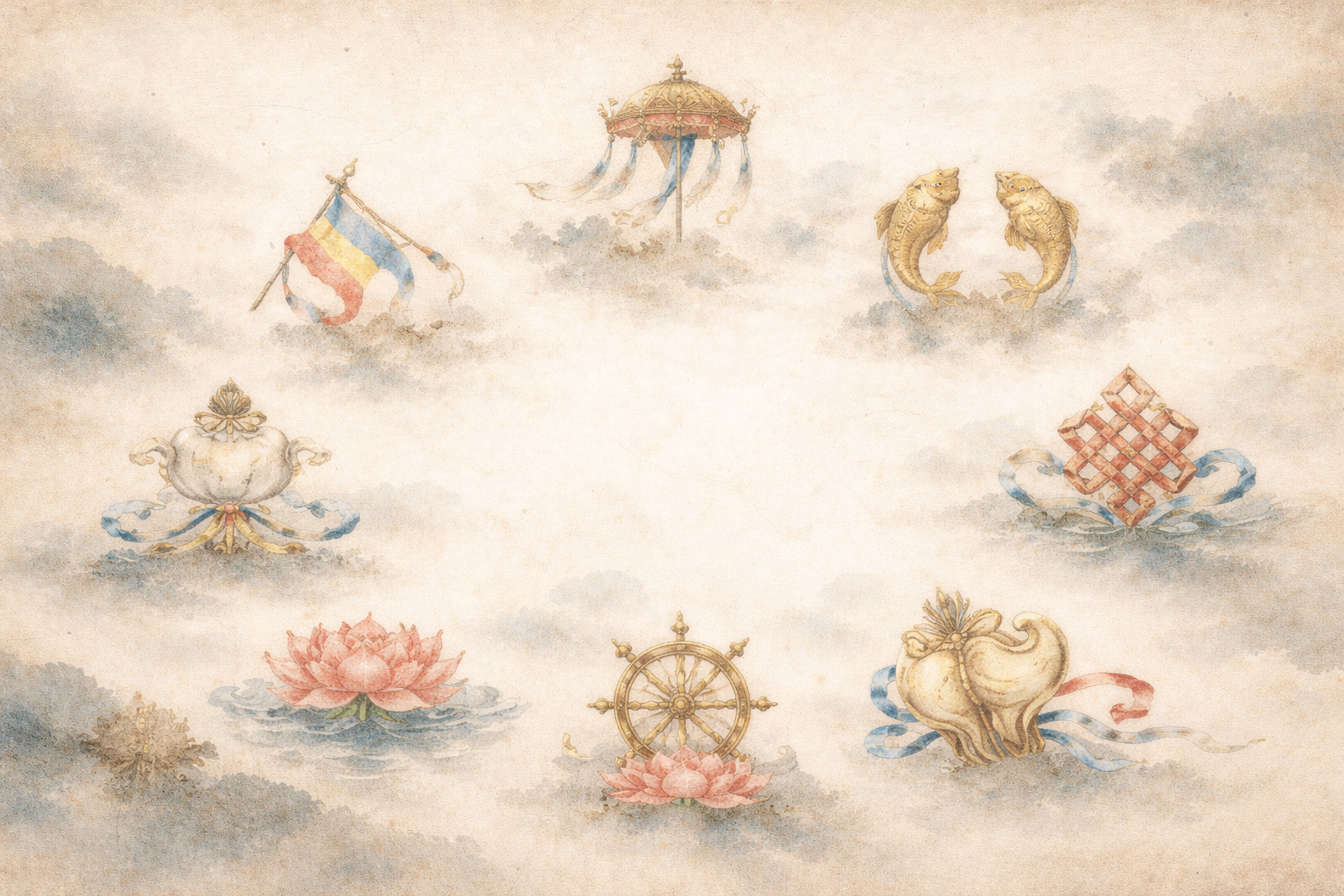
Quick Summary
- The “eight sacred symbols” (Ashtamangala) are a visual shorthand for key Buddhist values and practices.
- They’re not random decorations: each symbol points to a specific aspect of awakening and daily conduct.
- The set commonly includes: Parasol, Golden Fish, Treasure Vase, Lotus, Conch Shell, Endless Knot, Victory Banner, and Dharma Wheel.
- Meanings overlap on purpose—together they form a complete “map” rather than eight separate slogans.
- Different regions may depict them slightly differently, but the core intent stays consistent.
- Reading them well means treating them as prompts for attention, ethics, and clarity—not as superstition.
- You can use them as a simple reflection practice: notice, name, and apply one symbol to one moment.
Introduction: Why These Eight Symbols Keep Showing Up
You’ve probably seen the eight sacred symbols of Buddhism on temple walls, thangkas, jewelry, or even modern “Zen” décor—and the confusion is understandable: the images look beautiful, but the meaning behind the eight sacred symbols of Buddhism often feels vague, contradictory, or reduced to feel-good captions. At Gassho, we focus on clear, practice-oriented explanations that respect tradition without turning it into mystery.
The traditional set is often called the Ashtamangala, “eight auspicious signs,” and “auspicious” here doesn’t mean lucky in a slot-machine way. It points to what supports well-being: protection from overwhelm, steadiness in change, and the kind of insight that makes life less reactive.
Think of these symbols as a visual language. Each one is a compact reminder of a human capacity—discernment, resilience, generosity, clarity, and the ability to untangle habits that keep repeating.
Below, we’ll unpack each symbol’s meaning in plain English, then connect the set to ordinary experience so the images stop being “Buddhist wallpaper” and start functioning as practical cues.
A Practical Lens for Understanding the Eight Sacred Symbols
The meaning behind the eight sacred symbols of Buddhism becomes clearer when you treat them as a single lens rather than eight separate facts to memorize. Each symbol highlights one angle of a life that is less driven by grasping, aversion, and confusion—patterns that show up in everyone, religious or not.
In this lens, “symbol” doesn’t mean “mere metaphor.” It means a compact pointer: an image that can be recalled quickly when the mind is busy. The symbols work like reminders you can carry without needing a long explanation in the moment.
Also, the set is intentionally balanced. Some symbols emphasize protection and stability (parasol, vase). Others emphasize clarity and communication (conch, wheel). Others emphasize transformation and interdependence (lotus, endless knot). Together, they describe a whole path of living: how you meet difficulty, how you relate to others, and how you keep returning to what’s true.
Finally, it helps to hold the meanings lightly. Different cultures and artists stress different nuances, but the point is consistent: these are prompts for practice—ways to remember what matters when you’re pulled into habit.
GASSHO
Ask and learn about Buddhism in daily life.
GASSHO is a Buddhist community app where you can learn Buddhist teachings and ask questions to the head priest of Kongosanmaiin Temple on Mount Koya.
The Eight Sacred Symbols and What Each One Points To
Here is a grounded, widely shared way to understand the meaning behind the eight sacred symbols of Buddhism. Consider each meaning as a “direction,” not a rigid definition.
- Parasol (Chatra): Protection and dignity. It suggests shelter from the heat of agitation—an inner shade that comes from steadiness, ethical restraint, and wise boundaries.
- Golden Fish: Freedom and ease in the “waters” of life. Often read as moving without fear of drowning—an image for confidence, adaptability, and unforced well-being.
- Treasure Vase: Abundance that doesn’t run out when shared. It points to generosity, inner resources, and the surprising fact that clarity and kindness increase through use.
- Lotus: Purity and transformation. The lotus grows from mud yet blooms clean—an image for how difficult conditions can become the very ground for wisdom and compassion.
- Conch Shell: The clear call of truth. Traditionally associated with a far-reaching sound, it points to communication that is direct, beneficial, and timely—speech that wakes rather than wounds.
- Endless Knot: Interdependence and continuity. It reflects how causes and conditions weave together, and how our choices echo—inviting responsibility without fatalism.
- Victory Banner: The triumph of clarity over confusion. Not victory over other people, but over inner compulsions—habits that keep recycling stress.
- Dharma Wheel (Dharmachakra): The path in motion. It points to teachings that “turn” the mind toward understanding, and to a life guided by discernment rather than impulse.
Notice how the set moves from inner stability (parasol) to freedom (fish), to generosity (vase), to transformation (lotus), to communication (conch), to interdependence (knot), to resilience (banner), and finally to an integrated path (wheel). You can read it as a complete cycle of practice: steady the mind, live freely, give, transform, speak clearly, see connections, persist, and keep returning to the path.
How These Symbols Show Up in Ordinary Moments
In daily life, the meaning behind the eight sacred symbols of Buddhism becomes most useful when it’s tied to small, repeatable moments—especially the moments you usually rush past.
You’re in a conversation and feel your body tighten because you want to be right. The parasol can be remembered as “shade”: a pause that protects you from the heat of immediate reaction. Not suppression—just a small shelter where you can choose your next sentence.
You’re juggling tasks and notice a low-grade fear of falling behind. The golden fish can be a cue to soften the struggle: breathe, feel the “water” you’re in, and move one stroke at a time. The point isn’t to become carefree; it’s to stop adding panic on top of effort.
You’re tempted to hold back help because you feel depleted. The treasure vase points to a different experiment: give in a way that is sustainable—one honest message, one small act, one clear boundary. Abundance here isn’t endless output; it’s the discovery that wise giving doesn’t always drain you.
You notice an old habit returning—irritation, avoidance, doom-scrolling, self-criticism. The lotus reframes the moment: “This is the mud.” Instead of treating the habit as proof of failure, you treat it as material for attention. You don’t romanticize it; you use it.
You’re about to speak, and you can feel the pull toward sarcasm or a sharp “truth.” The conch is a reminder that clarity can be kind. You can ask: Is this accurate? Is it necessary? Is this the right time? The symbol doesn’t demand silence; it invites clean speech.
You replay a conflict and keep searching for a single villain—either them or you. The endless knot interrupts that simplification. It nudges you to see conditions: fatigue, misunderstanding, history, tone, timing. Seeing the weave doesn’t excuse harm; it makes your response more intelligent.
And when you feel discouraged—like you’ll never change—the victory banner and Dharma wheel work together. The banner says, “Confusion is not permanent.” The wheel says, “Return to the next right step.” Not a grand reset—just the next turn of the wheel: one honest action, one moment of attention, one repair.
Common Misreadings That Flatten Their Meaning
One common misunderstanding is treating the eight sacred symbols as a “good luck set.” While they’re called auspicious, their power is primarily practical: they remind you of causes that lead to well-being—like restraint, generosity, and clarity—rather than promising outcomes regardless of behavior.
Another misreading is assuming each symbol has only one official meaning. In reality, symbols are designed to carry layers. The lotus can point to purity, yes, but also to patience, gradual unfolding, and the possibility of dignity even in messy circumstances.
People also sometimes interpret the victory banner as conquest over others. That flips the direction. The “victory” is over inner confusion: the repetitive loops that keep you reactive, harsh, or numb.
Finally, it’s easy to treat the Dharma wheel as a purely religious emblem and stop there. But as a lived symbol, it’s about momentum: what you repeatedly return to becomes your path. The wheel asks what you’re practicing—intentionally or accidentally—every day.
Why the Eight Symbols Still Matter in Modern Life
The meaning behind the eight sacred symbols of Buddhism matters because modern life is rich in information but poor in reminders. We know what we “should” do, yet we forget in the moment of pressure. Symbols solve that problem by being fast: one image can recall an entire orientation.
They also balance the inner and outer sides of practice. The parasol and banner speak to inner steadiness; the conch speaks to how you affect others through speech; the endless knot speaks to systems and consequences; the vase speaks to giving and receiving. The set quietly insists that wisdom isn’t private—it shows up in how you live.
Most importantly, the symbols are non-technical. You don’t need specialized vocabulary to use them. You can simply ask, “Which symbol is most relevant to this moment?” and let that question guide one small choice.
If you want a simple practice, choose one symbol for a week. Put it somewhere you’ll see it. When you notice stress, recall its cue—shade, freedom, abundance, blooming, clear sound, interweaving, resilience, returning—and apply it in a single concrete action.
Conclusion: A Set of Images That Point Back to Practice
The meaning behind the eight sacred symbols of Buddhism isn’t locked inside art history or hidden doctrine. It’s closer to a pocket-sized guide for living: protect the mind from needless heat, move with less fear, give wisely, transform difficulty, speak clearly, see connections, persist through confusion, and keep returning to the path.
If you’ve been seeing these symbols as decoration, try meeting them as prompts. The shift is subtle but real: the images stop being “about Buddhism” and start being about your next moment.
Ask a Buddhist priest
Have a question about Buddhism?
In the GASSHO app, you can ask questions about Buddhist teachings, daily concerns, and how to understand Buddhism in everyday life.
Frequently Asked Questions
- FAQ 1: What are the eight sacred symbols of Buddhism?
- FAQ 2: What is the meaning behind the eight sacred symbols of Buddhism as a group?
- FAQ 3: What does the Parasol symbolize in the eight sacred symbols?
- FAQ 4: What is the meaning of the Golden Fish among the eight sacred symbols of Buddhism?
- FAQ 5: What does the Treasure Vase represent in the meaning behind the eight sacred symbols of Buddhism?
- FAQ 6: What is the lotus meaning in the eight sacred symbols of Buddhism?
- FAQ 7: What does the Conch Shell symbolize in the eight sacred symbols?
- FAQ 8: What is the meaning of the Endless Knot in the eight sacred symbols of Buddhism?
- FAQ 9: What does the Victory Banner mean among the eight sacred symbols of Buddhism?
- FAQ 10: What is the meaning of the Dharma Wheel in the eight sacred symbols of Buddhism?
- FAQ 11: Are the meanings behind the eight sacred symbols of Buddhism the same in every country?
- FAQ 12: Why are the eight sacred symbols called “auspicious” if Buddhism isn’t about superstition?
- FAQ 13: How can I remember the meaning behind the eight sacred symbols of Buddhism without memorizing long definitions?
- FAQ 14: Do the eight sacred symbols of Buddhism have to be used together, or can one symbol stand alone?
- FAQ 15: What is the best way to apply the meaning behind the eight sacred symbols of Buddhism in daily life?
FAQ 1: What are the eight sacred symbols of Buddhism?
Answer: The eight sacred symbols (often called the Ashtamangala) are a traditional set of auspicious signs: the Parasol, Golden Fish, Treasure Vase, Lotus, Conch Shell, Endless Knot, Victory Banner, and Dharma Wheel. They’re used in Buddhist art and ritual as reminders of qualities that support awakening and well-being.
Takeaway: The set is a visual “summary” of key Buddhist values and practices.
FAQ 2: What is the meaning behind the eight sacred symbols of Buddhism as a group?
Answer: As a group, they point to a complete orientation for living: steadiness under pressure, freedom from fear, generosity, transformation of difficulty, clear communication, understanding interdependence, resilience against confusion, and returning to a path of discernment.
Takeaway: Read them as one integrated lens, not eight disconnected icons.
FAQ 3: What does the Parasol symbolize in the eight sacred symbols?
Answer: The Parasol symbolizes protection and dignity—often understood as shelter from the “heat” of agitation and harmful impulses. It can be read as the support of wise boundaries, ethical restraint, and inner composure.
Takeaway: The Parasol points to steadiness that protects the mind.
FAQ 4: What is the meaning of the Golden Fish among the eight sacred symbols of Buddhism?
Answer: The Golden Fish commonly symbolizes freedom, ease, and fearlessness—moving through life’s changing conditions like a fish through water. It can also suggest good fortune in the sense of supportive conditions for practice and well-being.
Takeaway: The Golden Fish points to unforced movement and less fear.
FAQ 5: What does the Treasure Vase represent in the meaning behind the eight sacred symbols of Buddhism?
Answer: The Treasure Vase represents abundance, generosity, and inexhaustible resources—especially inner resources like clarity, patience, and compassion. It’s often understood as “fullness” that can be shared without being diminished when shared wisely.
Takeaway: The Vase reminds you that wholesome qualities grow through use.
FAQ 6: What is the lotus meaning in the eight sacred symbols of Buddhism?
Answer: The Lotus symbolizes purity and transformation: it rises from muddy water and blooms clean. In practice terms, it points to the possibility of wisdom and compassion emerging from difficult conditions rather than requiring perfect circumstances.
Takeaway: The Lotus reframes “mess” as workable material for growth.
FAQ 7: What does the Conch Shell symbolize in the eight sacred symbols?
Answer: The Conch Shell symbolizes the clear, far-reaching call of truth and beneficial communication. It’s often associated with speech that is direct and helpful—words that clarify rather than inflame.
Takeaway: The Conch points to clarity in how you speak and share what’s true.
FAQ 8: What is the meaning of the Endless Knot in the eight sacred symbols of Buddhism?
Answer: The Endless Knot symbolizes interdependence, continuity, and the weaving together of causes and conditions. It can remind you that actions have consequences and that life is shaped by many connected factors, not single causes.
Takeaway: The Knot encourages responsibility with a wider view of what shapes events.
FAQ 9: What does the Victory Banner mean among the eight sacred symbols of Buddhism?
Answer: The Victory Banner symbolizes the victory of clarity over confusion—overcoming inner obstacles like compulsive reactivity, discouragement, and delusion. It’s not about defeating others; it’s about not being ruled by unhelpful patterns.
Takeaway: The Banner points to resilience and the possibility of change.
FAQ 10: What is the meaning of the Dharma Wheel in the eight sacred symbols of Buddhism?
Answer: The Dharma Wheel symbolizes the teachings and the lived path—often described as the “turning” of understanding that guides actions, speech, and attention. It can also suggest momentum: what you repeatedly practice becomes your direction.
Takeaway: The Wheel reminds you to return to a path of discernment again and again.
FAQ 11: Are the meanings behind the eight sacred symbols of Buddhism the same in every country?
Answer: The core themes are widely shared, but emphasis and artistic depiction can vary by region and culture. Some explanations highlight ethical conduct, others focus on inner qualities, and some add additional layers—yet the symbols still function as reminders of supportive conditions for awakening.
Takeaway: Expect consistent themes with local nuances, not one rigid “official” glossary.
FAQ 12: Why are the eight sacred symbols called “auspicious” if Buddhism isn’t about superstition?
Answer: “Auspicious” can be understood as “supportive” rather than magical. The symbols point to causes of well-being—like clarity, generosity, and wise restraint—so they’re auspicious in the sense that they remind you of what tends to reduce suffering and increase stability.
Takeaway: Their “luck” is practice-based: they point to helpful causes and conditions.
FAQ 13: How can I remember the meaning behind the eight sacred symbols of Buddhism without memorizing long definitions?
Answer: Use a single keyword for each: Parasol (shade), Fish (ease), Vase (abundance), Lotus (bloom), Conch (clear speech), Knot (connection), Banner (resilience), Wheel (return). Then link each keyword to one small action you can do in a stressful moment.
Takeaway: Pair each symbol with a short cue and a concrete behavior.
FAQ 14: Do the eight sacred symbols of Buddhism have to be used together, or can one symbol stand alone?
Answer: One symbol can absolutely stand alone as a reminder (for example, the Lotus or Dharma Wheel). The full set is often used together because it creates a balanced picture—inner stability, ethical expression, and insight working as a whole.
Takeaway: A single symbol can be a focused prompt; the set offers a complete balance.
FAQ 15: What is the best way to apply the meaning behind the eight sacred symbols of Buddhism in daily life?
Answer: Choose one symbol for the day, watch for a moment of reactivity, and use the symbol as a cue to pause and respond differently—shade yourself (Parasol), speak cleanly (Conch), see conditions (Endless Knot), or return to your values (Dharma Wheel). Keep it small and repeatable.
Takeaway: The symbols work best as quick prompts for one better choice in one real moment.