



Why the Eight Buddhist Symbols Are Important
Quick Summary
- The Eight Buddhist Symbols matter because they translate big teachings into simple visual reminders you can actually remember.
- They work like a “practice vocabulary,” helping you notice intention, attention, and action in daily life.
- They’re important culturally because they preserve meaning across languages, regions, and generations.
- They’re not decorations only; they point to qualities like clarity, stability, protection, and awakening.
- They support ethical living by nudging you toward speech, choices, and relationships that reduce harm.
- They can deepen rituals and spaces by giving your mind a clear “what am I doing here?” cue.
- Used well, they invite humility and reflection rather than superstition or status.
Why the Eight Buddhist Symbols Are Important
You’ve probably seen the Eight Buddhist Symbols on temple banners, jewelry, art prints, or altar items—and felt unsure whether they’re meaningful teachings or just “Buddhist-looking” design. That confusion is reasonable: symbols can become aesthetic fast, and when the meaning isn’t explained, they start to feel like cultural wallpaper rather than something you can use. I write for Gassho, a Zen/Buddhism site focused on practical understanding rather than mystique.
GASSHO
Ask and learn about Buddhism in daily life.
GASSHO is a Buddhist community app where you can learn Buddhist teachings and ask questions to the head priest of Kongosanmaiin Temple on Mount Koya.
A Clear Lens for Understanding the Eight Symbols
The simplest way to understand why the eight Buddhist symbols are important is to treat them as a visual language for training the mind. Instead of asking, “Do I believe in these?” a more helpful question is, “What do these images help me remember when I’m distracted, reactive, or self-centered?” Symbols matter when they function as reminders that bring you back to what you value.
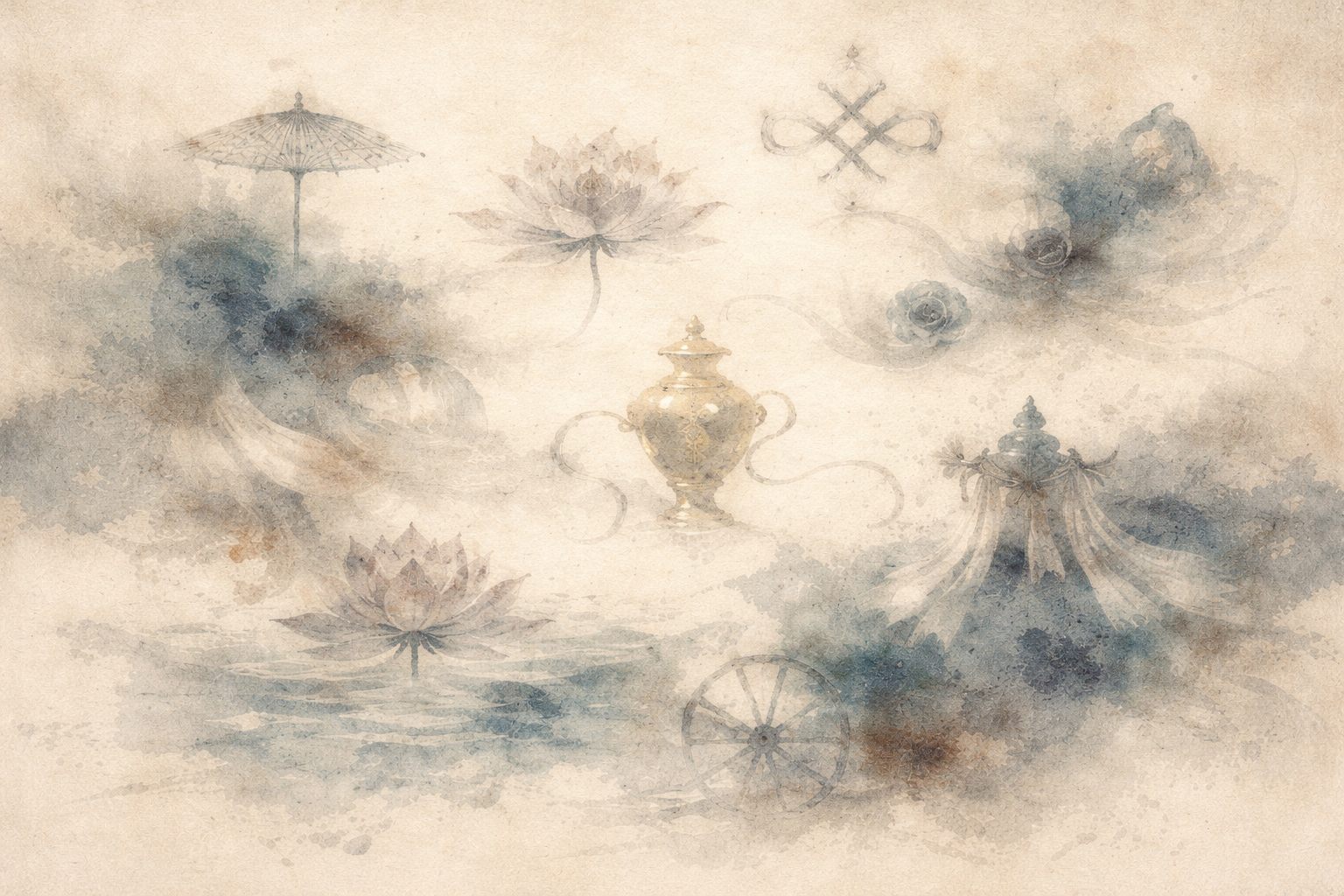
In practice, the Eight Buddhist Symbols compress a lot of teaching into a small set of cues. A wheel can point to a path of living; a lotus can point to purity that isn’t separate from messy conditions; a parasol can point to protection from what overheats the mind. You don’t need to memorize a textbook to benefit—your attention just needs a steady prompt.
They’re also important because they carry meaning across time and place. Words change, translations vary, and people argue about definitions. A symbol can hold a cluster of meanings without forcing a single rigid sentence. That flexibility is not vagueness; it’s a way of keeping the teaching alive in different contexts.
Finally, these symbols are a mirror: they reflect what you’re prioritizing. If you treat them as decoration, they stay decoration. If you treat them as prompts for conduct, attention, and compassion, they become a gentle form of guidance—quiet, nonverbal, and surprisingly persistent.
How Their Meaning Shows Up in Ordinary Moments
Imagine you’re rushing, already late, and your mind is narrowing into “get it done.” A symbol like the parasol can function as a pause button: not magical protection, but a reminder to step out of mental heat—urgency, irritation, the sense that everything is an emergency. You notice the tightening, and you soften it by one degree.
Or you’re in a conversation where you want to win. The conch (often associated with the call of truth) can become a cue to ask: “Is what I’m about to say helpful, timely, and honest?” You don’t need perfect speech; you just need to notice the impulse to perform or dominate.
When you’re discouraged—because you repeated the same habit again—the lotus is a practical reminder that clarity isn’t reserved for ideal conditions. The point isn’t to romanticize suffering; it’s to remember that growth can happen in the middle of imperfect days, not only after you “fix yourself.”
In moments of scattered attention, the endless knot can point to interdependence: your mood affects your choices, your choices affect others, and others affect you. That recognition can reduce the urge to blame a single person (including yourself) as the sole cause of everything. You start seeing patterns instead of villains.
When life feels unstable—plans change, people disappoint you, your body has limits—the victory banner can be read inwardly: not “I beat someone,” but “I don’t have to be defeated by every passing state.” It’s a reminder that you can relate to fear, craving, and anger without handing them the steering wheel.
Even generosity becomes more concrete with symbols. The treasure vase can nudge you to ask what “abundance” means today: maybe it’s patience, maybe it’s attention, maybe it’s giving credit, maybe it’s sharing time. The symbol doesn’t demand grand gestures; it points to a mindset that isn’t always calculating scarcity.
And when you need a sense of direction, the Dharma wheel can function like a compass: “What action reduces harm here?” “What action increases clarity?” The importance of the symbols is that they keep returning you to these questions—quietly, repeatedly—without requiring you to be in a special mood.
Common Misreadings That Flatten Their Value
One misunderstanding is thinking the Eight Buddhist Symbols are important only if you’re “religious enough.” In reality, their usefulness doesn’t depend on identity labels. If a symbol helps you remember patience, honesty, or steadiness, it’s already doing its job.
Another common misreading is superstition: treating the symbols like lucky charms that guarantee outcomes. That approach usually backfires because it encourages bargaining with life instead of meeting life. The symbols are better understood as training aids—reminders that shape how you respond, not guarantees that control what happens.
Some people dismiss them as “just cultural.” Culture is not a downgrade; it’s how wisdom survives. The symbols are important precisely because they preserve meaning in forms people can carry, wear, paint, carve, and place in communal spaces—so the teaching isn’t trapped in books or private opinions.
Another trap is reducing them to a single fixed definition. Different communities emphasize different nuances, and that’s normal. A symbol can hold multiple layers: ethical, psychological, communal, and contemplative. The goal isn’t to win a definition; it’s to let the symbol point you back to practice.
Finally, there’s the aesthetic trap: collecting symbol imagery because it looks “spiritual.” Beauty isn’t the problem—forgetting the purpose is. If you keep one question close—“What does this remind me to do?”—the symbols regain their depth.
Why These Symbols Still Matter in Daily Life
Modern life is saturated with symbols already—logos, notifications, status markers—each one training your attention toward wanting, comparing, and consuming. The Eight Buddhist Symbols are important because they offer a different kind of training: they point attention toward clarity, restraint, care, and perspective.
They also support ethical consistency. It’s easy to agree with kindness in theory and then abandon it under pressure. A symbol placed where you’ll see it—on a wall, a book cover, a small object—can interrupt autopilot. Not with guilt, but with a gentle nudge: “Choose the response you respect.”
In community settings, the symbols create shared reference points. You don’t have to explain everything verbally for people to feel the tone of a space. A banner with the wheel or lotus can quietly communicate, “This is a place for practice,” which helps behavior align without heavy policing.
They’re also important for continuity. When you’re tired, grieving, or overwhelmed, you may not have the energy to study or analyze. Symbols can carry the teaching for you until you’re ready again—like a bookmark for the heart.
Most of all, the Eight Buddhist Symbols matter because they keep the teachings close to the senses. You see them, and you remember: life is workable. Not perfect, not controllable—but workable through attention, intention, and compassion.
Conclusion
Why the eight Buddhist symbols are important comes down to function: they help you remember what you’re doing with your mind and your life. They preserve teachings in a form that survives translation, distraction, and time. If you approach them as reminders rather than ornaments or talismans, they become practical—quiet prompts toward clarity, care, and steadiness in the middle of ordinary days.
Ask a Buddhist priest
Have a question about Buddhism?
In the GASSHO app, you can ask questions about Buddhist teachings, daily concerns, and how to understand Buddhism in everyday life.
Frequently Asked Questions
- FAQ 1: Why are the eight Buddhist symbols important in Buddhism?
- FAQ 2: Are the eight Buddhist symbols important if I’m not a Buddhist?
- FAQ 3: Why are the eight Buddhist symbols important beyond being “auspicious”?
- FAQ 4: How do the eight Buddhist symbols help with understanding Buddhist teachings?
- FAQ 5: Why are the eight Buddhist symbols important in temples and sacred spaces?
- FAQ 6: Are the eight Buddhist symbols important as “protective” symbols?
- FAQ 7: Why are the eight Buddhist symbols important for mindfulness in daily life?
- FAQ 8: Why are the eight Buddhist symbols important in Buddhist art and design?
- FAQ 9: Do the eight Buddhist symbols have one fixed meaning, and is that why they’re important?
- FAQ 10: Why are the eight Buddhist symbols important for ethics and right conduct?
- FAQ 11: Why are the eight Buddhist symbols important if they’re used on jewelry or everyday objects?
- FAQ 12: Are the eight Buddhist symbols important historically, or mainly for modern practice?
- FAQ 13: Why are the eight Buddhist symbols important without believing in “luck”?
- FAQ 14: Why are the eight Buddhist symbols important as a set of eight rather than single symbols?
- FAQ 15: What’s the most practical reason why the eight Buddhist symbols are important?
FAQ 1: Why are the eight Buddhist symbols important in Buddhism?
Answer: They’re important because they condense key teachings into visual reminders that are easy to carry into daily life—ethics, clarity, protection from mental agitation, and the possibility of awakening.
Takeaway: The symbols matter most as practical reminders, not as decoration.
FAQ 2: Are the eight Buddhist symbols important if I’m not a Buddhist?
Answer: Yes, if you use them as prompts for attention and conduct. Their value doesn’t require adopting an identity; it depends on whether the symbol helps you remember qualities like patience, honesty, and compassion.
Takeaway: Their importance is functional—do they help you live better?
FAQ 3: Why are the eight Buddhist symbols important beyond being “auspicious”?
Answer: “Auspicious” can sound like luck, but the deeper importance is that they point to causes and conditions: how wholesome intentions and clear awareness shape experience over time.
Takeaway: They’re less about luck and more about training the mind and heart.
FAQ 4: How do the eight Buddhist symbols help with understanding Buddhist teachings?
Answer: They act like a visual glossary. Instead of memorizing concepts first, you can learn through repeated contact: seeing a symbol, recalling its theme, and applying it to a real situation.
Takeaway: Symbols make abstract teachings easier to remember and apply.
FAQ 5: Why are the eight Buddhist symbols important in temples and sacred spaces?
Answer: They set a shared tone and intention. In a space meant for practice, symbols quietly communicate values—reverence, restraint, clarity—without needing constant explanation.
Takeaway: In communal spaces, symbols guide attention and behavior.
FAQ 6: Are the eight Buddhist symbols important as “protective” symbols?
Answer: They can be understood as protective in a psychological and ethical sense: they remind you to step out of reactivity, reduce harm, and return to steadier intentions—forms of protection that depend on your response.
Takeaway: Their “protection” is often about protecting the mind from unskillful habits.
FAQ 7: Why are the eight Buddhist symbols important for mindfulness in daily life?
Answer: They provide quick cues that interrupt autopilot. A brief glance can prompt a check-in: “What am I doing right now?” “Is my speech helpful?” “Am I acting from fear or care?”
Takeaway: They support mindfulness by offering simple, repeatable prompts.
FAQ 8: Why are the eight Buddhist symbols important in Buddhist art and design?
Answer: Because they carry meaning, not just style. In art, they encode teachings in a way that survives translation and literacy barriers, allowing viewers to connect with practice through imagery.
Takeaway: In Buddhist art, symbols are teaching tools, not mere ornament.
FAQ 9: Do the eight Buddhist symbols have one fixed meaning, and is that why they’re important?
Answer: They often have a core theme with multiple layers of interpretation. Their importance isn’t that they’re rigid; it’s that they remain useful across different contexts while still pointing back to practice.
Takeaway: Their flexibility helps the teaching stay alive without losing its direction.
FAQ 10: Why are the eight Buddhist symbols important for ethics and right conduct?
Answer: They remind you of qualities that support non-harming—truthful speech, steady intention, generosity, and clarity. Over time, repeated reminders can shape choices in relationships and work.
Takeaway: The symbols can reinforce ethical living through repeated reflection.
FAQ 11: Why are the eight Buddhist symbols important if they’re used on jewelry or everyday objects?
Answer: Their importance can increase with everyday use because you see them more often. The key is intention: wearing a symbol can be a commitment to remember a quality, not a claim of status.
Takeaway: Everyday visibility can turn symbols into steady reminders.
FAQ 12: Are the eight Buddhist symbols important historically, or mainly for modern practice?
Answer: Both. Historically, they helped transmit teachings through art and ritual; today, they still function as compact reminders in a distracted world, linking practice to daily perception.
Takeaway: Their importance spans history because their function remains relevant.
FAQ 13: Why are the eight Buddhist symbols important without believing in “luck”?
Answer: You can treat them as prompts for cause-and-effect in behavior: when you act from clarity and care, outcomes tend to be less harmful. No luck is required—just attention and follow-through.
Takeaway: Their value doesn’t depend on superstition; it depends on practice.
FAQ 14: Why are the eight Buddhist symbols important as a set of eight rather than single symbols?
Answer: As a set, they balance each other—direction (wheel), growth in conditions (lotus), interconnection (endless knot), steadiness (banner), generosity (vase), and more. Together they form a rounded “map” of reminders rather than a one-note message.
Takeaway: The set matters because it covers multiple dimensions of practice.
FAQ 15: What’s the most practical reason why the eight Buddhist symbols are important?
Answer: They help you remember your intention when you forget—especially in ordinary stress, conflict, and distraction. That small moment of remembering can change speech, choices, and the direction of a day.
Takeaway: Their importance is practical: they help you return to what matters.