



The Eight Auspicious Buddhist Symbols and Their Meaning
The Eight Auspicious Buddhist Symbols and Their Meaning
Quick Summary
- The eight auspicious Buddhist symbols are a traditional set of images used to point the mind toward wise, compassionate living.
- They are not “good luck charms” so much as reminders of qualities to cultivate: clarity, steadiness, generosity, and ethical direction.
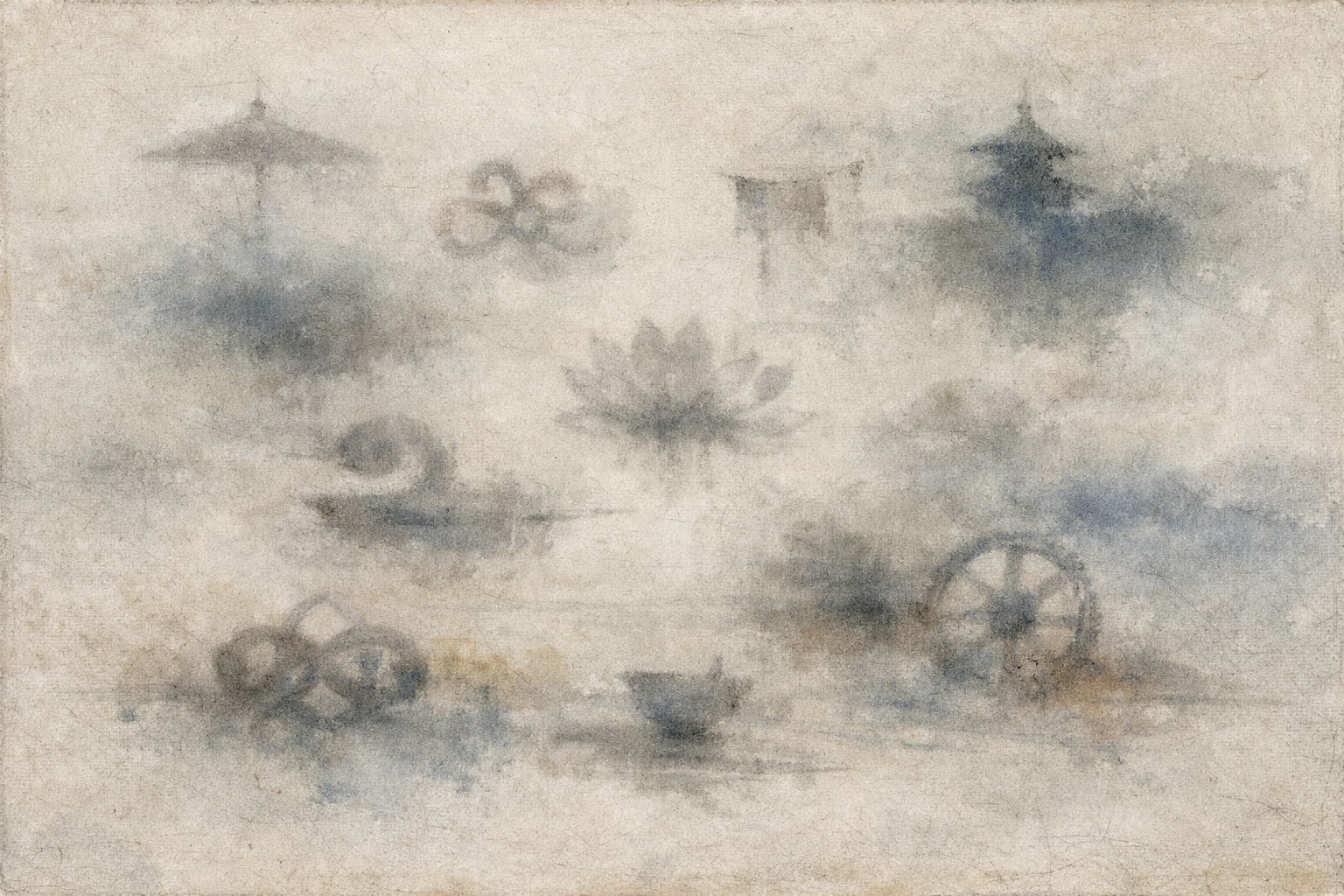
- The set commonly includes: parasol, golden fish, treasure vase, lotus, conch shell, endless knot, victory banner, and wheel.
- Each symbol can be read as a practical cue for attention: protect what matters, move freely, stay resourced, and return to what’s clean and simple.
- Meanings vary slightly by region and art style, but the core intent stays consistent: orient the heart and mind.
- You can work with them as a “daily check-in” rather than as a belief: notice, pause, choose a kinder response.
- When you see them in temples, textiles, or home altars, treat them as invitations to practice—not decorations to decode perfectly.
Introduction
If you’ve searched for the eight auspicious Buddhist symbols, you’ve probably run into two frustrations at once: lists that don’t explain anything, and explanations that turn the symbols into superstition. The truth is simpler and more useful—these images are best understood as a set of practical reminders for how to meet life with steadiness, clarity, and care. At Gassho, we focus on grounded Buddhist symbolism that supports everyday practice without mystifying it.
You’ll see these symbols carved into temple doors, painted on thangkas, woven into brocade, or placed on altars. They show up because they work: a symbol can interrupt autopilot faster than a paragraph can. When the mind is busy, a clear image can nudge attention back to what matters.
Below, we’ll walk through what the set is, what each symbol traditionally points to, and how to relate to them in a way that stays human and usable.
GASSHO
Ask and learn about Buddhism in daily life.
GASSHO is a Buddhist community app where you can learn Buddhist teachings and ask questions to the head priest of Kongosanmaiin Temple on Mount Koya.
A Practical Lens for Reading Auspicious Symbols
A helpful way to understand the eight auspicious Buddhist symbols is to treat them as a “visual vocabulary” for inner life. They don’t demand belief; they offer orientation. Each image points toward a quality you can recognize in experience—like protection from overwhelm, the ability to move through emotion, or the capacity to keep returning to what’s wholesome.
“Auspicious” can sound like fortune-telling, but in this context it’s closer to “supportive conditions.” The symbols represent conditions that help the mind settle and the heart open: clarity instead of confusion, generosity instead of grasping, and ethical direction instead of drifting.
It also helps to remember that symbols are intentionally compact. They’re designed to hold multiple layers without forcing you to pick a single “correct” interpretation. If one meaning feels distant, use the one that lands: the point is the shift in attention, not perfect decoding.
With that lens, the set becomes less like a quiz and more like a toolkit—eight ways to remember what you already know, especially when you’re stressed, reactive, or scattered.
The Eight Symbols and What They Point Toward
While details can vary slightly across cultures, the most widely recognized set of the eight auspicious Buddhist symbols includes the parasol, golden fish, treasure vase, lotus, conch shell, endless knot, victory banner, and wheel. Here are clear, practice-friendly meanings for each.
Parasol (Protecting the Mind)
The parasol suggests protection—not from ordinary weather, but from mental heat: agitation, overload, and the harshness that comes from constant striving. As a reminder, it asks: what would it look like to shelter the mind today?
In daily terms, the parasol can mean setting a boundary, simplifying inputs, or choosing a slower response. It’s the symbol of dignity and care: you don’t have to expose your attention to every demand.
Golden Fish (Moving Freely Without Fear)
Two golden fish often represent freedom of movement—traditionally, the ease of beings who swim without drowning. Read practically, they point to the possibility of moving through feelings and situations without being trapped by them.
When you’re anxious, the mind tightens and tries to control outcomes. The fish remind you to loosen the grip: breathe, feel what’s here, and keep moving with the current of reality rather than fighting it.
Treasure Vase (Inner Resources and Generosity)
The treasure vase symbolizes inexhaustible richness—not necessarily material wealth, but the sense that goodness can be replenished. It points to inner resources like patience, attention, and the ability to give without emptying yourself.
As a practice cue, the vase asks you to notice scarcity thinking: “I don’t have enough time, enough energy, enough appreciation.” Then it gently counters: what is already here that can be shared—one kind word, one honest pause, one small act of care?
Lotus (Clean Clarity in the Middle of Mess)
The lotus grows from muddy water and blooms clean. It’s a straightforward image for how clarity and kindness can appear right inside imperfect conditions. You don’t need a perfect life to practice; you practice inside the life you have.
In ordinary experience, the lotus can mean returning to what’s simple: one breath, one honest admission, one clean intention. It’s not about denying the “mud,” but about not being defined by it.
Conch Shell (A Clear Call That Wakes You Up)
The conch shell is associated with a resonant sound that carries. Symbolically, it points to a clear call—something that wakes you up from distraction and brings you back to what’s true and beneficial.
Practically, the conch can be your willingness to name what’s happening: “I’m spiraling,” “I’m being defensive,” “I’m rushing.” That clarity isn’t harsh; it’s liberating. It gives you a moment of choice.
Endless Knot (Interconnection and Cause-and-Effect)
The endless knot suggests interconnection: actions have consequences, and life is woven from relationships, conditions, and habits. It’s a reminder that nothing stands alone—not your mood, not your conflict, not your relief.
In a grounded reading, the knot supports responsibility without blame. If things are connected, small changes matter: a different tone, a pause before speaking, a more honest boundary. You tug one thread and the whole pattern shifts.
Victory Banner (Steadiness Over Reactivity)
The victory banner represents triumph, but not in the sense of defeating other people. It points to the quiet victory of not being ruled by compulsive reactions—anger that burns you, craving that never finishes, or discouragement that collapses your effort.
In daily life, “victory” can look small: you notice the urge to snap, and you don’t. You feel the pull to doom-scroll, and you stop. You’re tempted to exaggerate, and you choose accuracy. The banner celebrates that kind of inner steadiness.
Wheel (A Path You Can Actually Walk)
The wheel commonly points to a path of practice—something structured enough to guide you, but flexible enough to live. A wheel rolls; it moves. It suggests that understanding isn’t meant to stay in your head.
As a reminder, the wheel asks: what is one step you can take today that reduces harm and increases clarity? Not a grand reinvention—just a workable next action.
How These Symbols Show Up in Ordinary Experience
You notice the parasol when your day feels too loud. Notifications stack up, conversations blur together, and your attention starts to feel frayed. The symbol’s message is simple: protect the mind by reducing exposure and choosing fewer inputs.
You meet the golden fish when you’re trying to control what can’t be controlled. The body tightens, the mind rehearses, and you keep searching for certainty. “Move freely” can mean letting the uncertainty be present while you still take the next sensible step.
The treasure vase shows up when you’re convinced you have nothing left to give. That belief often comes with a hard edge: resentment, impatience, or numbness. The vase doesn’t demand self-sacrifice; it asks you to locate a realistic resource—maybe rest, maybe honesty, maybe one small act of generosity that doesn’t deplete you.
The lotus appears when you’re embarrassed by your own messiness. You might think, “I’ll be kinder when I’m less stressed,” or “I’ll practice when my life settles down.” The lotus quietly contradicts that: the practice is precisely to find cleanliness of intention inside the mud of real conditions.
The conch shell is the moment you hear yourself clearly. Not in a dramatic way—more like a clean internal echo: “This is defensiveness,” “This is avoidance,” “This is fear.” That recognition can be enough to soften the next sentence you speak.
The endless knot becomes visible when you trace a reaction back to its conditions. Hunger, lack of sleep, an old story, a tense email—suddenly the “mystery” of your mood isn’t so mysterious. Seeing the weave helps you respond with more intelligence and less self-judgment.
The victory banner and the wheel show up together when you choose a response that aligns with your values. You don’t need to feel pure or calm first. You simply notice the impulse, pause, and act in a way that reduces harm. That’s the banner. Then you do it again tomorrow. That’s the wheel.
Common Misunderstandings That Make the Symbols Less Helpful
One common misunderstanding is treating the eight auspicious Buddhist symbols as a promise of external luck. When that happens, the symbols become transactional: display the image, expect a reward. A more grounded approach is to treat them as reminders that shape choices—because choices shape outcomes.
Another misunderstanding is thinking you must memorize a single official meaning for each symbol. In practice, symbols work because they’re flexible. If the lotus helps you remember “clean intention,” use that. If it helps you remember “growth in difficulty,” use that. The point is the shift toward clarity and care.
People also assume the set is purely decorative. But these images were designed to be seen repeatedly—on thresholds, banners, offerings, and everyday objects—so the mind is gently trained by repetition. Decoration is not the opposite of practice; it can be a method of practice when it’s intentional.
Finally, some readers worry that using symbols is “too religious” or, on the other side, not religious enough. You can relate to them simply as human prompts. If an image helps you pause before speaking harshly, it’s already doing its job.
Why the Eight Auspicious Symbols Still Matter Today
Modern life is an attention economy. Your mind is pulled, sold, and fragmented all day long. The eight auspicious Buddhist symbols matter because they offer a counter-training: they gather attention and point it toward steadiness, interconnection, and ethical direction.
They also give you a non-verbal way to remember your intentions. When you’re stressed, language can become blunt or dramatic. A symbol can be gentler: the parasol says “protect,” the lotus says “stay clean,” the knot says “consider consequences,” the wheel says “take the next step.”
And they’re practical in relationships. The endless knot encourages you to look at conditions before blaming. The victory banner encourages you to win against reactivity, not against a person. The conch encourages clear speech that wakes you up rather than speech that escalates.
Most importantly, the set offers balance. Some reminders are soft (lotus, vase), some are firm (banner, wheel), and some are clarifying (conch, knot). Together they form a rounded “inner compass” you can return to without needing a perfect mood.
Conclusion
The eight auspicious Buddhist symbols are best approached as a calm set of reminders: protect the mind, move freely, trust inner resources, bloom in imperfect conditions, speak clearly, see interconnection, choose steadiness over reactivity, and keep taking the next workable step. You don’t have to turn them into superstition or scholarship. Let them do what symbols do best—bring you back to what you meant to live by.
Ask a Buddhist priest
Have a question about Buddhism?
In the GASSHO app, you can ask questions about Buddhist teachings, daily concerns, and how to understand Buddhism in everyday life.
Frequently Asked Questions
- FAQ 1: What are the eight auspicious Buddhist symbols?
- FAQ 2: Do the eight auspicious Buddhist symbols have one fixed meaning?
- FAQ 3: What does the parasol mean among the eight auspicious Buddhist symbols?
- FAQ 4: What do the two golden fish represent in the eight auspicious Buddhist symbols?
- FAQ 5: What is the meaning of the treasure vase in the eight auspicious Buddhist symbols?
- FAQ 6: Why is the lotus included in the eight auspicious Buddhist symbols?
- FAQ 7: What does the conch shell symbolize in the eight auspicious Buddhist symbols?
- FAQ 8: What is the endless knot meaning in the eight auspicious Buddhist symbols?
- FAQ 9: What does the victory banner represent among the eight auspicious Buddhist symbols?
- FAQ 10: What does the wheel mean in the eight auspicious Buddhist symbols?
- FAQ 11: Are the eight auspicious Buddhist symbols the same in every country?
- FAQ 12: Where do the eight auspicious Buddhist symbols commonly appear?
- FAQ 13: Are the eight auspicious Buddhist symbols meant to bring “good luck”?
- FAQ 14: How can I use the eight auspicious Buddhist symbols as a daily reflection?
- FAQ 15: Why are there exactly eight auspicious Buddhist symbols?
FAQ 1: What are the eight auspicious Buddhist symbols?
Answer: The eight auspicious Buddhist symbols are a traditional set of images used across Buddhist cultures to represent supportive qualities such as clarity, protection, interconnection, and ethical direction. The most common set is: parasol, golden fish, treasure vase, lotus, conch shell, endless knot, victory banner, and wheel.
Takeaway: They’re best understood as practice reminders, not just decorations.
FAQ 2: Do the eight auspicious Buddhist symbols have one fixed meaning?
Answer: Not always. Core themes are widely shared, but details can vary by region, art tradition, and context. A symbol may carry multiple valid layers, and the most useful meaning is often the one that helps you act with more clarity and care.
Takeaway: Look for the practical message a symbol points to, not a single “official” definition.
FAQ 3: What does the parasol mean among the eight auspicious Buddhist symbols?
Answer: The parasol commonly symbolizes protection and dignity—often read as sheltering the mind from agitation, overwhelm, and unhelpful mental “heat.” It can also suggest respectful care and wise boundaries.
Takeaway: The parasol points to protecting attention so it can stay clear.
FAQ 4: What do the two golden fish represent in the eight auspicious Buddhist symbols?
Answer: The golden fish are often associated with freedom and fearlessness—moving through life’s “waters” without drowning in anxiety or getting stuck. In a practical sense, they can remind you to stay flexible and keep moving through changing conditions.
Takeaway: The fish symbolize ease and freedom of movement through experience.
FAQ 5: What is the meaning of the treasure vase in the eight auspicious Buddhist symbols?
Answer: The treasure vase (or vase of abundance) symbolizes richness and replenishment—often interpreted as inner and outer resources that support generosity, wellbeing, and stability. It can also point to contentment rather than scarcity thinking.
Takeaway: The vase reminds you that wholesome resources can be cultivated and shared.
FAQ 6: Why is the lotus included in the eight auspicious Buddhist symbols?
Answer: The lotus is included because it vividly represents purity and clarity arising within imperfect conditions—blooming clean even when rooted in mud. It’s often used to point to the possibility of wise, kind intention in the middle of ordinary messiness.
Takeaway: The lotus suggests you can practice clarity without waiting for perfect circumstances.
FAQ 7: What does the conch shell symbolize in the eight auspicious Buddhist symbols?
Answer: The conch shell commonly symbolizes a clear, far-reaching call—often linked with speech that awakens, clarifies, and benefits. It can be read as a reminder to communicate honestly and to let clarity cut through confusion.
Takeaway: The conch points to clear expression that brings the mind back to what matters.
FAQ 8: What is the endless knot meaning in the eight auspicious Buddhist symbols?
Answer: The endless knot symbolizes interconnection and cause-and-effect: life is woven from conditions, relationships, and habits rather than isolated events. It can encourage responsibility and patience by showing that small changes can reshape the whole pattern.
Takeaway: The knot reminds you that actions and conditions are linked, so choices matter.
FAQ 9: What does the victory banner represent among the eight auspicious Buddhist symbols?
Answer: The victory banner represents victory over inner obstacles—especially reactive patterns that create suffering, such as compulsive anger, grasping, or discouragement. It’s less about defeating others and more about steadiness and self-mastery in the moment.
Takeaway: The banner points to winning against reactivity, not against people.
FAQ 10: What does the wheel mean in the eight auspicious Buddhist symbols?
Answer: The wheel commonly symbolizes a path of practice and guidance—something that can be put into motion through daily choices. It can be read as a reminder that understanding should translate into action: speech, behavior, and attention that reduce harm.
Takeaway: The wheel emphasizes a workable path you can actually live.
FAQ 11: Are the eight auspicious Buddhist symbols the same in every country?
Answer: The set is widely recognized, but presentation and emphasis can vary by region and artistic tradition. You may see differences in styling, ordering, or how a local community explains a symbol’s nuance, while the overall set remains consistent.
Takeaway: Expect small variations, but the core eight-symbol set is broadly shared.
FAQ 12: Where do the eight auspicious Buddhist symbols commonly appear?
Answer: They commonly appear in temple art and architecture, ritual objects, textiles, paintings, and household devotional spaces. Their repeated visibility is part of their function: they keep pointing attention back to wholesome qualities.
Takeaway: Seeing the symbols often is meant to reinforce remembrance, not just aesthetics.
FAQ 13: Are the eight auspicious Buddhist symbols meant to bring “good luck”?
Answer: They’re often called “auspicious,” but a grounded interpretation is that they represent conditions that support wellbeing—clarity, protection, ethical direction, and inner freedom. Rather than guaranteeing luck, they encourage choices that tend to lead to better outcomes.
Takeaway: Treat them as reminders that shape conduct and attention, not as guarantees.
FAQ 14: How can I use the eight auspicious Buddhist symbols as a daily reflection?
Answer: Pick one symbol for the day and let it frame a simple question: Parasol—“What can I simplify?” Lotus—“What’s one clean intention?” Endless knot—“What conditions are driving this?” Wheel—“What’s the next kind step?” Keep it brief and practical.
Takeaway: Use one symbol as a cue for one small, realistic shift in behavior or attention.
FAQ 15: Why are there exactly eight auspicious Buddhist symbols?
Answer: “Eight” functions as a traditional complete set—enough symbols to cover a rounded range of supportive qualities (protection, clarity, interconnection, abundance, and steady direction) without becoming unwieldy. The number helps the set stay memorable and repeatable in art and practice.
Takeaway: The “eight” is a practical, traditional way to hold a complete symbolic toolkit.