



8 Sacred Buddhist Symbols and What They Mean
Quick Summary
- The “8 sacred Buddhist symbols” (often called the Eight Auspicious Symbols) are visual reminders of qualities to cultivate, not objects to worship.
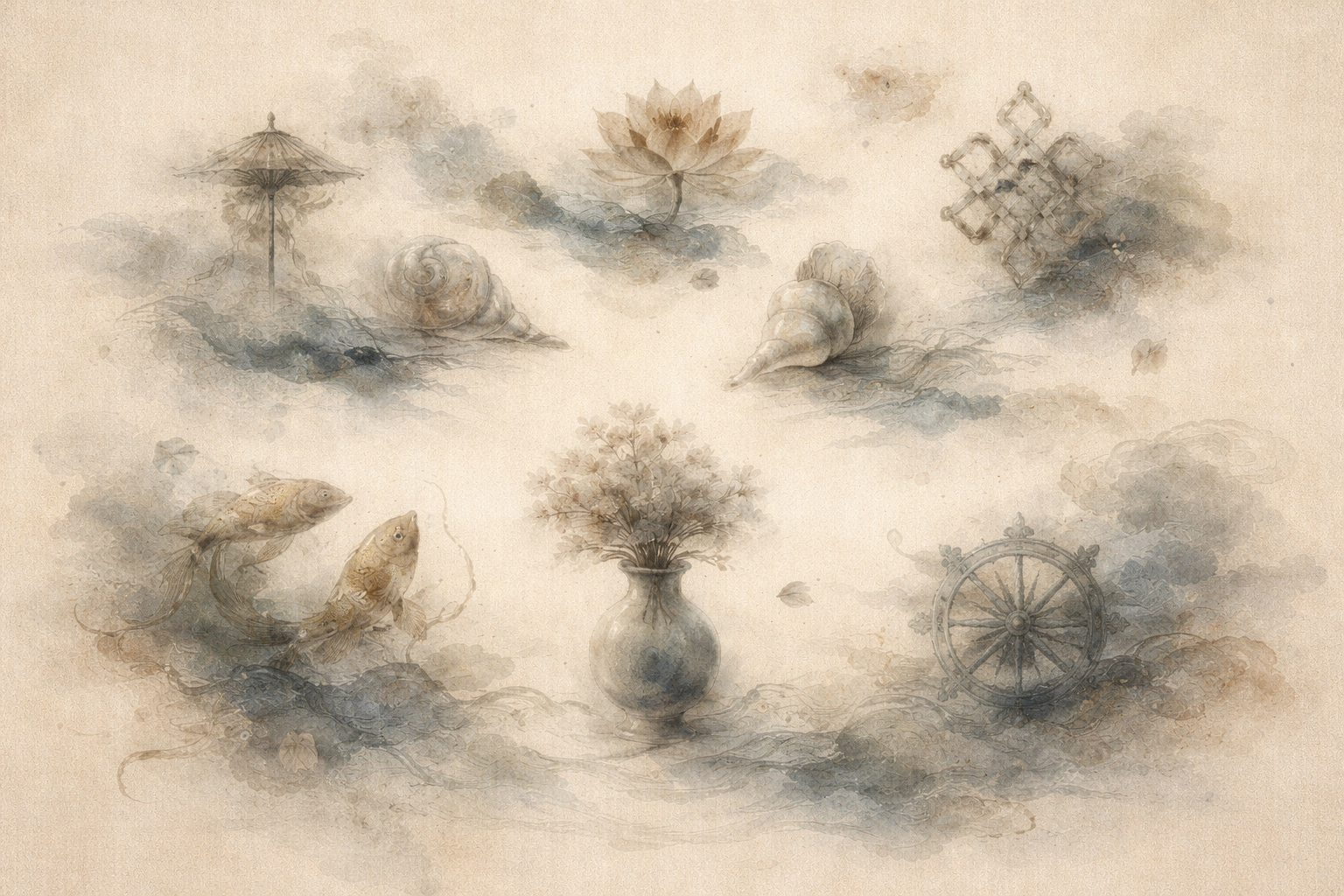
- Commonly listed as: Parasol, Golden Fish, Treasure Vase, Lotus, Conch Shell, Endless Knot, Victory Banner, and Dharma Wheel.
- Each symbol points to a practical inner movement: protection, freedom, abundance, clarity, awakening, interdependence, steadiness, and wise direction.
- Meanings can vary slightly by region and art tradition, but the core themes stay consistent.
- You can use the symbols as prompts for attention: “What am I clinging to right now?” “What would open up?”
- They show up everywhere—temples, thangkas, jewelry, architecture—because they communicate without needing words.
- Reading them well means looking for the lived message, not memorizing a perfect definition.
Introduction
If you’ve searched for the 8 sacred Buddhist symbols, you’ve probably found a mess: different lists, poetic explanations that don’t land, and images that look beautiful but feel vague. The useful approach is simple—treat these symbols as a visual language for the mind: each one points to a specific kind of inner shift you can recognize in ordinary moments. At Gassho, we focus on clear, practice-friendly explanations that respect tradition without turning it into trivia.
The set most people mean by “8 sacred Buddhist symbols” is the Eight Auspicious Symbols, widely used across Buddhist art and ritual. You’ll see them carved into temple gates, painted on scrolls, embroidered on banners, and worn as small charms—not because they’re “lucky,” but because they summarize a path of training in a compact, memorable way.
Below, you’ll find what each symbol is, what it traditionally suggests, and how to read it as a practical cue for attention, ethics, and clarity.
A Clear Lens for the 8 Sacred Buddhist Symbols
It helps to see the 8 sacred Buddhist symbols as reminders rather than claims. They don’t ask you to believe something invisible; they point to patterns you can observe: how the mind tightens, how it opens, how it gets lost, and how it steadies. In that sense, they work like signposts—simple shapes that keep you oriented when experience gets noisy.
Each symbol compresses a whole teaching into an image. A lotus doesn’t “prove” purity; it suggests what it feels like when clarity can exist even in messy conditions. An endless knot doesn’t “explain the universe”; it nudges you to notice how causes and effects weave together in your own habits, speech, and choices.
Another useful lens: these symbols speak to both protection and responsibility. “Protection” here isn’t magical shielding—it’s the kind of protection that comes from wise boundaries, honest reflection, and not feeding what harms you. “Responsibility” isn’t guilt—it’s the recognition that what you repeat becomes what you live.
So when you encounter the 8 sacred Buddhist symbols, you can ask one grounded question: “What quality is this inviting right now?” That question turns art into guidance and symbolism into something you can actually use.
GASSHO
Ask and learn about Buddhism in daily life.
GASSHO is a Buddhist community app where you can learn Buddhist teachings and ask questions to the head priest of Kongosanmaiin Temple on Mount Koya.
How the Symbols Show Up in Everyday Experience
In daily life, the “meaning” of a symbol often arrives as a small moment of recognition. You notice you’re bracing—jaw tight, shoulders up—and the parasol becomes a cue for gentleness: protect the mind from unnecessary heat, not by hiding, but by easing the pressure you’re adding.
You catch yourself chasing approval or certainty, and the golden fish becomes a quiet counter-image: what would it be like to move freely, without needing to gulp for air? That doesn’t mean becoming careless; it means noticing the difference between healthy effort and anxious grasping.
When you feel “not enough”—not enough time, not enough energy, not enough worth—the treasure vase points to a different kind of abundance: the abundance of what’s already workable. Breath is here. A next kind action is possible. A clear “no” is available. The vase isn’t about getting more; it’s about not overlooking what supports you.
In the middle of irritation, the lotus is less a pretty flower and more a practical question: can you keep your values clean even when conditions aren’t? Not perfect, not saintly—just clean enough to not spread the mud further through speech or impulse.
When you’re stuck in rumination, the conch shell can be read as the call of a clear note: return to what’s simple and true. One honest sentence. One direct apology. One step that aligns with what you already know, instead of rehearsing the same story again.
In moments of regret, the endless knot is surprisingly comforting. It reminds you that you’re not a single snapshot. You’re a web of conditions—some inherited, some chosen—and changing one strand changes the pattern. That’s not an excuse; it’s a way to start again without self-hatred.
And when you feel pulled in ten directions, the victory banner and the Dharma wheel become steadying images: victory as not being ruled by the loudest impulse, and the wheel as choosing a direction that reduces harm. The “win” is quiet: less reactivity, more clarity, more follow-through.
The 8 Sacred Buddhist Symbols and What They Mean
Below are the 8 sacred Buddhist symbols most commonly presented as the Eight Auspicious Symbols. You may see variations in artistic style, but the core themes are widely shared.
1) Parasol (Precious Umbrella)
Traditionally associated with protection and dignity. As a lived meaning, it points to sheltering the mind from what scorches it—excessive distraction, harshness, and needless conflict—through wise boundaries and calm restraint.
2) Golden Fish
Often linked with freedom, fearlessness, and ease. The fish move through water without drowning; in practice language, it suggests moving through life without being suffocated by anxiety, clinging, or social pressure.
3) Treasure Vase
Symbolizes inexhaustible richness—health, longevity, merit, and supportive conditions. Practically, it’s a reminder to recognize what nourishes wholesome action: time used well, relationships grounded in respect, and habits that replenish rather than drain.
4) Lotus
Represents purity and awakening arising within imperfect conditions. The lotus grows from mud yet blooms clean; as a cue, it points to integrity—keeping the heart oriented toward clarity even when emotions are messy.
5) Conch Shell
Associated with the far-reaching sound of truth and the call to wake up. In everyday terms, it’s the reminder to speak clearly and listen deeply—letting what is true be simple, not aggressive.
6) Endless Knot
Symbolizes interdependence, continuity, and the weaving of causes and conditions. It invites you to notice how small actions loop back: what you repeat becomes your default, and changing one pattern changes the whole weave.
7) Victory Banner
Traditionally signifies victory over obstacles—especially inner obstacles like confusion and reactivity. Read practically, it’s the quiet triumph of not being dragged around by impulse, and of returning again and again to what’s skillful.
8) Dharma Wheel (Wheel of Teaching)
Represents the turning of the teachings and the path that guides life toward wisdom and compassion. As a lived prompt, it asks: “What direction am I turning my life today—toward harm or toward clarity?”
Common Misunderstandings That Make the Symbols Feel Vague
Mistake 1: Treating them as “good luck charms.” The 8 sacred Buddhist symbols can be displayed for blessing, but their deeper function is educational: they point to qualities to cultivate. If you only use them for luck, you miss the invitation to change how you act and perceive.
Mistake 2: Assuming there is one fixed, universal definition. Symbolism is stable but not frozen. Different cultures and artists emphasize different layers. Instead of hunting for the “one true meaning,” look for the consistent core theme and apply it to your life.
Mistake 3: Thinking symbolism is “just decorative.” In Buddhist visual culture, decoration is often instruction. Repeated images train memory and attention. The point isn’t to decode a secret message; it’s to be reminded—again and again—of what matters.
Mistake 4: Reading them as metaphysical claims. You don’t need to turn the endless knot into a theory of reality to benefit from it. You can simply notice interdependence in your habits: sleep affects patience, patience affects speech, speech affects relationships, relationships affect your mind.
Why These Eight Symbols Still Matter Today
The 8 sacred Buddhist symbols matter because they translate big ideas into small reminders. In a world of constant input, a simple image can interrupt autopilot faster than a paragraph of advice. You see the lotus and remember: “Keep it clean.” You see the wheel and remember: “Choose a direction.”
They also offer a balanced map of inner life. Some symbols emphasize protection and steadiness (parasol, victory banner). Others emphasize openness and freedom (golden fish, conch). Others emphasize depth and continuity (endless knot, treasure vase). Together, they suggest a whole human training, not a single mood.
Most importantly, they keep the focus on what you can do. You can’t control every condition, but you can notice reactivity, soften it, and choose a response that reduces harm. That’s where symbolism stops being “spiritual decoration” and becomes practical guidance.
Conclusion
The 8 sacred Buddhist symbols are best understood as a compact visual vocabulary for living with more clarity and less reactivity. Whether you meet them in a temple, a painting, or a small emblem on a page, their value is the same: each one points to a quality you can recognize and practice in ordinary moments.
If you want to go deeper, pick one symbol for a week and use it as a daily prompt. Not as a superstition—just as a steady reminder to return to what’s skillful.
Ask a Buddhist priest
Have a question about Buddhism?
In the GASSHO app, you can ask questions about Buddhist teachings, daily concerns, and how to understand Buddhism in everyday life.
Frequently Asked Questions
- FAQ 1: What are the 8 sacred Buddhist symbols?
- FAQ 2: Are the 8 sacred Buddhist symbols the same as the Eight Auspicious Symbols?
- FAQ 3: What does the parasol mean among the 8 sacred Buddhist symbols?
- FAQ 4: What do the golden fish represent in the 8 sacred Buddhist symbols?
- FAQ 5: What is the meaning of the treasure vase in the 8 sacred Buddhist symbols?
- FAQ 6: Why is the lotus included in the 8 sacred Buddhist symbols?
- FAQ 7: What does the conch shell mean in the 8 sacred Buddhist symbols?
- FAQ 8: What is the endless knot in the 8 sacred Buddhist symbols supposed to show?
- FAQ 9: What does the victory banner mean among the 8 sacred Buddhist symbols?
- FAQ 10: What does the Dharma wheel represent in the 8 sacred Buddhist symbols?
- FAQ 11: Do the meanings of the 8 sacred Buddhist symbols change across countries?
- FAQ 12: How can I identify the 8 sacred Buddhist symbols in art?
- FAQ 13: Are the 8 sacred Buddhist symbols meant to be worshipped?
- FAQ 14: Why are there exactly 8 sacred Buddhist symbols?
- FAQ 15: What is the simplest way to use the 8 sacred Buddhist symbols for reflection?
FAQ 1: What are the 8 sacred Buddhist symbols?
Answer: The “8 sacred Buddhist symbols” usually refers to the Eight Auspicious Symbols: the Parasol, Golden Fish, Treasure Vase, Lotus, Conch Shell, Endless Knot, Victory Banner, and Dharma Wheel. They are used in Buddhist art as reminders of qualities like protection, freedom, abundance, clarity, interdependence, and wise direction.
Takeaway: They’re a traditional set of eight images meant to point the mind toward practice.
FAQ 2: Are the 8 sacred Buddhist symbols the same as the Eight Auspicious Symbols?
Answer: In most modern usage, yes—people use “8 sacred Buddhist symbols” to mean the Eight Auspicious Symbols. Occasionally you’ll see other “sets of eight” in Buddhism, but the well-known symbolic set in art and ritual is the Eight Auspicious Symbols list.
Takeaway: Most of the time, the keyword points to the Eight Auspicious Symbols.
FAQ 3: What does the parasol mean among the 8 sacred Buddhist symbols?
Answer: The parasol (precious umbrella) traditionally symbolizes protection, dignity, and shelter from harmful conditions. Practically, it can be read as protecting the mind through wise boundaries, restraint, and choosing environments that support clarity.
Takeaway: The parasol points to protection through steadiness, not superstition.
FAQ 4: What do the golden fish represent in the 8 sacred Buddhist symbols?
Answer: The golden fish commonly represent freedom, fearlessness, and ease—moving through life without being “drowned” by anxiety or clinging. They can also suggest good fortune in the sense of favorable conditions for practice and well-being.
Takeaway: The fish are a cue for inner freedom and unburdened movement.
FAQ 5: What is the meaning of the treasure vase in the 8 sacred Buddhist symbols?
Answer: The treasure vase symbolizes inexhaustible abundance—often explained as long life, prosperity, and spiritual richness. In a practical reading, it reminds you to recognize and protect the conditions that nourish wholesome action: time, health, supportive relationships, and good habits.
Takeaway: The vase points to sustaining resources, not endless consumption.
FAQ 6: Why is the lotus included in the 8 sacred Buddhist symbols?
Answer: The lotus is included because it symbolizes purity and awakening arising within imperfect conditions—blooming clean even when rooted in mud. As a lived reminder, it points to integrity and clarity even when emotions or circumstances are messy.
Takeaway: The lotus is about staying clear-hearted in real life, not escaping it.
FAQ 7: What does the conch shell mean in the 8 sacred Buddhist symbols?
Answer: The conch shell often symbolizes the far-reaching sound of truth and the call to awaken. In everyday terms, it can represent clear communication—speaking honestly, listening well, and letting what is true be direct rather than harsh.
Takeaway: The conch is a reminder to return to clarity in speech and attention.
FAQ 8: What is the endless knot in the 8 sacred Buddhist symbols supposed to show?
Answer: The endless knot symbolizes interdependence and the weaving of causes and conditions. It’s often read as a reminder that actions have consequences and that life is shaped by interconnected patterns rather than isolated events.
Takeaway: The knot points to how habits and choices “loop” and shape experience.
FAQ 9: What does the victory banner mean among the 8 sacred Buddhist symbols?
Answer: The victory banner symbolizes victory over obstacles, especially inner obstacles like confusion, reactivity, and unskillful impulses. It can be understood as the steady triumph of returning to what’s wise, even when the mind is pulled off course.
Takeaway: “Victory” here is inner steadiness, not domination over others.
FAQ 10: What does the Dharma wheel represent in the 8 sacred Buddhist symbols?
Answer: The Dharma wheel represents the teachings in motion and the guidance of a path that turns life toward wisdom and compassion. It’s often depicted with spokes, which can symbolize key aspects of training and the idea of moving in a clear direction rather than drifting.
Takeaway: The wheel is a prompt to choose direction and keep turning toward clarity.
FAQ 11: Do the meanings of the 8 sacred Buddhist symbols change across countries?
Answer: The core meanings are widely shared, but emphasis and artistic presentation can vary by region and tradition. For example, one culture may highlight “protection” in the parasol while another highlights “dignity,” without contradicting the overall theme.
Takeaway: Expect small variations, but the central themes remain consistent.
FAQ 12: How can I identify the 8 sacred Buddhist symbols in art?
Answer: Look for distinctive shapes: an umbrella-like canopy (parasol), two fish facing each other (golden fish), a rounded pot with a lid (treasure vase), a blooming flower (lotus), a spiral shell (conch), an interlaced looping design (endless knot), a vertical flag-like emblem (victory banner), and a wheel often with spokes (Dharma wheel). They may appear as a group or individually.
Takeaway: Learn the silhouettes—most depictions are recognizable once you know the forms.
FAQ 13: Are the 8 sacred Buddhist symbols meant to be worshipped?
Answer: They are generally not worshipped as deities. They function as auspicious signs and teaching symbols—visual reminders of qualities and directions of practice. People may treat them with respect, but their purpose is guidance and remembrance rather than devotion to the object itself.
Takeaway: Respect them, but understand them primarily as teaching images.
FAQ 14: Why are there exactly 8 sacred Buddhist symbols?
Answer: “Eight” is a traditional organizing number used in many Buddhist lists because it’s memorable and comprehensive. In this set, eight symbols provide a balanced spread of themes—protection, freedom, abundance, purity, truth, interdependence, perseverance, and guidance—without needing lengthy explanation.
Takeaway: The number eight helps package a broad teaching into a usable set.
FAQ 15: What is the simplest way to use the 8 sacred Buddhist symbols for reflection?
Answer: Choose one symbol and pair it with one question for the day—for example: Parasol (“What am I exposing my mind to?”), Golden Fish (“Where can I loosen fear?”), Treasure Vase (“What supports me that I’m ignoring?”), Lotus (“How can I keep integrity here?”), Conch (“What needs to be said simply?”), Endless Knot (“What pattern am I reinforcing?”), Victory Banner (“What impulse can I not follow?”), Dharma Wheel (“What direction reduces harm?”).
Takeaway: Use each symbol as a daily prompt that turns meaning into action.