



The Lotus Symbol in Buddhism: What It Really Means
Quick Summary
- In Buddhism, the lotus symbol points to clarity and compassion arising within messy, ordinary life—not outside it.
- “Mud and bloom” is the key image: difficulty isn’t a contradiction to awakening; it’s the condition where it’s practiced.
- The lotus is often shown supporting a Buddha or bodhisattva to suggest steadiness, purity of intention, and non-clinging.
- Lotus colors can carry different emphases (like compassion, wisdom, or purity), but the core message stays practical.
- The symbol isn’t about being perfect; it’s about being un-stuck while still fully in the world.
- Common misunderstandings include treating the lotus as a “good vibes” logo or a promise of instant transformation.
- You can use the lotus as a daily cue: notice reactivity, soften, and choose the next helpful action.
Introduction
If the lotus symbol in Buddhism feels like a pretty decoration that everyone references but nobody explains, you’re not missing something—most explanations stay vague on purpose, and that vagueness turns a practical symbol into a mood board. At Gassho, we focus on Buddhist symbols as tools for understanding experience, not as aesthetic trivia.
When you see a lotus under a Buddha image, on temple art, or in a mantra context, it’s not saying “be pure” in a moralistic way. It’s pointing to a specific kind of inner cleanliness: the ability to meet life without being dragged around by grasping, aversion, and confusion.
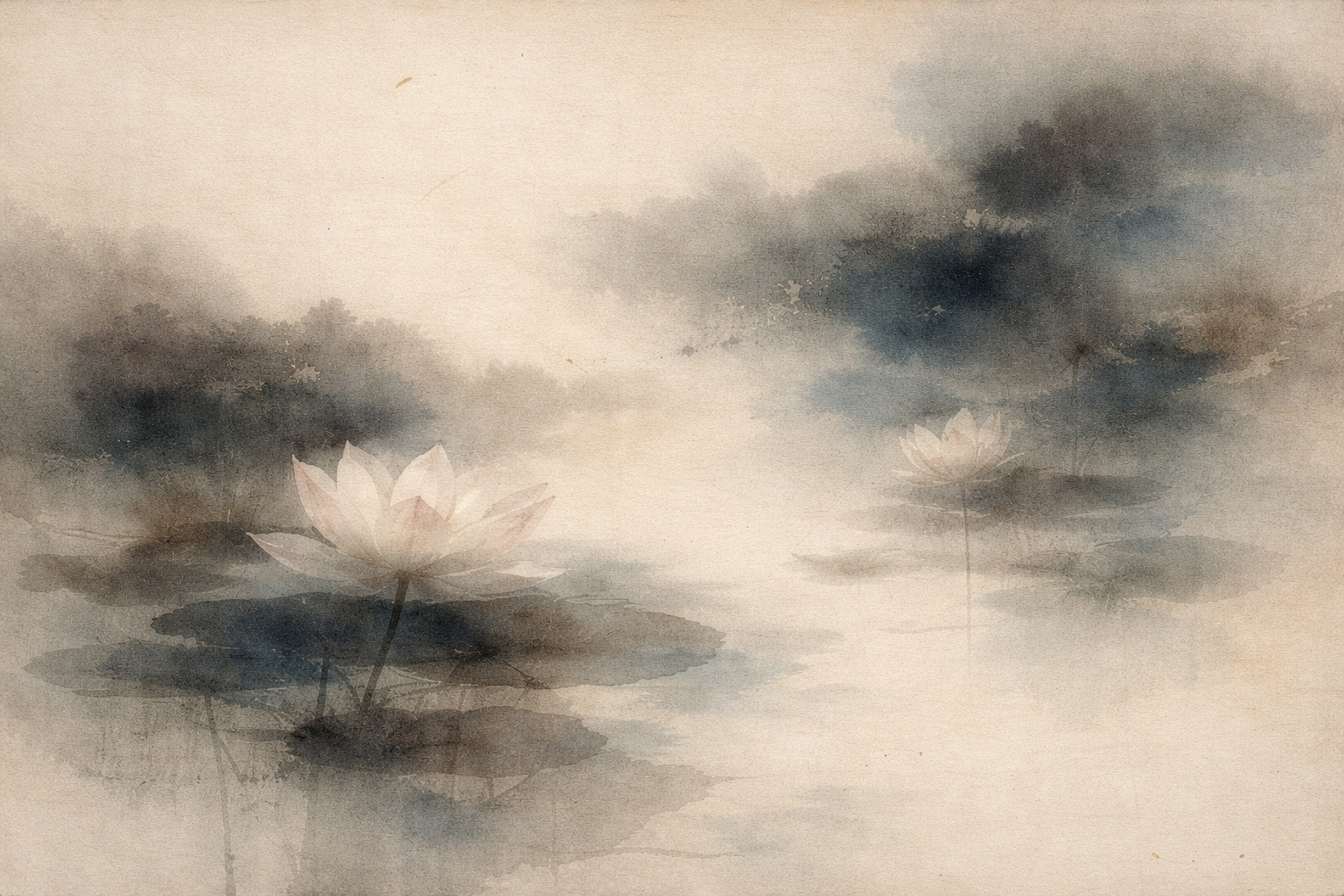
The lotus grows from muddy water and opens into a clean, bright flower. That contrast is the whole teaching in one picture: the conditions that feel like “mud” are not a disqualifier; they’re the material where attention, restraint, kindness, and insight can actually be practiced.
A Clear Lens for Understanding the Lotus
The lotus symbol in Buddhism works best as a lens: it helps you interpret what’s happening in your mind and what you do next. The “mud” is not just external hardship; it’s also the inner mix of impulses—wanting, resisting, comparing, replaying, justifying—that makes experience feel sticky and personal.
The “bloom” is not a fantasy state where nothing bothers you. It’s the capacity to be present without being owned by what arises. In that sense, the lotus points to non-clinging: feelings still appear, thoughts still appear, but they don’t automatically become commands.
That’s why lotus imagery often appears as a seat or pedestal. A lotus seat suggests stability without rigidity: you can be in contact with the world while not being stained by it. It’s not about rejecting life; it’s about relating to life with a cleaner grip.
Seen this way, the lotus symbol isn’t asking you to “rise above” your humanity. It’s reminding you that clarity and compassion can be cultivated right where you are—inside the very conditions you usually blame for your reactivity.
GASSHO
Ask and learn about Buddhism in daily life.
GASSHO is a Buddhist community app where you can learn Buddhist teachings and ask questions to the head priest of Kongosanmaiin Temple on Mount Koya.
How the Lotus Shows Up in Ordinary Moments
Think of a moment when you’re criticized—fairly or unfairly. The “mud” is the immediate surge: tightening in the chest, the urge to defend, the story that you’re being disrespected. The lotus symbol in Buddhism quietly suggests a different move: notice the surge as a surge, not as a verdict.
In that pause, you may see options you didn’t see a second earlier. You can ask a clarifying question instead of striking back. You can admit a mistake without collapsing into shame. You can set a boundary without adding cruelty. The bloom is not the absence of heat; it’s the presence of choice.
Or take craving—scrolling, snacking, shopping, refreshing for updates. The mud is the restless feeling that something is missing. The lotus lens doesn’t shame the craving; it helps you observe how the mind promises relief and then asks for more. When you see that loop clearly, even briefly, the grip loosens.
In relationships, the mud often looks like rehearsing arguments, keeping score, or trying to control how you’re seen. The lotus points to a cleaner intention: can you care about the person in front of you more than you care about winning the moment? That shift is small, but it changes the whole atmosphere.
In work and responsibility, the mud can be perfectionism—using “high standards” as a cover for fear. The lotus doesn’t tell you to stop caring. It suggests caring without self-punishment: do what’s needed, correct what’s off, and don’t add the extra suffering of identity drama.
Even in joy, the lotus symbol matters. The mud can be the reflex to cling: “Don’t let this end.” The lotus points to enjoying without gripping. You can appreciate what’s here while recognizing its changing nature, which makes gratitude steadier and less anxious.
Over time, the lotus becomes less like a religious emblem and more like a practical reminder: whatever is arising—pleasant, unpleasant, or neutral—can be met with a little more honesty and a little less compulsion.
Common Misreadings of the Lotus Symbol
One misunderstanding is treating the lotus as a symbol of being “above” everything—untouchable, always calm, always pure. In Buddhism, purity is closer to non-entanglement than to perfection. The lotus doesn’t deny mud; it grows from it.
Another misreading is turning the lotus into a promise of instant transformation: one insight, one ritual, one purchase, and suddenly you’re enlightened. The lotus image is patient. It suggests repeated returning—again and again—to what is actually happening, and responding with a little more skill.
A third confusion is making the lotus purely decorative, stripped of its ethical and psychological bite. The symbol is beautiful, but it’s not just “beauty.” It points to the work of not feeding harmful habits, and of choosing actions that reduce suffering for yourself and others.
Finally, some people assume the lotus means “ignore the world” or “detach from people.” The lotus points to a different kind of detachment: not coldness, but freedom from compulsive grasping—so that care can be cleaner and more reliable.
Why the Lotus Still Matters in Daily Life
The lotus symbol in Buddhism matters because it’s realistic. It doesn’t require ideal conditions, special personalities, or a life free from conflict. It starts with the honest admission that life includes mud—stress, loss, irritation, uncertainty—and then asks what you do with that fact.
As a daily cue, the lotus can interrupt autopilot. When you notice yourself tightening, rushing, or rehearsing a story, the symbol offers a simple question: “What would it look like to open here without pretending this is pleasant?” That question alone can soften the next reaction.
It also supports compassion without sentimentality. If everyone is dealing with some form of mud—fear, craving, confusion—then harshness becomes less satisfying. You can still be firm, but you’re less likely to dehumanize.
And it reframes setbacks. Instead of reading difficulty as failure, the lotus suggests difficulty is the training ground. That doesn’t romanticize pain; it simply refuses to waste it by turning it into bitterness.
Conclusion
The lotus symbol in Buddhism isn’t a vague sign of “spirituality.” It’s a compact, practical image: the mind can open without needing life to be clean first. Mud is included, not excluded.
If you keep one meaning, keep this: the lotus points to meeting experience directly, loosening the grip of reactivity, and letting wiser action emerge from the same conditions that usually trigger you.
Ask a Buddhist priest
Have a question about Buddhism?
In the GASSHO app, you can ask questions about Buddhist teachings, daily concerns, and how to understand Buddhism in everyday life.
Frequently Asked Questions
- FAQ 1: What does the lotus symbol mean in Buddhism?
- FAQ 2: Why is the lotus associated with purity in Buddhism?
- FAQ 3: What does the mud represent in the lotus symbol Buddhism uses?
- FAQ 4: Why do Buddhas and bodhisattvas sit or stand on a lotus?
- FAQ 5: Is the lotus symbol in Buddhism the same as the lotus in Hinduism?
- FAQ 6: What do different lotus colors mean in Buddhism?
- FAQ 7: What does a closed lotus bud symbolize in Buddhism?
- FAQ 8: What does an open lotus flower symbolize in Buddhism?
- FAQ 9: Is the lotus symbol in Buddhism mainly about enlightenment?
- FAQ 10: What is the meaning of the lotus in Buddhist art and iconography?
- FAQ 11: Does the lotus symbol in Buddhism mean you should avoid “dirty” or difficult situations?
- FAQ 12: What does the lotus symbol teach about suffering in Buddhism?
- FAQ 13: Is the lotus symbol in Buddhism a religious requirement or just a symbol?
- FAQ 14: What is the difference between the lotus symbol and the Dharma wheel in Buddhism?
- FAQ 15: Can the lotus symbol in Buddhism be used as a personal reminder without being Buddhist?
FAQ 1: What does the lotus symbol mean in Buddhism?
Answer: The lotus symbol in Buddhism points to clarity and compassion arising within ordinary, imperfect conditions—often expressed as “growing from mud and blooming clean.” It emphasizes non-clinging: being in the world without being trapped by reactivity.
Takeaway: The lotus is a practical image of inner freedom, not a demand for perfection.
FAQ 2: Why is the lotus associated with purity in Buddhism?
Answer: Purity here doesn’t mean moral spotless-ness; it means not being “stained” by grasping, hatred, and confusion. The lotus grows in muddy water yet appears clean, symbolizing a mind that can meet difficulty without being consumed by it.
Takeaway: “Purity” in the lotus symbol is about non-entanglement, not being flawless.
FAQ 3: What does the mud represent in the lotus symbol Buddhism uses?
Answer: The mud represents the conditions that feel messy or painful—stress, conflict, craving, fear, and confusion. It can also represent the inner habits that make experience sticky, like defensiveness or compulsive wanting.
Takeaway: The lotus includes the “mud” as the starting point for practice, not as a mistake.
FAQ 4: Why do Buddhas and bodhisattvas sit or stand on a lotus?
Answer: A lotus seat symbolizes steadiness, dignity, and freedom from clinging. It suggests awakened qualities can be present in the world without being dragged down by greed, aversion, or delusion.
Takeaway: The lotus pedestal is a visual shorthand for stability and non-attachment.
FAQ 5: Is the lotus symbol in Buddhism the same as the lotus in Hinduism?
Answer: Both traditions use lotus imagery, often overlapping in themes like purity and spiritual unfolding, but the meanings are framed within different teachings and contexts. In Buddhism, the lotus is commonly read through the lens of reducing suffering and loosening clinging.
Takeaway: The image overlaps across cultures, but “lotus symbol buddhism” is best understood within Buddhist aims and language.
FAQ 6: What do different lotus colors mean in Buddhism?
Answer: Color meanings vary by region and artwork, but common associations include white (purity/clarity), pink (a classic “Buddha” lotus), red (compassion), and blue (wisdom). These are emphases, not rigid rules.
Takeaway: Lotus colors can add nuance, but the core message remains “awakening within conditions.”
FAQ 7: What does a closed lotus bud symbolize in Buddhism?
Answer: A bud often suggests potential or the not-yet-open quality of understanding—something that can unfold with attention and practice. It’s less about ranking people and more about pointing to the possibility of opening.
Takeaway: A lotus bud highlights potential and the direction of opening, not a fixed status.
FAQ 8: What does an open lotus flower symbolize in Buddhism?
Answer: An open lotus commonly symbolizes awakened qualities expressed openly—clarity, compassion, and non-clinging. In art, it can indicate the full presence of these qualities rather than something hidden or merely promised.
Takeaway: An open lotus points to openness of mind and heart in the midst of life.
FAQ 9: Is the lotus symbol in Buddhism mainly about enlightenment?
Answer: It can be connected to enlightenment imagery, but it’s also about the everyday mechanics that support it: meeting difficulty, seeing clearly, and acting without compulsive grasping. The lotus is as much about the path-like qualities as it is about an ideal endpoint.
Takeaway: The lotus symbol is practical—about how to relate to experience, not just a distant goal.
FAQ 10: What is the meaning of the lotus in Buddhist art and iconography?
Answer: In Buddhist art, the lotus can function as a seat, a held object, or a surrounding motif. Across these uses, it typically signals purity of intention, non-attachment, and the possibility of awakening within the world’s messiness.
Takeaway: In iconography, the lotus is a visual cue for non-clinging and inner clarity.
FAQ 11: Does the lotus symbol in Buddhism mean you should avoid “dirty” or difficult situations?
Answer: No. The lotus image specifically includes mud as the condition for blooming. It suggests you can engage life—work, relationships, conflict—while practicing not to be ruled by reactivity or harmful impulses.
Takeaway: The lotus doesn’t teach avoidance; it teaches freedom within conditions.
FAQ 12: What does the lotus symbol teach about suffering in Buddhism?
Answer: It suggests suffering and difficulty can be met with awareness and compassion rather than automatically producing bitterness or harm. The “mud” isn’t celebrated, but it’s not wasted; it becomes the place where wiser responses can grow.
Takeaway: The lotus reframes suffering as workable—something you can relate to skillfully.
FAQ 13: Is the lotus symbol in Buddhism a religious requirement or just a symbol?
Answer: It’s a symbol—an image used to communicate meaning. You don’t need to adopt it as an identity marker for it to be useful; you can treat it as a reminder to open, soften, and see clearly in daily life.
Takeaway: The lotus is optional as a label, but valuable as a reminder.
FAQ 14: What is the difference between the lotus symbol and the Dharma wheel in Buddhism?
Answer: The lotus symbol in Buddhism emphasizes purity/non-clinging and awakening arising from conditions, while the Dharma wheel commonly represents the teaching and its movement in the world (often linked with guidance, practice, and direction). They overlap in spirit but point to different aspects.
Takeaway: Lotus = opening from mud; wheel = the teaching in motion and guidance for practice.
FAQ 15: Can the lotus symbol in Buddhism be used as a personal reminder without being Buddhist?
Answer: Yes. Many people use the lotus as a cue to pause, notice reactivity, and choose a kinder or clearer next step. Using it respectfully means keeping its core meaning intact: opening within difficulty, not pretending difficulty doesn’t exist.
Takeaway: You can use the lotus as a daily cue for clarity and compassion, regardless of identity.