



Buddhism vs Existentialism: Meaning, Suffering, and Freedom Compared
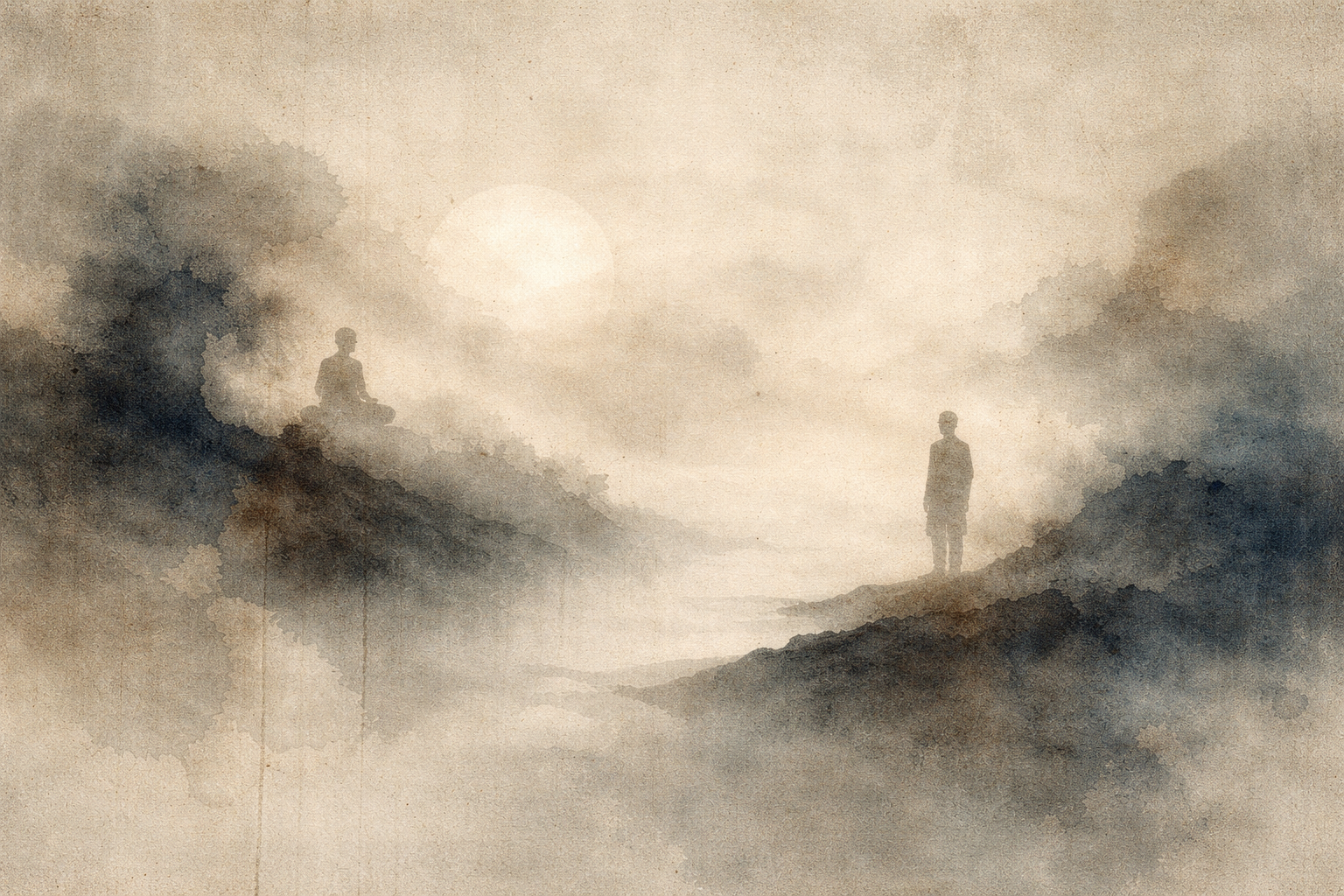
Quick Summary
- Buddhism vs existentialism often comes down to where “meaning” is located: in letting go of grasping, or in choosing despite uncertainty.
- Both take suffering seriously, but they describe its mechanics differently: craving and resistance vs anxiety, alienation, and responsibility.
- Buddhism emphasizes seeing experience clearly (impermanence, reactivity, selfing) to reduce suffering.
- Existentialism emphasizes freedom and authorship: you are responsible for your life’s direction even without guarantees.
- Buddhist freedom often looks like non-clinging; existential freedom often looks like commitment in the face of ambiguity.
- They can complement each other: existential honesty about choice + Buddhist skill at working with the mind’s reactions.
- The practical question is: do you need less mental friction, clearer values, or both?
Introduction: Why This Comparison Feels So Confusing
You’re trying to make sense of life without falling into either a vague “everything is fine” spirituality or a bleak “nothing matters” philosophy, and the Buddhism vs existentialism debate can feel like you’re forced to pick one mood. The truth is more practical: both are lenses for working with meaning, suffering, and freedom, and the differences show up most clearly in how they tell you to relate to your own mind in ordinary moments. At Gassho, we focus on grounded Buddhist practice and careful comparisons that respect lived experience over slogans.
People usually arrive at this comparison when they’re stuck between two impulses: the desire to stop fighting reality, and the desire to take responsibility for shaping a life. Buddhism can sound like “drop the self,” while existentialism can sound like “create the self.” But in day-to-day life, your actual problem is often simpler: you’re overwhelmed by thoughts, pressured by choices, and tired of chasing certainty.
This is why the comparison matters. If you misunderstand either side, you can end up using “acceptance” to avoid hard decisions, or using “freedom” to justify constant self-judgment. A clearer view helps you suffer less without becoming passive—and choose more honestly without becoming harsh.
Two Lenses on Meaning, Suffering, and Freedom
Think of Buddhism as a lens that asks: what in your experience is adding unnecessary friction? It points attention toward how craving, aversion, and confusion tighten the mind. Meaning, from this angle, is less about constructing a story and more about living with clarity and compassion when the story is unstable.
Think of existentialism as a lens that asks: what are you doing with your freedom right now? It highlights the discomfort of not having guaranteed answers and the responsibility of choosing anyway. Meaning, from this angle, is not discovered like a hidden object—it is enacted through commitments, values, and the courage to live without certainty.
On suffering, Buddhism tends to emphasize the mechanics of reactivity: how the mind grabs, resists, and spins narratives that intensify pain. Existentialism tends to emphasize the human condition: anxiety, finitude, isolation, and the weight of responsibility. Both are describing real features of life; they simply place the spotlight in different places.
On freedom, Buddhism often points to freedom from compulsive patterns—less being pushed around by urges, fears, and identity maintenance. Existentialism often points to freedom to choose—owning your direction even when you can’t prove you’re right. One leans toward release; the other leans toward authorship.
GASSHO
Ask and learn about Buddhism in daily life.
GASSHO is a Buddhist community app where you can learn Buddhist teachings and ask questions to the head priest of Kongosanmaiin Temple on Mount Koya.
How the Difference Shows Up in Ordinary Experience
Imagine you receive criticism at work. A Buddhist-leaning approach notices the immediate surge: tightening in the chest, the mind replaying the comment, the urge to defend. The focus is not “Who am I, really?” but “What is happening right now, and what happens if I don’t feed it?”
An existential-leaning approach notices something else: the criticism threatens a chosen identity—competent, respected, secure. The discomfort is not only emotional; it’s also about what you’re going to do with your life and how you want to stand in the world. The focus becomes “What do I choose to become in response to this?”
Now consider a quieter moment: scrolling your phone when you said you’d rest. Buddhism highlights the micro-movements of craving—one more refresh, one more hit of novelty—and the subtle dissatisfaction that follows. The experiment is simple: pause, feel the urge, and see that you don’t have to obey it.
Existentialism highlights the avoidance: the scroll can be a way to dodge the open space where you might have to face your life. The discomfort isn’t just boredom; it’s the feeling of being responsible for what you do with your time. The experiment is also simple: stop, feel the emptiness, and choose a direction without waiting for motivation to rescue you.
In relationships, Buddhism often points to how “I” and “mine” harden: my needs, my image, my fear of being wrong. When you watch that hardening, you may find more room to listen and less need to win. The emphasis is on softening the grip that turns disagreement into suffering.
Existentialism often points to honesty and responsibility: are you speaking clearly, or hiding behind politeness? Are you choosing the relationship, or drifting in it? The emphasis is on owning your stance—because not choosing is also a choice, and it shapes the life you end up living.
Even in a moment of sadness, the contrast is tangible. Buddhism invites you to feel sadness as changing sensations and thoughts, without adding the second arrow of “this shouldn’t be happening.” Existentialism invites you to let sadness tell the truth about what you care about, and to decide how you will live with that truth.
Common Misunderstandings That Flatten Both Sides
Misunderstanding 1: “Buddhism says life is meaningless.” Buddhism is often misread as pessimistic because it speaks plainly about suffering. But the point is not nihilism; it’s precision. When you see how clinging creates distress, you can live with more ease and care—meaning shows up as responsiveness, not as a perfect story.
Misunderstanding 2: “Existentialism is just despair.” Existentialism can sound dark because it refuses easy comfort. But its core move is not hopelessness; it’s responsibility. It asks you to stop outsourcing your life to certainty, approval, or fate, and to choose with integrity anyway.
Misunderstanding 3: “Buddhism is passive acceptance.” Acceptance is not resignation. It’s the willingness to see what’s here without distortion. From that clarity, action can be more skillful—less driven by panic, more aligned with care.
Misunderstanding 4: “Existentialism is pure individualism.” Taking responsibility for your life doesn’t mean ignoring others. In practice, existential responsibility often includes how your choices affect people around you, and whether your commitments are honest rather than performative.
Misunderstanding 5: “They can’t be compared because one is religion and one is philosophy.” Labels can block understanding. If you treat both as lenses on experience—how the mind suffers, how choices are made, how freedom is felt—the comparison becomes practical rather than ideological.
Why This Comparison Matters When You’re Making Real Choices
When you’re facing a decision—career, relationship, health—existentialism can help you stop waiting for a guarantee. It normalizes uncertainty and asks for commitment: choose, then take responsibility for the choice rather than endlessly rehearsing alternatives.
At the same time, Buddhism can help you see what is contaminating the decision: fear disguised as “logic,” craving disguised as “ambition,” or identity maintenance disguised as “principle.” That doesn’t tell you what to choose, but it can reduce the inner noise that makes every option feel like a threat.
In mental health terms (without turning this into therapy), the pairing can be powerful. Existentialism validates the weight of being human—anxiety and finitude are not personal failures. Buddhism offers concrete ways to relate to thoughts and feelings so they don’t automatically run the show.
In ethics, existentialism emphasizes authenticity: don’t hide behind roles or excuses. Buddhism emphasizes non-harming: notice how self-centered reactivity spreads suffering. Together, they can support a life that is both honest and gentle—firm in values, softer in ego.
Most importantly, the comparison helps you avoid two traps: using “no-self” language to bypass responsibility, and using “freedom” language to justify constant self-creation as a form of restlessness. A mature approach is simpler: see clearly, choose carefully, and don’t add extra suffering.
Conclusion: Release and Responsibility Can Work Together
Buddhism vs existentialism isn’t a contest between calm and courage. It’s a contrast between two helpful emphases: Buddhism trains release from compulsive reactivity; existentialism trains responsibility in the face of uncertainty. If you’re stuck, it may not be because you lack answers—it may be because you’re either clinging too hard or refusing to choose.
Try a simple diagnostic in daily life: when you’re suffering, ask whether the next step is to let go (stop feeding the mental loop) or to step up (make the honest choice you’ve been avoiding). Often, the wisest move is a small dose of both.
Ask a Buddhist priest
Have a question about Buddhism?
In the GASSHO app, you can ask questions about Buddhist teachings, daily concerns, and how to understand Buddhism in everyday life.
Frequently Asked Questions
- FAQ 1: What is the simplest way to describe Buddhism vs existentialism?
- FAQ 2: Do Buddhism and existentialism agree that life has no inherent meaning?
- FAQ 3: How do Buddhism vs existentialism explain suffering differently?
- FAQ 4: Is “no-self” in Buddhism the opposite of existentialist authenticity?
- FAQ 5: Which offers more freedom: Buddhism or existentialism?
- FAQ 6: Does Buddhism vs existentialism differ on whether emotions should be transcended?
- FAQ 7: Is existentialism compatible with Buddhist practice?
- FAQ 8: In Buddhism vs existentialism, what is the role of death in finding meaning?
- FAQ 9: Does Buddhism vs existentialism differ on whether suffering can end?
- FAQ 10: How do Buddhism vs existentialism approach moral responsibility?
- FAQ 11: Is Buddhism vs existentialism basically acceptance vs action?
- FAQ 12: What does “authenticity” look like in Buddhism vs existentialism?
- FAQ 13: Which is better for anxiety: Buddhism or existentialism?
- FAQ 14: In Buddhism vs existentialism, is the self something to dissolve or to create?
- FAQ 15: What is a practical way to combine insights from Buddhism vs existentialism?
FAQ 1: What is the simplest way to describe Buddhism vs existentialism?
Answer: Buddhism focuses on reducing suffering by seeing and releasing clinging in moment-to-moment experience, while existentialism focuses on facing uncertainty and taking responsibility for the meanings you live by.
Takeaway: Buddhism emphasizes letting go; existentialism emphasizes choosing.
FAQ 2: Do Buddhism and existentialism agree that life has no inherent meaning?
Answer: Many existentialists argue meaning is not given in advance and must be created or enacted; Buddhism tends to treat “inherent meaning” as less important than the direct causes of suffering and the possibility of freedom from reactivity.
Takeaway: Existentialism debates meaning; Buddhism prioritizes how meaning-making affects suffering.
FAQ 3: How do Buddhism vs existentialism explain suffering differently?
Answer: Buddhism often explains suffering through craving, aversion, and confusion that amplify pain into distress, while existentialism often highlights anxiety, finitude, and the burden of freedom as central to the human condition.
Takeaway: Buddhism maps the mechanics of reactivity; existentialism maps the weight of being human.
FAQ 4: Is “no-self” in Buddhism the opposite of existentialist authenticity?
Answer: Not necessarily. “No-self” points to the fluid, constructed nature of identity, while existential authenticity emphasizes owning your choices rather than hiding behind roles; both can challenge rigid self-images, but they do it in different ways.
Takeaway: Both question the “fixed self,” but one through insight into construction and the other through responsibility.
FAQ 5: Which offers more freedom: Buddhism or existentialism?
Answer: Buddhism often frames freedom as liberation from compulsive craving and aversion, while existentialism frames freedom as the inescapable responsibility to choose and commit; they describe different dimensions of freedom that can coexist.
Takeaway: Freedom can mean less compulsion (Buddhism) and more ownership (existentialism).
FAQ 6: Does Buddhism vs existentialism differ on whether emotions should be transcended?
Answer: Buddhism generally encourages meeting emotions clearly without clinging or resistance, not suppressing them; existentialism often treats emotions like anxiety as meaningful signals about freedom, values, and finitude rather than problems to eliminate.
Takeaway: Both can be emotionally honest—Buddhism through non-reactivity, existentialism through interpretation and choice.
FAQ 7: Is existentialism compatible with Buddhist practice?
Answer: Many people find them compatible at the level of practice: existentialism can sharpen honesty about choice and responsibility, while Buddhism can reduce the mental friction that distorts choices; conflicts arise mainly when either is turned into a rigid ideology.
Takeaway: They can complement each other if treated as practical lenses, not identity badges.
FAQ 8: In Buddhism vs existentialism, what is the role of death in finding meaning?
Answer: Existentialism often uses mortality to clarify urgency and commitment—your time is limited, so choose; Buddhism often uses impermanence to soften clinging and deepen presence—everything changes, so don’t grasp.
Takeaway: Mortality can motivate commitment (existentialism) and release (Buddhism).
FAQ 9: Does Buddhism vs existentialism differ on whether suffering can end?
Answer: Buddhism typically holds that suffering rooted in clinging can be substantially reduced through insight and practice, while existentialism often treats certain forms of anxiety and uncertainty as unavoidable features of human life that must be faced rather than “solved.”
Takeaway: Buddhism emphasizes alleviation through insight; existentialism emphasizes courage and responsibility amid inevitables.
FAQ 10: How do Buddhism vs existentialism approach moral responsibility?
Answer: Existentialism stresses personal responsibility for choices and the meanings they express; Buddhism stresses intention and the reduction of harm through understanding how actions arise from mental states like greed, aversion, and confusion.
Takeaway: Existentialism asks “Do you own your choice?” Buddhism asks “Does this reduce harm and reactivity?”
FAQ 11: Is Buddhism vs existentialism basically acceptance vs action?
Answer: That’s an oversimplification. Buddhism includes clear, deliberate action but tries to remove compulsive reactivity from it; existentialism includes acceptance of uncertainty but insists you still must choose and live the consequences.
Takeaway: Both involve acceptance and action—just with different targets.
FAQ 12: What does “authenticity” look like in Buddhism vs existentialism?
Answer: In existentialism, authenticity often means living in alignment with chosen values rather than social scripts; in Buddhism, authenticity can look like seeing through self-deception and acting with less ego-driven grasping and more clarity.
Takeaway: Existential authenticity is value-alignment; Buddhist authenticity is reduced selfing and clearer seeing.
FAQ 13: Which is better for anxiety: Buddhism or existentialism?
Answer: Buddhism can help by changing your relationship to anxious thoughts and sensations so they don’t escalate, while existentialism can help by reframing anxiety as connected to freedom, uncertainty, and what you care about—then choosing anyway.
Takeaway: Buddhism helps you unhook from anxiety; existentialism helps you understand and act with it.
FAQ 14: In Buddhism vs existentialism, is the self something to dissolve or to create?
Answer: Buddhism often treats the self as a changing process that becomes painful when reified and defended; existentialism often treats the self as something shaped through choices and commitments rather than discovered as a fixed essence.
Takeaway: Buddhism de-solidifies the self; existentialism emphasizes self-shaping through commitment.
FAQ 15: What is a practical way to combine insights from Buddhism vs existentialism?
Answer: Use a two-step check: first, notice and soften the reactive loop (tightness, rumination, defensiveness); second, make a small, concrete choice aligned with your values even without perfect certainty, and take responsibility for it.
Takeaway: Let go of reactivity, then choose with integrity.